
EPISODE · Oct 23, 2025 · 8 MIN
Ballroom for a Swan King
from Language Matters Podcast · host Elias Winter
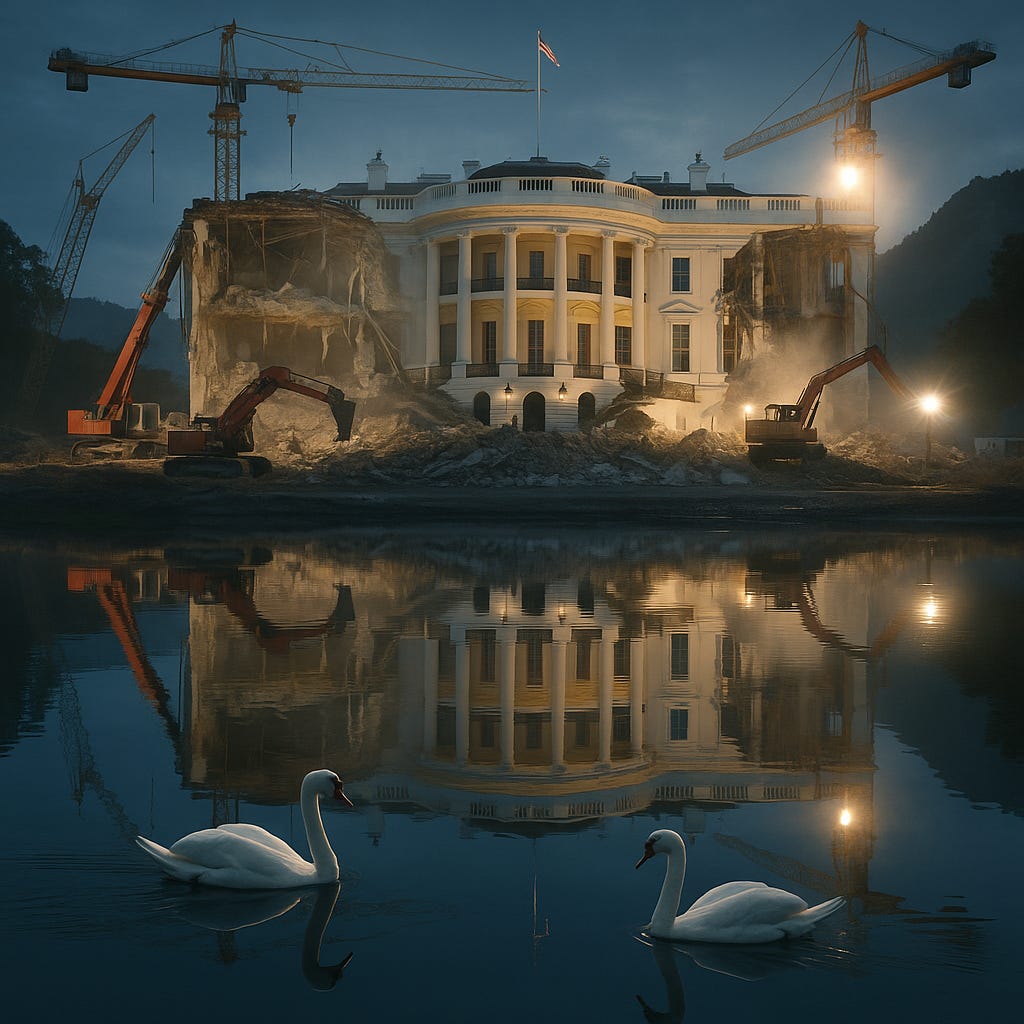
I used to think home renovation was a middle-class rite of passage: a sledgehammer, a coupon for drywall, and the brave decision to live with dust until the relationship ends. Then Washington reminded me—renovation is also a theory of power. Crews descend on the East Wing with their steel-toed verbs and call it “modernization.” The talking points keep changing—the size, the funding, the approvals—but the gesture does not: build a ballroom large enough to quiet the doubt. We don’t expand rooms to celebrate; we expand them to drown out what we can’t govern. It’s funny until the wall is dust.Let me start where the laughter is honest. A nation that cannot pass a budget can still pass a hat for a dance floor. “It won’t touch the house.” “It’s privately funded.” “It’s tasteful.” The script is familiar because power is addicted to acoustics. If the policy won’t sing, install a chandelier.And then, somewhere in Bavaria, a swan turns its neck.King Ludwig II did not inherit a stable century; he inherited loneliness with a crown on it. He preferred Wagner to cabinet meetings, myth to minutes. Up above his childhood home at Hohenschwangau he chose a mountain ledge and commissioned a dream with proper plumbing. A theater painter drew the elevations—an honest admission that government had become stagecraft—and an architect translated fantasy into stone. He named it “Neuschwanstein”, New Swan Stone, as if a word could correct the world.Here is the part people skip when they sell the postcard. The cost was not an accident; it was the point. Beauty keeps receipts. Ludwig financed the castle personally, then by loan, then by loans upon loans—stacked like scaffolds reaching for a sky that would not come down to him. Every redesign made the blueprint more faithful to his ache. He commissioned other palaces as if building more dream could amortize the first.Ministers tried to stop him. He answered with another wing, another vault, another pageant of swans. Debt answered back. In 1884 he finally moved into the still-unfinished castle and discovered the first rule of sanctuaries: they only give you yourself. He lasted 172 days.Power prefers mercy as procedure. Bavaria’s government declared him unfit without the dignity of a real examination, removed the crown, and confined the man to supervision. Three days later came the famous walk by the lake with his doctor, and then the unfamous water that accepted both men without writing down why. The official story says drowning. Official stories prefer stillness. The swans did not file a report.What happened next is the detail that matters here. Within weeks the ministers opened the doors to paying visitors. The kingdom that castigated extravagance monetized grief. Tickets chipped at the debt; the mountain kept its silhouette; the world learned that a dream can be solvent once the dreamer is gone. The moral accountants call that prudence. I call it a confession: we will forgive anything if it earns.Return now to the East Wing. The drawings will talk about sightlines and load, but the meaning is noisier and simpler. A glass link from spectacle to statecraft. Light rigs for the mood, donors for the volume, oversight for the after-action memo. Everyone swears the house itself is untouched, as if the republic were a doll you can accessorize without teaching the child anything. We keep repeating that word modernization the way the lonely keep saying fine.I do not throw stones at palaces. I notice their use. Neuschwanstein was an instrument for one man’s ache, tuned to medieval honor and enchanted birds. The planned ballroom is also an instrument—for broadcasting the mood of a regime that needs amplification where legitimacy has run out of pitch. Both are architectures of anesthesia. When you cannot hold the world, you enlarge the room.There is an evening on the Bavarian lake—the guides can’t schedule it, but it comes—when the surface forgets the century and becomes only water. Two swans cross the reflected castle like white commas in a sentence the mountain keeps refusing to end. They are not symbols; we made them that. They do not know they are working a double shift in the literature of men who couldn’t stand silence.This is the part the chandeliers can’t fix. Ludwig finally sat inside the room he had chased for half his life and found himself surrounded by obedient mirrors. The murals kept swimming nowhere. The crown could not make the reflection love him. The mountain kept the building; the lake kept the man; we kept the story because it is the cheapest way to keep anything.So let’s be direct with our renovations. Build if you must, but name what you are building. You are not merely adding a hall; you are writing a sentence and begging history to supply the predicate. You are not hosting the people; you are asking their gaze to hold you up a little longer. You are not modernizing the house; you are bargaining with time.When the music stops and the glass link sleeps in its transparency, the house will ask the same quiet question it has asked every occupant since Adams: did you serve the people or the performance? Ludwig answered with a mountain. We are answering with a ballroom. If you have to ask the room to vouch for you, you already know.—Elias WinterAuthor of Language Matters, a space for reflection on language, power, and decline. This is a public episode. If you would like to discuss this with other subscribers or get access to bonus episodes, visit eliaswinter.substack.com
Embed this episode
NOW PLAYING
Ballroom for a Swan King
No transcript for this episode yet
Similar Episodes
No similar episodes found.
Similar Podcasts
No similar podcasts found.