
EPISODE · Mar 25, 2026
Bats Inspire Advance in Aerial Robots
from WPI News · host Lisa Eckelbecker
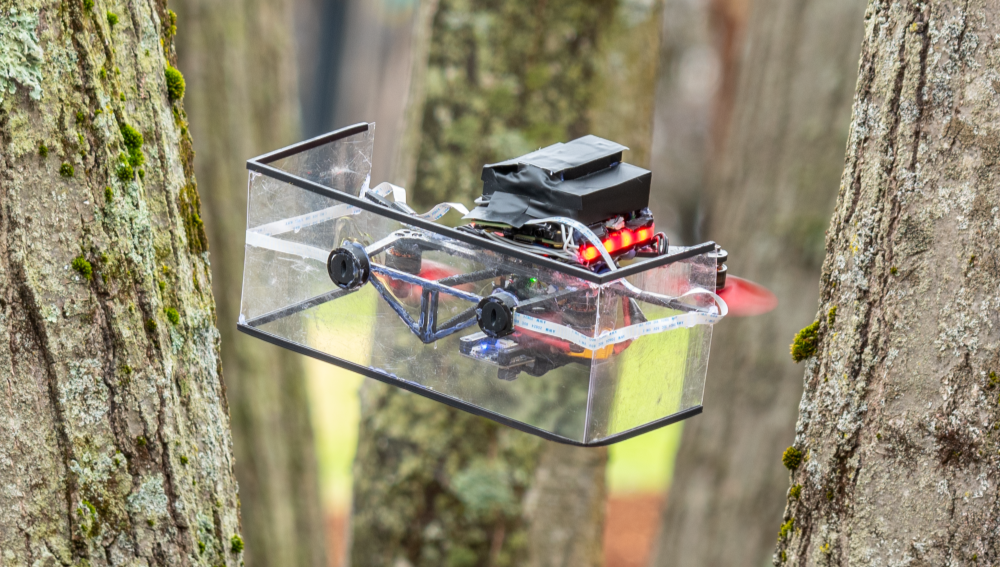
A team led by Worcester Polytechnic Institute researcher Nitin J. Sanket has shown that ultrasound sensors and a form of artificial intelligence can enable palm-sized aerial robots to navigate with limited power and computation through fog, smoke, and other challenging conditions during search-and-rescue operations. The advance, inspired by bats and published in the journal Science Robotics, suggests that ultrasound may be an alternative to existing navigation technologies that add weight and cost to a drone or falter in poor conditions. “Bats that weigh less than two paper clips can accurately navigate in dark, damp, and dusty caves by sending out short chirps and listening to the weak echoes with a limited number of neurons,” said Sanket, assistant professor in the Department of Robotics Engineering. “By creating an ultrasound-based system that needs just two tiny sensors and little computation, we can open up opportunities for small aerial robots to perceive their surroundings, make decisions, and independently operate longer in cluttered, hazardous places where current aerial robots struggle.” Sanket’s research focuses on robotics inspired by nature, such as bees and bats. The work featured in Science Robotics was supported by a grant from the National Science Foundation. Autonomous aerial robots typically use sensors, controllers, cameras, a power source, and sophisticated algorithms to perceive their surroundings and make navigational decisions. Some robots collect information about a landscape by analyzing radio waves or light pulses. However, technology based on lidar—light detection and ranging—and radar are heavy, power intensive, and costly. Darkness, poor weather, and noise can interfere with light-based perception systems. Sound from propellers adds complexity to an aerial robot’s calculations that aim to decipher useful echoes from propeller noise. Analyzing data requires a robot’s time and energy. The research team led by Sanket customized an X-shaped aerial quadrotor drone about 6 inches wide with ultrasound sensors and a physical barrier called an acoustic shield to dampen propellor noise. They also used an AI technique known as deep learning to train the robot’s computer to analyze weak ultrasound echo patterns similar to the way a bat brain processes sound to decipher echoes. They tested the robot, weighing about 1 pound, outdoors in a wooded area and indoors in a laboratory furnished with obstacles such as transparent plastic or metal poles. Some indoor tests took place in darkness with black obstacles, while others took place as the researchers blew fog or snow onto the obstacle course. The drone had enough battery power to operate for about five minutes per flight while navigating the course autonomously. The researchers reported that the robot had a success rate of 72% to 100% in navigating through challenging courses during 180 tests. The robot was less successful at dodging thin objects, such as metal poles, and it struggled to avoid slender tree branches, which weakly reflected signals. Co-authors with Sanket on the research were W.P.I. alumni and students Manoj Velmurugan, Phillip Brush, and Colin Balfour: and Richard Przybyla of TDK InvenSense, Berkeley, Calif. The next step for bat-inspired drones may be to use smaller, lighter devices that could fly longer using the team’s low-power ultrasound-based system, Sanket said. Future work could also improve flight speeds. “In a real search-and-rescue mission, a few more seconds of flight time could mean the difference between life and death for a survivor,” Sanket said.
Embed this episode
NOW PLAYING
Bats Inspire Advance in Aerial Robots
No transcript for this episode yet
Similar Episodes
No similar episodes found.
Similar Podcasts
No similar podcasts found.