
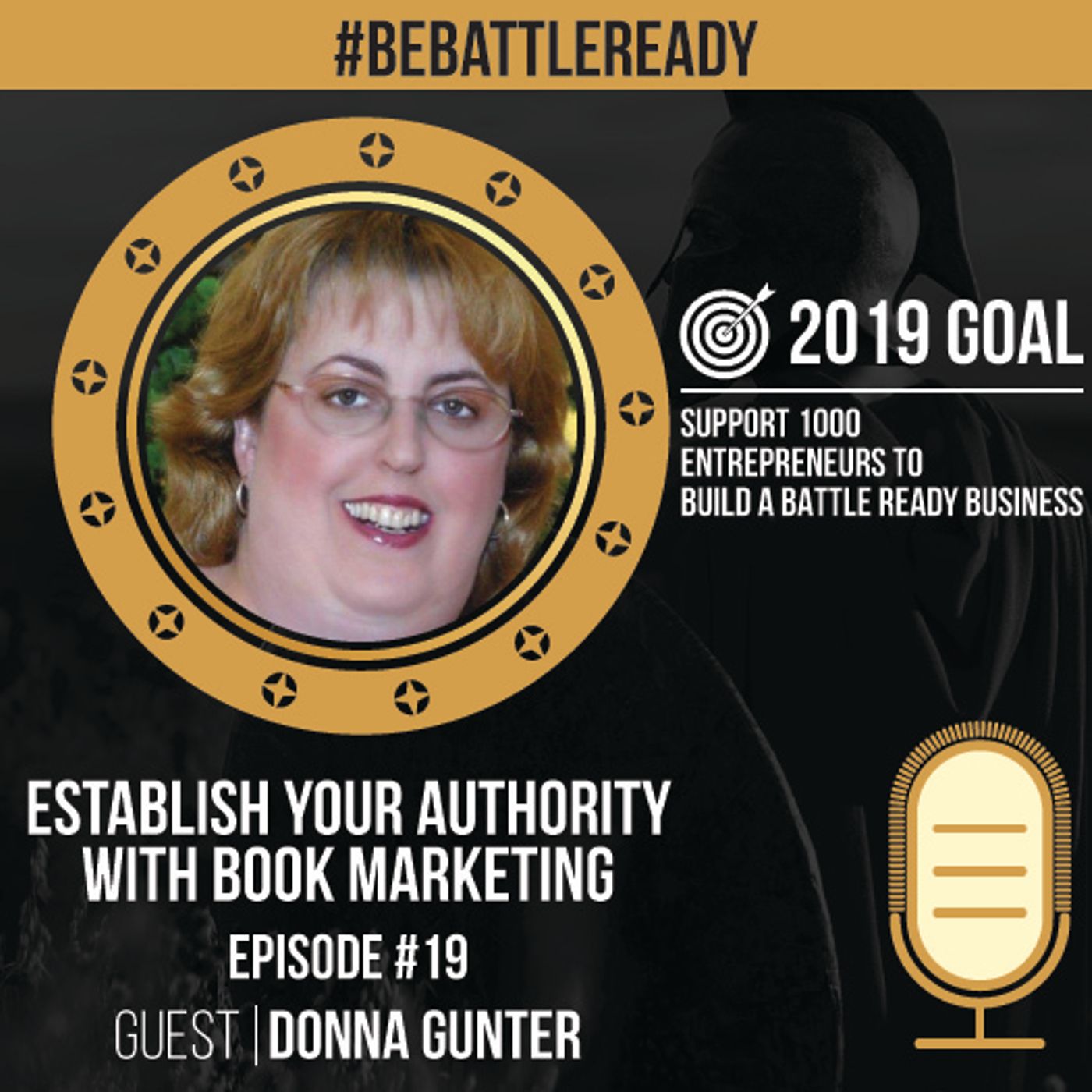
All right, welcome to the Be By The Ready podcast, interview special, and today we are on with Donna Gunter. She is a bookmarking specialist, and as usual, I'm gonna let her introduce herself and do herself justice. And welcome, Donna. Well, thank you, I am quite happy to be here.
Now in terms of me, I'm an Amazon number one best-selling author of three books. My newest one is called Make Them Chews You. And I've also published one called Branger Self, The Trust in Local Celebrity, and this smart quick guide, 10 Strategies to Online Visibility for More Traffic, clicks and profits. Through the business that I founded, Bismarck Media, I have entrepreneurs, and Sultas, speakers, coaches, and professionals stop the client's taste by leveraging their knowledge to gain authority status in their industry.
And I show my clients how to build powerful, personal, brand, and other businesses through speaking, publishing, and publicity. And we're gonna talk a little bit more about the publishing side of my business today. I also host my own podcast, Main Street Mavericks Radio, and I'm a writer for Business Innovator and Magazine. And I told Anthony earlier, I live in the booming metropolis of Orange, Texas, which you may guess is not really moving metropolis.
Completely from where I am originally from, it's Orange County, so probably completely different. Oh yeah, it says literally a 90 day difference. Yeah, absolutely. So what brought you to your current business?
Like, what's your history? Well, I have a very strange path in terms of how I got here. My background is in higher education administration. I got my master's degree in that field, spent a little over seven years in that industry before becoming completely fried out, made a first foray into entrepreneurship, and failed miserably with that.
I decided to turn one of my hobbies into a business and discovered that it wasn't fun anymore. It became my job, went back then into nonprofit management, ran a youth center, and I was living in Massachusetts at the time, became very disillusioned with my life, my marriage, et cetera. And so kind of blew up my life as for divorce, moved halfway back across the country, 1800 miles after asking my husband for divorce, moved back into my childhood home in my hometown, and opened up a business as a marketing, virtual marketing assistant in my mom's garage that was in 1999, and this year I celebrated 20 years in terms of being self-employed. My business has changed vastly in those 20 years.
So I've moved from being the back end in terms of providing tech support and task fulfillment for people who need help with their marketing task, to moving to online business coaching. And then in 2014, I discovered how cool it was to publish books. I joined a mastermind group, which helps people create businesses, where they help their clients with authority marketing positioning themselves as an authority, and book publishing is one of the great ways to do that. So I published my first book.
It's an anthology or a multi-author book, so I contacted a number of colleagues, found nine people who were nine other people who were interested in being book authors, and then we all contributed a chapter to my Bismar Quick Guide book on a topic that each of us specialized in. We had an Amazon bestseller campaign, that was my first experience at being an Amazon bestselling author. They shared in that Amazon bestselling author status. They were thrilled beyond belief, all of them were first time authors.
They were thrilled beyond belief about the experience, couldn't believe how easy it was to become an author, loved the status of being an author added to their personal profiles, to their business reputation. And I just kind of fell in love with it. And so since 2014, I focused my business fairly exclusively on authority marketing and helping my clients position themselves as the expert in their industry. I've tweaked it a little bit in the last year and a half or so where I had been working with people who had little businesses like coaches and consultants.
I'm finding much more joy and much more fun in working with local business owners because writing a book is really completely out of the box, local marketing idea for them. And what's very cool in that notion is that it's something their competitors are not doing, how many of you remotely consider doing it. And so it's a really quick and easy way, and not very expensive, quite frankly, way for them to stand out as the obvious choice in their local community, because, you know, if you're one of 20 dentists in a small city, I can almost guarantee you that your other and I think competitors don't have a book under their own name. Yeah, awesome.
Couple of things there. I want to step back. Since you've been in digital marketing for a bit, 20 years, like what do you see that's changed? I mean, obviously the technology's changed, but let's talk about what stayed the same in the last 20 years.
What are some principles that are like tried and true? And, you know, it just says they're lasting, long lasting. Well, there've been a lot of strategies that have come and gone. I was on a podcast earlier today, and we were talking about, I was kind of reviewing my history.
We were talking about this whole notion of article marketing, which was really hot in the early 2000s. And that's how I got a lot of traffic to my site. And that faded out of Google, sort of, kind of shutting down article banks and penalizing places for duplicate content. What seems to have stayed the course, though, has been search engine optimization.
You know, the back end of that in terms of how that works and how to match it better on your site has shifted and ebbed throughout the years, but it still remains a pretty important constant for somebody in the digital marketing industry. What I have seen is the offline industry, I guess, going from a converse to digital marketing to being a little dismayed by it in terms of being completely overwhelmed. Well, being overwhelmed is not new, but being overwhelmed with all of the claims that are made about what can happen with digital marketing and they're not experiencing their own business. You know, when it was all these new strategies, all these strategies came up saying every 2000, you know, it was a nice, it was a bright shining object, but now that they've had some experience with them, they've become kind of battle hard themselves and are subject to the same kinds of, oh yes, you know, give us three weeks and we will make you a billion dollars, you know, get your site on the first three sections of Google business or something like that.
So ironically, what I've seen as a result of that little bit of disillusionment is going back to old school method, we have become so accustomed to being inundated by YouTube videos and social media posts and emails that I see businesses going back to doing things like those 15-page direct marketing sale letters that show up in your mailbox. That used to be the Bayon of Art Existence in the 80s, 90s and even 2000s, I guess, even before that. And because we have, I guess, kind of turned on a lot of marketing strategists have turned their backs on those, those have become kind of rare now. So getting a postcard, getting a physical card, getting a physical book has now again become a novelty.
You know, I'm sure it'll pan out, you know, in five or so years before that will be over saturated as well, because marketing seems to go through an evidence-flow of strategy. But I see kind of a reversal in the digital marketing trend of people going back to things that they can hold, they can touch and aren't just present on a computer or tablet or a telephone, or phone or phone, which is a smart phone. Awesome. You know, it seems like the book, I mean, book marketing, I mean, writing a book is popularized a lot of people, but it's such a great way to break through, you know, to through all that noise, you know.
And what do you, like, how do you, a successful book launch? Like, what does that look like? Cause you could write a book and it could, like, I would say my fear for writing a book right now would be like, oh, it's gonna flop, right? And no one's going to, it's not going to, you know, I think that's the one of the biggest fears.
It's just gonna flop. It's like, how do you do it? Well, I guess I have a completely different philosophy from those book publishers. And my philosophy is that you're gonna make the best ROI on your book from never selling a single copy.
Yep. I know that sounds incredibly counterintuitive, but well, the second, play second way that I differ is that you wanna write a short book, a one problem, one problem, one solution book. If you're an accountant, you don't want to publish everything, you know about small business accounting, you know, 250 pages of it, basically nobody's gonna read. I mean, I've got a bookshelf full of business books.
I have read maybe a chapter or two out of each of them because I looked at the table content, went to the area where I was having a question difficulty, problem, et cetera, I read that, got the information I needed, and thus it sits on my bookshelf. So rather than trying to be the end all, and end all of a subject matter, and subject matter expert, take a very specific topic in which your target market has an interest and a problem and something you can solve, preferably something that's profitable for you to solve, write a very short book or have a short book created that deals with that particular issue. So we're talking about 50 to 70 pages, something that can be read in one sitting while you're on the train or on the bus commuting to work or you're out in the parking lot waiting to pick your kid up from school or from basketball practice or what have you. So it's designed to be read in, you know, 30, maybe 40 minutes, you're a little bit slower reader, and consumed in one-sail swoop.
And the philosophy behind that really works as opposed to publishing the end all in the end all, because it's a much easier book to create, it's much more palatable, it's much better reception and by your target market, and in terms of the book launch, that's typically integrated with your current marketing. I mean, you can't have depending upon the kind of business you've got, if you've got a retail location, it has a lot of foot traffic, I encourage my clients to have a book signing party or some kind of book launch reception where they get customers and vendors and prospects in, and the door, you know, we hype it up in the media. If they don't have that kind of business, they have a business anywhere, they're electrician or plumber or something, and they go out to companies as opposed to having a location where customers visit them, then we look at, you know, what are they doing in their television advertising, their radio advertising, their newspaper advertising, their advertising on their website, or if they do other kinds of social media ads or Google AdWords, and offering that as a lead generation magnet for them. So the launch process really varies depending upon the kind of business and the kind of marketing that they're currently doing, and how I think it's the best fit to integrate that book and giving away of that book into their current marketing processes.
Got it, cool. So what are some of like most recent, what's your favorite topic that you've had to do a book on, one subject, one solution? Sorry, one problem. One problem, one solution.
Well, actually, I guess I'll talk about this because it's really easy because I just finished it. I just finished a book on the topic of writing your one problem, one solution book, the one called Make Them Choose You. And it's fashioned in a little different way than you might normally look at a book. Basically, I took, I forgot how many questions I ended up with, maybe 25 or so.
I frequently asked questions about publishing, some that I thought my client might ask, some that they have asked, some that they don't know to ask, and put that together in a book that I think equivalent is equivalent now, so about maybe 80 pages or so. And it has the 25, 26 chapters and basically just a short answer, one, two, three page answers to each of those questions. I had a lot of fun putting that together and ironically enough, I had been stumbling over writing that book myself for two years. I knew I needed to get that out.
I couldn't figure out a way to do that and suddenly it occurred to me that, oh, well, instead of writing about book publishing, which so many other offers do, let's just cut to the chase and talk to specifically to the people I wanna talk to, the local business owner, and just do an FAQ because I can create that in a matter of days and that's literally what I did. I created that in a matter of days, got the book up. So from the time I started to the time I published was only probably about 30 days. And of course, I do all the formatting, I know how to do all the formatting and have a cover designer, et cetera.
So the same stuff that I signed to my subcontractors for my clients, I just had them do for me. But it really can be that easy to get a book up and out and have something that you're proud of and a finished product in your hands in that sort of period of time. That's great. I mean, that kind of, I mean, I think those two biggest problems are fears, right?
Or I would say the first resistance would be actually writing the book for somebody because it seems like a daunting task. And you've come up with a way and a solution to do that. And then, obviously having it not work or not of any value to anybody else. So that's awesome.
I really appreciate it. What about your, what's your favorite customer topic that you have worked with? I've done two books on this and they're about, the most people are in elder care. And it's something near and near to my heart.
My mother passed away back in 2008 from chronic obstructive pulmonary disease COPD. And I've had antinocles that I've had to help take care of who have also unfortunately passed away. But I see friends of mine going through the same thing with their parents or elderly relatives. And so one of my clients who is a former financial planner, he's an elder care specialist now.
And the other client who is, I forgot, I don't know if I can know what she, what label she gives her business, but she helps families with elder care planning. And they've both done books, very different books, both targeted to the same audience. The former financial planner documented in his blog all the questions and processes and things that he went through while he was caring for his elderly mother who suffered from dementia. What we ended up doing with that book was taking his blog post, creating topical areas, like five or six topical areas that became chapters, putting the blog post, segmenting the blog post to what chapter it was best to belong under.
And then just doing editing to make sure that there was a nice flow from page to page or topic to topic within the chapter. And created a longer book. His book was about 130 or so pages on the notion of caring for your elderly parents. The other client who's in the elder care industry, actually, we wrote a book a little differently.
I interviewed her and did a little bit of ghost writing in terms of how the caretaker takes care of himself or herself as a part of the healthcare taking journey. And that one that we're still working on, hopefully, will go to print on that sometime later this year. But two people in related industries on similar topics came up with the writing process and the creation process is very different for them. And the topic that they chose was very different.
So there's no darth of topics that people can choose from as a matter of fact, often encourage my clients. And that once I created a book on one topic, if that's not the end all of their business, assuming they do other things, that there's a wide open arena for them to create other books on other topics that would help them bring in customers and clients or a better ROI in their business. And maybe people would think, I want to reach out to them in a different way. Awesome.
Yeah, that was actually the first business I was involved in was senior care. So. Oh, okay. Yeah, very, very popular industry these days with us, baby boomers get older.
Yeah. Yeah, we ran care facilities. So that was good. We see, and we know a lot about that topic.
We took care of my grandma starting in my 90s. So that's what spawned the business. So. Right.
Yeah. Yeah, it's a big challenge to that business. So, well, you know, what type of budget does a business owner need to have to do this process? But I think that's one of the other things that, you know, how much is it going to cost me?
You know, it sounds expensive. Right. Well, if you look at people that are creating the full kind of 150 page, 200 book, 200 page book, prices on that typically go from anywhere from like 15 to 45,000. And that's a lot of money to have to pour into a marketing activity.
My one problem, one solution books that are much shorter in scope, typically around the $45,000 range, depending upon how much material you may have already available. And depending upon whether or not we're doing, we're going to an interview process to create the content for the book, or we're basing it on material that you've already gotten. So it's much more palatable for small business owners to be broken up into a couple of payments. And then if even if that is a little rich for their budget, I also work with a company where we do anthology books, or multi author books that are called expert profiles.
And so instead of having being responsible for an entire book, we can do a really short, 20 or 30 minute interview on a particular topic and insert that into a chapter of the book. They kind of get the status of becoming a book author by virtue of the fact they're in a multi author book. And then we can, for a little bit higher price if they want to use that book, a physical copy of that book and their marketing, we can get them prior to chapter placement, putting in the beginning of the book, putting their face on the cover, putting a call to action in there, so that it's a little bit more workable for them. And that's in the $2,500 to $3,500 category range.
Awesome. You've talked about a few different strategies of like multi author books. I had a coach that, you know, he spent, I think he was just in a video you're doing, maybe turning into a podcast, and he turned that into a book. And they were like, you know, influencers that were a couple of steps above him.
So what is that called? And what are other types of strategies to put the book together? Well, you know, I've talked about using your blog posts. You can also use content on your website if you have that.
Believe it or not, you can even use what's known as private label content, which is content that you buy from a third party source. And there are a lot of companies out there, especially one aiming at chiropractors at Dennis at fitness professionals who've got content that these professionals can publish in a newsletter. You can purchase that content and actually use that in your own book. The only caveat with that is we would not be able to publish that through Amazon because Amazon does not permit publishing private label content as a book.
They bandaid to publish only unique content. So we would have to look at one of our second tier publishers, like Lulu, where you can do a book and have that printed private list just not available for sale online and you wear it except through the author's website. And then there's of course the way that I do it, which is taking a look at or having a conversation with somebody and actually conducting that 45 to 60 minute interview come up with that one problem, one solution book. We know the topic that we're talking about.
I create a series of very specific questions, give the professional the opportunity, create talking points for himself or herself, then actually conduct the 45 to 60 minute interview and then create the one problem, one solution book in that fashion. And what my client's love about this process is instead of being completely overwhelmed with, oh my God, how am I gonna write this book? And do this and this? And I think there are 20, 30, 40, 50 hours involved in the process, there are actual times spent with the book is probably in the neighborhood of four, four and a half hours total.
And that includes the interview, that includes an initial strategy call, that includes giving me feedback about coverage, that includes eyeballing the content before it's published. That's their total buy-in in terms of time. And my clients appreciate that because hey, they're busy running their dental practice, they're busy running their accounting practice, they're busy running their law practice. They don't have time to take on any other tasks.
And so if they can find somebody to do that for them, take all the majority of the weight off of that in terms of making sure it happens in professional fashion, they get a really sharp looking product. They are more than relieved to hand that over to somebody and have that occur for them. So what are some big mistakes that you've seen like some things that people should avoid when publishing a book? One of the biggest ones that I see made time and time again, and this is by even the folks who self-publish their book, because the reason people who go with a traditional publisher like Penguin or a five-minute shoot or somebody like that, they're not allowed to do this.
But in your own book, if you're self-publishing, you need to have a call to action in your book. You need to have some way to connect the readers of the book, get them to your website, get them to your social media profile, get them somewhere where you can maintain contact with them because if you're doing something like giving it away or having it for sale on Amazon, you don't necessarily have contact with the customers to get an email address. So you want to provide something so enticing that touches on the subject matter that's covered in the book that probably isn't available anyplace else on your website, but it's something that takes the reader to the next level in the process or answers that question might come up as a result of reading the book and get them on your email list. And the email list is your asset and your business.
It can be taken away from you. If you depend upon Instagram or Facebook or YouTube, those can disappear overnight because they're not your platform or another company and you're able to use their services free or almost free of charge, I guess if you're paying for Facebook ads, it's not quite free. But your email list doesn't disappear. Your customer list doesn't disappear.
So if you choose to have your own book and you're, I'm going to make you do this. If you work with me, have a call to action in your book that gets them on an email list so that you can integrate that into your regular email marketing. If you don't have an email marketing plan, I can help with you to help you come up with how to make that happen as well. But that is taking them on a journey where they just become acquainted with you via your book.
Then they read the book and they become going down that like no-in-trust factor. They then think, oh, well, she knows really what she's talking about. But then you've got to continue to remind them that you exist. I mean, yes, your book says there.
People don't typically throw books away, except for my husband. He's weird. No, no, no, no, no, no, no, no, no, no, no, no, no, no. It's sitting there on your desk or your bookshelves on place.
You need a way to reach out and touch people on a regular basis. And typically, the best way to do that is via email, whether that's blog posts that you're sending or podcast interviews that you're sending out or coverage in your local media or national media that you might get. You need, we are inundated with lots of stuff. You don't want to be forgotten in the process, especially if the person who has your book is thinking about solving that problem.
But they're not quite there for some reason. Maybe a spouse doesn't agree. Maybe they don't have the money. Maybe the kids got a serious illness.
But you want them to remember you when they get to the point of being ready to solve that problem. So that's the biggest mistake that I see. The second biggest mistake is when I've alluded to earlier is thinking that they're going to make millions of dollars of bookshelves. And as I said earlier, your best ROI in this kind of situation is never selling a single copy of your book.
It's a spending your time to integrate it for millions of your marketing system, your marketing strategies so that you get a great ROI on the book and give it to as many people as you possibly can, whether that's a physical copy or a digital copy, to spread the word about who you are, what you do and how you do it. Got it, cool. Yeah, the downloads, the calls and actions, I have a lot of audio books and the last two or three, I'll go over here to download the tools. And I'm like, yeah, I'm going to go download the tools.
Like the word, no. That's perfect. Yeah. Well, cool.
So I understand you have a little gift for our listeners. Yeah, I do. I like to walk my talk as they say and get my book into as many hands as possible. So my newest book to make them choose you, how local business owners can double their business, get customers consistently and have more free time without being out hostage.
Black sense of marketers is available and the digital downloads. You can pick that up as a PDF or for your Kindle device, your iPad device, tablet device, smartphone, et cetera, just by going to makethemchooseyou.com forward slash BBR for B Battle Ready. So makethemchooseyou.com slash BBR and they can get a copy of my newest book. Awesome.
And how can people get a whole you or follow you on social media get best way to get a contact with you? I'm deciding a contact with me. Visit my website at bismartmedia.com. Awesome.
Well, I appreciate you jumping on. It was a great conversation. And I love learning about what you do and how you do it. Yeah.
Well, thank you, Anthony. I appreciated you asking me here. And I've enjoyed the time myself. All right.
We'll talk to you soon.