
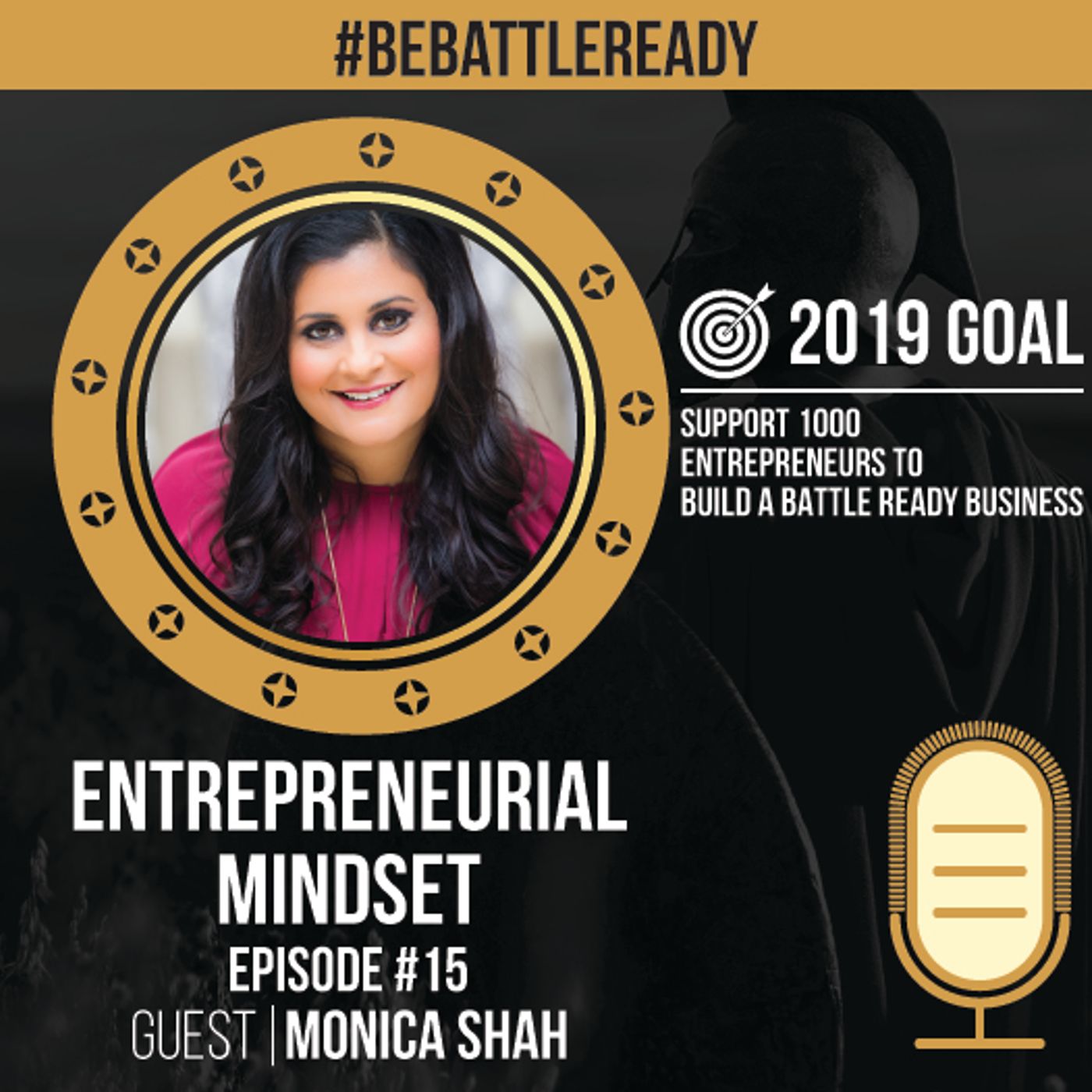
All right. Welcome to the BeBaddle Ready podcast, interview edition. And on today's episode, I'm talking with Monica Shaw. She is a seven figure business coach who helps entrepreneurs build their business that supports their ideal lifestyles.
But as usual, I'll let her do justice for introducing herself and giving her a better background than I can. So Monica, welcome to the show. Hi, I'm so glad to be here. Well, thank you.
I'm very honored to have you on and, you know, be talking with something very like my didn't and I love just looking forward to our conversation and where this is going to take us. So why don't you just tell us a little bit more about, you know, your background where you come from, you know, all that that good stuff. Sure. I mean, I, I've run a pretty big business coaching company now, but I'll tell you that when I started my very first company, it was a really difficult battle.
It was a sort of uphill battle. I have an MBA from the Kellogg School of Management. And then before and then after I got my MBA, I went to the Royal Paris and I worked as a brand manager for the Royal Paris. And I thought that I was really tough shit.
Like I was like, Oh, I mean, I know what I'm doing. And I have three letters behind my name and this is going to be fun. And I jumped out of that corporate world and I jumped into business. And within a year being in business, I was $25,000 in debt.
And I wasn't debt like paying for shoes and great clothes. It was real debt for the business. And I didn't have a problem with the debt. It was just that I didn't know how to pay it off.
And I think a lot of entrepreneurs are in that place. Like you build up debt as you're building your business. And then you don't, you're just not making a dent in that that like you're not starting to pay it off. And I really started to wonder how I was going to do that.
And so I did everything I possibly could to make money at that time and to start to make extra money like things like selling stuff on eBay and renting my apartment out on Airbnb and walking dogs and had sitting and all kinds of like extra things. Because I wasn't, I just didn't trust my business. Like it wasn't really there. And I know that this happened to so many entrepreneurs.
I just talked to somebody today who said, you know, I've been doing this for six years. And I can't seem to get like the consistency moving. And even when I get the consistency moving, then I run out of time. And I was really in that position.
And there was a particular week where I had rented my apartment out for seven days in a row. And I had rented at one person's place on one person's house for two days on another person's couch for three days on a third person's floor for two days. And I grabbed all my stuff and I was trying to get home. And I got off at the BDF Q on 53rd street in New York City.
And I had I got off the subway and two bags on one arm, two bags on another arm, a bag across my chest and a roller bag that I was carrying. And I started walking up the subway stairs and New Yorkers being the nicest people in the world that they are are running by me and knocking bags off. And I get to the top of the stairs. And I looked to the left and the escalator was closed.
I looked to the right and the elevator was closed and I looked straight in front of me. And there's literally four more flights of stairs to get to street level. And at that moment, I got really tired and really worn out. And I put my bags down on the floor.
And I did the unthinkable, which is that I sat down on the New York subway floor. You're adventurous, huh? Yeah, wonder that I'm still here and talking to you. You know, you hit rock bottom when you sit down on a New York subway floor.
And at that moment, I got really clear that I needed to figure out the money piece in my business and the time piece in my business because I was working, you know, 60 plus hours a week, 70 hours for myself. So that I didn't have to work 40 hours for somebody else. And I was just, I was exhausted and overwhelmed and confused. And so I did what I did when I hired business coaches and marketing experts, I went back and talked to the people I went and got my MBA from, I talked to my dad, who sold his company and was a very successful entrepreneur and sold his company when I was in college.
And what I got clear on is that, you know, there's a lot you can do as an entrepreneur and you're very busy all the time. But if you're not focusing on the right things, then you're not going to actually make money. And even if you are making money, if you're not focusing on the right things, you're not actually building yourself freedom, like of time and being able to go and do the things that you want to do. And what I got clear on is that most of us aren't focusing on the right things.
We're actually kind of doing a little bit of this and a little bit of that. And for most of us as entrepreneurs, and I know that it was true for myself, we're working twice as hard as we need to be, we're making half as much money as we could be. And we're doing that primarily because we're not focusing on the activities that can generate money. And we're also not focusing on our mindset around making money.
And for those of you that are making money, we're not focusing on the activities that could help scale your business. And we're not focusing on the activity on the mindset around what it means to actually get real support in your business. And then it's not fully dependent on you. And that's really what I got clear on and what what really served me was I figured out that they there are five real steps to generating money.
And when I followed them, I was able to pay off the $25,000 in debt, we crossed seven figures in 2013 as a coaching company, we've been a seven figure plus coaching company ever since for now six straight years. And what I know now and what I'm really proud of is that I'm able to help entrepreneurs all over the world be able to generate money in their businesses, because ultimately, money isn't everything, right? Like it's not like we're all doing this for the money, but it does touch everything that matters. And I know that if we put enough money in the hands of the right people, that this world is going to look like a different place.
And in my tribe, that's already happening. Absolutely. I completely agree with that. I mean, you know, you know, we can give you ways of making money and generating income.
But you know, if they're not fulfilling, you know, like I had a guy talk to me is like, Hey, if you were only doing real estate, you'd be pretty infatilate. But yeah, it's pretty that's pretty straightforward in that's so man, that was a I have so many questions based off of that. And I want to start with the all the things that you're doing prior to that, you know, you're you're doing all that. But in really focused on this depth versus width, and you really got focused because you were doing everything you're doing, so explain to me like, what was your mindset at that time and what shifted?
Like, what was the thing that shifted you in that? Right from Oh, I'm all over the place to focus more with the understanding of what actually creates wealth. So what actually puts money in the bag? And we love to think as entrepreneurs, and whether we do it conversation or so, consciously, we just love to be busy, we love to be challenged, we love to be creative, we love to be innovative.
And therefore, we can sort of live all over the place like any true creative that. But there is only really one activity that puts money in the bank account and that asking for it asking for money. In other words, and asking for money, you know, is defined as a sales conversation right in the entrepreneurial world. And so really, there's two different types of sales conversations, there's one to one where you're asking one person for money who's sitting in front of you or is on the phone or asking for many you're asking many people for money.
And ultimately, what I started to really like the big transforming moment for me was really getting that if I was going to track anything in my business at all, it was track sales conversation, like how many sales conversations, how many times a week am I asking for money? And that really when I started to really get and for me as a rule that I had, it's a rule that I give for all of my clients. And that is that you should be asking for money at least three times a week. And that and so that could be three individual asks, it could be one megask is what I call it if you're doing it in front of a group or you're doing it on a video, but at least three times a week is going to keep your business growing.
And so what what happened is when I got clear that that was my main activity, then I started to realize, okay, my real focusing is on activities that are going to help me generate sales. And those are called revenue generating activities or what I call revenue generating activities. So I thought, you know, just today I was having a conversation with someone who heard one of my talks, and she said, you know, after I heard about all the things that we do to waste time, I went home and I fired my graphic designer and I said, well, why did you fire her? And she said, because my business and partner and her were perpetually arguing about colors.
And she's like, and I really got from you that that wasn't making us any money. And we needed to just stop. And I was like, good for you, right? Like, that is a breakthrough moment when you really get sizing your picture on the on your newsletter doesn't matter, or the perfect color blue on your website, not that big of a deal, you know, the getting the perfect topic for your weekly newsletter, not going to make a break your business.
It's none of those things are revenue generating activities. What is a revenue generating activity is an activity that is going to lead to sales conversation. So this is going to vary depending on your business. But the number one activity I really like that leads to sales conversations is speaking, speaking in front of groups of people, because not only does that lead to sales conversations, because you make an offer at the end of your talk, it leads to conversations that are high converted, because those people already have energetically felt you, and they are and in a lot of cases, they're already convinced that they want to work with you that they want to do something with you by the time they get on the phone with you.
So that's one of the top activities that I recommend for people even above and beyond all of the online activities out there. Awesome. So let's go back to the debt part, because I think that, you know, in my history, experiencing taking on obviously real estate debt to start a business and expand a business. Let's talk about that, because that's a that's a big thing that as a in the sense of a mindset that we have to get over as entrepreneurs, because we have to take on debt sometimes, and it could be insurmountable as the way it feels at the time.
But talking about your experience with that and how you deal with having debt at that time. So interestingly enough, I don't think debt is an issue. And I think the way we have to think about that as entrepreneurs, you know, you have to have money to start a business, like that it has to come from somewhere. And especially if you like, it's why you see, if you watch Shark Tank, you see people coming on Shark Tank to ask for money, because especially if you have a product business or a brick and mortar business, you need some sort of money to create the product or to renovate your store space or your restaurant space.
And for many small business owners, that money that you're using to start your business is quite a card, right? It's like a loan. And in a lot of cases, it's a great loan, because it's a low interest or no interest loan. I think that what what the problem stems in is the pay off plan for the debt, and how how quickly can you pay it off.
And so this also comes about because for a lot of businesses, you're not breaking even, like it takes at least a year or two, sometimes three years to break even. So my feeling about that is not so much that you should worry about it, especially if you're just starting your business. But if you are a more advanced business owner and you're constantly finding that you're in debt, or you have a mountain of debt and you've been in business for, you know, five years, 10 years and you don't you're not actually paying it off. Then we need to look at the other side of the coin, which is revenue.
How can you start to increase your revenue, which goes back to the original point, which is how can we increase sales? I'm not a big proponent of, you know, cutting out your lattes so that you can pay off your debt. You need your lattes. It's the thing of, and it's there's a lot of things as we're raised, our systems are raising us to become employees, like where our school system, our society is all focused on employees.
We do have this culture of entrepreneurs and it's growing, but we're told as as you know, to pay off or not carry that that's bad. And then our lattes and spending, you know, how you actually get ahead is by spending less when as an entrepreneur, it's all the rules are reversed, right? Take on debt spend spend more and be okay with spending, you know, absolutely. And I what's it is an absolute role for personal and I have a little story that I think sometimes helps for any of you that are carrying down out there.
And that's that and that's that's I always explain entrepreneurs as being wizards and everyone else is being muggles. And if you're familiar, this is a Harry Potter reference doesn't case you know, then I did not get and so in Harry Potter, the wizards are just shins and the people who are magical and everyone else is a muggle. So as entrepreneurs, we're wizards and everyone else is a muggle. And I do a whole, you know, class, a whole section on the difference between wizards and muggles, you know, as entrepreneurs and non entrepreneurs, because if there's a whole piece around the fact that there's so many things that non entrepreneurs don't understand about entrepreneurs.
But one of the things when you're talking about debt is to realize that if you have shame around the debt that you're carrying, it's not helping you pay it off, because the energy of shame is taking away from the energy of action. So what do you do about that energy of shame or that energy of sadness? Much of it is passed on from an old school belief around that. So if you think back, most of our parents and grandparents, not our parents, but our grandparents and great grandparents were products of the depression era.
And in that era, you would make a certain amount of money. Let's say you made, you know, $30,000 a year. And then if you were lucky, you would get a 10% race. But that 10% raise wasn't that much money.
And you might get that every two years, you wouldn't even get it every year. So if you lived outside of your means, and you accumulated debt, you would die with that debt. Like, there's no way in your lifetime with a 10% increase every two years, you would ever be able to pay off that debt. And then that debt would be passed on to your children.
And they would carry the shame of your debt. So there became a cultural societal belief around, you should never carry debt and you're a horrible person, if you do, and you're never going to be able to pay it off. And then it's shameful and an awful thing to do. That's that's where it was created.
But the thing to remember is that as a wizard, as an entrepreneur, you actually don't have 10% increases, you can have a 30% increase, a 50% increase, 100% increase in your income. So that means that if you are carrying debt, you have a real possibility of paying it off within three to five years of you starting your business. And so there's a place where you have to, where you don't have to carry the same fear around that that the muggles are carrying, because as an entrepreneur, you have the ability to pay it off, you have the ability to as long as you're spending it, you're using it widely. So that's the piece that's interesting as is let go of the shame, my feeling around this is let go of the shame around your dad and put your focus and energy around really being able to generate more and more revenue, really being able to grow 30% plus per year.
So that if you are carrying that, you're making enough money to not only pay all of your bills, but to know to have extra and to start to really make a debt in that debt. Awesome. Awesome. So you know, one thing, when you're telling your introductory story, kind of your background, everything is you went from working being an MBA to working in a corporate environment and then transitioning over into entrepreneurship.
And I feel like there's two, there's two types of entrepreneurs that there's, there's people who just start businesses, you know, really don't go to traditional route. And then there's, you know, people like yourself who jump out of the corporate environment and then actually get into business. And I feel like a lot of them, they get, they're like great pieces to the puzzle a lot of times, right? So I just want to see what your how that, what the difference was, you know, the skills that you learned in the MBA and working in the corporate environment, how that transitioned over and what gaps were were there that weren't there that you had to learn, you know, to be to be even more successful and to learn.
I will say working in the corporate environment taught me to work hard. I worked at L'Oreal Paris. It was a very good demanding environment. And because it was run by a French company, the way that French run their meetings is that they there's never really an agenda.
So you're just expected to be prepared for anything. And I think that taught me a lot about working hard and preparation. But I don't think that it that it taught me much about the specific courage that is required to be an entrepreneur and the risks that you end up taking. Getting my MBA helped me with just basic skill sets for sure.
Reading a financial report, understanding revenue and expenses and profit and conversion rates and being able to look at a business model and understand target market like it definitely contributed to who I am as a business coach. I mean, earlier today, I was just talking to a group of clients who wanted to hire me for a VIP day, which is an intensive day with me. And I always talk to people before they do that. And their business model wasn't working.
And I was like, you guys, we can't, you know, we can't build this business if we don't have a business model isn't going to generate money. And I think that's a really, you know, I got both of those from my experiences. But what where the gap really was is first of all, the money piece, even as an MBA, they don't tell you how to they don't teach you sales or how to ask for money for yourself or how to build confidence around sales and the mindset piece. It's a whole completely different mindset to be selling for yourself, to be taking risks for yourself, to be spending money that is your money or someone else's borrowed money.
And so that piece of really like having to learn resilience, like grip, you know, learning how to use your intuition and being tenacious and being resilient and being able to withstand disappointment, I feel like it's all stuff that you have to just learn through action and taking actions and you know, and by surrounding yourself with a lot of really smart entrepreneurs and some great and great business coach to help prepare you for that. Because I think that that's the thing that really topples people over the fastest is the disappointment and the rejection that comes in the process. Yeah, you mentioned something about having a coach and just now a little earlier, you know, I know I've had a person start off with coaches early on and all that. But I know that that some people think it's like a sign of weakness to bring on a coach consultant and and all that like, you know, let's talk a little about that in your experience.
I mean, did you wrestle with that initially or was it something intuitively you knew you need to do you to jump into it? It was both. I knew I needed to do it and I jumped in right away. I hired a business coach as soon as I left L'Oreal like within a month of leaving L'Oreal I hired a business coach and I was paying more than $2,000 a month for it.
It was money that I didn't have. I mean, at that point, that was borrowed money that I was working on. So I and I was very clear at that point though, and I've always been like, I'm somebody who will hire help in every aspect of my life. Like as soon as I have a goal, if I'm not doing it at the pace that I want to do it on, well, then I'm hiring someone, whether it be a personal trainer or a health coach or a mindset expert or someone to help me with this flotation or leadership or management.
Like, I I really attribute that quality about myself. Like that that quality with a lot of the successes in my life because I'm super impatient. And so I just know that you hire the person that's the best out there doing what you want to do and you learn from them. And it's been like a real success rate for me.
But it is scary. So at the same time that you're doing that, you're paying money that you might not have, you're taking your risk on who this person is, you're taking your risk on yourself, you're having to leave your comfort zone. It's not very fun. It can be very uncomfortable to be pushed in ways that you don't want to be pushed.
And so there's a place where I think it can be and then there's this place, there's always a feeling of like, why do I need this person? Why can't I do it alone? Like, you know, like, why, why, why? Like, and then you find, of course, super human brain always find somebody who you think is doing it alone to compare yourself to and you're like, well, she can do it alone or he can do it alone.
Why can't I do it? And I think the thing that's always comforted me though is is the facts don't actually say that. Like the most successful people on the planet do have coaches, they don't always call them coaches, they might call them mentors, they might call them advocates, they might even just call them great friends. But there are people that they go to advice to who are more successful than they are, who guides them along the way, not to mention that if you look at the way companies are set up, CEOs are surrounded by boards and executive teams.
And a lot of times CEOs, their executive teams, the people on their executive teams and the people on their boards are smarter than they are and have complimentary skill sets than they do. And that is on purpose, that is to advise them and guide them to serve a coaching role. So when you're in business by yourself and you don't have a board and you don't have an executive team, you need someone that is going to be able to guide you in that direction. And it's not a sign of weakness, it's what everybody else is doing, it may just not be the same vocabulary, like, they may not call them a coach, but it's the same, it's the same consideration.
And I remember, I hired a coach on top of my business coach, I hired to come to my very first three day event to be their present with me and coach me. And she really helped me everything from like the outfit I was wearing to how I walk on stage to how I answered questions of the mic to the way that I presented myself on stage to my sales pitch. And I remember saying to my husband, it almost feels like I'm not doing anything alone. Like, gosh, like, I don't even like, like, I'm a child, you know, like I'm a small baby, like, showing me how to do everything.
And I don't know if this is okay. And he looked at me and he's like, Monica, every famous person has been made by other famous people, like they have all have counselors telling them what to wear they all have support and coaches and people and stylists that are helping him pick everything out. No one's doing this alone. And I really like took that to heart, you know, even you look at the president, he's got advisors around him.
So why should anyone have to do it by themselves? Absolutely. I mean, we, I don't know where this comes from, right? This superhero complex that we're that we push upon ourselves that we place upon ourselves that we have to be it.
And it's just actually more destructive than it needs to be and then it's more destructive than just submitting to it. And there's this huge thing that your success is in your submission, you know, the more you submit to being led and led, the more successful you'll be, I think some of the best leaders are really, really good followers, you know, and it's funny that you talk about that because I want to coach for everything. So here's stuff that I'm literally like in my background's in fitness and probably almost coming up on 20 years of being around it and involved in it and educated it, you know, and like I still want a nutrition coach and I still want somebody to write, you know, my workouts, you know, because it's it's this I think that us as that entrepreneurial personality type, you know, it's like, we're so in some ways, loners in the sense that like, that's how I feel, right? Like it's so how we think how we process how we go about doing things is so different that we feel alone that we want to have you surrounded by people to support us, you know what I mean?
And to and that's how I feel. I mean, I don't know if you've experienced that at all. Yeah, I totally agree with you. And I also think it's like an addiction, a good addiction, because I'll tell you like what you said is so true.
I always say to be a good leader, you have to know how to be a really good follower. And I and what's so great about being a really good follower is that you start to have successes, right? Like you work with a coach here, she helps you get successful. And then all of a sudden that pattern becomes like a great addiction.
You're like, Oh, let me just repeat this pattern. And every area of my life that needs help so that I can improve it and it starts to work everywhere. And I just I think that people who think of it as a weakness, they just haven't tasted the fruit of it yet. Like the fruit of like what it can be when you really get it and you start to have success as a result of someone really helping you.
Yeah, absolutely. So let's let's talk a little bit about your five steps to getting clear. I got that right, right? You have these five steps to you spoke about that can you talk to me about the more more about like that process and what that's all about?
Sure. They so each step is pretty lengthy. So I'll just go over it. But the first step is shifting your money mindset.
And what that what I'm talking about there is that most people are afraid or have issues with money. And so it's really looking at what those are and then replacing them with healthier beliefs. And that's going to clear the way at least step two, which is step two is focusing on revenue generating activities. So I alluded to that at the beginning, like really focusing on things that are going to generate money and letting know the things that are just wasting your time.
Step number three is tracking your numbers. So many entrepreneurs really can't answer the question, how am I doing? And what's working and what's not working? They can suspect it, but they don't really know.
And that's because they're not actually using numbers to help them get there. So looking at numbers is a huge part of just being really clear about what you need to do. It's also a great way to stop working. Because a lot of times when people aren't tracking their numbers, they're overworking because they're not really clear about how much work they need to do to be able to like feel to say, Oh, I can honestly stop at fourth or any on a Saturday and don't worry about it.
Because I did what I needed to do this week because they don't have any sort of quantitative evidence of what they actually got done that week. And then step number four is dynamic planning. And when I say dynamic planning, I don't mean like creating a plan in January and then kind of looking at it as a wall art piece, creating a plan that you're actually changing every week, every month and every corner, like that you're revisiting it and really treating it as a projection and not as a place to hang yourself. Because a lot of entrepreneurs will do their plan.
And then the moment it stops working, there's a lot of shame and disappointment involved. And then there's the then there's the just giving up of the plan. And that's not really what it's meant for. It's really meant to be the measuring tool between what you intended on doing and what happened.
And the space between what you intended on doing what happened is the growth, right? That's the learning curve. And so it's the it's really learning to be a piece with the growth piece of it. And that's what a plan can help you to do.
It helps you to stay out of delusion about what you thought you were going to do versus what actually happened. And then step number five is rinse and repeat. And I say rinse and repeat because we just a lot of a lot of us have a focus issue, right? We're focusing on too many things at once.
And we're not actually doing the really staying focused in on the things that are going to be the most helpful for us. Awesome. Awesome. So let's transition to like, you know, a little bit more of your programs and stuff as we wrap up in the next five minutes.
But let's talk about that. And like, you know, who's who are the people that who are the people you work with? You spoke a little bit about your clients that you've talked with. And talk, tell us about some of the programs that you have and all that.
Sure. So my focus is on helping entrepreneurs be able to double their incomes within 12 to 18 months. And I teach money skills, marketing skills and sales skills to do that. And I also combine that.
You know, one of the things I noticed, I've been doing this for 15 years now. And one of the things I noticed in my first five years is that I can teach people money and marketing skills literally all day long. But if there's fear beneath those skills, if there's limiting beliefs, if there's like things that need healing below that, we're not going to get anywhere. So I also combine that with I'm a psychic and a spiritual healer as well.
So I can look at what the beliefs are that are getting in your way, we can do clearings on them. So I work on both sides of the coin, the sort of MBA side and the spiritual side of growing a business. And in terms of like the first step of connecting with us, what I've created for people is a question I get over and over again. It's Monica, like I really got your teaching around sales and I need to be asking for money more often.
And most entrepreneurs will, will admit to that. But then the next question is how do I get those conversations, right? Like, what are those revenue generating activities that I need to be doing to get those conversations? And that is what we've created is that there's nine revenue generating activities that created a marketing calendar that outlines every revenue generating activity, the order that you do them in and the quantity in which you need to do them in.
And it's at revenuebreakthrough.com, front slash marketing calendar, revenuebreakthrough.com, front slash marketing calendar. I think this is a tool that every entrepreneur needs. It's super easy. You can print it out.
There's one that's filled in for you. One that is blank that you can fill in on your own. And it just simplifies this process of what do I need to do to make money? And for those of you that actually want to connect with us directly, maybe if you'd like support in your business or you have a question, you can find us at revenuebreakthrough.com.
And you can find us there on Instagram and on Facebook, just look up revenuebreakthrough.com. And then you can email us at support at revenuebreakthrough.com. Awesome. Well, you know, I appreciate you jumping on.
I've really enjoyed having this conversation with you, learning more about you and your program, your background. We'll go ahead and link all that up in the in the the note show notes and put all your information there. And I really appreciate you. And I look forward to, you know, connecting with you soon and everybody else.
So next time, we'll talk to you soon.