
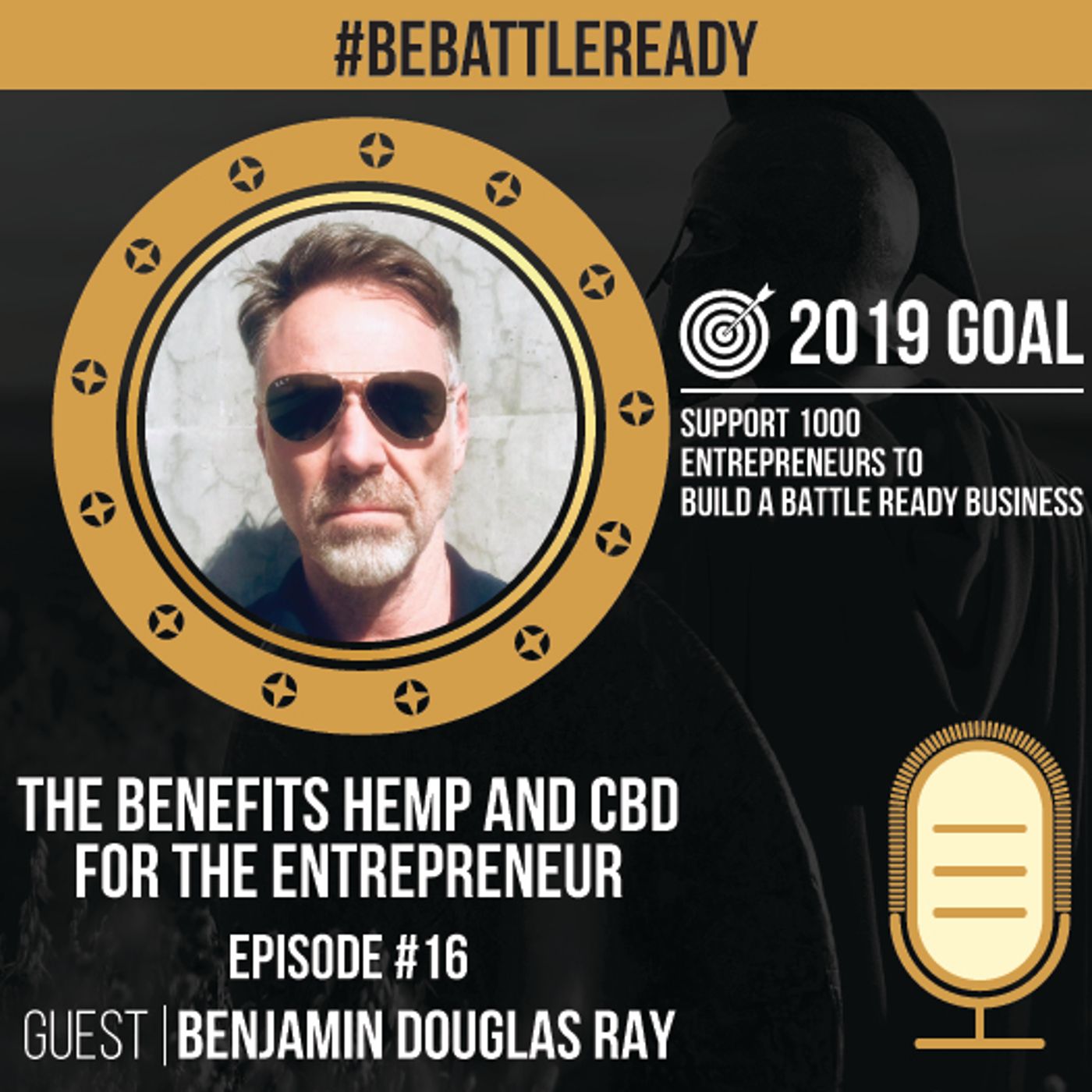
All right, everybody, thanks for joining in today on the program. This is the 16th episode of the B about already podcast. Today we have Benjamin Douglas race, you know, of eight Saints CBD hemp, sorry, my bad organic hemp and CBD. So we'll be discussing today health wellness.
And then also as an addition, Benjamin has a big background in digital marketing. So we're going to take a deep dive look into that and then go from there, but I want to introduce Benjamin to let him introduce himself even deeper and kind of give his background. Benjamin, welcome. All right.
Thanks, Anthony. Thanks for letting me be on your show. Yeah. You know, there's a lot I think that I can learn from CBD in general and about wellness.
You know, CBD is kind of the craze right now, but there's a lot that goes into it. And really when you think about being a well-rounded person in business, at home, with your body, you really need to take care of yourself. And what I found from being involved in this CBD business is that the organic really is kind of a way to prepare your body and your mind when you're going into business for the day. So I kind of like to think about it as, let's say you wake up.
This actually happened to me a couple of days ago. I woke up in the morning and I do a routine every morning. I get up between four, three, and five. And I got up and my hands were, we're not feeling quite right.
Like I got some sort of some of my thumb. And I made some coffee, I went downstairs and I started to grab the weights. And I couldn't quite grip the weight. And I was like, you know, what the heck's going on here?
I mean, something's going on, did kind of my routine. And then I'm thinking like, oh man, I forgot to take the CBD tincture for the night before. And that really, the not taking that night before really set my day up. What I did then is because my hands were hurting and I was a little bit pissed off that I didn't take the CBD.
When I went upstairs and my family came down for breakfast, I kind of was stressed out, you know, that kind of personal being about me. I just wasn't feeling right. When the family was there, I kind of crabbed it down. You know, so my relationship was kind of weird.
Then when I went into the office, I just couldn't focus at all because I hadn't had the CBD. So across all those kind of four areas of my life, I definitely wasn't, you know, about already to talk about your stuff really. It's just, I wasn't prepared. And it was really because the night before, so really what that taught me though, is I've got to look ahead.
And when I do have the CBD, it really helps me out in all four of those areas. And I can be, I can start in any one of those. If I'm stressed and I have CBD, it helps. If I can't sleep, the CBD really helps.
And certainly for aches and pains, really, really helps in the lesson for focus. So by taking CBD, I've learned a lot about myself and a lot about how it's not just the body, it's not just aches, but it's all those areas that really can set my day up to be battle ready for the day. Awesome, awesome. And kind of for anybody that's not too familiar with CBD, can you kind of give us like what it is, you know, and where does it come from, how does this come about?
That's... CBD is short for a kind of video, which is one of the around 110 cannabinoids that are found in cannabis plants. And so you've heard of THC, which is the psychotropic element that people get high up of when they smoke pot, you know, pot, we, that's cannabis. Okay, now hemp is also cannabis, but it's a different part of the plant and it's grown differently.
So cannabis, y'all are CBD, as I said, is one of the cannabinoids. And if you have whole plant hemp from the hemp plant, that is very therapeutic to your body and your wellbeing. And without the THC in it, you don't get high. So you could have, you could have cannabis y'all all day CBD and you won't get high.
Now, some of our products are made with CBD isolate and isolate means that everything else is stripped out. It's not whole plant. So what that means is all the CBD, CBN, THC, it's all stripped out and it comes in a powder form and you mix that then with, or is it just pure avocado oil for our tincture? So no fillers, no additives, it's just straight CBD and avocado oil.
Now, so for me, that works better because it's very concentrated, but I don't have what's called the entourage effect when you have the whole plant. So it's almost like eating a whole, let's say it's a carrot and you're gonna eat the carrot and the green, greens at the top, it's more whole plant. That's the idea or just a part of the carrot. So different people have different philosophies on that.
But Hint has been around for 5,000 years as a therapeutic product and only in the past year, a couple months, has it really, really taken off as something that's amazing. And it's not, some people say it's kind of like snake oil, like miracle drug, but it has been around a long time. And I think it's just now that the Farm Bill passed at the end of 2018 and it was signed, I think, on the 9th of January, really, that the day after is when you started seeing it in ads, in a few stores and it's really in everything now from tincture to food to cosmetics. And so that's what CBD is.
And you can find it in many forms. Yeah, I mean, there's a lot of companies popping out, but with, it sounds like based off of you taking it, when you're having a joint pain, it has an anti-inflammatory effect. That's what I'm doing. That's right.
Okay. And can you expand upon like how that helped out, you know, a business owner or someone who's in high stress? Like, well, yeah, so what it does, and for the mind is it calms the mind in a strange way. And there's not that much science behind it in terms of research, but I can say it is scientific.
I can say that the CBD helps to calm the mind. And it's similar to meditation in type of ways of kind of creating space in your mind to be able to focus on what's important. So it acts the same way as some opioids and some over-the-counter medication for focus, but you don't have a side effects. There's zero side effects of CBD, by the way.
And I wanted to add one thing, that if you're a first responder or someone who's allergic to any sort of THC, isolate, if you have isolate, you can't test positive for THC. But in some instances, if you take whole plant hemp, it is allowed to have 0.3% THC in it by the government. You potentially could test positive. So I wanted to add that, if you're worried about that at all, take isolate extract.
But in terms of the focus, it doesn't matter if it's whole plant or if it's isolate, either one of those that you take, specifically in the tincture, will help you focus on what matters. And what I mean by that is to clear out the noise is to slow down your mind so that you can really focus on prioritization of your teams, of your sales channels, of your organization, whatever that is. And first of all, it makes you, you can focus so that you can articulate what you want from your teams really well. And then secondly, for me, speaking of personal experience, it makes me more hyper-focused on responses from people and kind of seeing the big picture at the same time where I can see details.
So I think it's clearing out that noise so that I can help the teams move forward toward their targets in a much more, I'd say, fact-based, less emotional manner to get more done. Awesome, and then how did you get started? I mean, I know you have a background in business, but how did you get into the CBD? So I was in advertising for a long time.
And after that, I started, I sold an ad agency. And I started consulting for CEOs here in Colorado, just on brand identity and digital marketing and perception, crisis management, crisis preparedness. And just because there's a lot of cannabis companies around here, I started consulting for some CEOs and cannabis companies, some dispensaries, some grows. And then I became a consultant to the marijuana industry group, which is the trade organization for cannabis here in Colorado.
And I was helping them with their small donor program, their brand, expanding that. And at that time then I had consulted with about 12 different cannabis companies over a two-year period. This was like 2013, 14, 15 somewhere in there. And I was able to get a license for a cannabis mix, which is a marijuana infused products company in Adam's County here.
And so we sold, we extracted oil and we made vape pens and oil and got it into dispensaries. And I had that company for about 16 months and then I sold that to my investors. And then after that, I started a Rosin company. And Rosin, if you know, is just pressed to the flower and you get the oil out.
So it's very clean. Everything that we always did was organic. So no heavy metals, no pesticides, all organic, just pure as you could be, no fillers in the vape pens. And then after that, Rosin company, I got into hemp because I saw that the farm bill was going to pass and I also thought that it's a much bigger market, meaning that in cannabis, it's only legal rec in a few states throughout the country.
It's getting more so every year. But hemp, with farm bill pass, I can sell, especially using all organic hemp. I can sell to anybody in the country. I can sell internationally.
I can sell online. You don't have interstate commerce issues, zero issues. So for the same effects, if you're looking at hemp in cannabis for therapeutic reasons, same effects, but like, you know, one one one hundredth of the regulations, the technicalities, the hoops that you have to jump to to start a company to be able to sell your product. So we decided to go into hemp and then took the principles that I'd use before in terms of using only organic, only natural, creating a really a brand that is very strong, very approachable, and relied heavily on customer service and providing the best product that we can.
Awesome, awesome. And then let's talk about more about this farm bill a bit, you know, because this was a big deal. I mean, I know you have probably a lot of background understanding in this bill and the spaces that you've been in the past. So what did the farm bill essentially do and why was it so important for this?
The farm bill allows farmers to first of all grow the crop. So before the farm bill, there were 14 states, 14, 15 states where you could manufacture hemp, sorry, grow hemp, manufacture products and sell it, but that was it in the whole country. And, you know, hemp has been around for a long time. Like I said, before 5,000 years, it was a big crop for Thomas Jefferson and George Washington.
And then it got kind of caught up through the language in the whole kind of 1950s cannabis, it's that type of thing. And it really became something that was just not allowed for that reason, although there was a big, you know, there were a lot of hemp farmers in Colorado, Colorado and Kentucky specifically. And there was a lot that was happening in terms of just using biomass, doing experimentation for using gas, you know, obviously paper and, you know, rope and all that. So there's also hemp that's in milk, you get hemp milk, you know, and that was basically using hemp seeds.
But those, the therapeutic elements were not there. So what the farm bill did is it changed the way in which we look at definitionally cannabis and specifically the hemp part of cannabis. And so it just changed the language so that farmers could farm the country could manufacture and we could sell hemp products. So there's still, there's still some gray areas around the FDA, you know, not approving and what you can and can use it for.
And it's still a little bit gray, but it's that removed tremendous road blocks. And what that does is that gets our, one thing that gets our country, at least that part of our manufacturing back on track. And it's a huge area of growth for our country. The hemp for consumables and topicals in this space right now is $1 billion a year.
And by 2025, it's going to be projected at minimum, 25 billion, even up to 50 billion. So there's huge growth, huge jobs, I mean, amazing for business. So what you're seeing in this is truly the green rush. So it's, you know, if you think of cannabis as kind of, you know, cannabis point one, hemp point one is really like cannabis point 10.
There's, there's so much more to be done with it because when you think of cannabis, you think of, you know, a lot of therapeutic, but mostly people want to get high and it's more like alcohol, it's more of a recreational type of thing where the real healing properties are in the CBD. And that's why it's such a huge, huge expansive opportunity. And so the Farmvale really removed a lot of barriers for that to happen. It seems like hemp is going to be more, there's a lot more industrial uses, right?
Variations, uses, you said, broke paper. They're probably going to, I mean, you know, oils and everything. And I don't know if that has any implications into, you know, they've been doing that, they haven't been able to do that for a long time. So it's, I thought that 50 billion I was talking about isn't even included.
There are numbers that are way bigger than that in terms of hemp and paper that we're already doing around the world. Awesome. So, you know, I was talking about lady there, they should have sun, and I think she was giving them CBD oil because he was autistic. And, you know, I know that there's been talks about this.
Have you dug into any of that at all? The other lot uses, I mean, not just the areas that I talked about, but people do have real life experiences for epilepsy, for nerve damage, glaucoma, certainly joints, but there are so many uses that we haven't even explored. And in some ways, I think that it is kind of what I would call a miracle plant because of all these uses. And you can tailor it to specific things.
You can do that much more so in cannabis where you can grow specific strains to be able to affect like back pain or knee pain, glaucoma or migraines or whatever. And hemp isn't quite that sophisticated in terms of the genetic engineering yet, but it will be. So now it just works for almost all of those things. The same dose will affect people differently.
But in terms of children at lower doses, it is safe, especially if it's made from agricultural or industrial hemp with zero THC, there's absolutely no problems that we've given it to a child or a dog. I mean, or pet, there are a lot of studies where CBD is helping animals, especially animals that are in kind of later stages of dying or they have cancer to ease their pain primarily. Awesome. Let's pit it a little bit and talk about your experiences in digital marketing.
And, you know, I mean, I know you've sent me a few things we talked about it. And let's talk about that. Like, you know, what are digital marketing so broad now? And what areas did you, are you a specialist in or an early proficient at or expat?
So what I primarily focused on was online perception. And so basically what that means is when someone types in keywords up into the browser, good things come up about you or your company and bad things don't exist. So it's, you know, it's, it's, it's understanding how Facebook works. It's understanding how Google works.
It's understanding algorithms and understanding the metadata and how search actually works. And it's changing a lot. But essentially, if you think about how to be found online, most companies, what they'll do is, you know, you'll have a whiteboard session with the founder and say, here's who we are, here's what we want to be. And it's just their vision of what they're trying to create.
But it's not necessarily how they would be found online. So what I do is work with companies to say, OK, who's your customer and what would they type into the search bar to find you? And then when we determine that, then you build your ad campaigns and your keywords around what people would search for because it can be something that an owner would never think about. They may say we want to be the best, you know, Apple juice company in the world.
But nobody's going to search for that, especially if you're working on hyper local search, you're not going to find them that way. So you have to build in geographic locations, even zip codes, specific attributes, whether those are feature benefits or social media, you need to blend that in so that people can have a good idea where to find you. So the way to rise up in the search engines one is to have a lot of links coming into your site. So if you're talking about other companies or you have a lot of social media, you can get links into your site and you'll rise up.
Sorry, I'm talking about organic search. So that's one way, which means you don't pay for it. You get leads coming in and the other way then is to have all of your metadata, which is the code behind what you see really is all the words in there that people are going to search for. And that includes, if you're in articles, that includes photographs.
So the photos need to be tagged with keywords or named with keywords. So you'll be found in image search. So that's really what I have been working on for the past probably seven or eight years as my specialty is really how to be found online and against your competitors. So digital marketing is not just doing a banner ad and putting it on, you know, sports illustrated.
It doesn't work and it's super expensive. So it's really about 50% organic search, 50% paid through, you know, different mediums have different different platforms have different ways that you can do it. It really is about being found online because if you can't be found online, no one's going to convert anyway. So that's what's really important is to take up the first stage of Google.
I mean, that's really what matters. Yeah, we found, you know, one of the things that I think is I was like brilliant about CrossFit, right? If you look at, from your perspective, you know, they started this website and then they started always affiliates that had websites and then this thing that was there. Everybody was linking to each other.
And, you know, we at one point were getting for a local business, seven thousand visits a month, which is pretty, you know, for me, I think it's pretty good for a local business. You know, you know, and a lot of how to deal with the SEO, right? Is everything is, you know, there was a lot they were posting every day. Like it was, it was, it was interesting.
They're not time. Well, that's a big part of it too is to be very consistent in your marketing. And what I mean by that, let's say you have 30 days and you write a 30 word paragraph. And if you put that up once a month, that's what a lot of companies do or they used to do.
They'd labor about getting the words exactly right and they did it approved by legal. And you'd have to have CEO and marketing like you work on a paragraph and you get it out once a month. Okay. Oops, let's see.
You either click that there. Sorry. So you're so that's like once a month. And that way you're going to drop in the search engine.
So what's what would be more important to do is do one one word every day for 30 days in your blog, even whatever those keywords are, just get them out every day. Because that consistency is what builds in the search engines. And if you do not update your website, every 30 days with fresh content, the spiders, which are the things that go out and pull pull people into your or they read your website. And if there's no new content on there, you get dropped down in the search engines.
Yeah. So that's why that's why it's important. If you have WordPress website, have a blog, puts up a new fresh content every day with keywords, put up some new pictures, do some social media that ties back into it. Otherwise, it's not even, I used to be stale.
Now it won't even exist and you won't be found. So that's important to second consistency. So many times I say it's, you don't need to be perfect. You don't need to have it exactly, you know, what you need to say.
It's way more important to volume than then a perfectly crafted paragraph. It's funny. He said I was like, I just intuitively knew at that time, we used to like have all these sequences and blogs and all this other stuff. We would go on to like a strength program and, you know, it had this like, this cadence of like three things at least a week on that thing leading up to it.
So that it would be up there from social media to blogs, all this stuff. Real quick, you mentioned that YouTube and SEO, you know, prior to us talking, right? Is that how does that work on YouTube? So YouTube is kind of the second most robust search engine next to Google.
But people don't really use it as a search engine. So if you do a video on YouTube, by the way, you know, it's owned by Google. So this will get a little complicated here. But if you're filming a video, the best way to do it is to film it native on your phone and then upload it to, let's say, YouTube and in YouTube, do a transcript of what you said and put that in the copy down below.
So that way all of your keywords can be found as a search as a search engine. So they'll come up when people search. YouTube will come up if they find those keywords that are in your copy. Most people don't put copy in there.
Then there are other things that you can do, you know, like you can embed the transcript there, their transcription. You can do that. You can check a box that says that other people in other languages can translate for you. You should do that so that you're really able to get out there.
Now, I said the best way what a lot of people will do is they will take a, they will, they will take a Facebook, they'll take a Facebook video and they'll paste that into YouTube. And what happens there, because they're competitors, YouTube will not index that as well as native. And if you also have links to Facebook inside your YouTube text, you can get rejected for that because they're competitors. So YouTube, I would say that is that it's a very robust search engine working with Google.
I would not recommend Vimeo at all. I mean, in the old days, I might say three to five years ago, people would say, well, Vimeo is more professional. It's higher quality. YouTube is more just like, you know, my space.
It's just kind of like crap, but it's now that it's owned by Google and the search engines are in there. You'll index way higher on YouTube than Vimeo. Like you could, you could use Vimeo as well, but it's, it doesn't have near the robust capabilities or the automatic things that you can do in YouTube. The thing about then filming on your native phone, then you can take that and you can go back in and post that to Facebook as well.
So you can do it both. Alternatively, you could do live Facebook and you could do live YouTube. They work exactly the same way, but you have to do them separately. You can't use the same one unless it's one data.
So we talk about kind of sequencing and stacking your marketing things. The way that I find to do it is to write out like a blog post and that blog post is filled with keywords that those keywords then become my script for my video, my native video. So then I'll read through that. We're very close to it while I'm doing a video, then I'll upload each one into Facebook.
I already have the text there because I already wrote the blog post and then I'll post both of those to Facebook and YouTube. Then what I'll do is I'll also then take that native video and I'll put it into LinkedIn, which is a whole nother robust platform. Do the same thing. We'll copy the text and put it in there as, you know, in your status, you can do that too.
You can put in videos, which are separate from doing a post, but you could still do a post with a video in LinkedIn as well. But that native is a very specific trick to index better and not get blacklisted or just denied on either of those two other platforms. Very cool. Awesome.
That's a good little lesson. Well, cool. So where can people get a hold of your app? So the website is eight.
So it's the number eight and then saints saints brand.com. Eight saints brand.com. OK, and we've got three products on there. We've got an extract, a balm and a cream on there.
And we're coming out with, you know, we've got some gummies in the works. We've got capsules in the works. A lot of SKUs being created. We're also creating a couple of different lines, ones, a sport line, ones, a spa line.
There's just a lot of possibilities for the three markets we have, which are kind of 50 to 80 kind of joint pain. Second would be workout, which would be pre and post workout. And the third would be kind of cosmetic. So working on a CBD sunscreen line, a pre-sign, a post on and a sunscreen and all on eight saints brand.com.
Awesome. Well, I look forward to it. So I appreciate it. I'm going to our conversation and yeah, what are we doing to support you?
Yeah, same here. Let me know what I can do, but you're doing a great job. Just keep it up with the, you know, your podcast and I know you're doing a great job out there, help a lot of companies grow. All right.
Thanks. Sounds good.