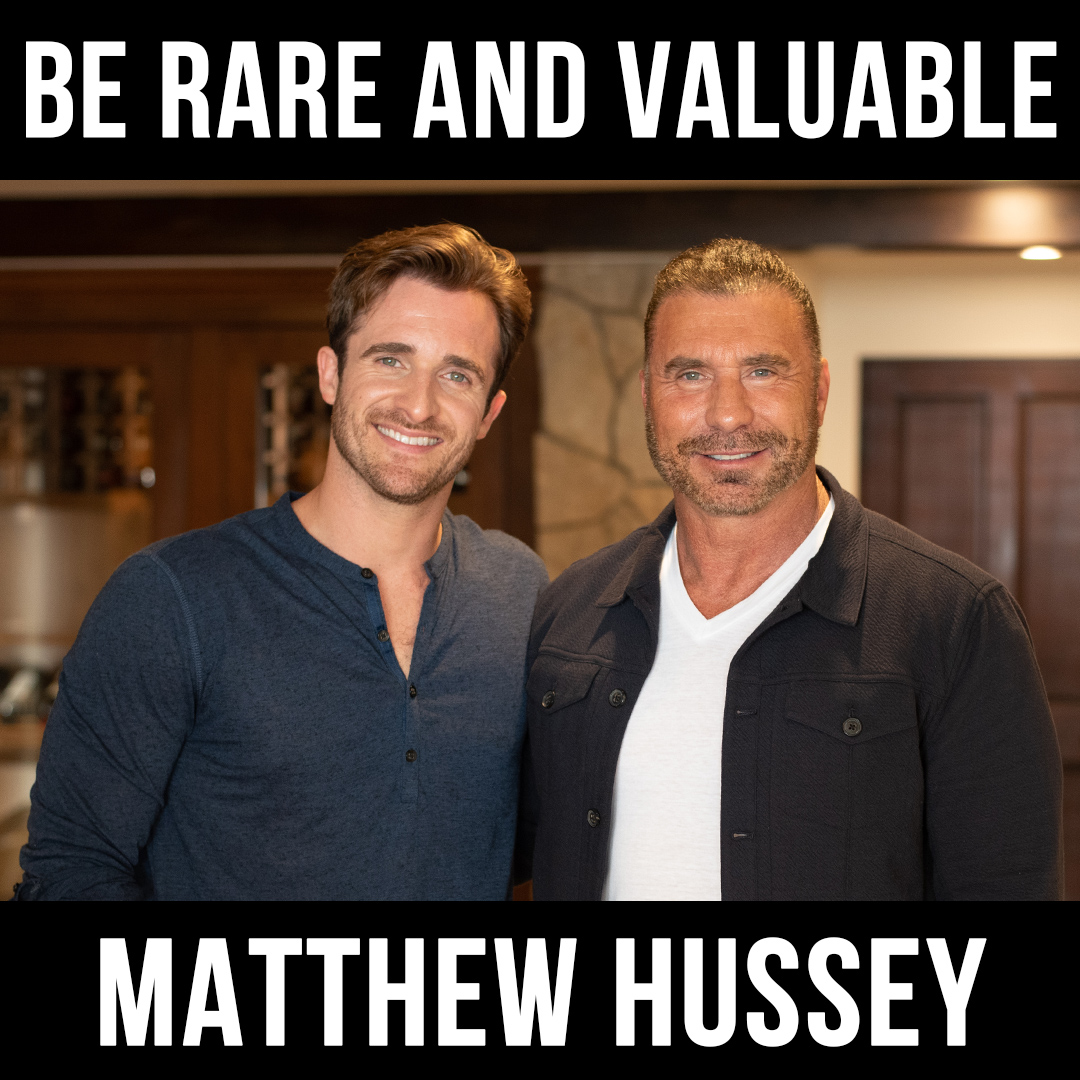
This is the end of my life show. Welcome back to Max out everybody. If I popular demand this man to my left is here today. We did a survey.
I didn't even told you this off camera. We did a survey and I asked for the top 20 people people wanted to have on the show and the topics. And your name kept coming up and coming up and coming up. And so you're welcome everybody even before we begin.
And if our conversation during the interview is anywhere near as good as it's been before the interview, this is going to change some life. So Matthew Hussey is here today. Thank you brother for being here. I'm having you here.
Those of you that don't know, we're talking about somebody with 300 million plus views on YouTube, 4 million, 4 1 half million plus people in your Facebook group. One of the largest followings in what I call the life strategy space and specifically an expert on relationships. And it's a topic so many people have wanted me to talk about on the show. And so I brought in I think the best person on spinning earth to discuss this.
So here we go. Thank you. I'm excited. I am too brother.
And it's going to go everywhere today guys. We're going to go all over the place. But I have one personally I wanted to ask you. Everyone's always looking for the one in a relationship.
Do you think there's such a thing? No. No. I, you know, the one to me the problem with that argument is the same with the idea of your calling.
I do believe that in business we find certain businesses or certain paths that meet our criteria. Like let's say everyone has a criteria for what I need to feel fulfilled in my career life. Sure. I might find something that meets my criteria on a very high level.
Like for me, my, what I do is I travel the world speaking to audiences. I do a lot of radio. I write. Ultimately I'm connecting and sharing ideas.
And that's what I love doing. I also get to run a business as part of that, which I really love. There's an entrepreneurial street to me. There's all these aspects to it that make it an organization and a life path that I really love.
But every now and again someone in my event will tell me like you found your calling. Yes. And I always think that's a dangerous idea because now what you have, and I'm sure you must experience this a ton in your work, is people coming to you saying, Ed, it's great that you know what you're doing and you've had this path for a long time. But I haven't found my thing.
Yes. I haven't found my calling. And that I think is a really corrosive idea because instead of bringing passion to the thing that we're doing, we look for the thing we're doing to bring us passion. Oh my gosh, it's great.
And so I think people do the same thing with relationships. I don't believe there's one calling for anyone. I'm like you, you're living many business lives. Sure, so yeah.
I'm going to live many lives in business. I'm going to live many lives in coaching. I'll end up talking about all sorts of different things over the course of my life. I don't want to be attached to this idea that this is the only thing I can be.
And in relationships I don't believe that on a planet of 7 billion people there's this one person that was somehow ordained to me. I just think there are lots of potential ones. The important thing for people to remember is, firstly the one for you, the person that you're going to end up being with, which I think people become the one based on what we build with them. So I do believe in the one in the sense that we choose one.
We choose who this person is going to be or we may choose it many times over and get it wrong. But ultimately when we're looking for a long term we choose someone and we go for it. But I say this to women who come to me all the time, the right person for you is both right and ready, firstly. Right and ready because a lot of people say, oh he's so great for me but he's just says he's not ready then he's not the right person for you.
He can't have, he's right for me but he's not ready. The right person is both right and ready. And secondly the one is someone who's going to really, you two, it's not just a feeling, it's not just a connection. The two of you are actually going to build something together.
You can connect with thousands and thousands and thousands of people in this world. But the number of people who will actually build with you is far more limited. And we have to graduate from the thinking that, you know, I always say this four stages of importance in relationship. There's admiration, which is no relationship.
That's just, I see you from afar and maybe you're beautiful, maybe you have, you know, you've achieved a lot, maybe you've got charisma, smile, whatever. I just admire you. First stage, not that important. We can admire many people.
Second stage is connection. That's mutual admiration. And also we have, we share certain ideas about life. We have a chemistry, a connection, whatever you want to call it.
But there's genuine mutual interest, connection. Third stage is commitment. That's, we have a connection. But it goes beyond that.
I'm saying yes, I want to be with you and do this. And you're saying yes, I want to be with you too. Let's do this. So commitment is we both actually say yes.
We don't just say we're interested, yes. And then the fourth stage, because we would, you know, I used to want to believe love conquers all right? That old idea, love is enough. Love is all you need.
Well, actually it's not. Because we know plenty of relationships where two people are in love, but they're not compatible. Which is where the fourth stage comes in, which is compatibility. So now we're not just saying yes to each other.
We actually can function well together in a relationship. Four stages. And when you have all four of those stages, you have someone who has the potential to be your one. But it needs all four stages.
And you don't get to sit in someone with stage two of connection, which is the world we live in right now. This is one of the things I see more than anything else is we both have a connect, like we have the best connection. All right. Well, what's the problem?
Well, he just doesn't want a relationship. And what are we talking about? You don't have commitment. Yeah.
And this isn't, this is not for you. Like, this isn't the thing, but you're making it the thing because you like the person. And that's a very dangerous thing. You see, the things I love about you.
And now, obviously a large shock, I'm not because they requested you know you. So we're going to go on all these directions. But the ones who don't, the most wonderful people in life take very complicated things and make them understandable and simple, which is exactly because relationships connecting with other human beings is a complicated dynamic. You have this unbelievable way of articulating and distilling it down into some simple things that as you save them, everyone driving or watching this right now is like, that's true.
That's true. That's true. It goes through the validation test almost when we put through it. So thank you for that.
And I think, I think it is especially true in the business sense, which you just said, whether I haven't found my calling as if there's only one. That's sort of a scarcity mindset to the extent you're thinking, boy, you can spend your whole life searching with this one human out of seven billion. You'd be in big trouble, right? And so that's exactly right.
It's very, very dangerous. Like it, because it stops you. That becomes an excuse for not just going into something now. Right.
Like you, we, we like to sit and so many of us, we've all done this. Like Tony Soprano said more is lost in indecision than in wrong decision, right? We sit in this parked car on the halfway up the block and we sit in this car that can give us answers if we get it moving. But stationary, we don't get any answers.
And we're trying to peek around the corner at the end of the block. Should I go right or should I go left? Should I do this or should I do that? Well, answers are reward for doing shit.
Yeah, right. You don't get answers sitting there. People do this in business. They also do it in relationships.
We sit in a parked car. I don't know whether to continue this relationship or not. I don't know whether. And then we ask a passenger.
Somebody knows no more than we do. Hey, my best friend. Should I be in this relationship? Should I leave it?
And they go, no, you should leave or whatever. But then we don't take their advice. So we look at another passenger. What do you think, Mum?
Should I stay? Should I leave? And then we sit in this parked car. You do, you know, I've heard Tony Robbins talk about, you know, one answer to getting clarity in a relationship that you're not sure about.
Give you all for three months or six months. See what happens when you truly give you all. And then if it can't work, then you get out. But that's another way of saying get the car moving, get answers by doing and then see.
And it's the same in business. Stop asking which is the perfect path experiment, experiment, experiment, experiment, experiment. See what works. I started out as a one-to-one coach.
Like I was 19 years old, 20 years old, and I was working with people one-to-one. And I thought that's what I wanted to do until I did it. And I kind of hated it. I didn't enjoy it.
I liked giving ideas. But the whole like five, six clients a day coming through the door, me spending an hour with each doing that, I realized this is, there are far better people. There are people who absolutely should dedicate their lives to doing that. It's just not something that I think I'm helpful.
But what I did learn by doing that was I do love speaking to groups. So then what was born out of that is the first ever I was like 21, the first ever mastermind I did was born out of, I've got these 25 one-on-one clients. Let me see them once or twice or three times a month as a group instead of this one-to-one thing which I'm not that great at because I don't have the patience for it. Whereas get me in a room to talk ideas and to give strategy and that's a different story I come alive.
So that was only born out of me going, what should I do? Yeah. Answer the reward for doing shit. I love that.
Now by the way, I got to tell everybody in my audience this. Because we're talking about relationships and I've been in the same one for a really long time, I want everyone to know that. As I'm asking questions today, don't assume because I'm asking a question that I either, it's an issue that I'm wondering about or it's an issue that I have a preconceived opinion about one way or the other. But you said something earlier and I have friends that say this to me.
So I'm asking them, let's just say I'm asking them on their behalf because I've been in a great relationship for a long time. But you said earlier that you may not have one calling in business and they have multiple callings. And then that one person, I know what you said about, there's more than just the one, however you will build it with that one. They'll become the one over time.
I have friends who say to me, in this day and age, we are not designed to be with one person for 50 or 60 or 80 years. We've all got a friend that thinks that or we've all thought that in the back of our mind. I'm curious just you who have coached in the relationship space forever, you're the number one person in space, particularly as it relates to women. Do you have a belief about that?
Do you believe that relationships can sustain loving and passionate dynamic with their ebbs and flows and that we are cut out to be with one person over our entire life? You're not going to ask you that, but I'm curious what you think. There's a wonderful, prussed quote that goes, the journey of discovery lies not in seeking new landscapes but in seeing with fresh eyes. And it's possible I believe some people find their new by constantly hunting for the next relationship and the next relationship.
In other words, they're always looking for new landscapes. Other people either have this innate ability or learned ability to see their partner with new eyes. Wow. And none of us are going to stay in the same relationship.
I've heard Esther Perel talk about, we're all going to have many relationships over our lives. Some of us are going to have them with different people, others are going to have them with the same person. But changing our relationships is a guarantee even if we're with one person. That's brilliant, Matthew.
I don't interrupt you. I just want to tell you. That's exactly the formula. The truth about sustaining a long-term relationship is that you're in new relationships with the same person.
By the way, you should educate me on because you're the pro there. How long have you been in your relationship? Well, known one another 45 years out of 48 or 50 and dating. And by the way, with breakups in there as well.
But to get 20, 30 years long time between marriage and dating. How have you evolved over time to move into another phase, another chapter of the relationship, or new beginning in the relationship? Both of you growing, obviously trying to grow together as well. But I will say to you, the times where the relationship hasn't been what we both hope it would be is when that's not taking place.
That's why I thought the answer was so brilliant. When it is the same relationship with the same conversations, the same thoughts, the same connection is when that relationship, you have to be very careful. That's when people begin to say they've grown apart. But actually what typically happens is what you said.
Which is it's just the same relationship with the same conversations, the same energy all of the time. I think that happens too, not just in romantic relationships. I think that happens in parent-child relationships, brothers, two brothers. And over time, I think the times we become disconnected from people we love is when we simply assume today we know them as well as we knew them yesterday.
Instead of saying, this person, I'm changing, I'm growing, my beliefs are changing about life, I'm developing, why am I assuming that this person is, that's just my brother. Since we were this lie, I know my brother inside out, do you? Because maybe if you haven't spoken even in three months properly, we all speak. Many people live under the same roof but they don't talk.
It's a big difference. And have I truly connected with who my brother, who my mother, who my child, who my best friend is today? And that comes from asking brave questions. We often don't like asking those questions because it threatens our sense of security to know that my girlfriend's changed.
My boyfriend's different. There's a discomfort there. Because we want to, over time, if you imagine a relationship, we want to get someone to a place where we feel completely safe with them. Let me get you out of that beautiful red dress I met you in and into your pajamas and embed watching Netflix and let's sit and have this cozy.
And of course, it's wonderful. There's a time and a place for that in a relationship. But we're often afraid of anything that would threaten what we know about someone. Because what if that meant they were growing apart from us?
What if that meant there was this distance that I'm uncomfortable with? Oh, I feel jealous. Oh, I feel threatened. You're now into dancing.
You've never been dancing before. You're now doing these salsa classes. I can't dance. So what does this mean?
Our partners, we have this need for them to stay or this desire for them to stay comfortable. But again, that's the pre-all would argue that's exactly what splashes desire within a relationship. I've made so many efforts to make you cozy and comfortable that there's now no sense of enigma about you. And that's the sad part actually, is that we do it to each other.
It's not that our partner doesn't remain enigmatic or have this natural inclination to grow. It's that we often, our insecurity, our fears have a need to keep them known instead of allowing them to grow, which even though it would make us uncomfortable at times would actually allow the desire in the relationship to flourish. And perhaps the answer in relationships is for us all to live a little, just to hear more dangerously than we are. Brother, I've never heard that before.
But having been in a long one and known one is more great when it was needed to do better, that idea that desire to create safety of the known in your relationship ironically is the one thing that long term can kill your relationship. Oh my goodness. That's by the way, there's applications about it, business, there's applications about it, everything. Huge business.
It's huge business and ask those questions you said that do scare us, that do make us uncomfortable. It's interesting if you've been with somebody for a long time and then you're in an environment where you're around a new group of people. And I watch this with my wife a few times where the one I know that's with me, they weren't a new group of people and I see her with their girlfriends or their friends. And there's this other person who's like, who the heck is that person right there?
And it does scare you a little bit. Yet it's incredibly interesting and attractive to it. It's a huge aphrodisiac. You make such a great point.
You see them over there interacting. That by the way, that is an important point you just made, is the perceiving our partner from a distance. Because when you're in a group of people and you're talking, I get to perceive you from a distance. I get to look at how you interact over there and there's something about that distance where you're not required to interact with your partner.
You can just sit back and be an audience member. There's something about that, incredibly compelling. And I think we should almost give our partner that audience more. I just want to sit back and that's what allows us to see with new eyes again.
Let me just watch you being your own independent person away from me for a moment and enjoy that. Unreal advice. This is one of my favorite things we've ever covered on this show before. It's such an area.
This dynamic, these things were discussing effect. Life is about connecting in relationships with humans. So whether that's in business or your interpersonal relationships or your dynamic with your children, as you've said, all this stuff is brilliant to me. I don't even want to move off of it.
We have to talk about dating. It's been a long time since I've dated. And my pals that are now single again, or the young people who follow me, what the heck has technology done to dating? So for those that are out there that aren't in a relationship right now, the swipe left, swipe right culture we're in now, Instagram, I think I know what the upside of it is for a second.
But how has it changed the dynamics of interacting with people beyond the obvious? So you would say, when you say upside, for you, we're just, we have the capability to meet many more people. I look at it, yeah, that ability to reach people. But then I look back to when I was single or, you know, when friends of mine were single, and that idea of having to be vulnerable to take a risk to approach somebody, and that you might potentially be rejected.
The whole process was a little bit slower, but it seemed to me to be potentially a deeper connection. I wonder, for example, if this access to all of these people makes each interaction less important, less valuable, less deep, and that maybe we miss out on great people because we're in this, people can pursue us constantly on the other side. If I have a date with you and it's a great date, before you get back and think about what a great date is, it was the next one, now you're checking your DMs and you've got 85 other people who want to take you out again. So how has that affected the dating process, do you think?
I think you nailed it. I mean, it's, there's a lot of life, I think, does actually follow the same principles. Yeah. There's, you know, there's breadth and there's depth.
When we interact with someone on a dating level, what is it that makes us appreciate things? If I said to you, you know, you're going to work for ten years to buy your dream car, and the first time you ever bought your dream car, I said to you, on that very same day, I get you buy this brand new Ferrari, and then I give you a Ferrari that is the exact same Ferrari, but I've just given it to you. And I say, which one do you want to keep on from? Which one do you want to keep?
The one I worked for for ten years, for sure, completely different. It's the same car, but we value the things that we invest in. We value the things that we give time to. And, and it is an interesting thing in life.
When we're, when we're giving to something, even approaching someone, right, most of us guys have been thankful that we don't have to do it every time we want to speak to someone these days. You can't actually just slide into someone's DMs. You can. You know, there is a kind of, oh, God, what a relief is.
I don't have to get out tonight, go over to that person, do this thing. But there was a special feeling that came from working up the courage to go over to someone. It went well. You exchanged numbers, and now you feel like there's already this romance plot line that's building.
And your mind is doing half the work for you. And for the other person too, is that I did that. And I did something that allowed for that to happen. And now, and there's just this whole narrative building.
Narrative is really important. And to a certain extent, we're losing narrative because there's so much noise. So now it is like we're talking to five different people. It's constantly interrupting.
We're building this circuitry that's based on this immediate reward, immediate validation. But that's based on this little dopamine hit. It's broken. It's not based on real connection.
It's not based on something more. And so it's just the key now is I need to, and this I think is what's really valuable for everyone out there to think about, is, and this is true in business too, is it is so vital that in a world of noise, you're able to more quickly build a connection these days. How many, you know, look, in the business world, everyone can relate to this. If you're a personal trainer, there's never been less barriers to entry for personal trainers in general to reach an audience.
That would appear to be a very positive thing. If you're giving business coaching, if you're a masseuse, if you're whatever it is, I have access now to this whole world of people that I didn't have access to before. But so does everyone else. And so everybody now can start an Instagram account and be that person.
So more opportunity, yes, more competition, more noise, yes. I now have to find a way. If I'm the first guy, someone's looking for dating advice or relationship advice, and I'm a guy that they come across a thumbnail of on YouTube, and like, who's this guy? Click.
I got to tell my story in a way that's compelling quickly, not even necessarily my story, but I've got to tell a story that's compelling so that someone doesn't see that 100 other videos they could be watching right now and think, all right, next, that's dating today. You've got to get on a date and you can't do the whole, like, no one cares that you're really great once you get to know you. You know what I mean? When you get to know, I'm there, so I'm there.
But once you get to know me, wow, that's great. No one cares. Because there's four other people that they could be going on a date with or whatever. They're texting other people.
We've got to find a way to be more vulnerable quicker. And I don't mean vulnerable in the sense of, you know, bearing your worst tragedies of your life or the work. No, but like vulnerable in the sense of just being real, being authentic, being someone who can laugh at themselves, being someone who, just being real, that drop the bravado, telling stories that show who you are as a person and what your values are, being curious about someone in a genuine way and actually showing that you're uniquely impressed by them. It's not just impressing, it's being impressed by someone else.
It's one of the interesting things about traction is we don't just look for someone that is impressive. We look for someone who recognizes how impressive we are in our own unique way. So that, those things have, I actually think, here's what's ironic, the old skills of truly interacting and connecting have become so much more important in today's world. Because the part, and I don't know if you ever came across the book, Deep Work, by Cal Newport, his theories there are actually very relevant to dating too.
In what sense? Because he talks about how, you know, the problem with technology right now, we all think we should be posting as much as possible as much content as possible this, that and the other. And he says anything that a six-year-old with a smartphone can do is not going to be rare and valuable. And the marketplace rewards what's rare and valuable.
So just talking isn't going to do it. You've got to go do the Deep Work to create something of value. Now come out and talk about it. Okay, stay on the Women's Talk about Rare and Valuable.
So, rare and valuable in dating is about, there's a number of things to do there. One is how you tell your story, but you've also got to do the things in your life that make you rare and valuable. Do you have the kind of life that feeds your passions that fulfills you, that where you have a community so that you're not over reliant on this person you just went on a date with, and now after three dates they become your community. Yes.
I've got my community over here. I don't need you for that. I'm having fun hanging out with you. So we should do that again.
Wow. But it's not, oh my god, you've come along and you're the only person in my life now and that's what scares people. It does. So, stay on Rare and Valuable and ask your question about that.
So, I need to be rare and valuable, but also things are moving faster now. And so I've got to be vulnerable earlier in the dynamic you're saying as well to stand out. So if I'm a woman and your advice to me was, I'm on this date. He's very interesting to me.
I know that part of what I need to be is me, but I need to be rare and valuable. Same time I also need to be vulnerable and open sooner than you're supposed to be. When it comes to being physical, that first date, setting aside your religious values, your moral and ethical values for a second, no one should be setting that aside, but I'm not asking you to give me a moral ethical answer. I'm asking you to give me a dating answer.
Your morals and ethics and religious values would dictate how you would behave most of the time. But what advice I'm curious, or do you not give to a woman about sleeping with somebody that first date when it comes up? Because I think one of the other things that's happened, if I'm being real about these dating apps, is that process has also been sped up because I think these men are like a lot of men who are out there like, well, if you don't, someone else will. I'm swiping as well.
Do you have any advice specifically on that topic? Well, firstly, if I don't, someone else will sleep with him argument is a race to the bottom. So that's definitely not a good reason to jump into bed with someone. A good reason to jump in bed with someone is I like you a lot.
I'm having a lot of fun with you. I feel comfortable with you. I feel respected by you. And I think this would be an enjoyable thing to do.
I avoid any kind of a rule that says when someone should do something. But there are some things that people should bear in mind. Firstly, know yourself. Self awareness is key in intimacy.
If you know that sleeping with someone right now, if it doesn't go anywhere, it's going to make you feel used and it's going to in some way make you feel negatively. You're going to beat yourself up. Then wait. Because there's nothing sexy about someone who jumps straight to frustration, anger or shame after intimacy.
You know, like I always say to people in general, don't, the whole, oh my God, did we do that last night? I was so drunk. That's for college kids. Be a grown up.
You did it. Own it. That was fun. Right.
And if by the way, that was a little fast for you. And he says, hey, you want to get together again tonight? Yeah. But in all honesty, that was a little fast for me last night.
I had the best time with you. But that was probably a little faster than I'd normally be going. And let's take some time to get to know each other. Why don't we go to lunch today?
You know, so there's own it. Own what you do. Because when you don't own it, it's like. Can I add to that?
For those of you that do have a moral or ethical stance, religious stance about that? Not only should you not violate your own moral ethics or religious beliefs in order to accommodate somebody else because you regret that. But one of the most unattractive things you could possibly do is not acting congruence with who you are. Then there's a lack of, it's ironic.
But even if you did do that, there's a lack of attractiveness to you now that I know you easily violate who you believe you are. Now I don't really know who you are. So if you have that stance where that's not something you would do, somebody even going to wait until you're married. And I know that that's not the vast majority of the audience.
But that's certainly a portion of my audience. And I would just say to you that if that's the case, then you need to be upfront and transparent about that from the very beginning so that person knows what you live by. That's why owning it is so important because it says I didn't do this last night because it was a mistake or I was so easily deviated from my values or what I am. I did it because I wanted to.
But if tonight I don't want to, I'm going to own that too. And the only argument for waiting, if anything, is that I'm not from an ethical standpoint, but from a personal standpoint or from a practical standpoint is there might be certain people where I want to see if there's a real connection and gauge intentions a little bit first. Which doesn't matter if again, if you're not going to feel bad at the end of this, it doesn't make it the wrong thing to do. But you might say with certain people, I'm going to gauge someone's intentions a little bit more to see if they're actually serious about taking something forward.
Or if they're even seriously open to a relationship right now, I'm going to give it a minute to figure that part out. Very good. And the argument is sometimes made when I say things like this, you know, well women should feel just as free to sleep with a guy quickly or whatever. Of course.
But I would actually, as I've got older, also I know I'm different in the sense that I think, you know, sex means different things to us. Sometimes at different stages of our lives. And what we might do in a much more cavalier way at one stage of our lives. Sometimes we get to another stage where we go, you know what?
I don't need this thing with someone I barely know, but it's more fun if I give it a minute. It's more fun if I, you know, allow this to play out and have more story that takes place before that moment. So that's something I would say to men and women. Because it's kind of stereotype that it's just men want to jump in bed quickly and women don't or whatever.
I would say the same to men. Sometimes I'm like with guys, I'm like, if you really like this person, give it a minute. You don't have to rush into like trying to take someone home tonight or whatever. If you really like this person, get to know them a little bit.
I love that project into the future which you've done. And along those lines, by the way, thank you for this. Like everyone's riveted like I am right now. So along those lines in the dating dynamic, I'm going to talk about existing relationships in a minute.
So a lot of you that are in a relationship that aren't dating, we're about to go there. We've been there and we're going to come back to it. I think it's an application of business too. Where's that line where I'm being persistent enough and I'm not trickling into stalker status after that first date or pursue that first date?
I think men and women struggle with it. But as a man and having a lot of my male friends that are dating again in their lives, I think they're not real sure where that is. You know, you want to be persistent and act interested at the same time. You can turn into that three unreturned text thing going on.
So we have any counsel on it for men or women. I just think meet them where they are. You know, that's a key phrase to me because I'm always looking for, you know, if one person is standing here and one person is standing here. So just imagine a first meeting.
Two people are in a coffee shop, a book shop, a bar, wherever. They want to meet. Or let's say this guy wants to meet this woman. He can walk over and stand here in front of her and talk for the next 20 minutes.
He's not really going to have much of an idea of how much she really wants him to be there, if he does that. What he may learn is she's very polite. She's very forgiving of him intruding on her evening for 20 minutes when she actually wants to have a conversation with her friends. We don't know much.
She might like him. We don't know. Here's what the way attraction can work better is he comes over or maybe even finds a way for the two of them to be close to each other. He goes and orders his coffee at the same time as her, whatever.
And he says, I love your shoes. Or you have a beautiful smile. Or whatever he wants to say. He then turns away and carries on his business here.
This person now has this, he's on her radar. She can now turn to say something to him. And this is an oversimplification because there's nothing wrong with someone going over and having a couple of minutes of conversation. But in recreating space, he closed down space and recreating it.
He's giving her opportunity now to close down the space again. And we forget that closing down space is good because it's what says to you, I like you. But I need to now recreate space for you to step into. So that we now have a dynamic where both of us are doing some of the walking.
And if we find that we're constantly the one closing down the space, that is the part where we have to pull back. Very good. Very good. True in business as well.
100% true in business as well. I'm just putting it through. I love your truth. I love your truth.
I put everything through these filters as you're saying. I'm like 100%. I love the concept of everybody closing down that space, then creating some. And allowing them to go.
I rather so good. Let's talk about we're going to go long term until breakups. I have a philosophy about long term relationships that isn't discussed very often. So for those of my friends that are in one that's I don't know how long, but for some people long terms a year.
Right. But for those of us that are in long term relationships, I get asked often on shows. Hey, what are one of the keys that I would not normally hear about that create a relationship that is still doing what you said early, which is so wonderful where there really is this observation, there's separation, there's growth happening. So there's all these things that stay along to be honest with one another.
You know, be trustworthy. Make sure you're communicating. One of the things that I find with my friends and I who have had long term really good relationships is physical intimacy. And real attraction to one another physically.
If you're you know, everyone says, I want to marry my best friend, which you do, but you have a lot of friends and you don't need to be married to all of them. One of the things I see in relationships is they start out where there's this physical chemistry. I know relationships ebbs and flow. I'm not just talking about sex.
I'm referring to physical touching and intimacy. When I was dating Christiana, her dad was older than her mother and it was his second marriage. His first wife had died of cancer. And oftentimes in second marriages, I see people kind of know the second time around.
Maybe the mistakes that made the first time his case, his wife had actually passed away. But I would date her. I would date her. I would often pick her up.
And when you walk up to their home, their front door, I knocked to come get her. You could see into their living room. And my family didn't have this. My parents have their own dynamic.
But I would go to the front door and more times than not Matthew, more times than not every time on a Saturday night, I'd come to pick up my girlfriend for a date. I could look into the living room and the TV would be off. I get emotional because he's passed away, but they'd be slow dancing. Wow.
And at an advanced age, they just slow dancing and living room together. Now I don't know if that led to more of a matter of the bedroom afterwards, but they had real physical intimacy. They weren't just friends. They were lovers in every sense.
Physical lovers. That doesn't always actually mean, but people ask me, what's this kind of the keys relationship? Physical intimacy. It's a box you better be checking.
There's got to be that touching and that physical attraction to have a passionate relationship. Do you agree with that when it comes to a long-term relationship? Or is that just some weird thing I've noticed? No.
Because I've heard you go the other way. You have? Well, I saw a piece of content like that. Are you curious to know what that was?
You know, one of the great challenges, I think, of what I do and of course what you do, what anyone like us does is that you're trying to create or not create, you're trying to discover these universal patterns and truths that we can draw on. And I'm always afraid of projecting too much the way I am onto everybody else. And I say that because I have a tendency to lean heavily in the direction you're talking. I was brought up by a ridiculously affectionate family.
Like my mum gave me up. She gave me so much information, so much love. So now I am, you know, the men in my family, how can kiss and they're close and it's like we're just so used to that. I know for me, physical affection is way up there.
I talked. Because as I was talking, I'm seeing this face go, yes. And I thought I saw something where you... No, you're like, I'm such an affectionate person.
I don't know how to be any other way. Now, that tempts me to say that's so important in a relationship. And I think that there is a general pattern that, yes, the people who don't stop touching, the people who continue to find ways to be close physically, and the people who don't suddenly start to relegate sex in the list of priorities in their relationship after they get married, after they have kids, after they got old and so on. I think they are rewarded for that in terms of their connection.
That being said, I also know there are people I come across in life for whom physical attention seems to be far lower on their list in general. And I can't relate to that because I'm so different. But I know that if someone like that exists, and I guess what I would say is those people who are not big on physical affection have to be self-aware enough to say, am I not big on physical affection because I'm afraid? And because it's not something I used to but deep down, I really want to be that.
And I say that because I have a retreat for six days where there are people who are on day one, say I'm not a hugger, and if I day six they're like, that's like, ah, you're not a hugger or you're someone who actually came quite closed off. That's a difference. But there are other people who I think are not as big on physical affection. And if you are that, you better find someone who is similar to you.
By the way, I'm really glad you said that because potentially I'm projecting myself that way. I didn't grow up with a lot of physical attention in my family either. I just look at the folks I know that have gotten divorced. Because when you're at my age, there's a long list of divorces of your friends.
And one of the major threads was there began to be a lack of physical intimacy in the relationship that started to gain momentum to the point where it would be months. She's very common. Correct. And then I'd sit in a restaurant, you know, nothing's sad for me.
You go out to dinner with your person you love and you're communicating with them and it's one of them and you look over the table and there's a couple not touching each other, not even looking at each other, the entire meal. And so a common thread I've observed is one of the two are both stopped being aware to use your term, that that is part of a relationship, at least the vast majority of the ones. I'll submit to you that there are people you're right who that's not a high priority. I also acknowledge that they probably should be with someone who that's also not a high priority for.
And I think we have to be really careful if we're someone who is a high priority for, we have to be careful. I've been in relationships. I remember one relationship in my life in particular where it was so much more important to me than it was to the other person. And I just constantly felt rejected.
Yeah, and I go back to your point of compatibility. That's a lack of compatibility. Right. So that's a dangerous thing.
Sometimes the mistake is in not seeing the incompatibilities early on that we then feel like we have to try and force them later. But they've always been there. And I used to have this person, we were trying to kiss this person on a train and she just wasn't into public displays of affection or whatever. She'd be like, no, I'd feel rejected by the person that I was with.
And that's a horrible, horrible feeling. And of course that happens in the bedroom all the time with people. It's a tough thing. One more thing about families and then we'll talk about breakups.
I'm loving this. I told you we were only in a short time. It's too good. One thing that I don't think people tell people is you are marrying their family too.
You're going to do a relationship. You're in a relationship with also everyone here. You're in a relationship with everyone else. They're in a relationship with.
So that can be their friends. That can be their parents. That can be their siblings. That's also true in business as well.
You get into business with another company. You're in business with who they're in business with. So do you think that's at least something someone should be evaluating when they meet somebody or should you just be judging me on who I am and it's unfair for you to. I mean a lot of people listening to this right now are watching this.
They're kind of nodding like, you know, one of the real hardships of my relationship is their family or is their other friendships. Should that be evaluated? In a way, look, it's not the fault of our partner that they have a crazy mother or a difficult brother or a... We all have colorful characters in our family somewhere, right?
Difficult people or whatever. I think the most important thing that has to happen there is we have to be able to trust that our partner is a good mediator of those two worlds. That ultimately, I am having a relationship with their family, but the one that's affecting me the most is my relationship with my partner. So what affects me the most is my partner's, the way my partner filters their family through them before they get to me.
Or when their family does something very difficult, how does my partner deal with it? Are they, is my partner constantly bullied by their family? Is my partner constantly emotionally manipulated by their family? Because if it's, I'm with someone and they say, my mum's making me feel bad again because of this and that and I've got to go, I've got to go.
And we're like, this person's mother is a nightmare or this person's father or this. This is, I can't bear this person. Often what we're saying is, I can't bear what this person is, the control and influence, this person is exerting over my partner, which then directly impacts me. So I think that in a way, we don't have to trust our partner's family.
We have to trust that our partner is actually the one in control. And has our back makes the relationship a priority. Not trying to pull you from your family. I respect what's going on with your family, but you also have to be the protector of our time, our love, our dynamic.
And if you're being constantly impacted in terribly negative ways that then come into our home and that then does become part of our world. See, I feel like there's two people listening, there's a single person getting all these nuggets, then there's a person in a relationship list. And this is almost one of the things you've listened to this or watched it. You should then go back and listen to and watch this with your partner.
Because what a wonderful answer. And along that have your back thing. I have to ask you this. I've been surprised of all the business coaching I've done.
I've done lots of different questions come my way in business, but it always comes back to relationships. The number one obstacle, or at least imagine obstacle, that the people that I coach, whether it's social media, my RTA syndicate group, one on ones that I do, is how do I get my partner to support me more in my business? They're antagonistic to it, they're negative, I can't get their support. And I'm really not ready to quipping them with an answer on something like that because I think that's just support overall.
But if someone were asking you in the business sense, how do I get my spouse to become more supportive of me? I'm at a loss of getting somebody a quality answer for that. Do you have one? There's a very, if you're with someone who is extremely negative in general, then that's an issue.
And we have to address our partner's negativity. Hey, this, I love you. But the negativity that's constantly being brought. If you've got issues you want to deal with and we deal with them together and we work on them, or you have stuff that you struggle with, that's great.
We can be a team in that. If you're constantly bringing negativity, because I say that on my retreat, even to the room, I say, we've got to be each other's partners here this week. If you're a toxic energy in this room and you're just bringing people down, that's not good. If you come to this room and you're like, I'm feeling depressed or anxious today, I need help.
That's different. We can work with that. So if your partner's just negative, that's a problem that needs to be addressed. I do think it's worth asking though, why is my partner scared of this?
What's behind this? There's a motive here. What's behind this? And people should consider, they should consider that starting a business and going all in on that business is, in many cases, a highly, highly selfish thing to do.
And that you shouldn't always ask the people around you to thank you for the most selfish thing you've ever done. You're saying, why can't you support me in my dream? All right, well, if we're doing that, let's find out what her dream is. Let's find out what his dream is.
Because maybe there's some big thing that if they went full tilt on that and suddenly didn't have evenings or weekends and didn't have time and didn't have this, maybe you wouldn't be so cozy with it. But because it's your thing, it seems very, very, very important and how could they not be supportive. So there is a kind of monasticism that often people have that pursuing your dream can inherently be a very selfish thing. And it doesn't mean you shouldn't do it, but it does mean that you should recognise that because it's your dream, it doesn't make it someone else's dream.
And if it's not your dream, then I have to show you that I'm committed to our relationship despite this dream, that I'm committed to the time we have together, to our love, that there's also a part of this vision that I am. Like, I want this to be about what we can create together, but you also have to be careful not to bullshit people because they can smell that bullshit when it's like, yeah, you're saying that because you want me to feel included, but really, this is about you. And it also is worth asking the question, I want you to support me here because this is really important to me, but you also need to tell me where I can support you. What's your dream or what's the thing, what would you love to be doing because I want this to work for both of us and I want this relationship to be one that constantly elevates both of us to do things that make us really happy.
It doesn't have to be conquering the world, but what does it we want to do? Let me get a list of your things as well. And let's figure that out. I think I've never heard someone answer it that way, Matthew, you know, and that's a really, I think the other, I want to emphasize one thing you said is what's behind their fear?
You know, I think sometimes we get so excited about these businesses we've started that they begin to think that that's more important than them. And I think also there's a layer behind there. I've always told entrepreneurs this that safety thing you said earlier was so huge and any change you begin to make, I think there's potentially a button that goes off in many people that you're leaving me. They can't articulate it.
They're not sure. It doesn't look like it. There's nothing you've done that indicates it. You're leaving me.
And then on your side of it, I think you have to ask yourself, I think it's one of the foundations of a relationship is you can work through all those other issues you've described. I agree, but the foundation of relationship is you have to believe in me. Do you believe in me? If I have this dream, do you believe in me?
That's the one thing I think you have to get to the depth of. But you use the word toxic. How do I know? Forget just the business sense.
How do I know someone's toxic for me? I'm in a relationship with someone who's toxic for me. You use that word and I love that word. Are there ways to just evaluate?
Is this person toxic for me? I think, are we one of the easiest ways? Is there a culture of kindness in our relationship or is there a culture of winning? Because in a culture of winning, it's constantly, even in an argument, winning could be, I make my point heard and I'm right.
But winning can also be, I inflict the most damage. I say the most hurtful thing that makes you cry. And now I've got more emotion out of you than you did out of me. And I think, I know for me personally, kindness is like, that's my highest, highest value in life.
It's just kindness. Between everyone. I just, I sound so trite. But I truly, I live by that lens of, I just want to be around kind to people.
And there's this insecure 19-year-old version of me that if he met someone he thought was particularly beautiful and attractive or whatever. Oh my God, I just want to go on and date with this person. Today's me, I can go on and date with the hottest person on Earth. And if I found a mean streak in that person, I don't want to see him again.
I just want to be around kind people. And I think that too often we value how spicy you are, how exciting you are, how attractive you are, how accomplished you are. And none of us are going, how kind is my partner? Because an unkind person is fine as long as everything's going right.
When something's going wrong or when they feel jealous or when they feel insecure or when they feel threatened or they don't feel like the most important thing that day or whatever they will fuck you up. You have to be so, you have to be so aware of that. And I think the toxic people, when we talk about real toxicity, it's someone who really consciously or unconsciously is always putting what they, you know, their desires, their needs, their insecurities ahead of what is good for the relationship itself. So good.
There's this, there's this, you should see our folks listening to you here. Their jaws are open. There's a, you're a remarkable man. You're a remarkable man.
It's your level of humility that allows you to have this depth of insight as you observe people. And I'm really so taken aback with you. I'm getting such great value from this. And so thank you 90% of the way through.
They're going to learn how to connect with you in a minute. But I have a couple questions about this because I feel like I'm with this treasure. Like I have to keep pulling more out of you. And they're going to get a whole bunch more from you when they come to some of your live events as well.
I break up with you because it was toxic. You may not be a toxic person, but us together is toxic. Right? And so are there do's and don'ts in a breakup for somebody?
Because there's a lot of people right now that, you know, are at that state. So they recently, you know, we're going to do relationships. They've broken up with their business. It failed.
But in the relationship sense, what are some of the do's and don'ts when you've broken up with somebody? My brother, who writes for our website is a very talented writer. He wants some Stephen Hussey. He, he wants said there's the hangover recovery method in a breakup.
And there's the athlete recovery method. When someone has a big night out and they do the hangover recovery the next day, very often they do, you know, got, I need just greasy foods. Just soak up the alcohol. I need, you know, bad TV.
I need to sit around on the couch all day and wallow. You know, like there's all these unhealthy things we do to recover from this thing, this damage we've just done to our body. Which doesn't make that not fun sometimes. But you know, when you look at the way an athlete recovers, an athlete gets an injury.
And they, okay, maybe my shoulder's out right now and it's a bad idea for me to do too much with the shoulder. I can do more damage. But what I am going to do is train every other part of my body right now. Because my shoulder can't do what I want it to do.
But every other part of my body is functioning and I'm going to do everything I can to train that. I'm also going to eat the right foods. I'm going to sleep enough. And where possible I'm going to do the physio on my shoulder to bring that back online.
But what that means is when my shoulder comes back online, the rest of me is ready to go. I'm firing on all cylinders everywhere else. My mind's right. I've been sleeping enough.
I've been eating the right things. The rest of me is strong. My core is strong. Now it's just this is back online.
Okay, let's do it. I think of a breakup the same way. That your heart is the muscle that is damaged. Trauma has occurred there in a breakup.
And we may not, it may not be a good idea and probably isn't a good idea for that to try and be brought back online right now by going out there and having an immediate other relationship. Because that muscle is not working properly right now. So maybe we say okay, this is recovering. But I can train every other part of me in my life right now.
So I can reestablish relationships with friends that I lost connection within my relationship because this relationship was so all absorbing. It took so much from me. I was so busy trying to make it work that I actually did a disservice to some of the most important relationships in my life. And I need to go and reestablish the connection there and deepen it.
Same goes for my family. Maybe there are hobbies that I have always loved doing that fell by the wayside during this relationship. Or maybe there are hobbies I've always wanted to do that would add new aspects to me that I need to go and feed right now and nourish a new part of me. I had a new dimension to me during this time.