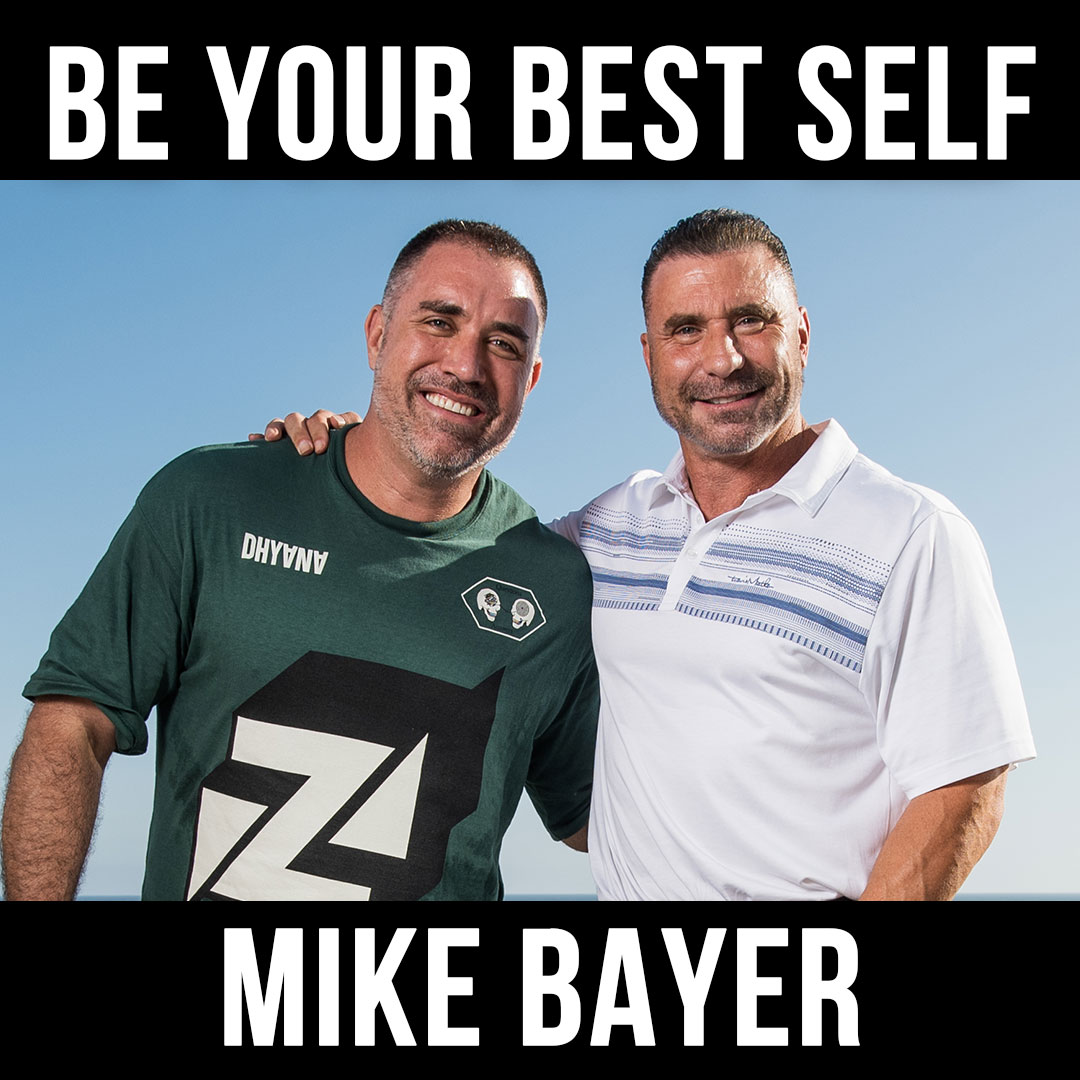
This is the environment show. Welcome back to Max Out everybody. I'm Ed Mylett and this gentleman to my left, I read his book and immediately after reading, I'm like I have to get this man on my show. Little did I know as I was chasing you to be on the show that you were a contributing person to the Doctor Phil Show at the same time, but this man's written a book that I love and I want you to get it's called Best Self.
This is Coach Mike Bear so Mike thank you for being here. Thank you Ed. Ready to max out. Ready to max out.
I want to be a better version of myself and I know everybody listening to this does too. So this book's so good. Thank you. Because there's actionable stuff on almost every single page.
That's how I tried to write my book as well. So I just want to acknowledge what a great job I think you did in this book. Why'd you write it by the way? Well I, thank you for having me here.
I wrote it because I wanted to create something that was affordable for someone who wanted to work with a life coach and wanted to have practical ways that they can improve their life and everything I kind of create can meet a person where they're at and I like to pull out their authenticity and start as that being the place we started. Because everybody you need to know something. This man's work we're not going to go through all the names but for a long time you've been working with some of the biggest names in the world in Hollywood in the entertainment business and coached them. And so for you to put the stuff in a book I really feel like people are very fortunate to get the sort of reserved for this sort of elite group theoretically of people.
And the reality is I like working with people who aren't part of the elite group a lot more. Why? Because I feel like people in day to day life don't have teams, not big teams per se. And when you're brought in to work with talent you're brought in to work with the 20 people around them.
And so it's really nice to be able to just work with someone where they don't have everyone being on payroll and everything being such a challenging. But it's rewarding, don't get me wrong. I know exactly what you mean. I don't know if you and I we've not met because we know so many of the same people and we've done similar things.
You just mind more with mainly athletes and years more with entertainers. When I started to research you, I wanted to get people hope and I want to get into some stuff. Because everybody today, if you're driving or maybe you're watching this on YouTube, this is going to be write some notes down stuff. Because the one thing I really like about Mike is all the strategies and techniques that people can apply to become their better self or their best self.
But when I was researching I was a little bit surprised. Because maybe I shouldn't know them because I think through everybody's pain or adversity everything happens for us and not to us. But if we went back when you were in college and then right after college, your life was you were not your best self. I grew up actually about five miles from here from where we are right now.
So I grew up in Nelliell Ranch and went to modern day high school and I went to play basketball. I'm already up. I'm 6'5". He's a big dude.
You got my mom. I'd say 6'6". Okay. So big dude basketball player.
Orange County. Went with the homecoming queen and just felt empty. Like the things outside of myself wasn't making me feel fulfilled. And I eventually, well I started partying and then I eventually got into crystal meth.
Have you done it? I've never done it for so much. Yeah, I know. You're not missing out.
But you're not trusting me. I mean, at first it's really great and you love cleaning your kitchen and you love it. So it doesn't actually get cleaned for me. No, no it doesn't.
It doesn't. And so you'd stay out for five days or a week or what have you and then I just looked at myself and then near it, I guess probably the 40th time and was just kind of like, I don't effing like you looking back and I don't know who you are and I was 22 years old and I'd been through some outpatients and I called my parents and just said, hey I want to go away. You know, these sayings are easy to say. Everything happens for me not to me.
My dad's drinking when I was a kid. You and I talked about that. My dad's been recovery for 30 plus years but one of the great gifts of my dad's drinking ironically was because I'd have to kind of discern which dad was walking through the front door every day. I had to assess him at four and five years old.
Is this dad that sober and kind of happy to be here? Or is it dad's been drinking for a while and he might be a little angry or tired or whatever. And it's ironic that one of the skills I use most in my life now is assessing people. Yeah, I bet you're really good with social cues and picking it up really quickly because you had to figure out how to regulate it.
And I would think when you grow up with something you're carrying where you feel different or other or whatever it is, whether it's your race, your sexual preference, your, maybe a lack of something, you don't have athleticism or you're not good at taking tests. That these things actually create parts of your personality that serve you if you'll use them eventually in your life. Don't you think if you've not grown up and not had this drug and alcohol addiction that you had or the meth addiction at least that you probably wouldn't be so great at what you're doing now? No, I wouldn't be.
There's no way. But that's for the people I've noticed that turn the corner in their life and for anyone who's listening, it's how do you turn your darkness into inspiration. So even now with like when I wrote Best Self and I was going through different struggles because I'm human, anytime I had to struggle I was like I got excited because I was like ooh I get to write about it. I get to figure out what's an exercise that can help someone shift out of that.
That's kind of how I view like whether it's universe work, God's work, whatever it is, it's kind of like whenever I experience something that's really difficult, I know that I can apply it to help someone else. It's a huge life hack, like secret. Like once you kind of start to accept like I'm supposed to get something or others are supposed to get something from this pain. This pain's supposed to produce something favorable for me or others or growth.
Like you can start to know that when it's happening. But I'm curious cause, and by the way, I just admire you so much for being able to share the vulnerabilities of your life. That's why I like you. I don't like watching people like I got it all together, I'm perfect.
Let me tell you to be perfectly. I like what you just said, I'm human. For anyone, I mean shame can ruin you. And it's whether you feel shame for who you're sexually attracted to, whether it's shame for something that happened with a family member or something that happened with just if you were abused, sexually abused, neglect, depression, whatever shame, whether you're not smart enough, being able to talk about it and communicate to people that are safe.
Sometimes it's assumed that we only should talk from mom and dad about it, but sometimes our parents aren't safe. And so it's figuring out who is safe. Is there a way to discern that? Well, I think, there's something called the social atom, which is where you create a circle and then you look at all the relationships in your life and you can just create a circle and a straight line would be anyone that you feel safe with, that you can be vulnerable with, that you feel like you could open up to.
And then you can kind of make with a squiggly line as someone where you get anxiety or it's a little bit complicated. And so I think being able to figure out who the safe relationships are to share it is the first step to shame is brutal. I mean that's one of those things that just destroys people. I think almost everybody listening to this is carrying some sort of shame.
I really do. Whether that's something they feel like a relationship they're in with and treat somebody appropriately or they let someone else down. And I completely agree with you. It's one of the things not discussed.
We talk about wanting to improve our lives or anxiety. Shame is something rarely discussed. I know I carry some. I carry shame.
That's a button from, that's a bucket. I enjoy filling sometimes with myself. If that makes any sense. Most of us have these buckets that were unconscious.
And one of the ones I like to do on me that hurts me, it's kind of repetitive is I'll fill my shame bucket. Oh yeah. You know what I mean? whether it's a conversation I had with my daughter shame myself about it, rather than just acknowledge what it is and grow from it.
And I'm really, really, really, really impressed that you're willing to share these things. I think your advice is so cogent. And I know that's why Phil probably has you on the show. I want to ask you a question.
Because I did one of your exercises. OK. I want to walk the audience. Yeah.
Let's do it. Because this book, guys, you're going to get it and you're going to love it. And you're going to love it because it's actionable. I love actionable stuff.
So there's a best self sort of, what do you call it exactly? What we're going to walk through right here? So best self is your authentic self. So best self is your truth.
Your honest truth. Like, my best self is a wizard who is a thousand years old. He's actually tattooed on me, right? So like, if you're not watching this, you have to go to YouTube.
Yeah, you have to. I mean, it's not done. This guy, Niko Hurtado did the tattoo. He takes forever to get into.
Beautiful. I've been freaking waiting forever. I mean, the guy's so hard to get into. Beautiful.
Thank you. Thank you. It's not done yet. So you've named him.
You've named him. You've named him. You've named him. You've named him.
You've named him. You've named him. My best self is Merlin. It's a wizard that's a thousand years old when I walk into a meeting.
Or when I present myself, that is maybe my best self. It's like wisdom, honesty, truth, alignment, living in the moment, kindness, love. And I think, you know, like, our parents give us names. Yes.
Right? And but we can name ourselves whatever we want at our core. And we can create, I find that being able to create that character in that story. It creates a safe place for our minds to go sit into.
Yes. And so, and it's something that a kid can do or a teenager, an adult. I want to go through your. I love it.
So I want you to walk them through it. It's a good place. I hadn't prepped it. I'm sorry.
But I'm sorry. Everything everybody can do it. This is so huge, everyone. I've been talking for 20 years about at any time in your life you can turn the page and become a new character in your life.
Right. That we repeat these old stories about ourselves. And our book of our life starts to look like one chapter that just kind of runs together. What a boring book to read.
It was just one chapter about the same character. There should be evolutions, right? And I'm always talking about change the character, change the character. And then I read your book and I'm like, this is an actual technique to name and change the character that is you.
Right. And identify it. So guys, this is so awesome the way you do this. So the first step is to do what?
The first step is to write out a description. OK. So how do we do that? You write out, you can look at times in your life when you felt like, wow, this is life.
Or you know that's the best part of yourself. It's not outcome driven. Yes. Sometimes you get stuck on outcomes.
Yes. And as you talk about, sometimes the outcomes happen 60 or 90 days down the road. Or two years down the road. So it can't just be, oh, that outcome.
It's when you feel good about yourself. It's sort of like adjectives to describe the best you. You got it. Adjectives to describe the best you.
What did you write down? Well, I wrote a few down. And I did this alone. Yeah.
And I never even mean. I coached people a lot. I never just take the time. What is the best adjectives to describe me when I'm the best me?
Right. So I put peaceful, kind, patient, confident, prayerful, strong, decisive, relentless, nonjudgmental, encouraging. I wrote leader. I wrote listener.
Or listening, focused, present in the moment. And funny. Those were the best things I like about me when I'm the good me. Got it.
And so then you took that description. And you felt pretty good about this. This feels like you're in alignment. I love when I'm that guy.
Yeah, that's you. Yeah, you're core. That's you. Right.
Yes. And so then you drew it. I drew it. And it's just what it is.
You said whoever it is. So you told me it could be whatever it is. It's kind of a Superman. Cool.
And I'm, you know, I even have my family have told me that I'm like a Superman when I'm the best version. And I, you also wanted me to name it. Name it. Name it.
And it's Superman. That looks amazing. That's my guy. By the way, that's as good as I can draw.
So that's the real means of Superman. Yeah. And he's all these things. And I would encourage every single person listening to this or watching this to do exactly this exercise.
And we're not done yet either, everybody. But take an inventory. What are the adjectives that describe the best you? And then you want them to draw a picture of it?
You name it. Because it's a great way to go. Am I walking into the room as Superman? Yeah.
Am I talking to my kid as Superman? Am I handling my relationship as Superman? Or Merlin. Or Merlin.
Right. And so that's really understanding authentically who you are. And that's how we kind of start off best self the book. It's figuring out who are you.
And let's name it. And so that's our starting point of compass. So the next part of the exercise is to figure out what is currently pressing into ourselves or on psyche that we know is not authentically who we are. So it's that part of us that goes, I shouldn't have said that.
I don't know why I feel this way. Oh, why am I being myself up? What am I saying to myself? It's like the committee in the head that we can't shut off.
Well, what does it say? And again, we want to write down the adjectives of what we call your anti-self. And so you did that, Ed. My anti-self is, you know, it was kind of cool.
I noticed something. And maybe I, do you find most people have an easier time writing down the good or the bad? Bad. I would assume that too.
One thing I kind of liked is you loved it. I had an easier time writing down the good things. That's great. That's shown the work I've done on myself.
So I would assume it's 80, 20, 90, 10. People are like, I can name it 80. You know, people normally don't have this long of a list, although I think this is incredibly healthy. They have a long list as being your best.
Yeah, I would think everybody writing this. The vast majority of you are probably going to have a really easy list of the negative things. And I think the more that you repeat, you utilize this exercise and the techniques that I teach. And that might teach you.
I bet you over the long term, you're going to have an easier time writing the good ones. Yeah. And I think that's when you know you're being that best self more often. You got it.
Because I live, I think I live, I'm definitely this guy a lot. But I think I live with that guy. Well, we love Superman. Okay.
I mean, super man. Yeah, this guy here is about the descriptions of your anti self judgmental. Okay. Impatient, scared, angry, indecisive, anxious, gossip or distant, serious, complainer, self centered.
And now that I'm name it, I'm like a name some more actually. But those are all the anti-me. Yeah. And you drew the same exercise.
I drew him. And he's a guy with an under me news bad language everybody, but he's a guy with a big old head and a hat with two phallic symbols coming out of the side of them. Yeah. Is that a penis coming out?
It is. There's two of them on his part. Yeah. And his name is actually Richard Kebesa, which is dick and in Spanish, Kebesa is head.
So I'm going to get the name. But we call him Richard Kebesa. Got it. No, this is great.
So we have a super man. We have super man. We have a super man. Yeah.
Richard Kebesa. Okay, great. And this is fantastic. And so what we start off in best self as we go.
Okay, who's your best self? And who do we know is going to get in the way of you even finishing the book? Who's going to get in and be like, oh, this is a bunch of BS and I don't have time for that and I'm good. And so we help identify those parts so that we can navigate the book.
And so what I find helpful once people do this is to figure out, okay, how do I get more of him? Yeah. And what situation currently is bringing out the most of him? So for you, Ed, what would you say, currently Richard Kebesa, when, what situation do you feel like currently where you go, oh, this comes out?
Anything that feels stressful to me, Richard Kebesa likes to rear his head, no pun intended, anything stressful. So I think that the most specific would be if I'm going to, if I'm prepping for or driving to something I think I'm not prepared for, that guy comes out. That guy is super judgmental. He likes the gossip.
He can get pretty anxious and scared and fearful. He doesn't pray. He isn't present. I'm always projecting.
That guy likes to project into the future all the time what he should be worrying about. Right. So he can't be in the moment. Not in the moment.
Okay. If I could identify one thing that causes most of those other adjectives to happen is pressure or stress and I'm not present. Got it. So because when Superman comes flying through in those situations, you feel, I feel incredible.
I feel strong. I feel peaceful. I feel like a leader. I feel like I'm doing what I called to do.
Right. You know what I was born to do? And I feel loving in that space. Yeah.
Yeah. That's a word that should have been in there. Loving. Yeah.
And so, so in best self what we do is then what we take you through what's called the seven spheres, which is an acronym I created, which someone rates their social life, social life, personal, health, education, relationships, employment and spiritual. And they line, you just rate it from a one to ten and it's full of exercises and you go, in all these areas of my life, how often do I feel like I'm being my best self? Because usually what happens for us is once we put down on paper and walk through it, we can have a roadmap. Yes.
And it doesn't become just theory. Yes. And so, can I give you an example of how powerful it is? Everybody's listening.
It's like, that's pretty basic. Everyone, y'all trust me, do it. Just go through the exercise. Even Richard Cabason, I almost laugh at that guy now.
That's why I gave him the name I gave him. He's hilarious to me. And I don't want him in my life. He's like a joke.
Right. And so in my case, I want to, if I'm going to have shame, I'm going to shame that dude outside of me. I'm going to tell you though, last night, I did this last night and I had fallen asleep. Perfect little example.
And you stack these things over life. So you gave my family a gift last night unknowingly. Okay. And so what I did was I had fallen asleep and actually posted it.
My lily was sleeping next to me. I was extremely tired. And I, every night going to kiss my daughter good night and say a quick prayer. And last night I was laying in bed and I was tired and I knew the lights were off in her room and I woke up tired and I went, I'll just do it tomorrow night.
Right. And immediately I thought about what would Superman do. Superman would get up and go in. Even if she's asleep and I'd kiss her and I'd pray with her even if she was asleep.
I didn't want to get up. I was tired. And Richard Kebesa was taking over. Yeah.
And I literally thought about Superman and Richard Kebesa and I chose to be Superman and I got up and I walked in and she was actually awake. Right. And I said, hey Boo, I love you. I gave her a kiss and she gave me a hug and we said a quick prayer.
And actually she had something she wanted to ask me and had I knock on in there she would never be able to ask me that question. And so that if this did nothing other than that one thing the rest of my life it was worth it. But I can already tell even today prepping for our interview and getting no better. I'm like I think I'm ready.
What would Superman do? Superman would go another little lecture in here. So probably it would be more relentless, more prepared, right? More present.
And so it's an effect even how we're doing this today. Yeah and you're welcome. No I'm grateful that you did this. It means a lot because you took it on your own initiative.
I didn't ask you. And you clearly dig in when you have people come on your show. And the thing about Richard Kebesa is when you, the interesting thing with the ego that I found is when you build out the character, if you say to someone, okay just don't be so angry. Ed, you don't like let's your wife say it.
Ed don't be so angry. She calls you Richard Kebesa. You may have a slit second of like and then you'll start to laugh. It's awesome.
And it's not that serious because you don't want to feel that way. It's awesome. And you get to get called out on your stuff in a way that's playful and not, what a great exercise to do when it works. Yes.
Where your coworkers are like, hey Richard Kebesa cut it out. That's awesome. I love that. So you can do that in your family and your family and your friends.
Yeah and you can do it with your kids and it becomes revealing of how they view themselves. Yeah. So good. So good.
Thank you for that. Yeah of course. I do. I gotta be honest with you.
I love simple actionable things that the audience can take with them and do. And guys you'll be different after you do this. And you're family will be different if you do it together. What a great gift man.
Thank you so much. I got so many things I want to ask you about. I want to get the books. I don't want to do anything more that's in the book.
But I do want to ask you about one thing just because it was important to me. Yeah. And so again the last thing in the book because everybody want you to get the book. I want you to get the audio version of the book too.
However, you talk about, I just want them to hear this because everyone listening wants to change something about their life and you have the five tenets of change. And I'll name them and you give me a little bit of fort. Okay. Curiosity is a ten of change.
Honesty, openness, willingness and focus. Right. Just give us a little flavor behind. Yeah so I love acronyms so I call it chow-f.
Sounds like a Chinese restaurant. Okay. Okay. It's just a massive amount of change.
I don't want to change anything in our lives. It's become curious to some extent. And I find curiosity feels good. You know when we're curious there's this energy to it.
We're not just going ugh. You're right. Right. I feel like research.
I think the reason that people kind of dig my show is I'm so hyper curious about the people that are on the show. I love them and I'm curious about them. So completely groovy. Yeah.
And then honesty is just a pillar of, can't be honest with yourself, your compass is all over the place. And then openness to other ideas, other suggestions, other solutions, willingness. What length are you willing to go to to make the change. What are you willing to do and then the focus really just focusing on the change.
Very good. Those are kind of what I call the five-tenths of change. I love it. When I was reading the book, I put everything through sort of like my life experience meter.
Like do I believe this? Right. How important is curiosity? Right.
You know that was kind of unique. I thought what a powerful mind opening word. Honesty was pretty obvious to me. Yeah.
Openness, willingness and I know about focus. I know you do. I think one of the, I maybe you agree with me on this. And I think one of the lost arts in the world, our peoples ability with all the distractions, the smart phones with TV with how quick things happen in life is to stay focused on something until the task is completed.
Until you've achieved. Do you see that too with the people you coach? They're the Omega achievers. I think one of their separators is their ability to focus.
Yeah. I think it's what people focus on whether they prioritize, where they put their energy. I even think like focusing on, I've started at least with social media. It's like what information do I want to put into my system?
Yeah. You know, yep. Anything that's going to give me anxiety. That's not keeping me safe.
I don't know why I would follow it. Very good. Right? Yeah.
It doesn't feel good. So I mean, I think in terms of focus, it's just what do I want more of in my life and what do I want a little less of? What a great distinction. I'm doing it on TV, politics.
Oh yeah. No matter what side you're on, and it just for me, it's like I just realized watching this, no matter what, I don't get into my political beliefs on the show. I don't even know that I'm that strong in any one place on that stuff. However, just watching the coverage and watching the people, it's like a live reality show all the time.
And as I was watching, I said, I can just ask myself, is this giving me joy? Right. Is this growing me? Is this giving me peace?
Yeah. To give me the things that Superman would want? Right. It's contributing to Richard Cabasa.
It's living in the news. Yes. Isn't it true? And for many of you, Richard Cabasa is exactly what you said.
It's the stuff that's giving you anxiety and stress and worry on your social media. Yeah. You're so good, brother. So good.
You strike me as a guy because of overcoming, you make light of it, but you're okay with methadiction. I mean, here's a guy who, everybody, he's has so much humility, but this is a guy who now, there's one person in really 17 years who's Dr. Phil's trusted with that seat to help be on the show on a relatively regular basis. The guy who that is was at one point at 22 years old calling his parents saying, I'm methadicted, get me into rehab.
Right. So, what you've turned yourself into. You've also founded these cast centers. Cast centers.
Tell them a little bit about the cast centers and what you do with that. Yeah. Everybody kind of the full rounded version of what you do. Yeah.
I kind of cover a totem pole in my career. So when I say totem pole at the bottom, it's like psychiatric disorders, chemical dependency, need a lot of support and structure. So I started treatment center. The first group I had in my apartment in Venice, because I know how the heck I was going to afford to have an office or anything.
And it's expanded quite a bit. And now it's an outpatient clinic with, we treat straight depression or straight anxiety, diagnosis, which means chemical dependency, alcoholism with another diagnoses. Yeah. So we have evening programs, day programs, and that's in West Hollywood.
And now with insurance, it's great. They cover. Thank God. Most insurance is covered treatment, which is awesome.
The topic that's come up a lot is mental health. Yeah. More and more on my show and in social media, people are asking me to discuss it more, I'm going to cover it more. I'm a believer that mental health is a huge spectrum.
It's a broad topic. It could be everything from suffering from some anxiety. That's what I'm saying. We're telling them up here.
Yeah. Yeah. I'm achieving. Yeah.
It's strange. The problem I feel like, is everyone pulls them off instead of, like, you're saying, we all have mental health. Right. There's just different levels of financial health.
Right. There's different levels of it. There's physical health. Yeah.
One of the things about mental health that you and I were talking about off camera, too, is that you all should be working towards being healthier mentally, emotionally. Like, even if you're a really well adjusted person, I feel like I'm a pretty well adjusted person. I'm still reading and seeking mentors and relationships, associations, experiences that improve that part of my life. My physical body, I'm trying to improve, I want to improve my emotional and mental well-being as well.
No matter what level you're, I think some people think, well, the mental health stuff's like for where people are like manic depressive or schizophrenic, or they're suicidal, that's one part of the spectrum. There's all kinds of other. So here you can have a more poor mental health day than somebody who's three days sober. What do you do for?
I'm in theory. No, I haven't had one in a while, but. No, I have. I agree with you.
I think you're completely right. I have one of the great things about people that are in recovery is the, what I would call almost forced self-awareness that begins to take place. The revelations and learning about oneself is one of the great gifts of recovery that sometimes people who don't need to go into recovery never get that gift of. It's just self-reflection, right?
Can you share with us maybe some habits that you do daily or routines that contribute to your wellness mentally? Yeah, I mean, it's rituals. I love a structure. So like, you know, I think for me, even before here, I go to your bathroom, it's like looking in the mirror and I go to just be yourself.
I listen to music, but when I roll down here, that made me feel like I could get outside of myself so I could actually be a vehicle for stuff. So like, there's the simple things like that. And then there's, can you go back to that thing in the mirror because I heard you talk about this before and it's powerful. You talk about what you actually do when you do that.
Yeah, it's changed a lot. Okay. But I feel like so often in the mirror, we just look at our aesthetic. It's like, and not to be dramatic, but it's kind of it.
It's like when you really look into who you are as a man or a woman, what do you say to yourself or what does it say back to you? And so I like to go to a mirror and I often will drop to my knees in the bathroom real quick in front of the mirror. Like, you know, I try to make sure no one's watching me. You know?
And then I pop up and I'll look at myself in the mirror and I'll just be like, you know, you got this or be yourself or just, you know, be my own coach because we're all human. We navigate life and I say I dropped to my knees for humility. Just be like, I don't have all the answers, okay. Hop up, look at myself, say something.
And that's something I do before I go into do anything publicly or anything where I feel like there's pressure or anytime I feel like I may not be myself. You know? Yes, I do know. Because I want to be that.
I want to be Superman. I want to be Merlin. Like, I don't want it. I know for my own life, good comes when I am myself.
And I hear you talk about that in your podcast and on your show. And so, you know, look, there's the basics of gratitude lists, you know, which they work. Yes, they do. And I always will call people to ask it.
If I'm ever feeling completely obsessed with myself, which we all do, because you get what you put out, right? And so when we're self-obsessed, it's hard to get out of it because we're just obsessed with ourselves. And so what I'll do is I'll consciously call people and purely ask them how they're doing and not tell them how I'm doing. And I'll do that just to get out of myself.
You know, and I feel like that's why I chose this profession too, is I get selfishly, I don't even know if I can catch up. You can fucking love helping people because I in return feel the spiritual connection to life. You too, right? And so it feels good to do that.
So I mean, I want to acknowledge a couple things because it's just ironic. The reason I want you to tell that story was not anybody else ever share that. So I don't do it in a mirror. But before, and at first it sounds like in George Michael moment and it's not.
No, I actually, I mean, it's made to somebody who's never done it before. But what it is is, no, no, I know exactly what you mean. And you can get away from saying that probably a little bit of a bit of an eye can. Having said that though, I don't feel that way.
I, before every show, every speech, every significant encounter I have, I hit my knees as well and say a prayer. And it's, I asked, you know, for God to support me in that meeting and be my best self. Actually, I don't know that I use that exactly where, but that's the thought. And every night when I pray, people ask me, how do you physically pray?
I pray on my knees. And it's just a reason that it humbles me, it gives me a version of humility. So I, grounding, grounding, literal grounding. So I just want to second that, because there's so many things we're covering people.
That's a big deal for me. The other thing that you do about calling people, we do it a little bit differently, but calling people and checking on how they're doing. I do that. But what I love to do, everyone, I'll give you anything that's weird, but when I'm in a public place, I will find people regularly.
About every time I'm out in public, I'm in a gym, I'm in a restaurant, I'm in a grocery store, I just randomly pray for somebody. Just peace me with you or God bless them. And I just pray, I get out of myself and pray for the person. For some reason that gives me comfort, gives me strength, gives me humility.
And I don't know why there's this as part of me that I just feel better when I'm helping someone, somehow. Oh yeah. So that's my version. Oh man, if sometimes I'll go with friends, I'll be like, let's just give compliments.
It's so funny. I'm term 40 next month. I love stuff like this. You go to a grocery store and you literally are just dishing out compliments.
You know, we'll make a little competition where we're laughing. But people love it. People love anonymous compliments. I feel so good to give.
It's so fun. I have an audio on that. Where I talk about, if you want to change your state, start complimenting other people. First, it forces you to become a habitual observer of people's blessings and giftedness.
And then it feels so good to give them that gift. And it's something that you may be the only person that year who will give them a sincere compliment about something. You could completely, you could, what a great look and tie. You know, the guy ends up going home and I feel better about himself and he's nicer to his children that night.
It's just the ripple effects of these things. These are life hacks that matter. So thank you for giving me. And I think that's why it's for guys like us, it's not that fun to watch the news or watch politics.
Because you don't see people lighting up other people's candles or their lights. You just see them blow it out. And so I think you have to create that environment like you're talking about where you're constantly in that flow. Yeah, I totally agree with you.
So good. OK. We're flying through this, fortunately, because I'm loving this. But I want to ask you, so everyone wants to change something in their life.
The baseline question. Someone listening to this, say, gosh, I got these two guys there today. And you better ask them this. What advice would you give somebody who just wants to create a change?
It could be anything from I've got an addiction and I want to fix that in me. All right. I've got a job and I'd love to start my own business. I weigh 50 more pounds than I want to.
I want to transform something about myself. Can you give us some thoughts or actual steps? Yeah. Well, I think two things, which you know better than I do about setting a goal.
And if you don't have a goal, they can't really achieve anything. So setting a goal, an intention, and a goal of what you want. What is it? And by when?
And having it be measurable and practical. And so one is a goal. And then the other that I think, well, a few other things, I think having accountability, figuring out who can help keep you accountable, if there's anyone in your life. Is it possible?
Even if it's Mom or Dad's just checking out. Mom, I want you to call me twice a week. And ask me, are you making that 6 a.m. class?
Or whatever it is. And then the other that I found more recently, and I've gained so much benefit of it from Dr. Phil, is how coachable are you with your change? A lot of people don't know what the answer is.
I found. But their own ego gets in the way of being coachable. And a lot of people actually aren't coachable who think they're coachable. Agree with you.
Right? Yes. And so to me, in terms of change, you're going to do it alone if you're not coachable. Like, it's really good.
It's really true. Because if someone has figured it out, and they're trying to mentor or lean in, and so many people I find want to give solutions. Because it feels good to help. Yeah, I agree with that.
And so it's just keeping that in mind when you ask, most people, no matter how successful they are, they'll give you advice. I agree with that. Speaking of successful people, a couple more things. Do you work with some of the most successful people in the world?
I bet most people would be curious. Are they happier than a person who's not quite as successful? Well, I mean, by and large, did this success, this achievement, give them, if we're being really honest, did it give them more joy, happiness? Well, I mean, you could ask yourself.
Like, you've had a lot of success at different times. You feel like that. I love how you do that. I love how you do that.
I love that way you're a good coach. No, I mean, it's real, though, because I mean, you're a product of. Yeah, I think I'm always asking people that question that are sort of in this space, too. I think that, well, I don't think material things long-term give you lasting happiness.
No. Right. I don't. However, it's a lie to say the material things don't bring you some happiness.
Right. You have a nice pair of shoes or a new car. You feel happy temporarily. I love your shoes.
Thank you. But you're really looking for long-term is fulfillment. Yeah. And those are two different things.
And I think fulfillment is typically comes through a couple of different sources. One is always in the service of other people. And I think it's identifying what your passions and giftedness and blessings are and using them in your life in the service of other people. Like, you can start to figure out, you know, I'm kind of good at this.
Or I enjoy that. Or I'm passionate about this. You identify those gifts and blessings. And then you utilize those things in the contribution to other people.
That's how you become fulfilled in my mind. So I have friends that are school teachers that don't have a jet and don't live oceanfront. They're incredibly fulfilled people. Because their model of life isn't anything to be looking at the ocean.
I have other friends that have that sense of achievement and growing and pushing past barriers and achieving all these goals. That's what gives me fulfillment. So I think everyone's blueprints a little bit different on it. But I'm curious of the people that you've coached.
Do you know what I think it would be? What depends if they have worked with a lot of people, you know, pretty chronic depression. Yes. And those people struggle differently than someone that doesn't have it.
But by and large, I feel like it matters. What matters is how connected to a community and safe relationships and friendships and love that the person has is an indicator. I think sometimes people struggle quite a bit when they're super famous. Because the story they tell themselves is they can't trust people.
Or which there are some realities to it. But I think it's about how safe somebody feels in their connection of love. Yes. The reason I believe that.
The reason I asked you was, my observation is the more and more someone achieves a celebrity status, the more and more it's important to have somebody in your life constantly having them come back to learning about themselves. That they lose themselves in the pursuit of celebrity. And they almost become this person they think everybody wants them to be. And I don't know that that's just for people to become famous.
But it's my observation of the people that I've worked with closely that have become very well known is there's a propensity to possibly lose sense of self. Yeah. And there's something about it hanging out with friends playing a game and just connecting with other humans and feeling love when that starts to get stripped away and becomes isolating. I think for anyone it becomes, or when you're connected with people, no one's better or worse than anyone.
But if you're in an environment where you hold power or perception that you're better, I think that can also be really isolating. So I don't know if there's a difference. I don't think there is. But I think the sense of self needs to be protected.
I realize I'm saying this to everybody. It's forget celebrity. As you're achieving things, as you're moving up the ladder towards your goals, make sure that you're constantly giving yourself gratitude, giving yourself rituals and habits that connect you back to yourself, whether that is hitting your knees on a regular basis, or a gratitude exercise, praying for somebody, or calling other people, and always make sure that you're connecting with yourself, that you don't lose yourself in the pursuit of stuff. Correct.