Beating the Cold-Start Problem: A Platinum Breakthrough You Didn’t See Coming ❄️➡️🔥 episode artwork

EPISODE · Apr 1, 2026 · 20 MIN

Beating the Cold-Start Problem: A Platinum Breakthrough You Didn’t See Coming ❄️➡️🔥

from The Deep Dive Lab: Unraveling Materials Science · host Son Hoang

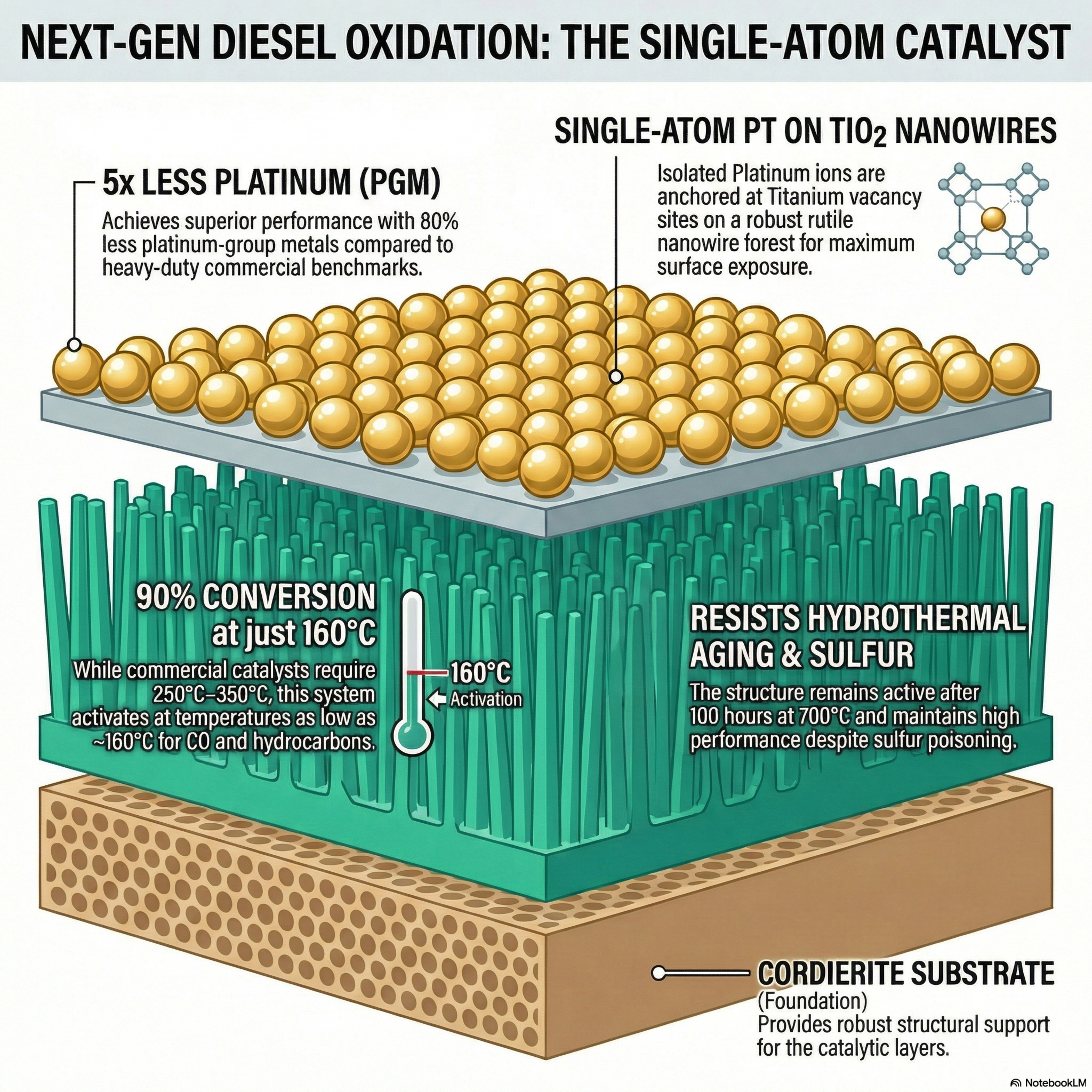
For decades, one stubborn problem has haunted engine technology: the cold-start gap—a critical window where harmful emissions escape before catalysts even “wake up.”Now, a radical innovation is changing everything.Imagine a “forest” of titanium nanowires, where single platinum atoms are individually anchored like microscopic guardians—each one actively neutralizing toxic gases at temperatures as low as 150–160°C.This isn’t just an upgrade. It’s a paradigm shift:🔬 80% less platinum, but higher efficiency⚡ Early activation that beats the 200°C barrier🧱 A structure so stable it survives extreme heat and vibration🧪 Even sulfur—once a catalyst killer—can’t stop itCould this be the final piece that allows combustion engines to reach near-zero emissions?Or are we witnessing the beginning of a new era where atomic-scale engineering reshapes clean energy forever?🎙️ Tune in as we break down the science behind one of the most exciting breakthroughs in emissions technology.#SingleAtomCatalyst #CleanAirTech #Nanotechnology #PlatinumRevolution #FutureOfMobility #DeepDiveLab #BocTachKhoaHoc #DaoSauNghienCuuLow-temperature diesel oxidation catalysts using TiO₂ nanowire arrays integrated on a monolithic substrate — US Patent 12,161,996Activating low-temperature diesel oxidation by single-atom Pt on TiO₂ nanowire array — Nature Communications, Volume 11, Article 1062 (2020)

For decades, one stubborn problem has haunted engine technology: the cold-start gap—a critical window where harmful emissions escape before catalysts even “wake up.”Now, a radical innovation is changing everything.Imagine a “forest” of titanium nanowires, where single platinum atoms are individually anchored like microscopic guardians—each one actively neutralizing toxic gases at temperatures as low as 150–160°C.This isn’t just an upgrade. It’s a paradigm shift:🔬 80% less platinum, but higher efficiency⚡ Early activation that beats the 200°C barrier🧱 A structure so stable it survives extreme heat and vibration🧪 Even sulfur—once a catalyst killer—can’t stop itCould this be the final piece that allows combustion engines to reach near-zero emissions?Or are we witnessing the beginning of a new era where atomic-scale engineering reshapes clean energy forever?🎙️ Tune in as we break down the science behind one of the most exciting breakthroughs in emissions technology.#SingleAtomCatalyst #CleanAirTech #Nanotechnology #PlatinumRevolution #FutureOfMobility #DeepDiveLab #BocTachKhoaHoc #DaoSauNghienCuuLow-temperature diesel oxidation catalysts using TiO₂ nanowire arrays integrated on a monolithic substrate — US Patent 12,161,996Activating low-temperature diesel oxidation by single-atom Pt on TiO₂ nanowire array — Nature Communications, Volume 11, Article 1062 (2020)

NOW PLAYING

Beating the Cold-Start Problem: A Platinum Breakthrough You Didn’t See Coming ❄️➡️🔥

0:00 20:03

No transcript for this episode yet

We transcribe on demand. Request one and we'll notify you when it's ready — usually under 10 minutes.

No similar episodes found.

No similar podcasts found.

Frequently Asked Questions

How long is this episode of The Deep Dive Lab: Unraveling Materials Science?

This episode is 20 minutes long.

When was this The Deep Dive Lab: Unraveling Materials Science episode published?

This episode was published on April 1, 2026.

What is this episode about?

For decades, one stubborn problem has haunted engine technology: the cold-start gap—a critical window where harmful emissions escape before catalysts even “wake up.”Now, a radical innovation is changing everything.Imagine a “forest” of titanium...

Can I download this The Deep Dive Lab: Unraveling Materials Science episode?

Yes, you can download this episode by clicking the download button on the episode player, or subscribe to the podcast in your preferred podcast app for automatic downloads.
URL copied to clipboard!