
EPISODE · Jan 15, 2026 · 28 MIN
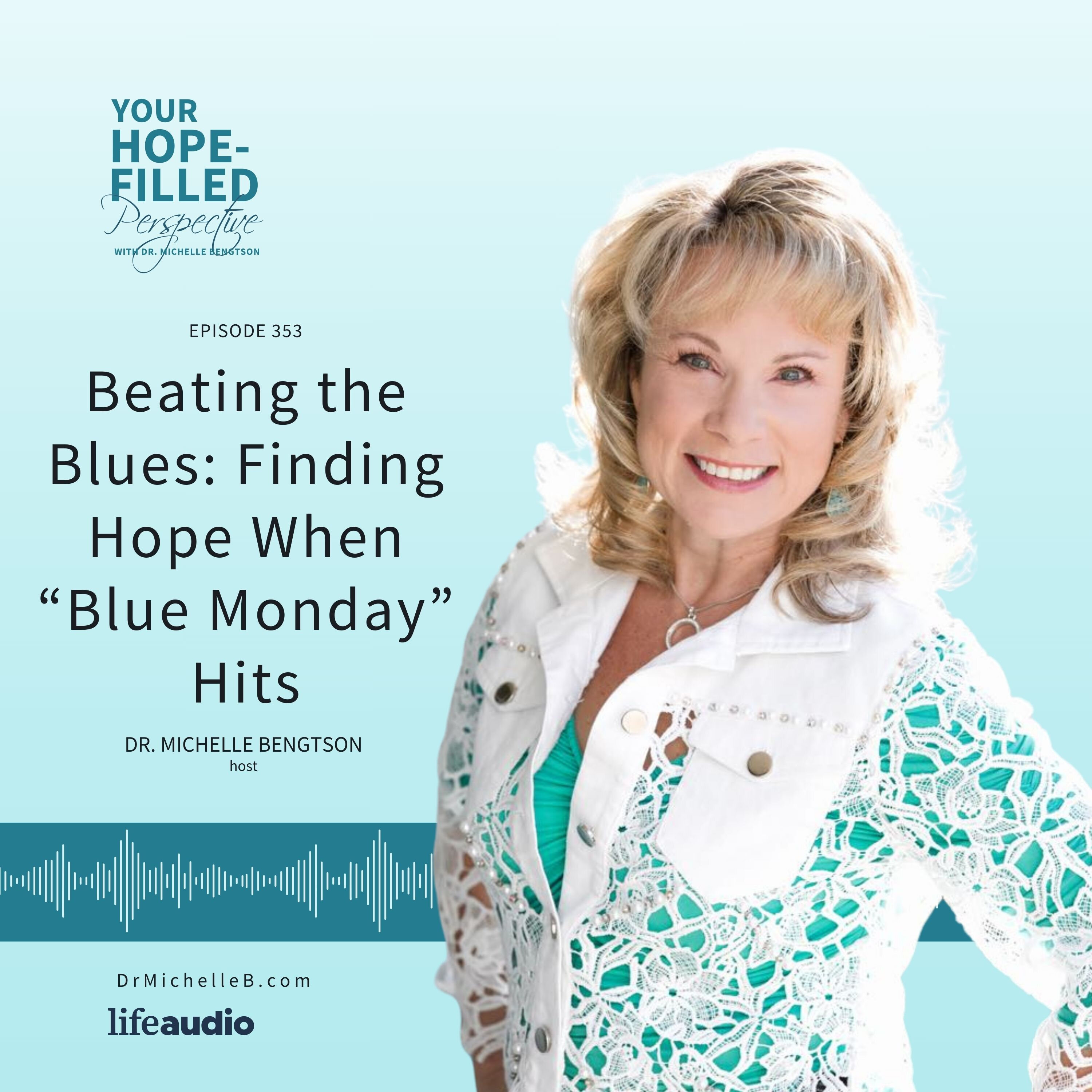
Beating the Winter Blues: Finding Hope When “Blue Monday” Hits
from Your Hope-Filled Perspective with Dr. Michelle Bengtson podcast · host Dr. Michelle Bengtson
Episode Summary: Today we’re tackling a topic that hits many people hard each January: “Blue Monday.” You may have heard it called “the most depressing day of the year”: a day when motivation runs low, bills come due, and the sparkle of the holidays fades into the grayness of winter. But is “Blue Monday” real? Why do so many people feel down this time of year? And what can you do, spiritually, emotionally, and physically, to climb out of the slump and find renewed hope? If you’ve ever felt like the light of Christmas faded too fast or that you’re struggling to find joy in January, this episode is for you. In this episode, I share How to Beat the Blues: Finding Hope When “Blue Monday” Hits. We unpack where the idea of “Blue Monday” came from, what really contributes to winter sadness, how to recognize when it’s more than just a passing mood, and how God invites us to nurture our mind and soul even in the darkest season. Quotables from the episode: Every January, the search engines light up with people looking for answers about “Blue Monday.” Some call it the most depressing day of the year. But here’s the truth: God doesn’t mark any day on His calendar as hopeless. Even when science can explain some of the factors that make us feel low, Scripture reminds us in John 1:5 that “the Light shines in the darkness, and the darkness has not overcome it.” So today, let’s uncover both the science and the Savior’s invitation to find peace, joy, and renewed perspective, no matter what your calendar says. Part 1: Where “Blue Monday” Came From The term “Blue Monday” actually originated not from a psychologist or neuroscientist, but from a marketing campaign in the early 2000s. A British travel company wanted to boost winter vacation sales and partnered with a psychologist to create a formula that supposedly calculated the “most depressing day of the year.” They based it on factors like weather, debt level, time since Christmas, failed New Year’s resolutions, and low motivation. The date usually lands on the third Monday in January. But here’s what’s interesting: the science behind it was never validated. It was largely pseudoscience; a catchy idea meant to sell trips to sunny places! Yet it resonated with people because, truthfully, many do feel a dip in mood this time of year. Why? There’s a real physiological and psychological basis for that. Shorter daylight hours disrupt our circadian rhythm and lower serotonin levels—our brain’s natural mood stabilizer. Colder temperatures mean less outdoor activity and fewer endorphins. Holiday aftermath leaves us financially stretched and emotionally fatigued. Unmet resolutions of ourselves or others stir up shame or disappointment. So while “Blue Monday” may not be an official scientific day, it does point to something many experience: what we might call the post-holiday blues or seasonal affective slump. Part 2: How to Identify It Let’s talk about how you can tell if what you’re feeling is just a short-term dip or something more concerning. Here are some common symptoms of the “Blue Monday” slump: Low motivation or energy Irritability or tearfulness Difficulty concentrating Changes in sleep or appetite Feeling disconnected or unproductive Hopeless thoughts like “What’s the point?” If you’ve noticed these for a few days after the holidays, you’re not alone. Our brains and bodies crave rhythm and light—and winter often disrupts both. But sometimes, what starts as a temporary funk can evolve into something more serious like Seasonal Affective Disorder (SAD) or Major Depression. Part 3: When to Seek Professional Help Seek professional help if: Your sadness lasts more than two weeks. You lose interest in things you usually enjoy. Your sleep or appetite drastically change. You feel worthless, helpless, or hopeless. You find yourself withdrawing from others. You experience thoughts of death or suicide. Those are not signs of weakness—they’re signals from your body and brain that you need care and support. Just as you’d seek medical help for persistent pain, it’s wise to seek mental health help for persistent sadness. As a neuropsychologist, I’ve seen firsthand that depression and anxiety are treatable. There are excellent therapies, medical interventions, and lifestyle approaches that can help. But the first step is reaching out. And as a believer, I want you to know this: needing help does not make you a failure of faith. God often works through professionals to bring healing. He created our minds and bodies with complexity, and He delights when we care for them wisely. Remember Elijah in 1 Kings 19? He was exhausted, afraid, and said, “It is enough; now, Lord, take my life.” God didn’t rebuke him. God fed him, let him rest, and then gently spoke truth to him. That’s a model of divine compassion toward our emotional distress. Part 4: How to Take Care of Yourself If you’re feeling those “Blue Monday” blues—or a longer winter sadness—here are practical, biblically grounded ways to care for your mind, body, and spirit. 1. Get More Light Exposure to sunlight—or a light therapy box—can boost serotonin and regulate your circadian rhythm. Genesis 1:3 says, “And God said, ‘Let there be light,’ and there was light.” Light was His first gift to creation, and it still brings life today. 2. Move Your Body Exercise increases endorphins and dopamine, improving both energy and outlook. You don’t need to run a marathon—start with a short walk or stretch. 1 Corinthians 6:19–20 reminds us our bodies are temples of the Holy Spirit. Caring for them is an act of worship. 3. Nurture Connection When we isolate, sadness grows louder. Reach out to a friend, attend a Bible study, or volunteer. Ecclesiastes 4:9–10 says, “Two are better than one… if either of them falls down, one can help the other up. 4. Adjust Your Expectations After the holidays, it’s easy to compare today’s ordinary moments to the excitement of December. Give yourself permission to slow down, to reset. The Bible gives us multiple examples of Jesus, the Son of God, taking time to rest. If He needed rest, why would we expect differently of ourselves? Matthew 11:28—“Come to Me, all you who are weary and burdened, and I will give you rest.”* 5. Feed Your Spirit Immerse yourself in Scripture, prayer, and worship music. Depression dims perspective, but God’s Word renews it. Psalm 42:11 “Why, my soul, are you downcast? Put your hope in God, for I will yet praise Him.” 6. Practice Gratitude Gratitude activates brain regions associated with joy and resilience. Even small blessings count—warm coffee, a friend’s text, a sunset. 1 Thessalonians 5:18 “Give thanks in all circumstances; for this is God’s will for you in Christ Jesus.” 7. Set Rhythms of Rest Winter is nature’s reminder to rest. God Himself modeled rest on the seventh day—not from exhaustion, but completion. Rest refuels your mind and aligns your soul with His peace. Part 5: Reframing the Season Maybe this January feels heavy. Maybe you’re tired of gray skies or unmet resolutions. But let’s reframe it: What if winter isn’t a punishment, but an invitation? An invitation to slow down. To nurture your inner life. To rediscover hope not in circumstances, but in Christ Himself. Remember: no day is truly “blue” when it’s covered by God’s grace. He specializes in turning mourning into dancing, ashes into beauty, and despair into praise (Isaiah 61:3). The same God who paints the sunrise after the darkest night will bring light to your soul again. Friend, if you’re listening today and feeling the weight of winter, know this: you are not alone. God sees you. He is not disappointed by your sadness; He is near to the brokenhearted (Psalm 34:18). There’s no shame in reaching for help—from Him, from loved ones, or from professionals. Healing doesn’t mean pretending everything is fine; it means letting God meet you in the reality of your pain. Scripture References: John 1:5 “the Light shines in the darkness, and the darkness has not overcome it.” 1 Kings 19 “It is enough; now, Lord, take my life.” Genesis 1:3 says, “And God said, ‘Let there be light,’ and there was light.” 1 Corinthians 6:19–20 “Do you not know that your bodies are temples of the Holy Spirit, who is in you, whom you have received from God? You are not your own; you were bought at a price. Therefore honor God with your bodies.” Ecclesiastes 4:9–10, “Two are better than one… if either of them falls down, one can help the other up.” Matthew 11:28 “Come to Me, all you who are weary and burdened, and I will give you rest.” Psalm 42:11 “Why, my soul, are you downcast? Put your hope in God, for I will yet praise Him.” 1 Thessalonians 5:18 “Give thanks in all circumstances; for this is God’s will for you in Christ Jesus.” Isaiah 61:3 “and provide for those who grieve in Zion—to bestow on them a crown of beauty instead of ashes, the oil of joy instead of mourning, and a garment of praise instead of a spirit of despair. They will be called oaks of righteousness, a planting of the Lord for the display of his splendor.” Psalm 34:18 “The Lord is close to the brokenhearted and saves those who are crushed in spirit.” Recommended Resources: Sacred Scars: Resting in God’s Promise That Your Past Is Not Wasted by Dr. Michelle Bengtson The Hem of His Garment: Reaching Out To God When Pain Overwhelms by Dr. Michelle Bengtson, winner AWSA 2024 Golden Scroll Christian Living Book of the Year and the 2024 Christian Literary Awards Reader’s Choice Award in the Christian Living and Non-Fiction categories YouVersion 5-Day Devotional Reaching Out To God When Pain Overwhelms Today is Going to be a Good Day: 90 Promises from God to Start Your Day Off Right by Dr. Michelle Bengtson, AWSA Member of the Year, winner of the AWSA 2023 Inspirational Gift Book of the Year Award, the 2024 Christian Literary Awards Reader’s Choice Award in the Devotional category, the 2023 Christian Literary Awards Reader’s Choice Award in four categories, and the Christian Literary Awards Henri Award for Devotionals YouVersion Devotional, Today is Going to be a Good Day version 1 YouVersion Devotional, Today is Going to be a Good Day version 2 Revive & Thrive Women’s Online Conference Revive & Thrive Summit 2 Trusting God through Cancer Summit 1 Trusting God through Cancer Summit 2 Breaking Anxiety’s Grip: How to Reclaim the Peace God Promises by Dr. Michelle Bengtson, winner of the AWSA 2020 Best Christian Living Book First Place, the first place winner for the Best Christian Living Book, the 2020 Carolina Christian Writer’s Conference Contest winner for nonfiction, and winner of the 2021 Christian Literary Award’s Reader’s Choice Award in all four categories for which it was nominated (Non-Fiction Victorious Living, Christian Living Day By Day, Inspirational Breaking Free and Testimonial Justified by Grace categories.) YouVersion Bible Reading Plan for Breaking Anxiety’s Grip Breaking Anxiety’s Grip Free Study Guide Free PDF Resource: How to Fight Fearful/Anxious Thoughts and Win Hope Prevails: Insights from a Doctor’s Personal Journey Through Depression by Dr. Michelle Bengtson, winner of the Christian Literary Award Henri and Reader’s Choice Award Hope Prevails Bible Study by Dr. Michelle Bengtson, winner of the Christian Literary Award Reader’s Choice Award Free Webinar: Help for When You’re Feeling Blue Social Media Links for Host: For more hope, stay connected with Dr. Bengtson at: Order Book Sacred Scars / Order Book The Hem of His Garment / Order Book Today is Going to be a Good Day / Order Book Breaking Anxiety’s Grip / Order Book Hope Prevails / Website / Blog / Facebook / Twitter (@DrMBengtson) / LinkedIn / Instagram / Pinterest / YouTube / Podcast on Apple Hosted By: Dr. Michelle Bengtson Audio Technical Support: Bryce Bengtson Discover more Christian podcasts at lifeaudio.com and inquire about advertising opportunities at lifeaudio.com/contact-us.
Embed this episode
NOW PLAYING
Beating the Winter Blues: Finding Hope When “Blue Monday” Hits
No transcript for this episode yet
Similar Episodes
No similar episodes found.
Similar Podcasts
No similar podcasts found.