
EPISODE · May 18, 2026 · 20 MIN
Beating your biological trading instincts
from Breaking News To Trading Moves
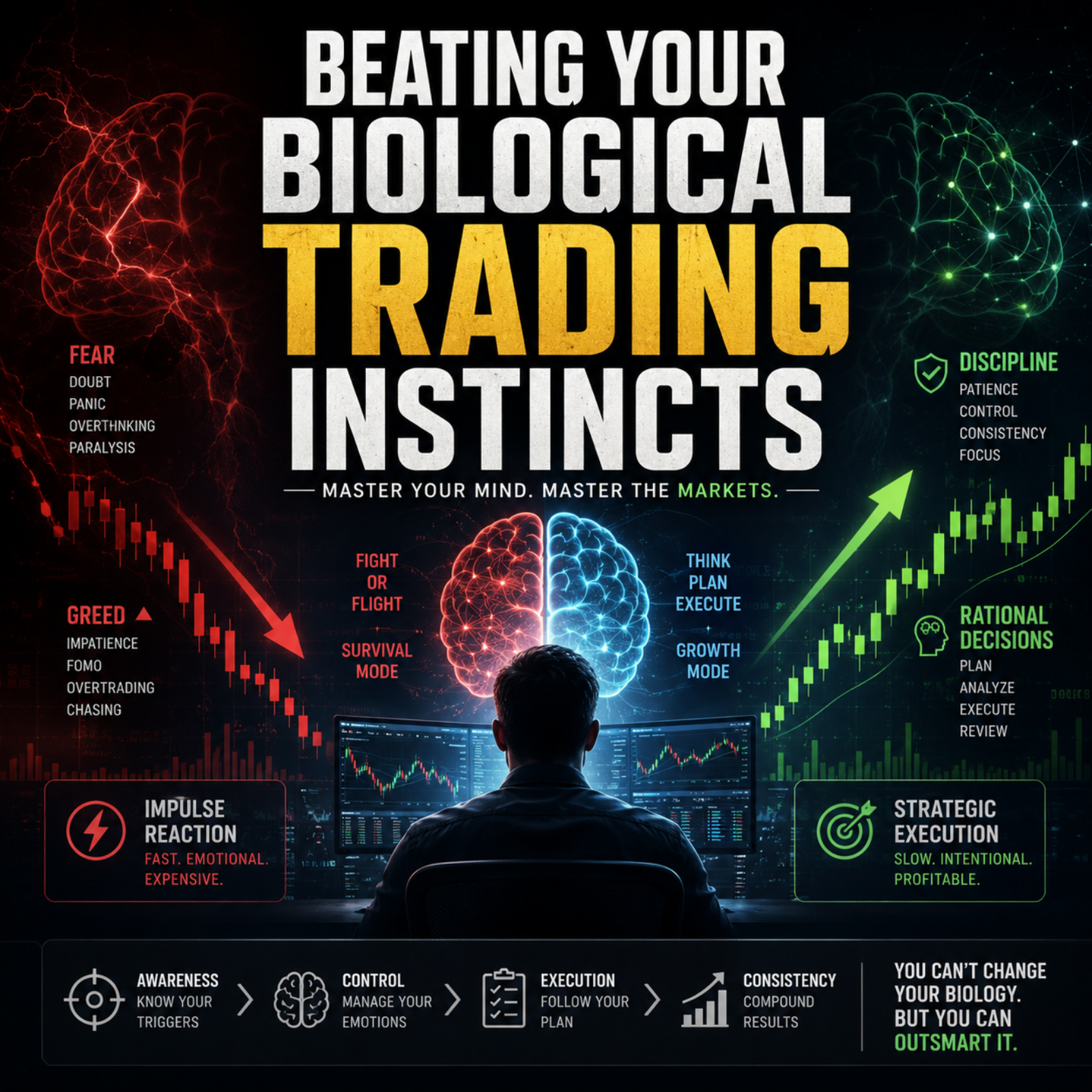
Welcome to this deep debate on trading psychology, market bias, emotional control, and rules-based decision-making. This discussion explores one of the most important questions in financial markets: does long-term trading success come from mastering emotions, suppressing fear, and training the brain, or from building rigid systems that remove emotion from execution altogether?The debate begins with a simple biological example: when your hand touches a hot stove, your nervous system reacts automatically. Pain triggers a reflex, and your hand pulls away before conscious thought can intervene. In everyday life, this survival mechanism protects us. But in financial markets, the same instinct to avoid pain can become a dangerous liability.Key Debate ThemeMarkets are full of fear, greed, uncertainty, and emotional pressure. Human beings naturally feel the pain of losses more strongly than the pleasure of gains. This creates common trading mistakes such as holding losing trades too long, selling winners too early, chasing break-even points, and refusing to accept losses.Point 1: The Case for Emotional MasteryOne side argues that professional traders succeed because they learn to suppress emotional reactions. Research on trader behavior and brain activity suggests that experienced market participants may reduce fear responses in the amygdala while increasing activity in the prefrontal cortex, the part of the brain linked to planning, analysis, and cognitive control.Point 2: The Case for Rules-Based SystemsThe opposing side argues that emotional dampening is not enough and can even be harmful. If traders become too emotionally detached, they may react too slowly to urgent negative market information. Fear, in some situations, can act as useful data. It can warn a trader that risk is rising and that action is needed.Point 3: The Disposition Effect A major focus of the debate is the disposition effect, where traders tend to sell profitable positions too soon and hold losing positions too long. This happens because realizing a loss feels like admitting defeat. As long as a losing trade remains open, the loss feels temporary. Once it is closed, the pain becomes real.Point 4: Mental Accounting and Reframing The debate also explains how cognitive framing changes trading behavior. For example, investors often sell losing positions near tax season because the loss can be reframed as a tax benefit instead of a personal failure. This suggests that market mistakes are not only emotional but also deeply connected to how traders mentally categorize gains, losses, and decisions.Point 5: Human Brain vs Automated Execution Both sides agree that raw instinct is dangerous in trading. The disagreement is about the best solution. One view says the trader must train the brain to operate calmly under stress. The other says the trader must design systems that protect them from their own brain.#TradingPsychology #FinancialMarkets #BehavioralFinance #TradingMindset
Embed this episode
Ready to play
Beating your biological trading instincts
No transcript for this episode yet
Similar Episodes
No similar episodes found.
Similar Podcasts
No similar podcasts found.