Hey, Obsessors. This is Julia. You know I am all about getting obsessed with your big ideas and turning those dreams into actual businesses. I work with entrepreneurs every single day, and so many of my clients rave about Shopify. And I get why. Beautiful storefronts, easy setup, and even an AI assistant called Sidekick to help you along the way. And listen, Black Friday is coming. Why not get your business?
up and running before the holiday shopping rush. Are you ready to launch? Go to Shopify.com to start your free trial. That's Shopify.com. Go to Shopify.com today so you can start hearing. At Capital One, we don't just use technology, we architect it. Our teams have true end-to-end product ownership, shipping distributed systems that handle high concurrency at scale. No single server bottlenecks, engineered beyond legacy downtime, and operating right here in downtown Toronto. That's technology at Capital One. Search technology at Capital One Canada.
Welcome to the Backpacking Clusters podcast. We are tips and tales with a sense of humor. With me today is a man who lives in a country... where you can find igloos on Zillow. Jesse Mantai, how's it going today? The question is, have you ever stayed in one of those igloos? Don't judge it till you try it. That's all I say. And with me today is the one and only first time extreme Mount Everest rock climber of all times, and going to podcast us all the way through it, Carl Mandrioli. Mount Everest rock climber, that sounds real. Yeah, would that put you into, like, I mean, you've done some pretty crazy things, but would you be a beginner if you went to Mount Everest, would you? Or would you still like, would you be grading other people as you go up the mountain? There's a ton of beginners on Mount Everest. Are you serious? They can't even like hike for themselves. Exactly.
See, that's what my point is. You'd be a beginner, but you'd still be grading everybody else on Mount Everest as you're going up there. And podcasting, is that what you said? And podcasting as you go. Yeah, you'd have, like, your little, like, I'd give them an A, I'd give them a B, share the climb in the, like, tallest mountain in the world. And I've never done it either, but they get a C. I would not do Mount Everest. I don't think it's really appropriate to have, like, landmarks, like, be dead bodies, which is, like, what they actually have there. I'm not into that at all. Okay, that just got dark real quick. That's what they have. I would, you know, I wouldn't be like, hey, sorry, I got to leave you behind because, like, I got to survive. I would try to, you know, help whoever, whether they deserve to be up there or not.
I also have like $100,000 for a permit. So that's not gonna happen. Way to take that introduction and just turn it real dark and all about money. But that's okay. That's okay. It's all about the money. Rescuing people and not having enough money. Anyways, yeah. So we got beginner backpacking gear. Buy this gear to get started. This is what you want. I don't think that...
Everybody who's tuning in is a beginner backpacker. I think they're curious what we're going to say, and they might even have some strong opinions about some alternatives, which is totally fine, because we have not tried every single piece of gear out there. I think that, to be honest, the people are going to be grading us on what we say is beginner gear. We're going to be getting it in the comments. No way, that's not beginner, or you should have chosen something else. And you know what? We're here for that. We're here for that car, right? We might not even agree about what's beginner or not. So I think that's fair. But if you are a beginner, we've got some ideas for you. And so we're going to get into that. We also have, okay, so for those who are fans of backpacking on YouTube.
One of the icons in the backpacking world is Suge. And I don't know, a few weeks ago, I don't know if you saw this, but a few weeks ago, he put out a video and revealed that he's got some serious health issues. He's going to be in the hospital for weeks. And so, yeah, prayers go out to him. I'm definitely praying for him. And I found like an old Suge clip just to honor him and just to kind of, I don't know, just keep him kind of in our thoughts and prayers. I'll throw that at the end of the episode, but this is like Suge at his best, basically. So that's coming up at the very end. Highlights his personality and his character just perfectly because he is like one of the OGs, for sure, in the backpacking nation. Yeah, and camping all this stuff, for sure.
All right, this episode is brought to you by Enlightened Equipment, the company that can help beginning backpackers, pros, and everyone in between by lightening their loads at EnlightenedEquipment.com. All right, the Bible verse of the episode is 1 Peter 5, 6, and 7. Humble yourselves, therefore, under the mighty hand of God so that at the proper time, he may exalt you, casting all your anxieties on him because he cares for you. Jesse, the Lord can take away all of our anxieties. But can we help new backpackers limit, not take away, but limit their gear anxieties with this episode? So is that like, are we like the hands and feet of Jesus then in this kind of analogy? Like we're helping take their anxieties a little bit in the backpacking, just in backpacking. I'm asking, I don't know. I don't even know if that's appropriate. Yeah, I don't know. I think we can. We're probably like the number one beginner backpacking tool that we should offer at the start. It's like, yeah, pray. You know, pray before every trip. Cast your cares and your anxieties on the Lord. Because that goes a long way before any trip happens. But yeah, no, I think we'll be able to take some people's fears away. I think so. I think people that come with an open mind, if they're truly new, they might.
have us have some takeaways here. I think others who just like know better might just tell us why we're wrong. So we're gonna find out. So I think, I think the biggest fear that most beginners have, and I think it's the fear of getting started, knowing where to start, what to take on, how to, how to get started. So I hope if nothing else that, that today's episode will be like, okay, I've got like one or two ideas of places to start no matter where I'm at. If I've got no money or not very much money, or at least a little bit of money set aside savings, you have a couple of ideas to get started. So for sure. And so we, so we categorize these as for every,
Every PC we talk about is going to have like a budget option, a mid-level option, and a premium option, which are very flexible. So how would you define those? Like, or how did you define those? Yeah, I think the intermediate option, the middle option was like kind of the hardest for me to figure out. And to be honest, there's like one or two, I think, that I don't even have anything for. But to me, budget is pretty straightforward. It's going to be the lowest cost starting. Again, we've got to talk these are beginner gear. So it's not just the lowest cost. It's the lowest gear that's good for beginners to get started with. And yeah, and then the premium, something that's a little bit more.
It might require a little bit more experience or might require a little bit more comfortability on the trail, but is at higher cost perhaps as well. I just had higher costs. I just had like, this is the top cost option. We can talk about whether that's even appropriate for some beginners. Yeah. One of the things that often comes up when people talk about beginner gear is this idea of like, well, should beginners begin with anything less than like expert gear? Because if it's like, if it's good enough for experts, Carl, then like, shouldn't the beginner start? And I've had so many comments of this over the years of like, there's no such thing as beginner gear. And even I've even had gear manufacturers reach out, not appreciating that I've highlighted that I thought one of their pieces of gear was good for beginners because they feel like that's somehow like a low, you know, like a lesser level. That's offensive, man. You're offending that gear company. They're like, well, does that mean that?
Mid-level or more experienced backpackers can't use this just because it is good for beginners. That's what's implied. It's not what you're saying. It's implied though, right? No, exactly. So then what are you meaning when you say this is beginner gear? What are you taking that as? So beginner gear means I think it's like accessible to most people. Most people can figure out how to use it and use it well. And yeah, I think just work it basically. And we'll get into that category by category. But it's funny you mentioned the whole idea of like expert gear because I don't know that expert gear even exists. If you look at how they label it, there's no expert level. So you know what there is? There's pro. You can buy the X-Mid Pro.
But there's not a pro backpackers out there, let's be honest. Professional walkers. That's right. But I do think there is a difference between some, like there are certain tents. There are certain things that I would say like, man, if a beginner came to me and was like, oh, I'm looking at getting this tent. I'd be like, wow, like, okay, that's like, have you gone backpacking before? No, I've never gone backpacking before. Probably might not be the best thing to start with. Yeah, we're going to, yeah, I've got that. I've got, I've got specific questions about tents, but I want to do tents first, but I think we're on the same track. And so, well, I think we are. We're going to find out because I think what I think beginners can do and what you think beginners can do might differ. So I think I have probably, tents might be my most controversial pick for a couple of reasons, but we'll, we'll get to that
Here, I'm just gonna tell you my like theory behind the type of pack that I would suggest for a beginner and really for most folks out there is I would want, there's two criteria I have. I want something that's adjustable. I mean, a lot of packs are coming out these days and they are not adjustable. So I want something that is. And I want it from a place that has a good return policy. That's two criteria because you got to try it on the trail to know if it's going to fit. Now, not all my packs fit that, but I don't know. I try my best. So is there any other criteria or ideas behind packs you had? Okay. Yeah, that's, I really like the return policy and I think have.
I would probably change my list now in light of what you said, but I'm going to keep it the same. But no, the other thing that is versatility, because beginners change quickly. After your first, second, third trip, what you want in a piece of gear might change pretty quickly. And so while you might not know that on your first trip, you might want some optionality by your third or fourth trip. And so one of the pieces of gear is optionality. Optionality is a real word. Yes, it is, sir. At least up here in Canada where we got igloos. Totally real word. Are you kidding? You're a teacher. You don't know what optionality is.
I think I know what you think it means, but I don't think it's a real word. Oh, man. I wish I could, like, screen share a, like, Webster dictionary. You're going to want some optionality with your gear. Like, are they using that at the outdoor stores? I would be like, what's the optionality of these trekking poles? That's what I want to know. Can they also? This gear's good, but this one has optionality. I don't even know why you're mocking me with this. That's a real word. People, meet me in the comments. I could be wrong. I could be wrong. I just think it's funny. Sorry, go ahead. All right, so optionality with gear. Yeah, versatility, I guess, would be another word for those of you who might have a smaller vocabulary.
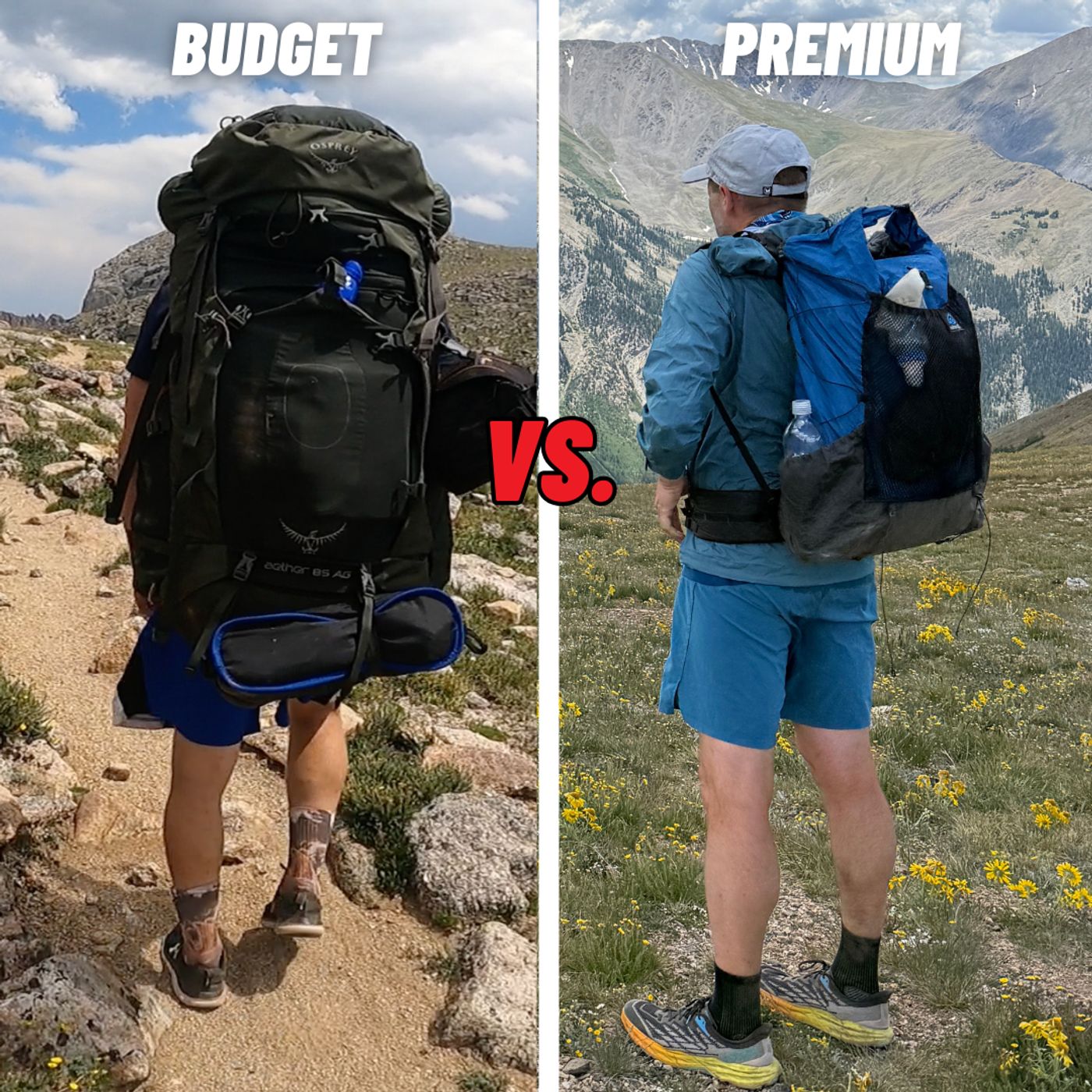
Okay. But yeah, versatility. Things that, I mean, I don't think versatility is not the right word because that means you can use it for different things. Yeah, you can use it as a beginner or as a pro. Yeah. Okay, I guess. Well, so yeah, you want to get into backpacks. Why don't you start, what's the, what is your budget beginner backpacks? Okay, and just to clarify, we're not going to sit here and review it and give you like five minutes per piece of gear. We're going to tell you what we think, give you a quick rundown and move on. And if you want to dig deeper, then you can research these things deeper. But we're going to tell you what we think from experience. But my budget one is the REI Flash 55. I got one right here.
For my son, because he's more of a big beginner backpacker. It comes in men's and women's size. It weighs a little under three pounds, depending upon the size, and gets high marks from many gear testers, including our good friend, Justin Outdoors. Nine exterior pockets. The colors are horrific. They're not the best. It's the one downside. I don't know, sunshine yellow or that weird emerald green. And then $229. I think this is pretty high. I think this is like for a budget. I think it's actually pretty pricey for a budget item, but I like it better than anything that's lower than that in terms of cost. Yeah. Yeah, that's more expensive than my premium option. What?
We're going to have different opinions. What are you bringing? Like Jansport? Use knapsack off eBay? What do you got for budget? Pretty well. I realize I've got to approach the beginner and budget because I think beginner budget, when you put those two together, they do create a different category thought in my brain. And that is, I kind of talked about optionality, but also this isn't probably going to be the gear that you're going to use for the next 10 years. And I know that there are some people who are really big, like pay once, cry once kind of thing. I'm not. I don't encourage beginners to do that. I encourage beginners just to.
get something. And that we've covered the theory behind this. I know I'm going to know what your budget pack is. Okay. It's the mountaintop 60 liter backpack off of Amazon. It is less than a hundred dollars. It is not the best backpack that you're going to find. It will be a great backpack for your first two, three trips. I still have it. I haven't used it in a while, but I have used it for my last winter backpacking trip because it can carry a little bit more and has a little bit more versatility to it. So great backpack, cheap, affordable, not something you're going to want to use for the next 10 years. Okay. And we should specify that Jesse might be talking in Canadian dollars. I'm talking US dollars.
No, I looked that up. That's US dollars. We have audiences in both places, just to clarify. So I'm throwing out ounces and pounds. I didn't translate everything. And so you don't talk grams. That's fine. That's fine. Sure. I don't know exactly what it is in Canada. I try to look everything up in US dollars. Too much preparation. So, all right. That's okay. Amazon's fair. If you've used it and you like it, like I would trust you on that one. I actually probably trust your judgment on gear more than mine. I feel like you're more of a gear expert than I am. So take that with a grain of salt, folks. Put it this way. Put it this way.
My wife was just gifted a backpack from my father, her father. And so she's going to use that on her first backpacking trip. But prior to us getting that gift, I was going to give this backpack to her. It's fully adjustable. It'd be able to fit her. And I think it would have been a great thing for her to take on the first backpacking trip. So he trusted. All right. Mid-level, I've got the Exped Lightning 60. So this, if you notice, this doesn't have any reviews yet because it says coming soon. It's going to be out in the next few weeks or so. I got a chance to check it out at a gear show. And it, yeah, just checks all the boxes here. So it's got...
So it's obviously 60 liter. It comes in men's and women's sizes. It weighs in two pounds, 10 to 13 ounces, depending on size. It's got a roll top closure. Great back ventilation. It's water resistant. It's more expensive than the REI. It's at $300, which does feel high end for packs until you really look at what high end packs cost, like the premium stuff, which we'll get to.
Man, you're talking like Derek budgets over here, Carl. Man. I did not call this a budget backpack. I said mid-level. That's true. You're right. But even your budget backpack. Aren't most backpacks, like if you look up what Osprey Gregory's, aren't they in the $300 range? Isn't that like mid-level? Yeah. Yeah. That's fair. All right. What's yours? Did you have a mid-level for this one? Yeah. Actually, my mid-level, ironically, and I'll justify this, is the most expensive option.
That makes sense. And it is the Granite Gear Crown 60. I have the second version of this and they've just released a third version of this, the Crown 360. And the reason I like this is for its optionality. It's to me like a step up from beginner as you're like, okay, maybe you've gone, you're still a beginner, but like you've gone on one trip, you've maybe borrowed some gear, you're looking for something, you see this as like a long-term hobby, but you want something a little bit more expensive than the Amazon thing. That's where this kit falls in. So it functions as a roll top and has just, yeah, it has a brain that also comes off. Yeah, it's still a roll top. It has a,
a frame, but you can take the frame out. So it just has a lot of optionality so that as a beginner, you can try a bunch of different things. You have all the features to start and then within the first few years, try a few different things, take them out and then decide, okay, what kind of like premium backpack do I want down the road? So I think it's like, even though it's like $260, I think it is a great intermediate option, middle option that will give you the most kind of long-term versatility optionality. That's the one that I said has a lot of optionality. Okay. I like that you're like 300 for a mid-level pack and then you come back with 260. Nice, dude. Nice. I've used Granite Gear packs and they're fine. They're fine. They're a little floppy for me. That's why I was...
The one that I had didn't have the roll top closure, but I feel like with the brain attached on, this can happen for any pack, but it seemed to happen more with the granite gear pack. So let's say you are, you unzip and you want to put something inside the top part of the brain. And for whatever reason, you like leave the zipper unzipped and then you move the pack. That thing flops upside down. Everything falls out. That happens to me probably like three times a trip. That's like, okay, so I made, I left my backpack unzipped as I walked down the trail and my backpack lost all my stuff. So that backpack's garbage. No, it's the only pack that flops so much. Like it's like, it doesn't take much for that thing to flop upside down. No other pack does that that I've had.
Like, this is not a problem except for that pack. I don't know what to tell you about it. It makes no sense. I don't know, man. That makes no sense to me. It's floppy. It's a floppy pack. Well, okay. I can't speak to your pack. My pack, the Crown 60, has like toggles that like hold it down in the front. The updated version might be better. I had one of the Crowns and I had, I don't know, they had like a gorilla model. I forget what they called it. I don't know. It was a black one if that helps. Mine's gray. Yeah, I don't know. I don't know. Well, maybe you're just using it wrong. User error. Yeah, probably. I don't know how to put things in the brain of the pack and keep them in there. All right. I got the premium one is the one that I've been using the most in the last year. It's about a year ago. It's just hanging
That is not a beginner backpack. It's premium. What? Why not? Okay. It might be premium, but it's not beginner. How many liters is it? 60. Oh, okay. I thought they were low. I thought there was like a 45. It'd be hard. You're right. 60. It's 60. It's hard to fit probably a full 60 liters in there, but it's adjustable. So it hits the adjustable category. Okay. It's simple. So you're not going to overthink how to use it. It's water resistant, which is pretty like you don't have to do anything for that. It weighs under a pound and a half.
A couple things to beware, though, is that it's not returnable. You have to pay a return fee up front if you think you might not like it. It's like 40 bucks, I think, is what it was when I bought it. A lot of people want the hip belt pockets or the shoulder strap pockets. It doesn't come with those, so they charge you a premium fee for those. I wouldn't buy those because not only are they way too expensive, they're also terrible. I actually lost my map out of the hip belt pocket. Speaking of losing things, maybe it's a personal problem. Again. Maybe it's me. I don't know how to zip things up. All my snacks fell out of my hip belt pocket. Okay, so why is this not...
Why would a beginner have a hard time putting things inside this? Well, I feel like that's exactly the issue is a beginner hasn't figured out their systems well enough. So the idea of just putting everything in one central compartment is pretty tough. They need to have the comfort and the like reliability of knowing, okay, this is the spot for this. This is the spot for that. I put that there. There's a pocket right here. Come on. That's enough. That's a soft answer. Okay, Carol. I don't have experience with premium packs. And so you could go with like a Gregory Baltoro, which is meant to carry. It's like a six pound empty pack, but it's meant to carry heavy loads. If you're going to be a beginner, who's going to be, you know, throwing in like three pairs of jeans.
Yeah, that's, that would be the other thing with the art haul is I don't know how, how much, isn't it designed to carry lower weights? Like you have to be pretty ultra light. No, no, that's why, that's why it's the most versatile pack with a lot of optionality is that it has, it can carry the lighter weight, but it can also carry, I think it's like up to 30, 35 pounds, like comfortably. 35 pounds is not a beginner. Wow. Well, these days, these days, Jesse, you can disagree. It's fine. Okay. What's your premium pack that costs less than the Granite Gear pack? It is the Outdoor Vitals Shadowlight backpack for $200. I think it's a great backpack. It is also a roll top. It is a large central compartment.
but it has a lot of other compartments on the side. It has two front pockets. It has a lot of choices of where you're going to store things. It's also water resistant, although you still need a pack liner. It has a zipper down the middle, so it's just easy to access things. I took that backpack on my thru-hike and I just, actually, it's right here. My backpack one, or the one from the thru-hike got super beat up and I actually just bought a replacement. This is a 45. I got a 45, but even a 45, to be honest, it can fit a ton. I don't think I'd recommend it for maybe a beginner, although if a beginner really was... That comes in bigger sizes, right? Yeah, it does. Yep. I think it's a...
I want to say it's 60. 60 and 45. I'm pretty sure it's 60 and 45. You just said you had a hard time with me saying it's 60. Now you're saying your 60 is good? No, I thought the alcohol was less. No, I thought the alcohol was less. And then you said it was 60. Yeah, when you said it was 60, it was like, okay, okay. I thought it was a 45 liter. Okay. $200. That's a pretty good premium backpack for a beginner. Just saying. I don't know how I associate outdoor vitals with premium. I view them as more like mid-level or beginner. Well, that's fair. That's your assumption. Their brand, literally, their branding is literally premium. Like, I think their brand is like premium gear. Okay, so whatever they tell you, you should buy. Yeah, I'm like a lemming. I just follow it. I'm like run, yeah. That's fair. No, I think it's a...
beginner I think it's great like sure you could go to the like get the most premium thing but for a beginner I think it counts as premium quality gear I used it on my through height I just bought it again I'm not a beginner I'm looking for a premium backpack I bought it all right tents really check the sizing is my advice to make sure it fits you and whoever or whatever else you want to put inside sometimes a one person is not really a one person and sometimes a two person is not really a two person so here's I think the real the crux for tents and maybe you have a different category to talk about but do you recommend would you recommend a track and pull tent for a new backpacker yes but only one There is only one. I would not. I would not assume that they have trekking poles or make them bring trekking poles just for their tent than if they did. I don't know. Maybe you have one that's really easy to set up, but I know that...
that they're not easy to set up? They aren't easy to set up except for one. One is really easy to set up and it's the superior trekking pole tent. And normally I would never recommend a beginner get a trekking pole tent except for this one. But it's not my budget one. Did I hit on, okay, what are your other issues with tents in general? Yeah, no, I think you nailed it. I think in general the advice I give to people is do one size more than what you're going for. So if you're a one person, get a two person. If you're a two person, get a three person. Sometimes, some of the tents now are like, we acknowledge that we were undersized in them and now they, that's why I say check the sizing and check the floor space.
Not all of them, but some of them are doing that. Sure. And a good beginner, like a really, really responsible beginner, might check the sizing. And like me, I like actually masking taped out on the floor the different sizes of tents. But most beginners aren't going to do that. Whoa, whoa, whoa, whoa. What does that mean? You masking taped it? Like you measured it on your floor and then taped this like a rectangle and then tried to lay in the rectangle? Yeah. Brought my buddy over, actually. We both laid in the rectangle and tried to decide could we do a two person or a three person. And we got a three person. I was happy. Oh, my gosh. That's awesome. You've never done that?
I've never heard of anybody doing that. Folks, if you've done that, please let us know because maybe I'm behind the signs on this. But I like that idea. It's weird to do that on like the kitchen floor with your buddy, but it makes sense. I analyzed over which tent to get for like months. Like I looked at everything and I was really budget concerned too. It was like there was bigger tents that I wanted, but I like had to keep something, keep it affordable. If only this episode was out when you were doing that, you just had the answer, right? Your future self could have just told you exactly what to get. Exactly, exactly. All right, first one up.
Teton Mountain Ultra, one or two person, depending upon the size that we talked about. About 4.7 pounds, easy to set up, durable, reliable, basic, on sale, $112. All right, that's my budget tent. Jesse, what's yours? Nature Hike, a Nature Hike brand Star River Tent. I think it's very affordable. You can get those online on a few different places and yeah, really affordable. Great starter tent. Okay, yeah, I was looking at this actually the other day. That's a good one, all right. My mid-level tent, I would like, this is my personal and very strong opinion is, folks.
There are no mid-level tents in terms of price. Every tent maker that makes a decent tent pretty much has doubled their prices in the last few years. So you're either buying budget or you're buying premium. That's my advice. What do you think? Yeah, yeah, I think I agree with that. Even again, my mid-level, mid-level, I guess I took my mid-level, I'm realizing I took it as like intermediate, not like intermediate beginner. That's like not really what mid-level really means. So again, it's more expensive. Either way, you can define it any way you want. I wasn't hyper-specific. So my intermediate, what I was going to say, but I think I'm going to switch it around now, was the X-Dome. And I chose the X-Dome as my like middle tent because it's still a tent pole tent. And you can set up, it's fairly easy. It's really easy for beginners to set up.
This is the Durson one, right? Yeah, so it's definitely more expensive, but I felt like it was more intermediate approachable. So it's $488 Canadian, so probably around $350 US. I think a reasonable price for a tent. And it's ultralight. It's got great features. It's a well-designed tent. Yeah, you actually make a good case there. I was thinking under $400 would have to be more what the mid-level was. So yeah, you're on track with that. Is this one which I've been using for years, the Nemo?
Hornet Elite. It's about two pounds. Easy setup. Semi-freestanding. Durable. Has lasted me for years. Premium now because the one person is now selling for $600. The two person, $700. It's not that I spent a lot of money on gear, but like when I bought this one, it was just a few years ago. And I bought my two person. I bought that for under $300 a few years back. I think I used a coupon. So I got a little money off, but it still wasn't even close to the prices they are now. How dare they? How dare they? Yeah, there's a lot of, like you said, there's a lot of premium tents. You want to spend a lot of money on a tent, you can do that easily. Like anywhere. REI. Yeah, just lots. So I went, again, kind of a little bit more of a weird way with this. I went more of like a...
like a more professional, I'm thinking premium, like pro premium professional gear for a beginner. I like that every time we hit this category, you've got to re-explain your logic reasoning. They just want to know, what's your tent? What's your premium tent? Jesse, what you got? X-mid one person. Also one or two, if you're going with two people. It's the only tent that I think a beginner can get without having to like upsize their tent. Like if you're one person. That's the Durston folks for those who are hiding under a rock for a lot of years. Yeah, just an X-mid one. If you're one person, it's enough for one person. If you're two people, the two is enough for two people. It is $366 Canadian, which is probably something like $300 American, roughly, maybe even a little less. It is a trekking pool tent. It is the easiest trekking pool tent to set up in the world. You can set it up in your backpack once or
Pro. Have you ever seen one of these? Well, you have seen one of these in person. Have you ever actually really looked at one in person, Carl? No, I've never actually used any Dursing gear, strangely. So we've had dressed on the show a couple of times. I really like him, but I have not, I've yet to buy his stuff. I don't, I'm not a trekking pole tent guy. So that's part of the issue. I have to, next time we go, because I use this tent all the time, I have to show you the setup for it. It is easier than most tent poles, tents, like freestanding tents. It is easier than most freestanding tents to set up. And it uses trekking poles. It's just amazing. Okay.
Uh, pads are personal preference, but if you, if you haven't been going for years, then here's gonna be the ones we like best. Like you gotta figure out if you like, like various baffling systems. If you like the slats that go vertical or horizontal, you get, you know, what's firm, what feels like a bubble. You gotta figure all that stuff out. Budget, outdoor vitals, foam pad, 30 bucks will insulate you, but it will be horrible to sleep on. But if you are not a wealthy backpacker and need something, I would describe it as the, uh, the better than nothing category. That is, I don't actually, I think it might be worse than nothing.
It would be worse. It's worse than not going backpacking. If your first backpacking trip is that miserable that you're sleeping on a foam, like a quarter inch foam pad for $30, you're going to have a worse experience than if you just didn't go backpacking. Horrible advice. Horrible advice. No, for $40, for $10, for $10 more, Carl, $10 more, $40. You can get the most comfortable sleeping pad I have ever slept on. It is the Trekology UL80. Oh, I've not tried that one. It is not a warm sleeping pad. It will not insulate you worth anything, but it is comfortable. I love this pad.
and it's $10 more than what Carl was recommending, and you would actually enjoy backpacking. Do not listen to Carl, okay? Yeah, I think if you enjoy backpacking and you're freezing at night, then agree with Jesse on this. It's not like it'll be freezing, but like if temperatures are going below freezing, it's not a good sleeping pad. I've taken it to freeze, actually, to freezing. I took it to freezing and it was cold. It was not fun. But anything, if you're staying at like 20 degrees plus, you're fine.
Mid-level is the Climate Static V Summit. These are the ones that, like, they look like the V kind of cut into it. It's 100 bucks. It's three inches thick. Weighs in at a pound and a half, which is on the heavy side for a pad if you're, you know, trying to go ultra light. 2.4 R value is also not on the most insulated side, but it's probably better than whatever Jesse just said. So there's that. All right. What's your mid? No, that's a great one. Okay, I fully admit I have not tested this one. It's just one that I'm really interested in. So I put it as my mid, and it's the Trekology UL R7 that came out recently. It is insulated, heavily insulated.
I have heard kind of mixed reviews on how well its installation stacks up. So it's not a winter pad, but I'm interested in that. And that was, I can't remember the price. I think it was like 80 bucks. Still really affordable. All right. Premium. I wasn't going premium ultra light. I was just going premium sleep. And so the thick, there's like the battle of the extra thick pads now. You got all sorts of different ones. Like Nemo just came out with one. X-Pads got one. But I went with a ThermoRest Neoloft 4.7 R value. It weighs in at a ridiculous two pounds, a couple hundred bucks, but it's got four inches of plush bed-like feel to it.
I actually don't have one for this category because I have not tested enough what I would say premium sleeping pads are. I'm really interested in the Nealoft. I want to get that pad and try it off. But I don't feel like I can actually, even though I didn't test my intermediate one, I feel like I know enough about it. It's style. It's similar. Whereas these new sleeping pads with the premium ones that are coming out, they're different. They're different than what's out there on the market. And I haven't tested them to speak to them enough. Well, that brings to bags and quilts. If you're a new backpacker, Jesse, would you opt for a bag or a quilt? Only a bag. I would only recommend bags for a beginner. What about you? On par with that.
My other piece of advice is that women should look for women's specific bags. Like for this category specifically, it really does make a difference. I feel like I bought my wife. She's like, I'm always cold backpacking. I'm like, I'll tell you what, I will buy you a negative 100 degree bag. I will spend $100,000 just so you can be warm. And she's like, I'm still cold. And then she got a women's specific bag. She ended up getting a Sierra Designs bag they don't make anymore. And she's like, I'm comfy and cozy and it like solved all her problems. So that's my piece of advice. Would you be willing to give me that $100,000?
A sleeping bag that you said? I'll sell that on the market and make some money. It's Western Mountaineering. That's why it costs so much. Oh, I gotcha. It was actually $100,000. You took out a mortgage for it. She was still cold in Western Mountaineering. No, I'm exaggerating. I gave her like a negative 20 and she was still cold. I was like, come on. But still, like that's, yeah, okay. And then she had that 20 degree. See her designs and it worked for her. So anyway. Budget bag is the Exped Deep Sleep 30 degree bag. It comes in around $100. It weighs 2.8 to 3.2 pounds depending upon sizing.
What you got? Yeah, similar weight. The Teton Leaf. The Teton Leaf. It's a synthetic bag. It's not a down bag, but it's really affordable. It's only $80. I think that's budget. To me, that's a budget bag to get started on. And I would recommend it. Again, don't take it down to freezing. Don't take it to sleeping bags. I guess something else I would add to sleeping bags overall is do not take them to their rating level. If you think you're going to be camping at 20 degrees, don't take a 20 degree bag. You want it to be a little bit warmer. There's like survival rating versus comfort rating and...
Companies mix and match all the time. All right, my mid-level bag. I feel like there's a lot that hit the mid-level. Like, you can pick whatever you want. I would, to be honest, I would find one that's going to be in the two-pounder under range and find one that's on sale.
and find one that you can buy, more in like the $200 range. I didn't find any sales on any that fit this criteria, so I just kind of picked one from a company that works for me for a mid-level bag, which is Mountain Hardware. They have their Bishop Pass 30. It's $315, so on sale will be in the $200 range, and they typically, or they sometimes go on sale depending, and that's a bag that's under two pounds. Yeah, again, more affordable than Carl's, like Crazy Derek budget over here. $150, less than $150 for the Teton Altos, which was my second sleeping bag, down bag. You keep on mentioning, you're like Durson and Teton, those are all your answers. That's not true, that's not true. I also had Mountaintop and Granite Gear. You literally had two in a row Dursons, and you just had two in a row Teton.
But I think this, to me, that's the, it's like, it's like beginner, you want the most budget. That's one of the things I love about Teton. I think they are one of the best beginner backpacking brands because they really do. It's like, here, you're like super budget. Here's like entry level budget. Here's like intermediate budget. And then they don't really do anything premium. And I think that's really smart for beginners. Anyways, the Altos, it was my first down bag and I love it and take it car camping now. So still recommend it. Great intermediate. Premium. Western Mountaineering. If you want to spend over $700 on a bag, it's called the Versalite.
for $750 to $790 for a 10 degree bag. I'm not really recommending this. I've been poking fun at Western Mountaineering for a while because I think that this is not for beginning backpackers or for most backpackers. People, so we put out this episode, I had John Kelly as a host on it like over a year ago, it was like January 2025. And we said that we, we were a little too aggressive. We said like Western Mountaineering was a ripoff company. Like we're just, that's probably too aggressive because they do make quality stuff and make US made stuff. But I'm still, like I got a comment this week from that episode, people that are like, nuh-uh, nuh-uh. And then they tell you about how, you know.
just how it's made and that they haven't had to buy. One person literally said, you buy this bag, you'll never have to buy a bag again. I bought four of them. I'm like, you just contradicted yourself. They are like, I think quality is there and they're branded. Branding is really interesting with Western mountaineering is it's like branded as like premium. Like it's like, this is the best in the market, the Ferrari of sleeping bags. But it's called mountaineering. It's literally in the name. Most backpackers are not mountaineering. If you're mountaineering, maybe that's for you, but not for backpackers. And most beginners are not mountaineering, Carl. So that's like, that's not a beginner option. Yeah, I know. I was joking.
Okay, I actually do have a quilt just because... I was between doing a quilt. Because we are the Enlightened Equipment Podcast. I got the Revelation quilt. I think it's easy enough to use. You can disagree. Customizable. So like the price depends on like what size, what fill, and the kind of little doodads you have. But it weighs in at about a little over a pound. So really ultra light, premium option. And...
What you got? Yeah, I was tempted to say a quilt, except I'm going to stand by my principles and say that I don't think beginners should start with quilt. Like if you haven't gone backpacking once, if you've only gone once or twice, or if you haven't gone at all, don't start with quilt. And so I was going to say something super premium, which was like a Zen Bivy, but I even felt like that was like, I don't know, even too much. I don't know. Maybe I should have said with Zen Bivy, I'm going to go with my secondary option, which was Outdoor Vitals, the Storm Loft. And that's your third favorite company. I'm just saying, I think, I like that it's, I think it's beginner friendly. There we go. You hit Outdoor Vitals twice for premium. All right, well.
We'll circle back to that. I think that's like some interesting philosophical discussion there. All right. I was going to let you pick the stove kit. I'm going to pick the filter and we each have a luxury item. So stove, what you got? If you're just getting started and you want a budget option and you want something that you're going to be comfortable with that will fit you like 90% of your backpacking trails, just go to Amazon and get whatever different Amazon backpacking stove kit is there. Bizgear is one that I've recommended. Amazon Basics. Yeah, Amazon. Well, not just stove. I'm talking pot. So the bizgear one comes with a one liter pot, a pan, some utensils, and a stove all in one for 50 bucks. It's a great beginner budget option.
The funny thing is that the premium option is actually cheaper. It just takes a little bit more like buying the separate things all separately. And that would be getting like a Toks titanium 750 milliliter pot with a BRS 3000, a Pika lid from Justin Outdoors and whatever other little utensils you want to buy. Like a Toks spoon. That's good. Those are good suggestions. Filter, I just had Katadine be free. I think it's easy. Dip and go. Dip and go. I still use it. It's my favorite one. Okay, so what's your luxury item? My luxury item, if you're just getting started and you're a beginner, is you've got to bring a pillow. It will make your sleeps so much more satisfying. And go out there, buy a good pillow. I recommend a budget option as a trichology option. Yeah, there's the trichology like super.
super comfortable pillow that Carl convinced me to buy. And I haven't taken that out on a backpack trip, but that's super luxury. Or even just their lower end model, 20 bucks, you'll thank me later. What about you? What's your luxury option? So I thought I'd say the box on this one because I bring a lot of beginners and have brought a lot of beginners over the years. And beginners, when you're in a group setting, are typically like consumers. You are helping them along. You're giving them advice. You're encouraging them. You're typically taking care of them. You're showing them how to do things. Maybe you're helping them with their tent, helping them with their pack. They are on the consumer side. So I thought, you know what?
What if they could contribute something? Luxury item, bring baked goods to share. Because I had a beginner do that one time where like his wife made some baked like brownie bite things and he brought them not just for himself, but to share. And I thought that was like one of the most amazing beginner moves ever. They're a little bit on the heavy side, but he's sharing them. So he's reducing that weight pretty dang fast and everybody loved them.
So that's my luxury, Adam. Literal brownie points. Backpacking brownie points. Did you plan that? No, that's actually brilliant. You're right. Especially if you wanted to build friends and you're like going into a large group like the Patreon trip where you don't know people. I don't think most beginners are going to do that, but there are a lot of beginner backpacking clubs where it's like you can go on Facebook, join a club, go on your first trip. I think, I don't know if REI does this, but MEC up here has things like that where you can sign up and do it for a weekend. So great idea. Build friendships, get connections, and probably be invited on a future backpacking trip. Yeah. Oh, yeah. Yeah. And they're more likely to put up with whatever nonsense you've got. Oh, yeah. Great idea. That is a solid beginner suggestion, Carl. I'll give you that. Thank you. Yeah.
Okay, so there we go. I know we scratched the surface because there's more than that, but I don't know. I feel like that is, I feel like that's a good starting spot for a lot of folks there. But what did we miss? If you feel like there's some gear that should have made the list, if you feel like Jesse kept on choosing the same companies over and over again and he missed out on some other ones, then feel free to let us know in the comments. All right, so we've got a couple things coming up. We've got the backpacking support line and we've got a special, strange, and fun message from Suge right after this.
At Capital One, we don't just use technology, we architect it. Our teams have true end-to-end product ownership, shipping distributed systems that handle high concurrency at scale. No single server bottlenecks, engineered beyond legacy downtime, and operating right here in downtown Toronto. That's technology at Capital One. Search technology at Capital One Canada.
The Backpacking Support Line is brought to you by Magnet Designs. Check out the Ultralight Alpha Joggers, one of their best sellers. They can be used as camp pants, a base layer, or even pajama pants, and they only weigh between three and six ounces. Check out these popular joggers that come in men and women's cuts by googling Magnet Designs. When you're having trouble on the trail, call the Backpacking Magazine Support Line. All right, Jesse. This is from Charles from BC. Just wondering what the correct weight ratio is for Nalgene, Carabiner, and Buffs.
to correct pack weight. Charles from BC, you have made the critical error that so many other people do. You think the ratio of Nalgene carabiners and buffs is to your pack rate, but really it's the ratio of Nalgene's two carriers, two buffs. If you're going to bring a Nalgene, you have to bring at least three carabiners. If you're going to bring three carabiners, you have to bring at least two buffs. That's the way that it's going to do. If you're going to bring four carabiners, you might want to consider upping your Nalgene ratio because these three all combine together. My recommendation, leave all three of these at home. That's what I was going to say. The correct ratio is zero to one pack for all of the above. Thanks for calling the support line. All right. We have a couple of folks that have joined.
the Patreon family. Woohoo. Woohoo. All right. So thank you so much for joining. We got barefoot Lisa, who apparently hikes barefoot. She's from Florida. I think she's planning on heading out on one of our, our backpacking adventures and she's a hammock camper. She's not inviting us to hang con. So Lisa, hopefully you'll enjoy this little thing. We have a show here upcoming in a moment, but yeah, I have not been hang con. We're going to try to make it one of these days, but Lisa welcome. And thank you for supporting us. It keeps our podcast going. Carl, could you backpack barefoot?
I think Lisa might be the most premium thing on this podcast that we've talked about so far. Like, I mean, barefoot. Like, that's pro. That's pro. That is pro. I don't think so. I think I need a little more support. I got foot problems, man. I have, like, shoe inserts and stuff, so I don't... Not Lisa. She's a hobbit. All right, next up, we got Rachel from Utah. Rachel, welcome. She started backpacking with her dad, and she got the backpacking bug a couple years ago, and she's gone to all the epic places, including Wyoming and Idaho. She calls herself a backpacking addict now.
And so all of her off time, she's not working. She is backpacking. It sounds like 100% of the time. So Rachel, welcome to the family. Thank you for supporting us. We really appreciate it. We will look into starting Backpacking Anonymous just for you, Rachel. You know what? We got a couple new reviews as well, but I want to get to the Shug thing. So if you've recently left us a review, please reach out. I will read those here in an upcoming episode, but please reach out and we'll send you some limited edition backpacking and blisters stickers. When Derek and I first started getting this podcast going, I didn't know that Derek's going to be co-host. So I started interviewing folks for the co-hosting gig for the Backpacking Blisters podcast and Shug.
was one of the folks that I interviewed. I hadn't even heard of him at the time, and so here's how it went down. All right, next up we got, let's see, is it Shrug? Is that your name, sir? It is Shooj. My name is Shooj, and I love talking about myself, and I love talking about the blister. The blister. And not the backpacking, backpacking, backpacking. The backpacking leads to blister. Sometimes we get the kitchen and the chafe. This is what I want to talk about. And I am from Lourdes, Vavobia. Yes, and my name is Derekondo. I don't know what your name is, but it says here that you're a former circus clown as a backpacker? Well, yes.
I work as a circus clown, but, you know, like a United States Marine. Once a Marine, always a Marine. And a clown is always a clown. You just take off the maquillage. You know, you take the makeup away, and still you have a face like this that people go, is that your makeup on or off? I can't really tell shoes. Yes, I don't know. It is always there. We are never off duty. Just, I got to ask this, like, do you know anything about backpacking? You're talking about makeup. Do you have backpack knowledge? I do know very much about it because I was in special forces as clowns. Clowns are very sneaky. We build things. We know how to infiltrate. We go in, play the buffoon, and in the end, you know, yes, we backpack a bit. I carry mortar. And in life, then, I start to go in the...
ultra light to bring candy. I like the backpack. It's the nicest cake. But the only thing I don't like about it is people don't know who I am out there. And I tell them, I'm sure. Shush is who I am. Okay. Well, hey, if this podcast takes off, they'll definitely get to know you. But you know what? I got your resume. I got your number. We'll be in touch. Yes, I have met you, Carl. And that's Carl with a C. It should be a cake maybe. But I'm not going to get into it in the European way. But I think you need me as a host because, you know, we bring a continental flavor to the show. I just sit here and purse my lips and look pretty.
All right. That was Shug, man. Any thoughts on that, Jesse? That's classic Shug. Classic Shug. I mean, I'm surprised you chose Derek after listening to that. Let's be real. I know. I know. I've had some buyer's remorse there, for sure. I'm surprised you chose me over that. Like, I mean, get him on the line. We got more of those, but those might come out later if you guys are interested in hearing who else auditioned for the co-hosting gig. But anyway, Shug, man, we're praying for you, brother, and hopefully we'll have an update soon. So you got anything else? That's it. Remember, folks, buying new gear isn't always a good idea. I bought an air purifier months ago, and now it's just collecting dust. Have a good weekend. God bless.
B&B, rock here. Hope you're all doing well. Jennifer and I actually went to a support group for people who have had strokes, right? Pretty intense. There were over 40 people there. Stroke survivors are people that have been through things, you know, brain trauma and stuff. We're talking intense. And the thing was, you know, it was really encouraging for a lot of people there. I could not believe how many people said they felt alone. And I really do think they were alone, are alone in this. But this support group is really bringing people together. Really something. But I think when I go back, I'm gonna wear my backpacking and blister shirt.
And it just, you got to pick the right time for sure, right? You got to be really tactful because people are really dealing with some tough stuff. But there was a lot of lightheartedness there at the same time. And so I do want to introduce that group to backpacking and blisters. And I think I'm going to. And here's the thing. Another thing Jennifer really noticed about these people, they are not beginners. A lot of them have weathered the storm for over a decade with stuff that they've dealt with. And they put up with a lot and they put up with a lot of hurt and pain in their life. And obviously I'm, you know, there's a few people in particular that I know the Lord's just telling me, hey, tell this person about me.
I want to help them. And that's what God does, of course, right? But here's the thing, Jennifer, notice about these people. They are not beginners. And there are backpacking beginners, that's for sure. I think backpacking beginners, their gear, well, really, I would say their gear looks a lot like mine because I pack like a beginner. I think that's been pretty apparent in this show. I've gotten better at some things, but I will say this for beginning gear.
One of them, boots. I've never worn them, but I've got to side with Jesse. I don't think you need boots to go through streams. I think you just need good old shoes and socks. I've gone through streams, you know, sometimes very deep. I've never gotten a blister from those. I've gotten a few blisters here and there from other things, but not necessarily from the streams. So I think boots, you know, those would be beginner gear. But I think there is one beginning gear above all. And folks, if you like Derek, I'm about to really side with him on this one. I'd say that a trowel for, you know, when you have to go number two. I think a trowel is a beginning piece of gear because Derek says pine cones. We've never seen him use them.
You know, Derek says, he's even mentioned sticks and stuff like that. I've never seen him use them. But I will say that, you know, when I have to go, I just use a stick, I really do, to dig a hole. Sometimes I'll dig a hole. I mean, you know, the ground, as far as I know, is clean. Well, as clean as ground can get, I guess. Sometimes I just use my hand to dig a hole. I think a trowel is a totally beginning piece of gear. God bless you, everybody. Thanks for all your prayers for me and my family.
Thank you so very much for listening to the show. Please take a moment to rate, review, and subscribe. It really does help the show to grow. Thank you for listening.