
EPISODE · Apr 9, 2026 · 22 MIN
Behavioral Interviews: What Big Tech Actually Evaluates
from Deep Dive · host Deep Dive
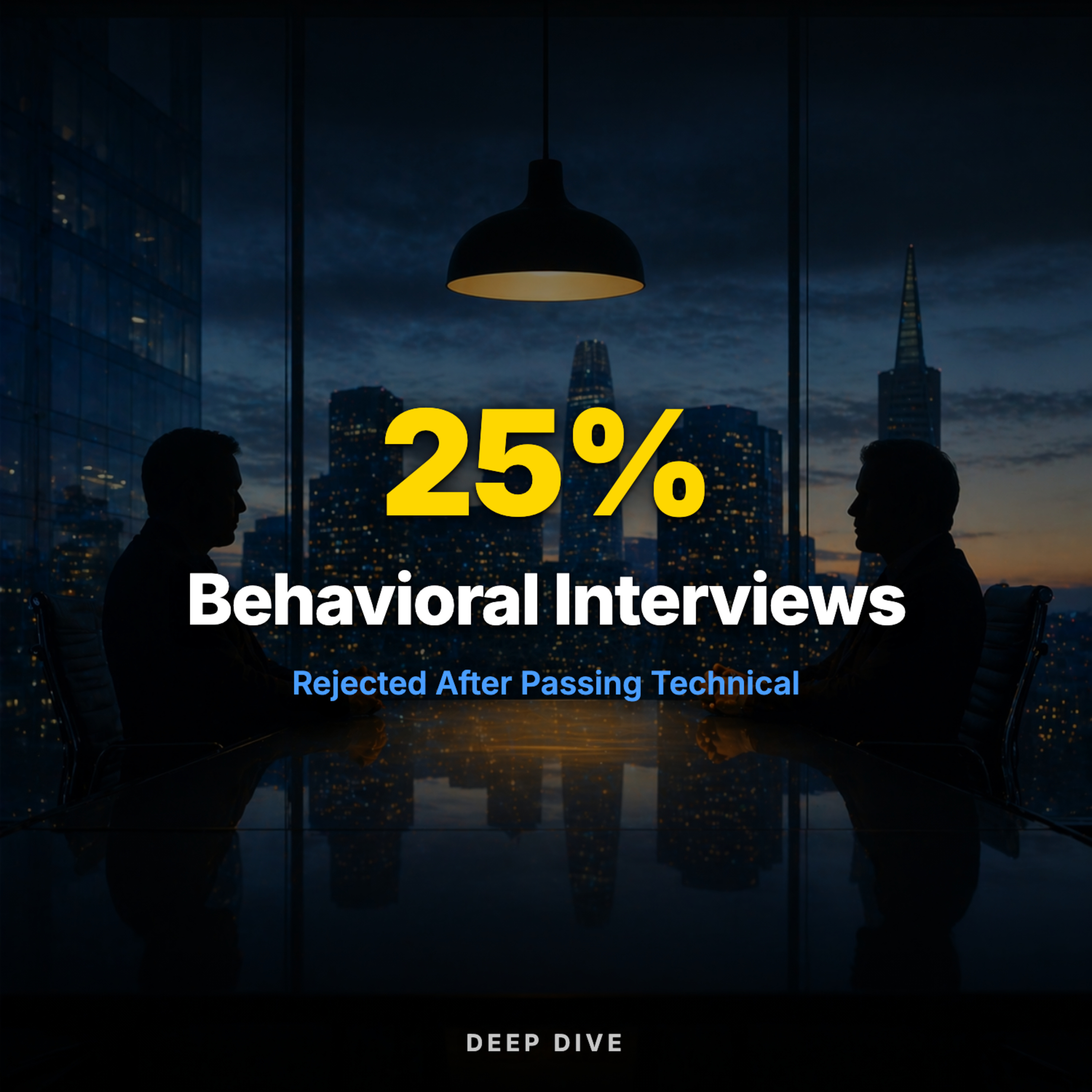
25% of engineers who pass Amazon's technical bar get rejected on behavioral. At senior level, 63% get downleveled. Not because they can't code — because their stories showed mid-level scope when the role needed senior. Every big tech company runs behavioral. They all test different things. Amazon: 16 Leadership Principles + Bar Raiser veto. Interviewing.io's compression — lead with customer impact and you cover most of them. Google: four attributes, Googleyness as the disqualifier even if you ace algorithms. Apple: customer experience and shipping minimalism — Amazon-scale brag answers fail here. Anthropic: barred AI in applications May 2025, reversed two months later. Microsoft: Growth Mindset since Nadella. Netflix: Keeper Test, Culture Memo — "I needed approval" is a red flag. Meta: 45-minute Jedi interview, six axes. STAR is fine as a starting point. Actions should be 50-60% of your answer; most candidates do the opposite. STAR ends at Result — interviewers want Learning. CARL: Context-Action-Result-Learning. Google's STAR-L adds 15% on what you'd do differently. Decode-Select-Deliver: the framework that beats memorizing dozens of stories. Decode what signal the interviewer wants. Select the largest-scope story even if it's not a perfect fit. Deliver four to five versatile stories that flex across questions. Junior vs staff is scope. Same disagreement story sounds different at L4 vs L6. Worked examples in the episode: disagreement, failure, ambiguity, influence-without-authority, Amazon Earn Trust — weak version vs strong version, with specific numbers. The 10 mistakes that sink most candidates: no impact metrics, conflict-detail trap, 'we' vs 'I,' naming Leadership Principles at Amazon, too much setup, sanitized failures, winging it. Interviewing.io scored 1,000+ technical interviews: only 20% of candidates perform consistently. The other 80% show major variance — a third of high-mean candidates bombed at least one round. Biggest predictor of success: number of practice interviews. AI is making behavioral more important, not less — in-person rounds rose from 24% to 38% (2022-2025) because behavioral can't be gamed. RELATED EPISODES System Design Interviews — sister episode on the technical rubric The AI Layoff Gap — Anthropic-banned-AI-in-hiring quote in its labor context When AI Agents Go to Court — Workday/Eightfold algorithmic-hiring case the AI-in-application bans foreshadow CHAPTERS 00:00 Cold open — 25% rejected, 63% downleveled 00:45 Company rubrics — Amazon's 16 LPs and the Bar Raiser 01:32 Google's four attributes and the Googleyness disqualifier 02:05 Apple's customer-experience filter, Anthropic's brief AI-in-apps ban 03:28 Microsoft's Growth Mindset, Netflix's Keeper Test and Culture Memo 07:05 Meta's Jedi interview 07:32 Why STAR breaks down — actions should be 50-60% of the answer 08:14 CARL, STAR-L, and the Decode-Select-Deliver framework 09:38 Junior vs staff is scope — and why 63% get downleveled 11:00 Worked example: disagreement at weak vs strong level 12:19 Failure question, ambiguity question, influence without authority 15:18 Amazon Earn Trust — be honest, not nice 15:57 The 10 mistakes from 500 Amazon + 1,000 Meta interviews 17:31 How interviewers actually score — Google 1-4, Amazon Bar Raiser 18:42 Interviewing.io: only 20% of candidates perform consistently 20:34 Why AI is making behavioral more important, not less 21:21 The playbook SOURCES Interviewing.io — analysis of 1,000+ technical interviews Amazon — 16 Leadership Principles + Bar Raiser process Google — Project Oxygen + hiring committee structure Netflix — Culture Memo, Keeper Test Anthropic — May/Jul 2025 hiring AI-use policy reversal Microsoft — Satya Nadella's Growth Mindset rollout Meta — Jedi interview rubric (former hiring committee chairs) Triplebyte / IEEE — in-person vs remote interview trends 2022-2025
Embed this episode
Ready to play
Behavioral Interviews: What Big Tech Actually Evaluates
No transcript for this episode yet
Similar Episodes
No similar episodes found.
Similar Podcasts
No similar podcasts found.