
EPISODE · Sep 4, 2025 · 1H 3M
Being a Priest in ancient Egypt: Power, Ritual, and the Divine
from Afterlives of Ancient Egypt with Kara Cooney · host Kara Cooney and Jordan Galczynski
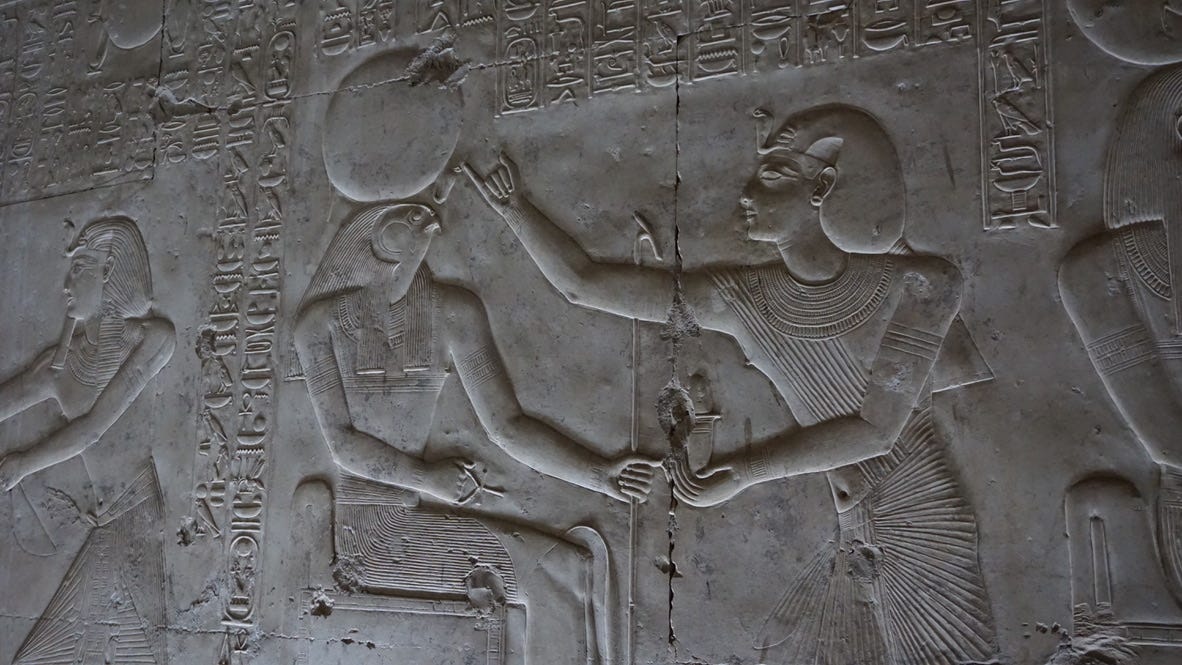
Egyptian priests didn’t just waft incense and mutter incantations; they had to run the cosmic machine, make sure the sun rose and set, the Nile rose and receded as appropriate. From feeding the gods to managing temple estates, priesthood sat where divinity, money, and monarchy intersected. It’s not that the Egyptian priests were so simple-minded as to believe humans were needed for grand actions of cosmic continuance, but rather they realized pleasing the gods would bring the best version of divine power into the human world—whether that best version was copper (Hathor), wheat and barley (Osiris), inundation (Sobek), healthy children (Isis), or miraculous craft (Ptah). The Egyptians thus knew they had to create a perfect habitat to pull the gods into their human spaces. First the god needed a body, a sacred statue made of precious things like gold, silver, electrum, precious stones, glass. Then that body needed a grand house, the temple. And the divinity would have to be carefully cleaned and anointed, fed the best bread and beer, wine and beef, duck and lettuce. The gods had to be dressed in fine linens, entertained with dancing and music. Without such magnificent bribery, they wouldn’t be pulled into the realm of the human, we are told, and they wouldn’t bestow their gifts. This was a give and take world, after all. Divine-human quid pro quo. When you tug on the priestly thread of religion in ancient Egypt, the garment unravels into issues of restricted knowledge, kingship, patriarchy, money, land, and power. Let’s start with the basics: what was a priest in ancient Egypt? When you think of an Egyptian priest, think of a specialist, someone set apart and equipped with bespoke and unusual knowledge of how to connect with the divine. He could read and write; he had thousands of incantations memorized. He knew the movements to make in front of the shrine, how loudly or quietly to speak, when to raise or lower his eyes. He held restricted knowledge that few had—spells that woke the god, calmed them, provided the conditions for their transformations—because in the end every god was representative of a life and death cycle that had to be renewed. Osiris had to be transformed seasonally, the sun god daily, the goddess yearly. Never forget that his knowledge of texts and spells made him privileged. It gave him power and access to those with political, economic and military power. And in ancient Egypt, these worldly powers were combined with religious powers such that the pharaoh was the highest of high priests atop a hierarchy descending down to his chief priests, lector priests, and on to the lowest wab priest, all of them helping to run the whole sacred-human game. But alongside the rituals that sustained the gods and the cosmos came bureaucracy, taxes, the constant search for income to keep the temple open. Priests didn’t just chant incantations and carry out their religious duties—they managed vast estates, redistributed offerings, and, in many cases, enriched themselves. They also needed to pay / feed their employees, other priests. When the state pulled their financial support, they invented a number of income creating schemes, including animal mummies and votives available for purchase. Selling a couple thousand of those a year would set a Late Period temple up well. So, were the Egyptians devout? Absolutely. But not in the way we think of “belief.” They didn’t sit around wondering if the gods were real. Divinity was everywhere—the sun on your skin, the river rising or not, the fate of your harvest. You got up in the morning and did your rituals because if you didn’t, the whole system might collapse. It wasn’t a question of faith. It was survival—pull the gods into your man-made temples or suffer the consequences. So go hug a tree, light a candle, pull a tarot card—make your own connection to the spirit world. The Egyptians would tell you it’s not about belief. It’s about participation.Show Notes* Forshaw, Roger. The Role of the Lector in Ancient Egyptian Society. Archaeopress, 2014. JSTOR, https://doi.org/10.2307/j.ctvqc6jxb. Accessed 1 Sept. 2025.* Sauneron, Serge. 1960. The priests of ancient Egypt. Translated by Ann Morrissett. Evergreen Profile Book 12. New York: Grove.* Wilkinson. 2000. The Complete Temples of Ancient Egypt. * Lazaridis, Nikolaos. 2010. Education and apprenticeship. Edited by Elizabeth Frood and Willeke Wendrich. UCLA Encyclopedia of Egyptology 2010 (October), 14 p., 2 figs [ills].* Haring, Ben. 2007. Ramesside temples and the economic interests of the state: crossroads of the sacred and the profane. In Fitzenreiter, Martin (ed.), Das Heilige und die Ware: Eigentum, Austausch und Kapitalisierung im Spannungsfeld von Ökonomie und Religion, 165-170. London: Golden House.* Haring, B. J. J. 1997. Divine households: administrative and economic aspects of the New Kingdom royal memorial temples in western Thebes. Egyptologische Uitgaven 12. Leiden: Nederlands Instituut voor het Nabije Oosten.* Gillam, Robyn. 2016 “The Priestesses of Hathor: Their Function, Decline and Disappearance.”* God’s Wife of Amun* Ayad, Mariam F. (2009). God's Wife, God's Servant: The God's Wife of Amun (c. 740–525 BC). Routledge. ISBN 9780415411707.* See also Kara’s monograph on Hatshepsut, “The Women Who Would Be King” * Personal Piety* Baines, John. 2021. Was the king of Egypt the sole qualified priest of the gods? In Collombert, Philippe, Laurent Coulon, Ivan Guermeur, and Christophe Thiers (eds), Questionner le sphinx: mélanges offerts à Christiane Zivie-Coche 1, 73-97. Le Caire: Institut français d'archéologie orientale.* Kemp, Barry J. 1995. How religious were the ancient Egyptians? Cambridge Archaeological Journal 5 (1), 25-54. DOI: 10.1017/S0959774300001177* Sola Busca TarotAncient/Now is a reader-supported publication. All is free and available, but Jordan and Amber cannot work for free! To receive new posts and support our work, consider becoming a free or paid subscriber. Get full access to Ancient/Now at ancientnow.substack.com/subscribe
Embed this episode
NOW PLAYING
Being a Priest in ancient Egypt: Power, Ritual, and the Divine
No transcript for this episode yet
Similar Episodes
No similar episodes found.
Similar Podcasts
No similar podcasts found.