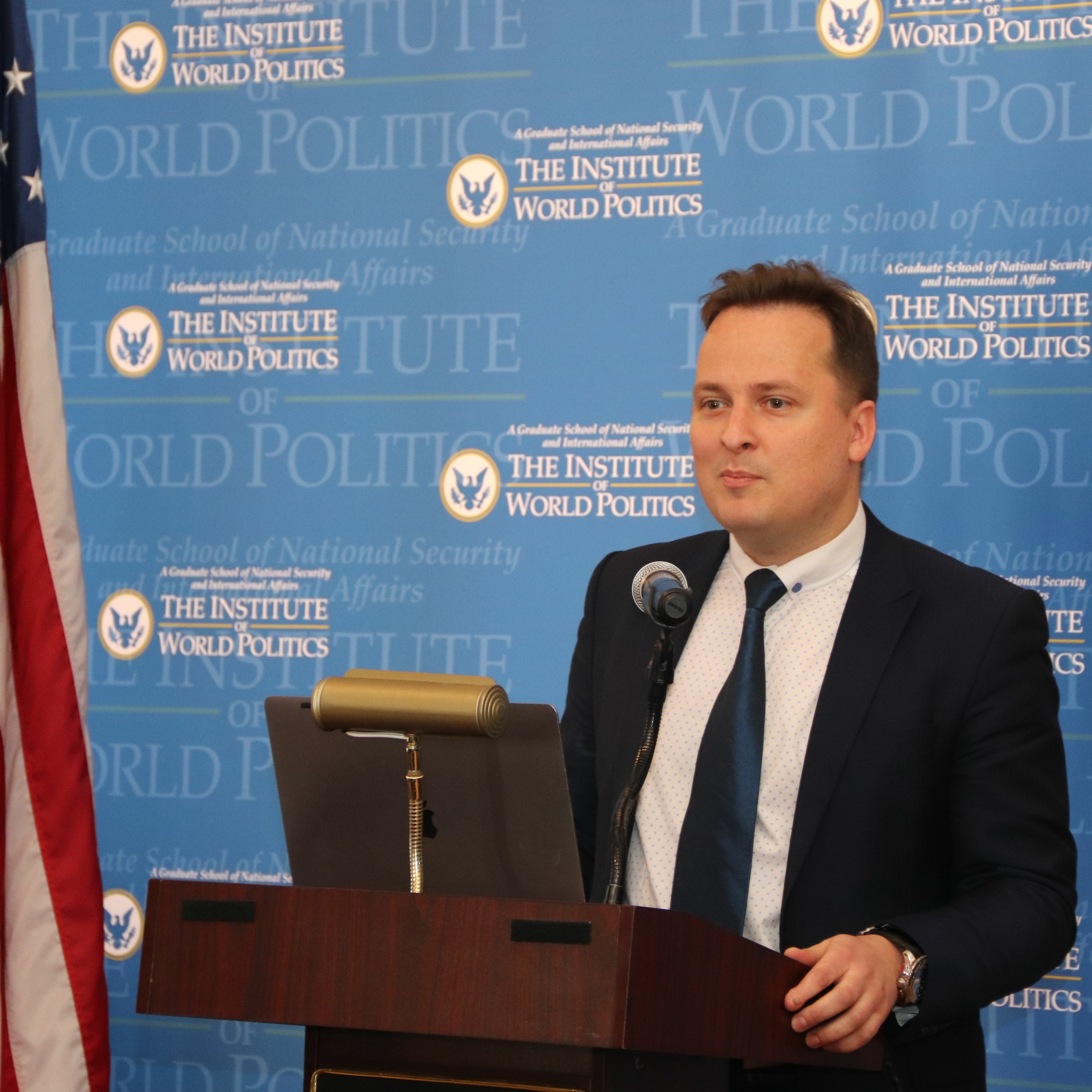
Belarus Under Putin's Radar episode artwork

EPISODE · Feb 27, 2019 · 1H 7M

Belarus Under Putin's Radar

from The Institute of World Politics · host The Institute of World Politics

About the Lecture: Russian Prime Minister Dmitry Medvedev made it clear to Belarusian President Alexander Lukashenka: Minsk must take steps towards deeper integration between the two countries. Polls have shown that, following the rise of Russian media presence in Belarus, pro-Russian sentiment increased within the society. What, exactly, is the situation in Belarus? What role could Belarusian civil society, the EU, and the U.S. play in the new paradigm? About the Speaker: Franak Viačorka is the Vice President of the Digital Communication Network. He concurrently works as the consultant for U.S. Agency for Global Media, and he is the Creative Director of RFE/RL Belarus Service. Mr. Viačorka is a frequent speaker and advocate for democracy and personal freedom in post-Soviet countries. An expert in Russian disinformation, he recently published research on the Kremlin-backed media, Russian Orthodox church, and think-tanks as the Kremlin's “soft-power.” Mr. Viačorka is the founder and vice president of the Belarusian cultural initiative Art Siadziba. In 2014, after the Ukrainian Revolution of Dignity, he launched a nationwide campaign promoting the national identity of Belarus." Before that, he served as a leader of the youth wing of the Belarusian Popular Front (BNF). After suffering through torture while serving under forced conscription in the Belarusian army, Mr. Viačorka’s personal story became the plot for the award-winning, Polish-French film Viva Belarus. His work in Belarus has been chronicled by documentary filmmakers and recognized by many international organizations, including the National Endowment for Democracy, Freedom House, and Open Society Foundations. Mr. Viačorka was the first Vaclav Havel fellow for RFE/RL under Havel’s personal recommendation. Mr. Viačorka has earned degrees from American University in Washington D.C. and Warsaw University in Poland, and he has also studied at Georgetown University and European Humanities University.

About the Lecture: Russian Prime Minister Dmitry Medvedev made it clear to Belarusian President Alexander Lukashenka: Minsk must take steps towards deeper integration between the two countries. Polls have shown that, following the rise of Russian media presence in Belarus, pro-Russian sentiment increased within the society. What, exactly, is the situation in Belarus? What role could Belarusian civil society, the EU, and the U.S. play in the new paradigm? About the Speaker: Franak Viačorka is the Vice President of the Digital Communication Network. He concurrently works as the consultant for U.S. Agency for Global Media, and he is the Creative Director of RFE/RL Belarus Service. Mr. Viačorka is a frequent speaker and advocate for democracy and personal freedom in post-Soviet countries. An expert in Russian disinformation, he recently published research on the Kremlin-backed media, Russian Orthodox church, and think-tanks as the Kremlin's “soft-power.” Mr. Viačorka is the founder and vice president of the Belarusian cultural initiative Art Siadziba. In 2014, after the Ukrainian Revolution of Dignity, he launched a nationwide campaign promoting the national identity of Belarus." Before that, he served as a leader of the youth wing of the Belarusian Popular Front (BNF). After suffering through torture while serving under forced conscription in the Belarusian army, Mr. Viačorka’s personal story became the plot for the award-winning, Polish-French film Viva Belarus. His work in Belarus has been chronicled by documentary filmmakers and recognized by many international organizations, including the National Endowment for Democracy, Freedom House, and Open Society Foundations. Mr. Viačorka was the first Vaclav Havel fellow for RFE/RL under Havel’s personal recommendation. Mr. Viačorka has earned degrees from American University in Washington D.C. and Warsaw University in Poland, and he has also studied at Georgetown University and European Humanities University.

NOW PLAYING

Belarus Under Putin's Radar

0:00 1:07:34

No transcript for this episode yet

We transcribe on demand. Request one and we'll notify you when it's ready — usually under 10 minutes.

Frequently Asked Questions

How long is this episode of The Institute of World Politics?

This episode is 1 hour and 7 minutes long.

When was this The Institute of World Politics episode published?

This episode was published on February 27, 2019.

What is this episode about?

About the Lecture: Russian Prime Minister Dmitry Medvedev made it clear to Belarusian President Alexander Lukashenka: Minsk must take steps towards deeper integration between the two countries. Polls have shown that, following the rise of Russian...

Can I download this The Institute of World Politics episode?

Yes, you can download this episode by clicking the download button on the episode player, or subscribe to the podcast in your preferred podcast app for automatic downloads.
URL copied to clipboard!