
EPISODE · Jun 3, 2025 · 21 MIN
Beyond Fermi: LST-1 Detects Geminga Pulsar Down to 20 GeV
from Multi-messenger astrophysics · host Astro-COLIBRI
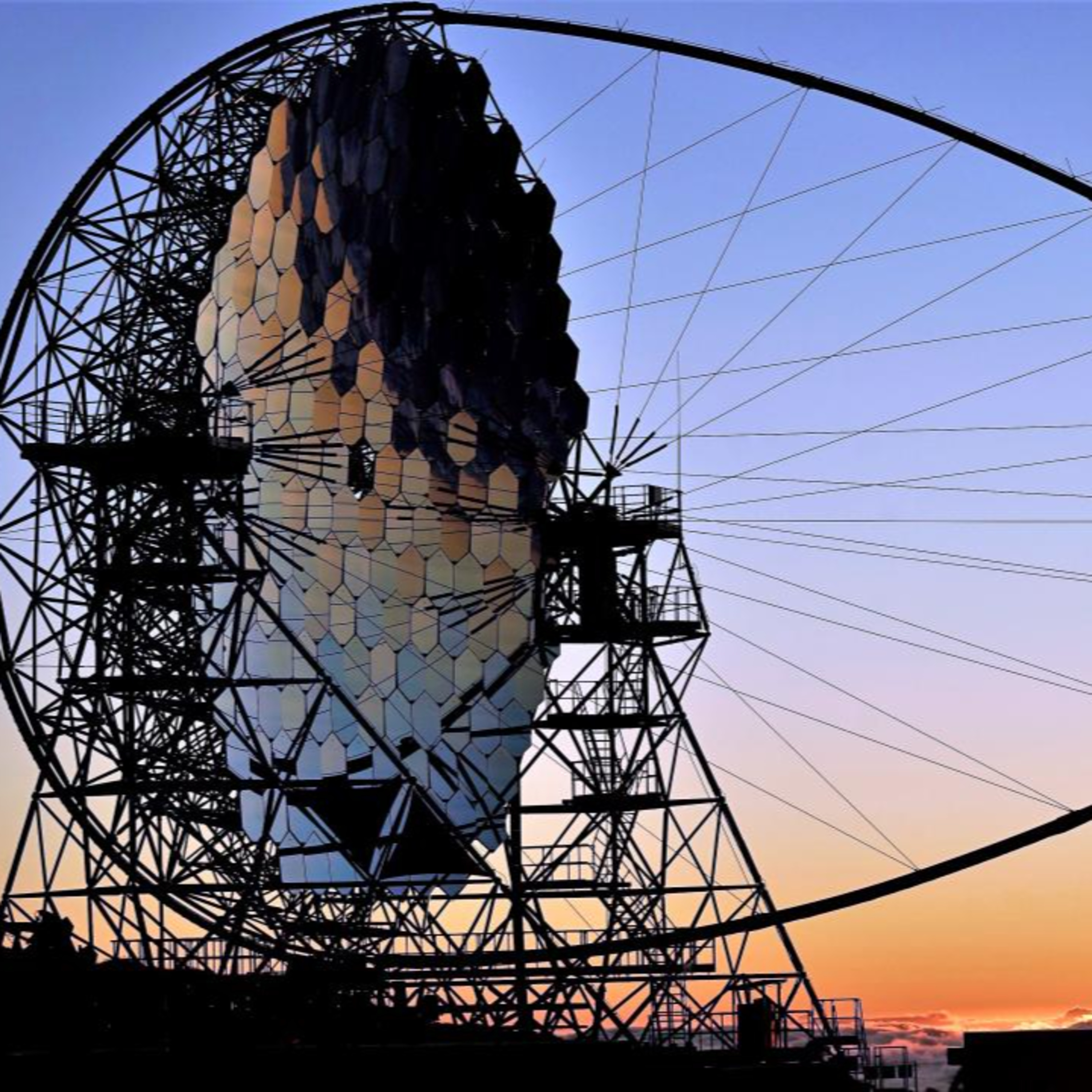
In this episode, we discuss a significant new detection of the Geminga pulsar, a middle-aged, radio-quiet gamma-ray pulsar. The **Large-Sized Telescope (LST-1)**, the first of the Cherenkov Telescope Array Observatory (CTAO) Northern Array, has detected Geminga at energies down to 20 GeV.Key takeaways from the study:* The LST-1 detected the Geminga pulsar using 60 hours of data.* The **second emission peak (P2)** of Geminga was detected with a high significance of **12.2σ** in the energy range between 20 and 65 GeV. This is a doubled significance compared to previous results by the MAGIC Collaboration, achieved with less observation time and a single telescope.* The first peak (P1) was detected at a lower significance level of 2.6σ.* The LST-1 analysis has an estimated energy threshold as low as 10 GeV for pulsar analysis, although the peak in reconstructed energy was around 20 GeV.* The best-fit model for the P2 spectrum was a power law with a spectral index of Γ = 4.5 ± 0.4 (statistical uncertainty). When considering systematic uncertainties, the spectral index is Γ = (4.5 ± 0.4stat)+0.2sys −0.6sys. This is compatible with previous results from the MAGIC Collaboration.* A joint fit of LST-1 and Fermi-LAT data preferred a power law with a sub-exponential cut-off (PLSEC) over a pure exponential cut-off (PLEC), although the PLSEC model didn't fully match the LST-1 points.* While no curvature was detected in the LST-1-only spectrum, combining LST-1 and Fermi-LAT data showed a statistical preference for a curved log parabola model at lower minimum energies (10-20 GeV).* Theoretical models, such as the synchro-curvature (SC) model from Harding et al. (2021), can explain the dominance of the SC component at high energies and the non-detection of the first peak above 20 GeV, although improvements are needed to match the LST-1 SED better.* These results demonstrate the LST-1's excellent capabilities for observing pulsars at the upper end of their spectra and its overlap with the Fermi-LAT energy range. Future observations with the full CTAO Northern Array are expected to improve sensitivity and allow for more detailed studies of the pulsar peaks and spectra.**Reference:*** K. Abe et al. (CTAO LST Project). Detection of the Geminga pulsar at energies down to 20 GeV with the LST-1 of CTAO. *Astronomy & Astrophysics* manuscript no. aa54350-25 ©ESO 2025 May 29, 2025.Acknowledements: Podcast prepared with Google/NotebookLM. Illustration credits: Iván Jiménez (IAC)
Embed this episode
Ready to play
Beyond Fermi: LST-1 Detects Geminga Pulsar Down to 20 GeV
No transcript for this episode yet
Similar Episodes
No similar episodes found.
Similar Podcasts
No similar podcasts found.