
EPISODE · Apr 25, 2026 · 18 MIN
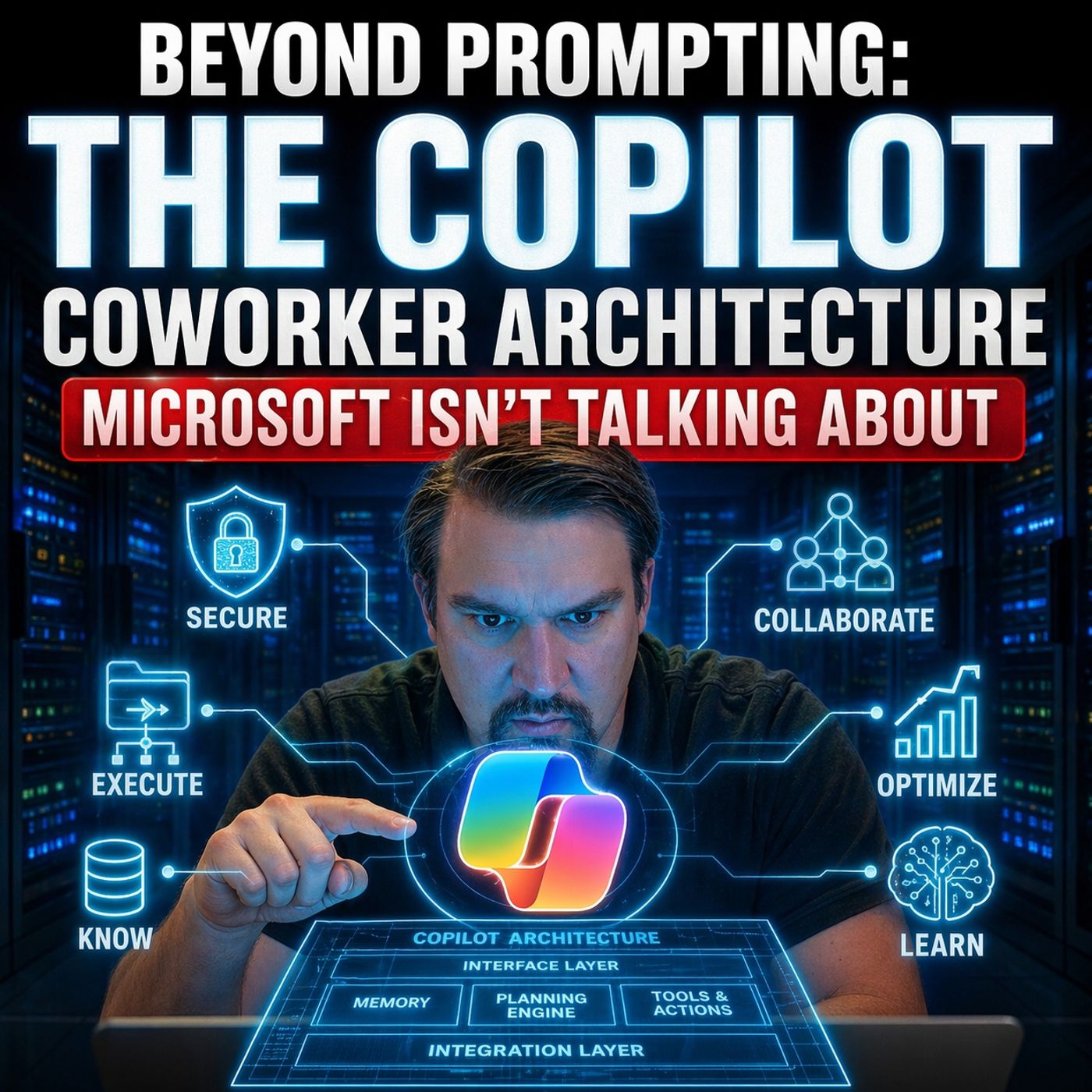
Beyond Prompting: The Copilot Coworker Architecture Microsoft Isn't Talking About
from M365.FM - Modern work, security, and productivity with Microsoft 365 · host Mirko Peters - Founder of m365.fm, m365.show and m365con.net
Prompt engineering is a 2024 solution to a 2026 problem. For the past year, organizations have been told that success with AI comes down to phrasing—finding the perfect prompt. The promise is simple: say the right words, and suddenly your AI behaves like a senior consultant. But that promise doesn’t hold up in real-world environments. A prompt is not intelligence. It’s just a surface-level request hitting a deeply disorganized system. Right now, many organizations treat Copilot like a magic wand. They rely on tricks like “think step-by-step” or curated prompt cheat sheets. But these are band-aids, not strategies. If your data environment is chaotic—unmapped files, duplicate content, conflicting sources—no amount of clever wording will fix the outcome. You’re not guiding a genius.You’re asking a genius to search through a dumpster. We are moving out of the era of improvisation. Prompt hacks don’t scale across teams, departments, or enterprises. The future is not about how well individuals talk to AI—it’s about how well organizations architect the system behind it. We are entering the era of orchestration.THE STRUCTURAL ROT: WHY CONTEXT COLLAPSES What looks like AI failure is often something else entirely: structural rot. You’ve likely seen polished demos where Copilot delivers perfect summaries. But in production environments, results are inconsistent—missing context, pulling outdated data, or contradicting itself. This isn’t randomness. It’s architecture.CONTEXT COLLAPSE The first failure mode is context collapse. Work today is fragmented:Conversations in TeamsIdeas in LoopDocuments in SharePointThe moment these drift apart, there is no longer a single source of truth. Copilot doesn’t resolve conflicts—it guesses.Ask the same question twice → get different answersChat says one thing → document says anotherNo hierarchy → no reconciliationThe system breaks because your data model is broken.MIS-SCOPED POLICYThe second failure is trust erosion through poor governance. Two extremes dominate: Over-restrictive environmentsEverything locked down with PurviewAI cannot access enough dataOutputs become empty or uselessUnder-restrictive environmentsLegacy “open to everyone” linksSensitive data exposed unintentionallyAI surfaces what should have stayed hiddenBoth scenarios destroy trust.Too locked → AI is uselessToo open → AI becomes dangerousAnd once trust is gone, adoption stops.ORPHANED KNOWLEDGE The third—and most dangerous—issue is orphaned knowledge. Every organization has it:Draft_v1Draft_FinalDraft_Final_v2_REALHumans understand context like timestamps and ownership. AI does not. To a model:Old data ≈ New dataStale strategy ≈ Current truthThis creates a dangerous effect: AI doesn’t hallucinate from nothing—it amplifies outdated reality. And that’s worse than no answer at all.BEYOND PROMPTS: THE SHIFT TO ARCHITECTURE We’ve built systems for humans navigating folders. But AI doesn’t navigate. It retrieves. And retrieval requires:Clean dataStructured relationshipsGoverned accessDefined contextIf you don’t fix the foundation, the prompt doesn’t matter. You’re building a skyscraper on a swamp—and arguing about the glass quality.REPLACING THE PROMPT WITH THE DECISION LATTICE The real shift is this: From conversation → to system design A prompt is a request.A business runs on systems. Enter the Decision Lattice. A structured framework where outputs are:groundedrepeatableauditableInstead of hoping someone asks the right question, the system ensures the right answer is inevitable.THE FOUR LAYERS OF THE DECISION LATTICE SIGNALS (RAW INPUTS) These are the incoming streams:EmailsMeetingsTransactionsLogsBut raw signals are just noise—until filtered. Key idea: Not all data deserves to be used.2. CONTEXT (CURATED TRUTH) This is where most organizations fail. Instead of “search everything,” you define:curated SharePoint librariesscoped datasetsGraph connectors for external systemsYou create a boundary of truth.3. DECISION NODE (LOGIC ENGINE) This is where Copilot operates—but not freely. Here you embed:business rulesSOPsrisk logicThe “prompt” becomes:structuredrepeatableembedded in the system4. ACTION (TRUSTED OUTPUT) The result is:auditabletraceableconsistentEvery output can be traced back to:source signalapplied logicgoverning rulesANCHORING THE ARCHITECTURE: BEYOND THE INTERFACE Copilot is not the system. It’s the front door. The real architecture lives underneath:CORE COMPONENTSMicrosoft Graph → the nervous system (relationships + context)Graph Connectors → bridge to external systemsMicrosoft Purview → governance + safety boundariesEntra ID → identity-driven contextMicrosoft Fabric / OneLake → structured data layerCopilot Studio → orchestration + logic designIf these layers are weak:AI becomes inconsistentoutputs become riskytrust collapsesBecome a supporter of this podcast: https://www.spreaker.com/podcast/m365-fm-modern-work-security-and-productivity-with-microsoft-365--6704921/support.
Embed this episode
NOW PLAYING
Beyond Prompting: The Copilot Coworker Architecture Microsoft Isn't Talking About
No transcript for this episode yet
Similar Episodes
No similar episodes found.
Similar Podcasts
No similar podcasts found.