
EPISODE · Aug 20, 2026 · 17 MIN
Beyond Surveillance: How Behavioral Analytics Became a Trust Problem
from Technically U · host Technically U
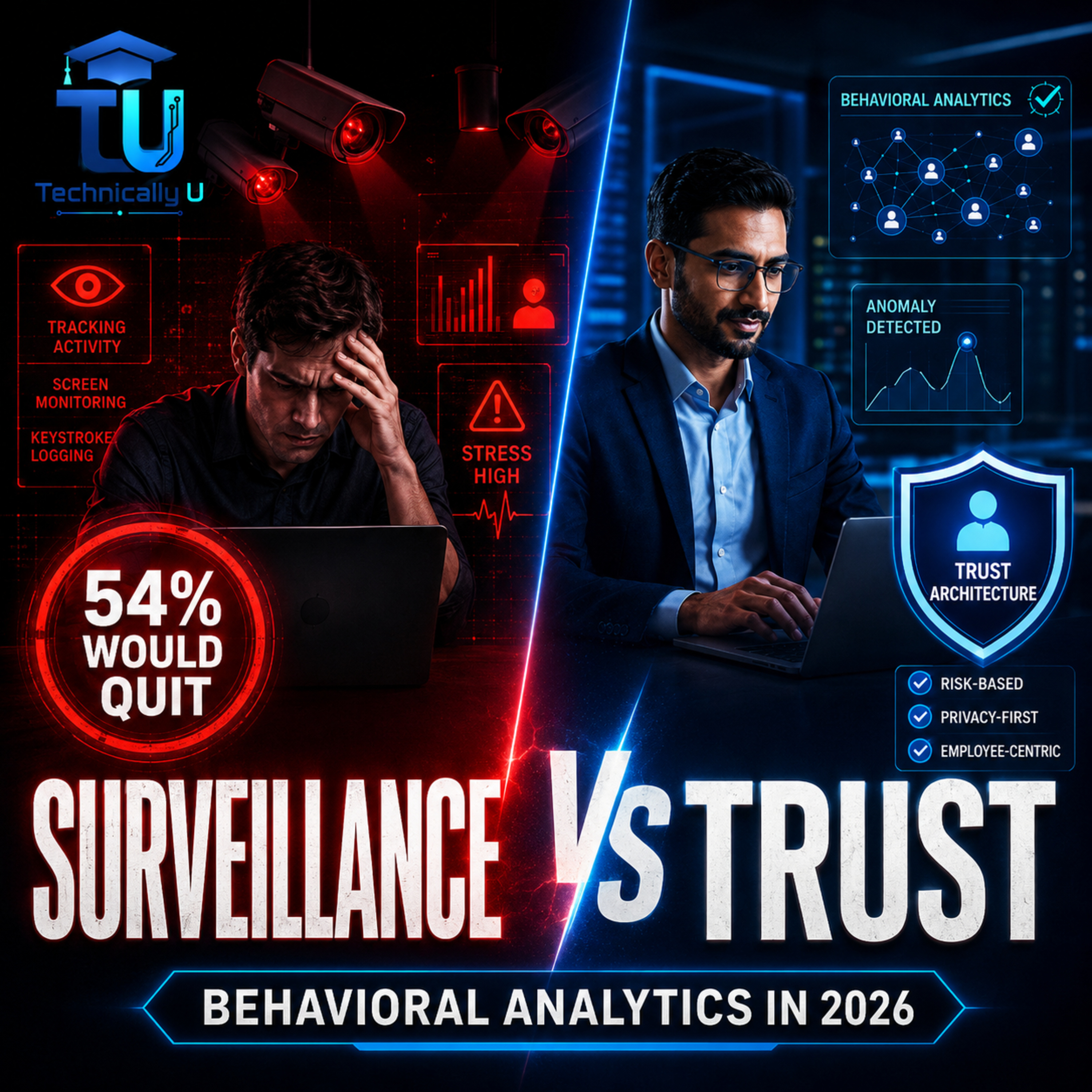
Behavioral Analytics in 2026: How Companies Are Moving From Surveillance to Trust ArchitectureThe paradox nobody talks about: 76% of companies see efficiency gains from monitoring. But 60% of employees report feeling MORE stressed. 54% would quit if surveillance increased. This is how leading organizations are reframing behavioral analytics from "surveillance" to "security."🎯 THE REAL COST OF INSIDER THREATS:$19.5 MILLION: Average annual cost of insider threat incidents per organization (2026)22-24 MILLION: North America average (doubling from 2018INSIDER THREAT BREAKDOWN:- 53% from negligent employees (mistakes, errors, accidents)- 27% from malicious insiders (intentional data theft)- 20% from stolen credentials (external attackers using legitimate access)- 68% of organizations experience 21-40+ insider incidents per YEAR- Average organization: 13.5 incidents annually- Each incident costs $676,517 (negligent) to $715,366 (malicious)SPEED MATTERS:- Caught in 31 days: $10.6M total cost- Caught in 30-90 days: $14.2M average- Caught in 90 days: $18.7M+ total cost- Containment alone costs $211,021 per incidentINCIDENT TYPES:- Credential theft: $779,707 per incident (most expensive)- Malicious insider: $4.7M average total impact- Negligent employee: $4.5M average total impact- Data breach via insider: $4.92M (costliest initial vector)---🚨 THE SURVEILLANCE PARADOX:THE SHORT-TERM GAIN:✅ 76% of companies report increased efficiency after monitoring deployment✅ 86% of large organizations already use some form of monitoring (Gartner 2026)✅ 94% of companies with remote/hybrid work now deploy monitoring toolsTHE LONG-TERM COST:❌ 60% of employees report feeling MORE stressed under surveillance❌ 54% say they would consider quitting if surveillance increased❌ 30% report decreased job satisfaction❌ Companies using invasive monitoring see 22% LOWER productivity long-term than transparent monitoringTHE TRUST GAP:- 68% of managers believe monitoring improves work- 54% of employees say they would quit if surveillance increased- 44% of employees receive NO information about what data is collected about them-77% would accept monitoring IF transparent about itTHE HUMAN COST:Companies optimizing for "looks busy" instead of "actually productive." Invasive monitoring creates short-term activity increases but long-term engagement collapse.---🔒 BEHAVIORAL ANALYTICS VS. SURVEILLANCE:BEHAVIORAL ANALYTICS (Security Tool):✅ Establishes behavioral baselines for each user✅ Flags deviations from normal patterns✅ Uses machine learning to detect anomalies✅ Targeted and efficient✅ 70% faster insider threat detection than traditional monitoring✅ Transparent about what's tracked✅ Involves human review of alertsSURVEILLANCE (Control Tool):❌ Constant recording and monitoring❌ Keystroke logging, screenshots, video surveillance❌ Exhaustive data collection❌ Invasive and stress-inducing❌ Creates compliance and legal risks❌ Often hidden from employees❌ Generates alert fatigueWHICH WORKS BETTER?Organizations using transparent behavioral analytics see 22% higher productivity gains than those using invasive surveillance (Gartner 2026 data).---📊 THE BUSINESS CASE:REASON 1: INSIDER THREAT DETECTION- UEBA-equipped organizations catch insider threats 70% faster- Organizations with UEBA save average of $5.1M annually on insider costs- Every day faster containment = hundreds of thousands in savingsREASON 2: COMPLIANCE & REGULATORY- EU AI Act (August 2, 2026): AI monitoring tools classified as "high-risk"- Emotion recognition AI banned in EU workplaces (February 2025)- 20 US states have enacted privacy laws affecting workplace monitoring- Regulators expect organizations to have behavioral monitoring controls- Lack of controls = audit red flags---
Embed this episode
NOW PLAYING
Beyond Surveillance: How Behavioral Analytics Became a Trust Problem
No transcript for this episode yet
Similar Episodes
No similar episodes found.