Beyond the Burst: How Host Galaxies Shape Fast Radio Bursts episode artwork

EPISODE · Aug 13, 2025 · 16 MIN

Beyond the Burst: How Host Galaxies Shape Fast Radio Bursts

from Multi-messenger astrophysics · host Astro-COLIBRI

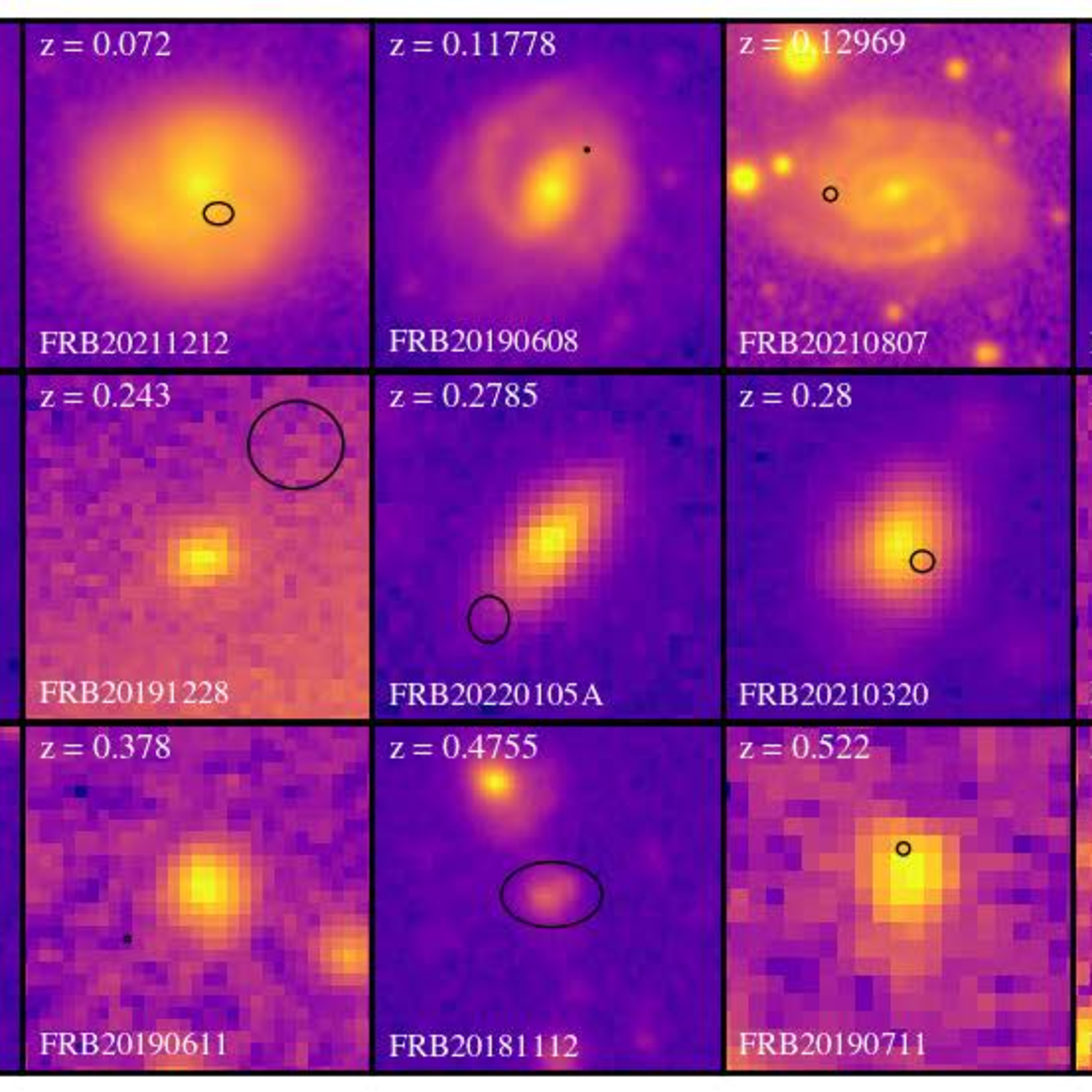
Join us as we explore the latest research into Fast Radio Bursts (FRBs), mysterious, intense pulses of radio emission lasting only milliseconds. These cosmic phenomena are not just fleeting signals; they are powerful probes of the ionized gas across the universe and valuable tools for cosmological studies. In this episode, we delve into an investigation of FRB properties and their host galaxies, aiming to understand how the environment surrounding an FRB influences its observed characteristics.What we discuss:• The Phenomenon of Scattering: Learn how FRBs' paths through ionized media cause "scattering," a frequency-dependent broadening of their pulse profiles. This scattering is thought to primarily originate within their host galaxies.• Key Correlations Found with FRB Scattering: ◦ Compactness and Stellar Surface Density: The study found a highly significant positive correlation between an FRB's scattering timescale (τ) and the stellar surface density (or compactness) of its host galaxy. This suggests that more compact (denser) host galaxies may contain more ionized content, leading to greater scattering of the FRB signal. ◦ Mass-Weighted Age: A highly significant positive correlation was also found between scattering timescale and the mass-weighted age of stars in the host galaxy. This implies that older stellar populations might contribute to increased scattering, though it's not driven by the overall galaxy mass. ◦ Gas-Phase Metallicity: There's a weakly significant positive correlation between scattering timescale and the gas-phase metallicity. Higher metallicity gas could mean more ionizing photons and electrons within the galaxy, contributing to scattering. This might be connected to compactness and mass-weighted age, as these properties can also correlate with metallicity.• Surprising Absences of Correlation for Scattering: ◦ The study found no correlation between FRB scattering and host galaxy stellar mass or star formation rate. ◦ Crucially, there was no correlation found with the galaxy's inclination angle or optical disc axis ratio (b/a) for scattering. This finding challenges previous suggestions of an inclination bias in FRB detection.• Rotation Measure and Galaxy Orientation: ◦ A strong anti-correlation was identified between the absolute Faraday rotation measure (|RMex|) of an FRB and the optical disc axis ratio (b/a) of its host galaxy. This means that FRBs from more edge-on galaxies tend to exhibit greater rotation measures, likely because the signal travels through a larger amount of the galaxy's magnetic field. ◦ The absence of other strong correlations for RM suggests the immediate environment of the FRB progenitor might play a significant role in determining RM, but the host galaxy's orientation is still important.• Polarization Insights: ◦ While some weak correlations were seen for circular polarization fractions, these were often driven by single outlier datapoints and are not considered broadly significant across the sample. No strongly significant correlations were found for linear polarization.• The Modest Sample Size: The researchers emphasize that while several correlations are statistically robust, the sample size is still relatively modest. Further high-time resolution FRB detections and detailed host galaxy follow-up are essential to confirm these initial findings.Source Article:• Glowacki, M., Bera, A., James, C. W., et al. (2020). An investigation into correlations between FRB and host galaxy properties. Cambridge Large Two, 1–21.Acknowledements: Podcast prepared with Google/NotebookLM. Illustration credits: ICRAR

Join us as we explore the latest research into Fast Radio Bursts (FRBs), mysterious, intense pulses of radio emission lasting only milliseconds. These cosmic phenomena are not just fleeting signals; they are powerful probes of the ionized gas across the universe and valuable tools for cosmological studies. In this episode, we delve into an investigation of FRB properties and their host galaxies, aiming to understand how the environment surrounding an FRB influences its observed characteristics.What we discuss:• The Phenomenon of Scattering: Learn how FRBs' paths through ionized media cause "scattering," a frequency-dependent broadening of their pulse profiles. This scattering is thought to primarily originate within their host galaxies.• Key Correlations Found with FRB Scattering: ◦ Compactness and Stellar Surface Density: The study found a highly significant positive correlation between an FRB's scattering timescale (τ) and the stellar surface density (or compactness) of its host galaxy. This suggests that more compact (denser) host galaxies may contain more ionized content, leading to greater scattering of the FRB signal. ◦ Mass-Weighted Age: A highly significant positive correlation was also found between scattering timescale and the mass-weighted age of stars in the host galaxy. This implies that older stellar populations might contribute to increased scattering, though it's not driven by the overall galaxy mass. ◦ Gas-Phase Metallicity: There's a weakly significant positive correlation between scattering timescale and the gas-phase metallicity. Higher metallicity gas could mean more ionizing photons and electrons within the galaxy, contributing to scattering. This might be connected to compactness and mass-weighted age, as these properties can also correlate with metallicity.• Surprising Absences of Correlation for Scattering: ◦ The study found no correlation between FRB scattering and host galaxy stellar mass or star formation rate. ◦ Crucially, there was no correlation found with the galaxy's inclination angle or optical disc axis ratio (b/a) for scattering. This finding challenges previous suggestions of an inclination bias in FRB detection.• Rotation Measure and Galaxy Orientation: ◦ A strong anti-correlation was identified between the absolute Faraday rotation measure (|RMex|) of an FRB and the optical disc axis ratio (b/a) of its host galaxy. This means that FRBs from more edge-on galaxies tend to exhibit greater rotation measures, likely because the signal travels through a larger amount of the galaxy's magnetic field. ◦ The absence of other strong correlations for RM suggests the immediate environment of the FRB progenitor might play a significant role in determining RM, but the host galaxy's orientation is still important.• Polarization Insights: ◦ While some weak correlations were seen for circular polarization fractions, these were often driven by single outlier datapoints and are not considered broadly significant across the sample. No strongly significant correlations were found for linear polarization.• The Modest Sample Size: The researchers emphasize that while several correlations are statistically robust, the sample size is still relatively modest. Further high-time resolution FRB detections and detailed host galaxy follow-up are essential to confirm these initial findings.Source Article:• Glowacki, M., Bera, A., James, C. W., et al. (2020). An investigation into correlations between FRB and host galaxy properties. Cambridge Large Two, 1–21.Acknowledements: Podcast prepared with Google/NotebookLM. Illustration credits: ICRAR

NOW PLAYING

Beyond the Burst: How Host Galaxies Shape Fast Radio Bursts

0:00 16:57

No transcript for this episode yet

We transcribe on demand. Request one and we'll notify you when it's ready — usually under 10 minutes.

The 48 Laws of Power by Robert Greene (Full Audiobook) Robert Greene Amoral, cunning, ruthless, and instructive, this multi-million-copy New York Times bestseller is the definitive manual for anyone interested in gaining, observing, or defending against ultimate control – from the author of The Laws of Human Nature.In the book that People magazine proclaimed “beguiling” and “fascinating,” Robert Greene and Joost Elffers have distilled three thousand years of the history of power into 48 essential laws by drawing from the philosophies of Machiavelli, Sun Tzu, and Carl Von Clausewitz and also from the lives of figures ranging from Henry Kissinger to P.T. Barnum.Some laws teach the need for prudence (“Law 1: Never Outshine the Master”), others teach the value of confidence (“Law 28: Enter Action with Boldness”), and many recommend absolute self-preservation (“Law 15: Crush Your Enemy Totally”). Every law, though, has one thing in common: an interest in t API Intersection Stoplight Building a successful API requires more than just coding. It starts with collaborative design, focuses on creating a great developer experience, and ends with getting your company on board, maintaining consistency, and maximizing your API’s profitability.In the API Intersection, you’ll learn from experienced API practitioners who transformed their organizations, and get tangible advice to build quality APIs with collaborative API-first design.Jason Harmon brings over a decade of industry-recognized REST API experience to discuss topics around API design, governance, identity/auth versioning, and more.They’ll answer listener questions, and discuss best practices on API design (definition, modeling, grammar), Governance (multi-team design, reviewing new API’s), Platform Transformation (culture, internal education, versioning) and more.They’ll also chat with experienced API practitioners from a wide array of industries to draw out practical takeaways and insights you can use.H MTG PodQuest Echoblade Studios Podcast reporting events relating to Magic: The Gathering Puzzle Quest, and specifically covering ”The Gods of Theros” multi-coalition for the online game Magic: The Gathering--Puzzle Quest. Can be enjoyed by any players of MTGPQ or anybody with ears. Maybe.TRIGGER WARNING: A LOT of nerdy stuff. Possibly an occasional vulgarity, though we keep that to a minimum. Passive Investing Podcast The Real Estate Women The Passive Investing Podcast is a round table discussion where we teach you how to create a stream of passive income through Multi Family investing. Crystal, Candy, Colleen & Tamara dive into the classroom, board room and living room on Multi Family real estate investing, with Guests Matt Pichney, Rod Khleif, and Julie Holly pulling up a chair to share stories and insight on their areas of expertise. Whether you’re trying to jump into real estate to free yourself from the grind of the 9-5, to build a stream of passive income or to create generational wealth, join us at the table!

Frequently Asked Questions

How long is this episode of Multi-messenger astrophysics?

This episode is 16 minutes long.

When was this Multi-messenger astrophysics episode published?

This episode was published on August 13, 2025.

What is this episode about?

Join us as we explore the latest research into Fast Radio Bursts (FRBs), mysterious, intense pulses of radio emission lasting only milliseconds. These cosmic phenomena are not just fleeting signals; they are powerful probes of the ionized gas across...

Can I download this Multi-messenger astrophysics episode?

Yes, you can download this episode by clicking the download button on the episode player, or subscribe to the podcast in your preferred podcast app for automatic downloads.
URL copied to clipboard!