
EPISODE · Jun 23, 2026 · 1H 12M
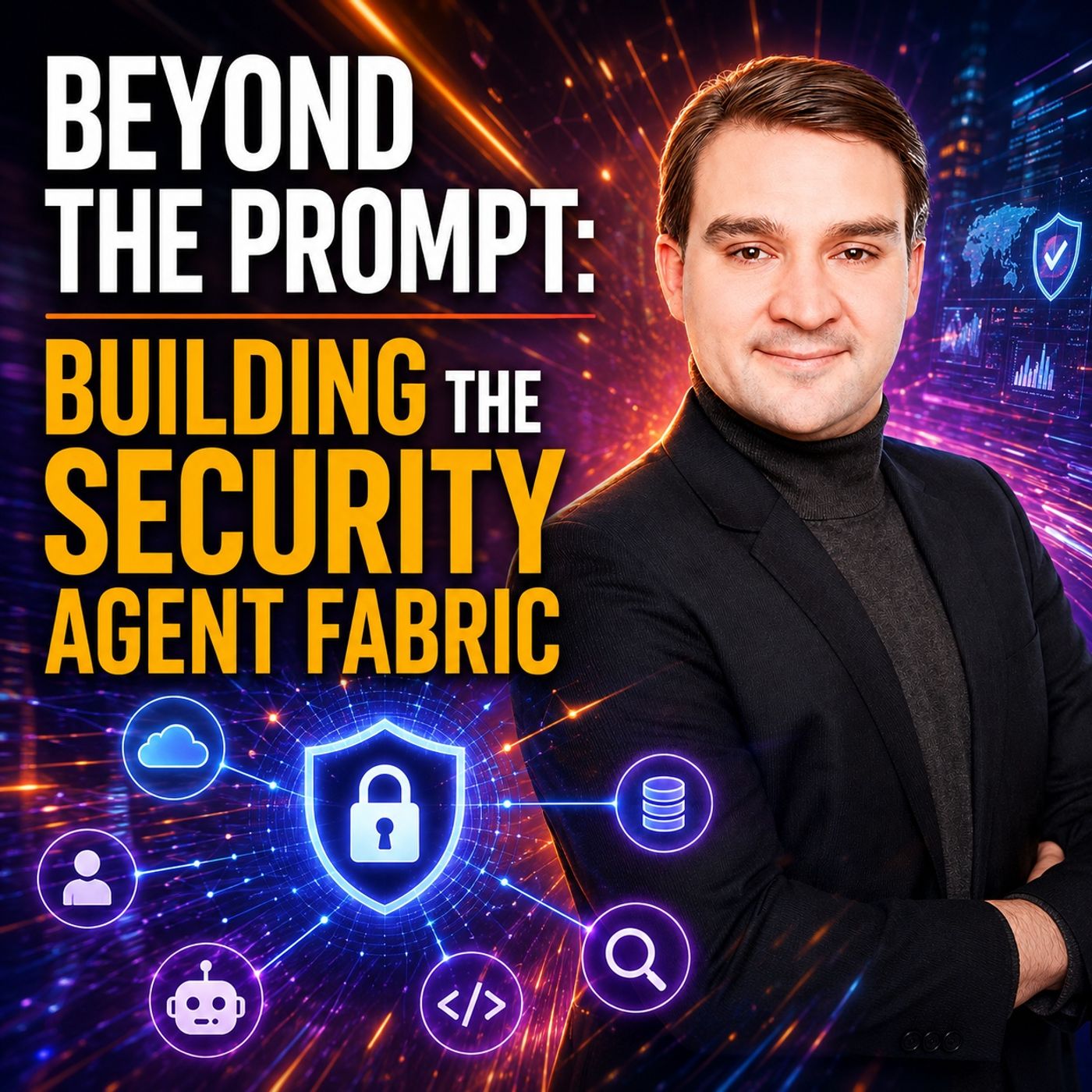
Beyond the Prompt: Building the Security Agent Fabric
from M365.FM - Modern work, security, and productivity with Microsoft 365 · host Mirko Peters - Founder of m365.fm, m365.show and m365con.net
What if the biggest bottleneck in your Security Operations Center isn't your technology stack—but the humans forced to orchestrate it?In this episode of the M365.fm Podcast, we explore one of the most important shifts happening in cybersecurity today: the rise of Agentic Defense and the emergence of the Security Agent Fabric.For years, organizations have tried to solve security challenges by adding more tools, generating more alerts, and hiring more analysts. Yet burnout continues to rise, alert fatigue remains a critical issue, and attackers continue to exploit the gaps created by human bottlenecks.The reality is simple: modern security environments generate far more signals than humans can realistically process. Cloud platforms, hybrid environments, identity systems, endpoints, and applications all produce enormous amounts of telemetry. The traditional SOC model wasn't designed for this scale.This episode examines how security teams are moving beyond simple automation and toward intelligent agent orchestration, where AI-powered security agents enrich, correlate, validate, and even act on security signals while keeping humans focused on high-value decisions.THE HUMAN MIDDLEWARE PROBLEMOne of the most thought-provoking concepts discussed is the idea of "human middleware."Most analysts spend a significant portion of their day opening alerts, gathering context, enriching incidents, switching between tools, and manually correlating data. Instead of focusing on risk reduction, they become the orchestration layer connecting disconnected systems.We discuss why this architecture is fundamentally unsustainable and how agentic systems can remove repetitive work from analysts while improving consistency, speed, and security outcomes.WHY MTTR IS THE WRONG SECURITY METRICSecurity leaders often focus on Mean Time To Respond (MTTR), but does closing tickets faster actually make organizations safer?This conversation explores why traditional SOC metrics can incentivize the wrong behaviors and why dwell time—the amount of time attackers remain undetected inside an environment—may be a far more valuable measure of security effectiveness.Rather than optimizing for ticket closure, modern security operations must optimize for risk reduction, validation, and threat containment.FROM SECURITY COPILOTS TO AUTONOMOUS AGENTSThe episode dives deep into the evolution from AI assistants to fully autonomous security agents.We explore:• Assistive AI systems that recommend actions• Semi-autonomous agents that execute low-risk decisions• Fully autonomous workflows operating inside governance boundaries• Human oversight models for high-impact security actions• Building trust through transparency and explainable reasoningUnderstanding where your organization sits on this autonomy spectrum may determine how quickly you can scale security operations in the years ahead.REAL-WORLD SECURITY AGENT USE CASESThe discussion includes practical examples of agentic security workflows already delivering measurable results today.Topics include:• Phishing triage agents• EDR alert investigation agents• Identity protection agents• Conditional Access optimization agents• Cloud security validation agentsYou'll learn how organizations are achieving dramatic reductions in analyst workload while improving detection accuracy and reducing attacker dwell time.THE POWER OF MULTI-AGENT ARCHITECTURESOne of the most fascinating sections of the conversation examines Microsoft's MDASH framework and why the future of security AI isn't about building bigger models.Instead, success comes from orchestration.Specialized agents perform distinct functions including:• Discovery and scanning• Validation and adversarial review• Proof generation and exploit validation• Deduplication and signal refinement• Confidence scoring and consensus buildingThis multi-agent approach creates systems that are not only faster but significantly more trustworthy and accurate.GOVERNANCE, TRUST, AND THE AUTONOMY CHALLENGEAs agents gain more authority, they must be treated as first-class operational entities rather than simple software tools.The episode explores:• Agent identities and permissions• Least-privilege design principles• Auditability and transparency requirements• Human override mechanisms• Feedback loops and continuous learning• Governance frameworks for autonomous security systemsWithout governance, autonomy creates risk. With governance, autonomy becomes a force multiplier.HOW THE SOC ROLE IS EVOLVINGPerhaps the most important takeaway is that security professionals aren't being replaced—they're being elevated.The role of the modern SOC analyst is shifting away from repetitive triage and toward:• Agent supervision• Detection engineering• Security architecture• AI governance• Prompt and workflow optimization• Security operations engineeringThe future SOC is less about processing alerts and more about designing and supervising intelligent systems.THE ROAD TO AGENTIC DEFENSETransitioning to agentic security operations is not an overnight transformation.Organizations must progress through stages:Assistive AIHuman-in-the-loop workflowsSemi-autonomous operationsFully governed autonomySuccess depends on strong data quality, clear governance models, analyst training, and a structured implementation roadmap.FINAL THOUGHTSAgentic Defense represents one of the most significant architectural shifts in cybersecurity since the introduction of SIEM platforms and modern SOC operations.As attackers increasingly leverage AI and cloud environments continue generating exponentially more security signals, traditional human-centric workflows are becoming impossible to scale.The future belongs to organizations that successfully combine human judgment with autonomous security agents—creating a Security Agent Fabric capable of validating threats, reducing noise, accelerating investigations, and ultimately shrinking attacker dwell time.The question is no longer whether security agents will become part of the SOC.The question is how quickly organizations can learn to trust, govern, and orchestrate them effectively.Listen now to discover how Agentic Defense is reshaping cybersecurity and why the Security Agent Fabric may become the operating model for modern security teams over the next decade.Become a supporter of this podcast: https://www.spreaker.com/podcast/m365-fm-modern-work-security-and-productivity-with-microsoft-365--6704921/support.
Embed this episode
What this episode covers
What if the biggest bottleneck in your Security Operations Center isn't your technology stack—but the humans forced to orchestrate it?In this episode of the M365.fm Podcast, we explore one of the most important shifts happening in cybersecurity today: the rise of Agentic Defense and the emergence of the Security Agent Fabric.For years, organizations have tried to solve security challenges by adding more tools, generating more alerts, and hiring more analysts. Yet burnout continues to rise, alert fatigue remains a critical issue, and attackers continue to exploit the gaps created by human bottlenecks.The reality is simple: modern security environments generate far more signals than humans can realistically process. Cloud platforms, hybrid environments, identity systems, endpoints, and applications all produce enormous amounts of telemetry. The traditional SOC model wasn't designed for this scale.This episode examines how security teams are moving beyond simple automation and toward intelligent agent orchestration, where AI-powered security agents enrich, correlate, validate, and even act on security signals while keeping humans focused on high-value decisions. THE HUMAN MIDDLEWARE PROBLEM One of the most thought-provoking concepts discussed is the idea of "human middleware."Most analysts spend a significant portion of their day opening alerts, gathering context, enriching incidents, switching between tools, and manually correlating data. Instead of focusing on risk reduction, they become the orchestration layer connecting disconnected systems.We discuss why this architecture is fundamentally unsustainable and how agentic systems can remove repetitive work from analysts while improving consistency, speed, and security outcomes. WHY MTTR IS THE WRONG SECURITY METRIC Security leaders often focus on Mean Time To Respond (MTTR), but does closing tickets faster actually make organizations safer?This conversation explores why traditional SOC metrics can incentivize the wrong behaviors and why dwell time—the amount of time attackers remain undetected inside an environment—may be a far more valuable measure of security effectiveness.Rather than optimizing for ticket closure, modern security operations must optimize for risk reduction, validation, and threat containment. FROM SECURITY COPILOTS TO AUTONOMOUS AGENTS The episode dives deep into the evolution from AI assistants to fully autonomous security agents.We explore: • Assistive AI systems that recommend actions • Semi-autonomous agents that execute low-risk decisions • Fully autonomous workflows operating inside governance boundaries • Human oversight models for high-impact security actions • Building trust through transparency and explainable reasoning Understanding where your organization sits on this autonomy spectrum may determine how quickly you can scale security operations in the years ahead. REAL-WORLD SECURITY AGENT USE CASES The discussion includes practical examples of agentic security workflows already delivering measurable results today.Topics include: • Phishing triage agents • EDR alert investigation agents • Identity protection agents • Conditional Access optimization agents • Cloud security validation agents You'll learn how organizations are achieving dramatic reductions in analyst workload while improving detection accuracy and reducing attacker dwell time. THE POWER OF MULTI-AGENT ARCHITECTURES One of the most fascinating sections of the conversation examines Microsoft's MDASH framework and why the future of security AI isn't about building bigger models.Instead, success comes from orchestration.Specialized agents perform distinct functions including: • Discovery and scanning • Validation and adversarial review • Proof...
NOW PLAYING
Beyond the Prompt: Building the Security Agent Fabric
No transcript for this episode yet
Similar Episodes
No similar episodes found.
Similar Podcasts
No similar podcasts found.