
EPISODE · Jan 16, 2026 · 59 MIN
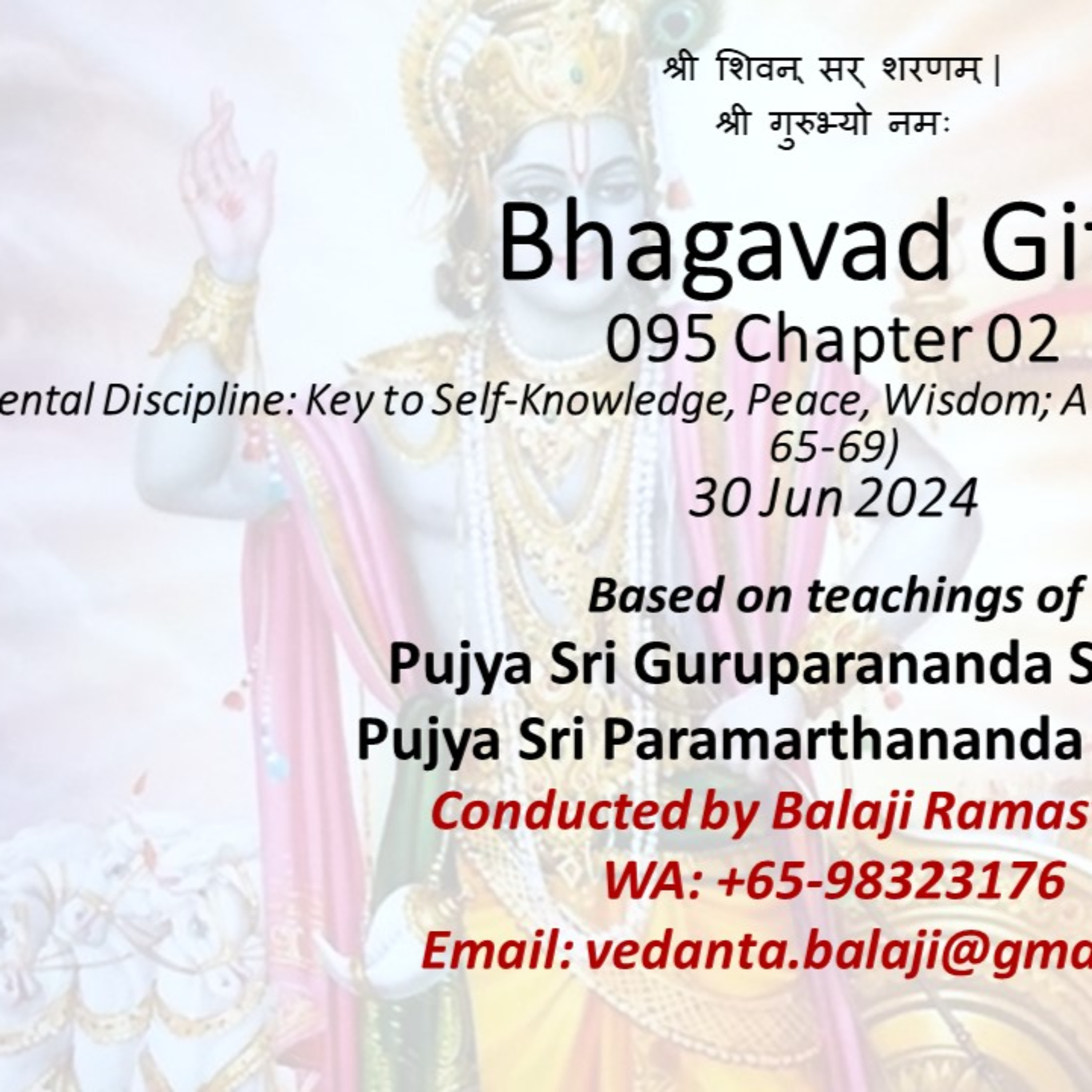
Bhagavad Gita - Class 095 - Chapter 02 Slokas 65-69 - Mental Discipline - Key to Self-Knowledge, Peace, Wisdom; A Jnani is awake to Immortality - Class taken on 30 Jun 2024
from Bhagavad Gita | Advaita Vedanta | English | Balaji Ramaswamy | [email protected] · host Balaji Ramaswamy
Chapter 02 - Sankhya YogaSloka 65 (Contd...) - Establishment of Knowledge Through Tranquil MindDescribe the analogy of the pickle and its relevance to the cultivation of jñāna nishta. How does patience play a role in this process?Explain the phrase "prasanna-chetaso hyāśhu buddhiḥ paryavatiṣhṭhate." What does it signify about the firm establishment of knowledge?Sloka 66 - Mental Discipline: Key to Self-Knowledge and PeaceWhy can’t a person practice Nidhidhyasana effectively if they lack mental discipline?Explain the significance of the phrase "nāsti buddhir-ayuktasya."Why does self-knowledge (ātma jñāna) not arise for an undisciplined person?What is the meaning of the term "buddhiḥ" in this context, and why is it important for self-knowledge?How does mental discipline influence the conversion of words heard during śravaṇam (listening) into knowledge?How does lack of Nidhidhyasana affect a person’s peace (śāntiḥ) ?How does Bhagavan emphasize the necessity of contemplation for achieving peace and withdrawal from worldly activities?Why does Bhagavan question "aśāntasya kutaḥ sukham"?Explain how the analogy of reflection in calm waters relates to ātma ānanda and mental tranquility.Why is the study of the Bhagavad Gītā more than an academic pursuit according to the notes?Sloka 67 - The Impact of Mental Discipline on WisdomHow do the slokas 67 & 68 fit into the broader segment that began in sloka 58?What role do Damaha and Shamaha play as sādanas for Nidhidhyasana?How does the mind following the wandering sense organs affect one's spiritual progress?How is the wandering of the sense organs compared to a grazing cow?What are the dangers when the mind and sense organs wandering without control?Under what conditions can even knowledge be taken away?How are the mind, knowledge, and samsara represented in this analogy?How can an uncontrolled mind lead to the destruction of knowledge?How does the wind typically help a boat, and what happens when it is adverse?What is the broader lesson Bhagavan conveys about the mind's role in spiritual progress?Sloka 68 - Mastering the MindWhat segment is Bhagavan concluding in this sloka?What topics did Bhagavan discuss starting from sloka 58?What will Bhagavan talk about in the last four slokas (69 to 72)?Why is the word "Tasmāt" important in this context?How does sense control contribute to spiritual growth?What does "nigṛhītāni" imply about the state of the sense organs?What should the sense organs be controlled from?How does Bhagavan suggest we can know if our knowledge is firmly established?What is Shastra's stance on suppression of sense organs?How do some Western psychologists misinterpret the concept of sense control in Eastern religions?What is the difference between suppression, uncontrolled expression, and intelligent regulation?What is the desired outcome of channelizing sensory and mental energy?What is the relationship between Shamaha, Damaha, and Nidhidhyasanam?What benefits arise from combining the "oushada" (medicine) and "pathiyam" (diet)?What does "prajñah pratiṣṭhitā" signify?Sloka 69 - Awake to ImmortalityWhat does Bhagavan refer to as "night", and who is awake on that?Explain how a jñāni is described as "awake" on what is considered "night" for ajñānis. What does this reveal about the jñāni's perception of reality?How does Shankaracharya interpret the concepts of day and night in the context of Advaita and Dvaita?What distinguishes a jñāni from an ajñāni in their perception of reality?In what ways does the day-night analogy help elucidate the philosophical concepts of Advaita (non-duality) and Dvaita (duality)?Discuss the implications of seeing Advaita (non-duality) as "day" for a jñāni and Dvaita (duality) as "night" for an ajñāni. How does this impact their respective experiences of the world?Explain the implications of the analogy involving the rope and the snake as discussed in the interpretation.
Embed this episode
NOW PLAYING
Bhagavad Gita - Class 095 - Chapter 02 Slokas 65-69 - Mental Discipline - Key to Self-Knowledge, Peace, Wisdom; A Jnani is awake to Immortality - Class taken on 30 Jun 2024
No transcript for this episode yet
Similar Episodes
No similar episodes found.
Similar Podcasts
No similar podcasts found.