
EPISODE · Feb 27, 2026 · 57 MIN
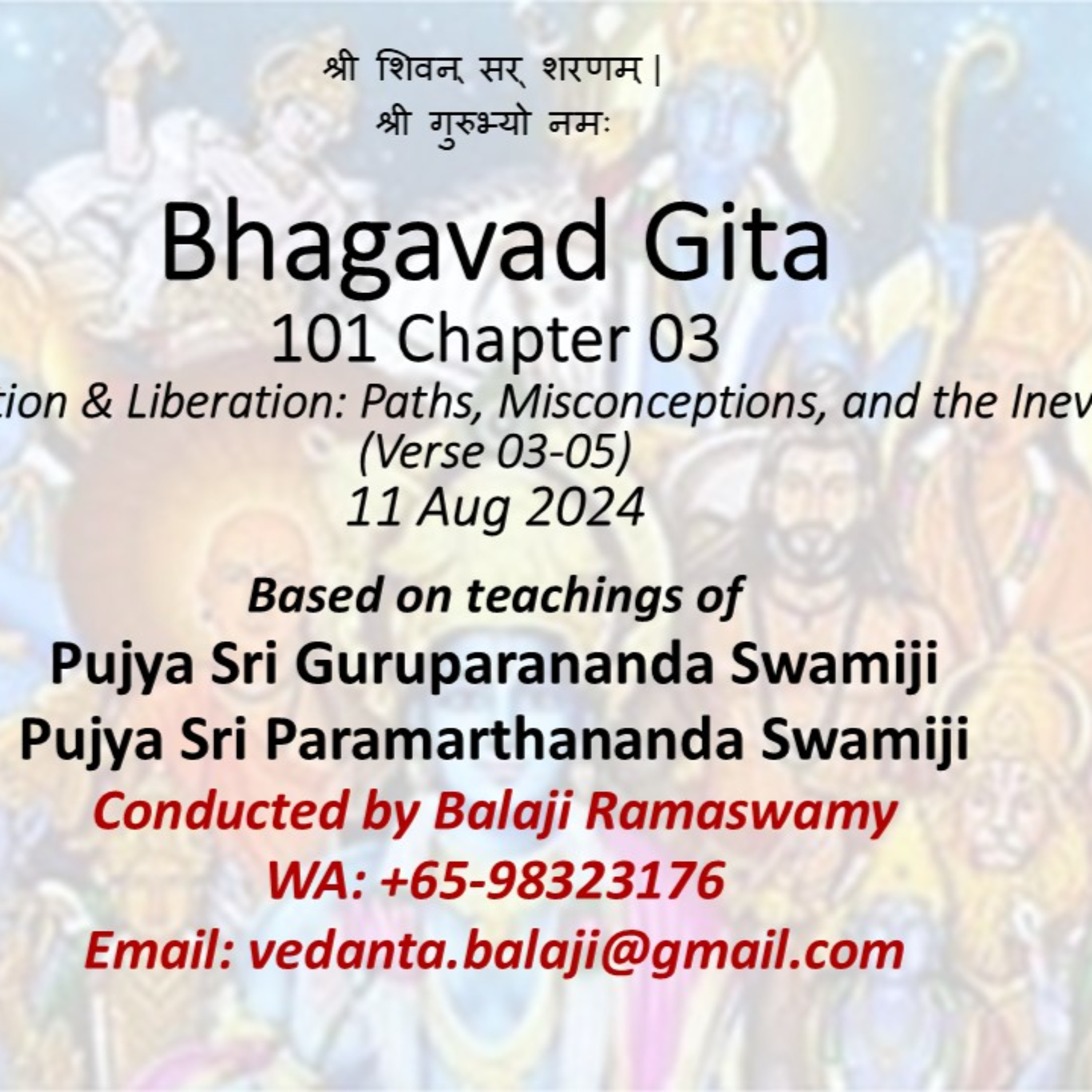
Bhagavad Gita - Class 101 - Chapter 03 Slokas 03-05 - Understanding Action & Liberation: Paths, Misconceptions, and the Inevitability of Action - Class taken on 11 Aug 2024
from Bhagavad Gita | Advaita Vedanta | English | Balaji Ramaswamy | [email protected] · host Balaji Ramaswamy
Chapter 03 - Karma YogaSloka 03 (Contd...) - Path to Liberation: Karma Yoga and Jnana YogaWhat misunderstanding about lifestyle and moksha is common among many people, including Arjuna?What is the consequence of adopting the sannyasa lifestyle without performing karma yōga or jñāna yōga?Why does being a householder not automatically qualify one for jñāna yōga?If sādanas are what determine moksha, why did Bhagavan create the two lifestyles of householder and renunciate?Why is the Grihastha ashrama particularly suitable for performing karma yōga?What does the word 'Yogah' mean, and how does it apply to both jñāna yōga and karma yōga?How does jñāna yōga unite Jivatma with Paramatma?What is the gap between Jivatma and Paramatma that jñāna yōga seeks to bridge?What role does karma yōga play in leading one to jñāna yōga?What information does Bhagavan provide in the subsequent slokas related to jñāna yōga and karma yōga?Sloka 04 - Inaction cannot lead to LiberationWhat is Arjuna's mindset regarding his duty and ashrama, and what does he want to pursue instead?Why does Bhagavan emphasize the necessity of Karma Yoga before Jñāna Yoga in the upcoming slokas?What is the significance of conditioning the mind through Pravrtti Marga before progressing to Nivrrti Marga?What is Bhagavan's response to Arjuna's reluctance to engage in karma and responsibilities?How does Tamo guna influence Arjuna's desire to avoid responsibilities, and what should be done to address it?What would happen if someone in Tamo guna attempted meditation (dhyana)?Why is engaging in activities essential for a brahmachari studying Vedanta in an ashram?How does taking responsibility help transition the mind from Tamo guna to Rajo guna, and eventually to Sattva guna?What does Bhagavan say about avoiding duties and responsibilities in relation to attaining liberation (moksha)?Why is Karma Yoga considered a compulsory step before Jñāna Yoga?What determines moksha: lifestyle or sādanas?Why can't inaction be a means to attain the state of inaction (naiṣkarmyam)?What analogy is used to describe the state of inaction amidst action?Why is mere renunciation or donning ochre robes insufficient for moksha?How does Bhagavan clarify the seemingly contradictory Vedic statements regarding moksha through renunciation?What is the significance of scriptural study in achieving liberation through sannyasa?What is Bhagavan's overall message regarding inaction and renunciation in relation to attaining moksha?What misconception does Bhagavan address regarding responsibilities and samsara?Why is avoiding duties not a valid sādana for moksha or Chitta Shuddhi?How should individuals determine their appropriate sādana and ashrama according to Sastras?What is the essence of the sloka regarding inaction, renunciation, and moksha?What are the three reasons Bhagavan gives in the three slokas to address Arjuna’s mindset?Sloka 05 - Inaction is impossibleIs it possible to remain inactive?What does the term "akarmakṛt" signify in the context of Sloka ?How does Bhagavan explain the inability of anyone to remain inactive, even for a moment?What example is given to illustrate that no one can remain without action?Who or what forces everyone into action, according to the second line of Sloka?What is the significance of prakṛti (maya) in the context of this Sloka?What is the difference between an Ajnani and a Jnani regarding action?Why is it said that an Ajnani cannot remain inactive even for a moment?How does an Ajnani mistakenly perceive their body and mind in relation to ātma?What does it mean when it is said that an Ajnani always considers themselves to be active?How does a Jnani view their actions differently from an Ajnani?What does it mean for a Jnani to be inactive, even when the body is active?What is the first explanation provided for the first line of Sloka 5?How does the second explanation of the first line differ from the first one?
Embed this episode
Ready to play
Bhagavad Gita - Class 101 - Chapter 03 Slokas 03-05 - Understanding Action & Liberation: Paths, Misconceptions, and the Inevitability of Action - Class taken on 11 Aug 2024
No transcript for this episode yet
Similar Episodes
No similar episodes found.
Similar Podcasts
No similar podcasts found.