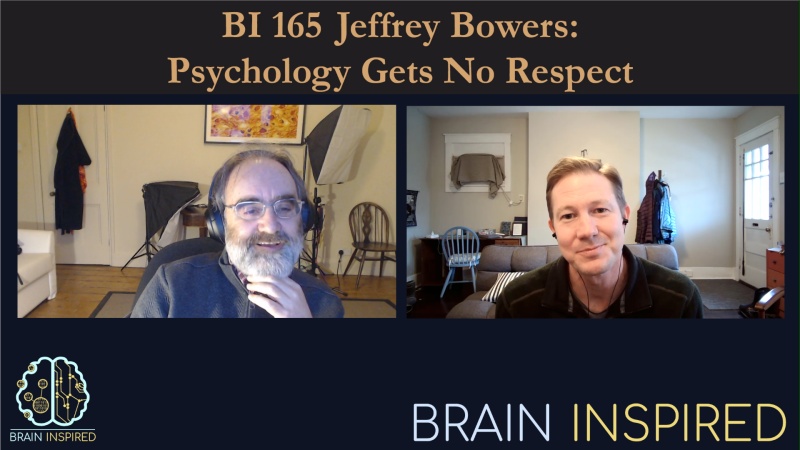
BI 165 Jeffrey Bowers: Psychology Gets No Respect episode artwork

EPISODE · Apr 12, 2023 · 1H 38M

BI 165 Jeffrey Bowers: Psychology Gets No Respect

from Brain Inspired · host Paul Middlebrooks

Check out my free video series about what's missing in AI and Neuroscience Support the show to get full episodes, full archive, and join the Discord community. Jeffrey Bowers is a psychologist and professor at the University of Bristol. As you know, many of my previous guests are in the business of comparing brain activity to the activity of units in artificial neural network models, when humans or animals and the models are performing the same tasks. And a big story that has emerged over the past decade or so is that there's a remarkable similarity between the activities and representations in brains and models. This was originally found in object categorization tasks, where the goal is to name the object shown in a given image, where researchers have compared the activity in the models good at doing that to the activity in the parts of our brains good at doing that. It's been found in various other tasks using various other models and analyses, many of which we've discussed on previous episodes, and more recently a similar story has emerged regarding a similarity between language-related activity in our brains and the activity in large language models. Namely, the ability of our brains to predict an upcoming word can been correlated with the models ability to predict an upcoming word. So the word is that these deep learning type models are the best models of how our brains and cognition work. However, this is where Jeff Bowers comes in and raises the psychology flag, so to speak. His message is that these predictive approaches to comparing artificial and biological cognition aren't enough, and can mask important differences between them. And what we need to do is start performing more hypothesis driven tests like those performed in psychology, for example, to ask whether the models are indeed solving tasks like our brains and minds do. Jeff and his group, among others, have been doing just that are discovering differences in models and minds that may be important if we want to use models to understand minds. We discuss some of his work and thoughts in this regard, and a lot more. Website Twitter: @jeffrey_bowers Related papers: Deep Problems with Neural Network Models of Human Vision. Parallel Distributed Processing Theory in the Age of Deep Networks. Successes and critical failures of neural networks in capturing human-like speech recognition. 0:00 - Intro 3:52 - Testing neural networks 5:35 - Neuro-AI needs psychology 23:36 - Experiments in AI and neuroscience 23:51 - Why build networks like our minds? 44:55 - Vision problem spaces, solution spaces, training data 55:45 - Do we implement algorithms? 1:01:33 - Relational and combinatorial cognition 1:06:17 - Comparing representations in different networks 1:12:31 - Large language models 1:21:10 - Teaching LLMs nonsense languages

Check out my free video series about what's missing in AI and Neuroscience Support the show to get full episodes, full archive, and join the Discord community. Jeffrey Bowers is a psychologist and professor at the University of Bristol. As you know, many of my previous guests are in the business of comparing brain activity to the activity of units in artificial neural network models, when humans or animals and the models are performing the same tasks. And a big story that has emerged over the past decade or so is that there's a remarkable similarity between the activities and representations in brains and models. This was originally found in object categorization tasks, where the goal is to name the object shown in a given image, where researchers have compared the activity in the models good at doing that to the activity in the parts of our brains good at doing that. It's been found in various other tasks using various other models and analyses, many of which we've discussed on previous episodes, and more recently a similar story has emerged regarding a similarity between language-related activity in our brains and the activity in large language models. Namely, the ability of our brains to predict an upcoming word can been correlated with the models ability to predict an upcoming word. So the word is that these deep learning type models are the best models of how our brains and cognition work. However, this is where Jeff Bowers comes in and raises the psychology flag, so to speak. His message is that these predictive approaches to comparing artificial and biological cognition aren't enough, and can mask important differences between them. And what we need to do is start performing more hypothesis driven tests like those performed in psychology, for example, to ask whether the models are indeed solving tasks like our brains and minds do. Jeff and his group, among others, have been doing just that are discovering differences in models and minds that may be important if we want to use models to understand minds. We discuss some of his work and thoughts in this regard, and a lot more. Website Twitter: @jeffrey_bowers Related papers: Deep Problems with Neural Network Models of Human Vision. Parallel Distributed Processing Theory in the Age of Deep Networks. Successes and critical failures of neural networks in capturing human-like speech recognition. 0:00 - Intro 3:52 - Testing neural networks 5:35 - Neuro-AI needs psychology 23:36 - Experiments in AI and neuroscience 23:51 - Why build networks like our minds? 44:55 - Vision problem spaces, solution spaces, training data 55:45 - Do we implement algorithms? 1:01:33 - Relational and combinatorial cognition 1:06:17 - Comparing representations in different networks 1:12:31 - Large language models 1:21:10 - Teaching LLMs nonsense languages

NOW PLAYING

BI 165 Jeffrey Bowers: Psychology Gets No Respect

0:00 1:38:45

No transcript for this episode yet

We transcribe on demand. Request one and we'll notify you when it's ready — usually under 10 minutes.

Carnivores Don't Get Sunburn - Carnivore Diet Talks Carnivores Don't Get Sunburn - Carnivore Diet Talks Welcome to “Carnivores Don’t Get Sunburn,” where we have fun and explore the carnivore diet and its transformative power. Join us as we uncover real stories from individuals who have thrived on this diet, defying convention and embracing optimal health. Plus, stay tuned for our upcoming documentary featuring diverse carnivores overcoming health challenges. Learn more at www.carnivoredietdocumentary.com.Excitingly, we’re working on an upcoming documentary where we’ll feature carnivores from various walks of life, conquering diverse health challenges. Join us on this journey and learn more at www.carnivoredietdocumentary.com.Join us in uncovering the power of the carnivore diet. Prepare to be inspired, informed, and empowered to embrace optimal health and well-being.Welcome to “Carnivores Don’t Get Sunburn: Unveiling Real Stories of the Carnivore Diet.” Stay tuned for our upcoming documentary. Discover how this lifestyle can transform lives. Learn more at www.carnivoredietdocumentary.com Living Out Loud Podcast: Entrepreneurship | Blogging | Work-Life Balance | Travel Lifestyle Valerie Fidan: Online Entrepreneur, Social Media Expert, Blogger Living Out Loud (LOL) is a podcast about living vibrantly with health and wellness blogger, digital strategist Valerie Fidan. Each week, LOL is bringing you episodes with interesting interviews and guests in the health and wellness industry. We discuss everything from Millennial entrepreneurship, wellness hacks and topics, key industry advice while keeping it a fun, light-hearted conversation, inviting to feel like you are having out with friends. This is a breeding ground for ideas and excitement for a balanced and inspired lifestyle for living out loud! Submit your questions and topics of interest to [email protected]. And, for more fun, healthy recipes, blog posts and travel visit www.livethelittlethings.com // social media: craveablesocial.com / [email protected] Naturally Inspired Podcast: Health. Freedom. Lifestyle. Tammy Cuthbert Garcia Naturally Inspired Podcast is a weekly podcast where we interview health practitioners, authors, filmmakers, scientists and leading experts in the fields of health and wellness. Guests are on the cutting edge and our conversations aim to inspire listeners to think critically about health choices for better life results. Learn More At https://naturallyinspiredpodcast.com/ Made You Think Neil Soni, Nat Eliason, and Adil Majid Made You Think is a podcast by Nat Eliason, Neil Soni, and Adil Majid where the hosts and their guests examine ideas that, as the name suggests, make you think. Episodes will explore books, essays, podcasts, and anything else that warrants further discussion, teaches something useful, or at the very least, exercises our brain muscles.

Frequently Asked Questions

How long is this episode of Brain Inspired?

This episode is 1 hour and 38 minutes long.

When was this Brain Inspired episode published?

This episode was published on April 12, 2023.

What is this episode about?

Check out my free video series about what's missing in AI and Neuroscience Support the show to get full episodes, full archive, and join the Discord community. Jeffrey Bowers is a psychologist and professor at the University of...

Can I download this Brain Inspired episode?

Yes, you can download this episode by clicking the download button on the episode player, or subscribe to the podcast in your preferred podcast app for automatic downloads.
URL copied to clipboard!