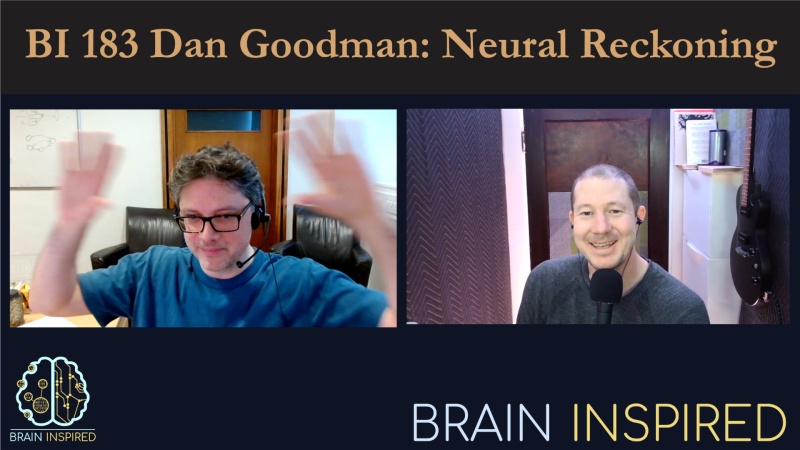
BI 183 Dan Goodman: Neural Reckoning episode artwork

EPISODE · Feb 6, 2024 · 1H 28M

BI 183 Dan Goodman: Neural Reckoning

from Brain Inspired · host Paul Middlebrooks

Support the show to get full episodes, full archive, and join the Discord community. You may know my guest as the co-founder of Neuromatch, the excellent online computational neuroscience academy, or as the creator of the Brian spiking neural network simulator, which is freely available. I know him as a spiking neural network practitioner extraordinaire. Dan Goodman runs the Neural Reckoning Group at Imperial College London, where they use spiking neural networks to figure out how biological and artificial brains reckon, or compute. All of the current AI we use to do all the impressive things we do, essentially all of it, is built on artificial neural networks. Notice the word "neural" there. That word is meant to communicate that these artificial networks do stuff the way our brains do stuff. And indeed, if you take a few steps back, spin around 10 times, take a few shots of whiskey, and squint hard enough, there is a passing resemblance. One thing you'll probably still notice, in your drunken stupor, is that, among the thousand ways ANNs differ from brains, is that they don't use action potentials, or spikes. From the perspective of neuroscience, that can seem mighty curious. Because, for decades now, neuroscience has focused on spikes as the things that make our cognition tick. We count them and compare them in different conditions, and generally put a lot of stock in their usefulness in brains. So what does it mean that modern neural networks disregard spiking altogether? Maybe spiking really isn't important to process and transmit information as well as our brains do. Or maybe spiking is one among many ways for intelligent systems to function well. Dan shares some of what he's learned and how he thinks about spiking and SNNs and a host of other topics. Neural Reckoning Group. Twitter: @neuralreckoning. Related papers Neural heterogeneity promotes robust learning. Dynamics of specialization in neural modules under resource constraints. Multimodal units fuse-then-accumulate evidence across channels. Visualizing a joint future of neuroscience and neuromorphic engineering. 0:00 - Intro 3:47 - Why spiking neural networks, and a mathematical background 13:16 - Efficiency 17:36 - Machine learning for neuroscience 19:38 - Why not jump ship from SNNs? 23:35 - Hard and easy tasks 29:20 - How brains and nets learn 32:50 - Exploratory vs. theory-driven science 37:32 - Static vs. dynamic 39:06 - Heterogeneity 46:01 - Unifying principles vs. a hodgepodge 50:37 - Sparsity 58:05 - Specialization and modularity 1:00:51 - Naturalistic experiments 1:03:41 - Projects for SNN research 1:05:09 - The right level of abstraction 1:07:58 - Obstacles to progress 1:12:30 - Levels of explanation 1:14:51 - What has AI taught neuroscience? 1:22:06 - How has neuroscience helped AI?

Support the show to get full episodes, full archive, and join the Discord community. You may know my guest as the co-founder of Neuromatch, the excellent online computational neuroscience academy, or as the creator of the Brian spiking neural network simulator, which is freely available. I know him as a spiking neural network practitioner extraordinaire. Dan Goodman runs the Neural Reckoning Group at Imperial College London, where they use spiking neural networks to figure out how biological and artificial brains reckon, or compute. All of the current AI we use to do all the impressive things we do, essentially all of it, is built on artificial neural networks. Notice the word "neural" there. That word is meant to communicate that these artificial networks do stuff the way our brains do stuff. And indeed, if you take a few steps back, spin around 10 times, take a few shots of whiskey, and squint hard enough, there is a passing resemblance. One thing you'll probably still notice, in your drunken stupor, is that, among the thousand ways ANNs differ from brains, is that they don't use action potentials, or spikes. From the perspective of neuroscience, that can seem mighty curious. Because, for decades now, neuroscience has focused on spikes as the things that make our cognition tick. We count them and compare them in different conditions, and generally put a lot of stock in their usefulness in brains. So what does it mean that modern neural networks disregard spiking altogether? Maybe spiking really isn't important to process and transmit information as well as our brains do. Or maybe spiking is one among many ways for intelligent systems to function well. Dan shares some of what he's learned and how he thinks about spiking and SNNs and a host of other topics. Neural Reckoning Group. Twitter: @neuralreckoning. Related papers Neural heterogeneity promotes robust learning. Dynamics of specialization in neural modules under resource constraints. Multimodal units fuse-then-accumulate evidence across channels. Visualizing a joint future of neuroscience and neuromorphic engineering. 0:00 - Intro 3:47 - Why spiking neural networks, and a mathematical background 13:16 - Efficiency 17:36 - Machine learning for neuroscience 19:38 - Why not jump ship from SNNs? 23:35 - Hard and easy tasks 29:20 - How brains and nets learn 32:50 - Exploratory vs. theory-driven science 37:32 - Static vs. dynamic 39:06 - Heterogeneity 46:01 - Unifying principles vs. a hodgepodge 50:37 - Sparsity 58:05 - Specialization and modularity 1:00:51 - Naturalistic experiments 1:03:41 - Projects for SNN research 1:05:09 - The right level of abstraction 1:07:58 - Obstacles to progress 1:12:30 - Levels of explanation 1:14:51 - What has AI taught neuroscience? 1:22:06 - How has neuroscience helped AI?

NOW PLAYING

BI 183 Dan Goodman: Neural Reckoning

0:00 1:28:54

No transcript for this episode yet

We transcribe on demand. Request one and we'll notify you when it's ready — usually under 10 minutes.

Carnivores Don't Get Sunburn - Carnivore Diet Talks Carnivores Don't Get Sunburn - Carnivore Diet Talks Welcome to “Carnivores Don’t Get Sunburn,” where we have fun and explore the carnivore diet and its transformative power. Join us as we uncover real stories from individuals who have thrived on this diet, defying convention and embracing optimal health. Plus, stay tuned for our upcoming documentary featuring diverse carnivores overcoming health challenges. Learn more at www.carnivoredietdocumentary.com.Excitingly, we’re working on an upcoming documentary where we’ll feature carnivores from various walks of life, conquering diverse health challenges. Join us on this journey and learn more at www.carnivoredietdocumentary.com.Join us in uncovering the power of the carnivore diet. Prepare to be inspired, informed, and empowered to embrace optimal health and well-being.Welcome to “Carnivores Don’t Get Sunburn: Unveiling Real Stories of the Carnivore Diet.” Stay tuned for our upcoming documentary. Discover how this lifestyle can transform lives. Learn more at www.carnivoredietdocumentary.com Living Out Loud Podcast: Entrepreneurship | Blogging | Work-Life Balance | Travel Lifestyle Valerie Fidan: Online Entrepreneur, Social Media Expert, Blogger Living Out Loud (LOL) is a podcast about living vibrantly with health and wellness blogger, digital strategist Valerie Fidan. Each week, LOL is bringing you episodes with interesting interviews and guests in the health and wellness industry. We discuss everything from Millennial entrepreneurship, wellness hacks and topics, key industry advice while keeping it a fun, light-hearted conversation, inviting to feel like you are having out with friends. This is a breeding ground for ideas and excitement for a balanced and inspired lifestyle for living out loud! Submit your questions and topics of interest to [email protected]. And, for more fun, healthy recipes, blog posts and travel visit www.livethelittlethings.com // social media: craveablesocial.com / [email protected] Naturally Inspired Podcast: Health. Freedom. Lifestyle. Tammy Cuthbert Garcia Naturally Inspired Podcast is a weekly podcast where we interview health practitioners, authors, filmmakers, scientists and leading experts in the fields of health and wellness. Guests are on the cutting edge and our conversations aim to inspire listeners to think critically about health choices for better life results. Learn More At https://naturallyinspiredpodcast.com/ Made You Think Neil Soni, Nat Eliason, and Adil Majid Made You Think is a podcast by Nat Eliason, Neil Soni, and Adil Majid where the hosts and their guests examine ideas that, as the name suggests, make you think. Episodes will explore books, essays, podcasts, and anything else that warrants further discussion, teaches something useful, or at the very least, exercises our brain muscles.

Frequently Asked Questions

How long is this episode of Brain Inspired?

This episode is 1 hour and 28 minutes long.

When was this Brain Inspired episode published?

This episode was published on February 6, 2024.

What is this episode about?

Support the show to get full episodes, full archive, and join the Discord community. You may know my guest as the co-founder of Neuromatch, the excellent online computational neuroscience academy, or as the creator of the Brian spiking...

Can I download this Brain Inspired episode?

Yes, you can download this episode by clicking the download button on the episode player, or subscribe to the podcast in your preferred podcast app for automatic downloads.
URL copied to clipboard!