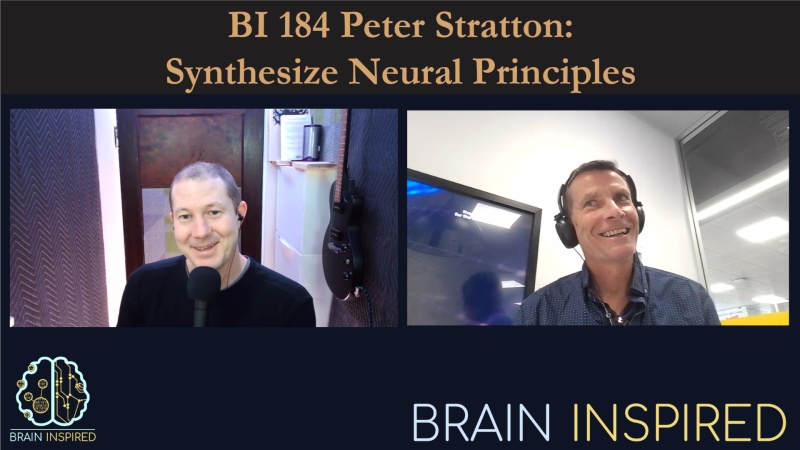
BI 184 Peter Stratton: Synthesize Neural Principles episode artwork

EPISODE · Feb 20, 2024 · 1H 30M

BI 184 Peter Stratton: Synthesize Neural Principles

from Brain Inspired · host Paul Middlebrooks

Support the show to get full episodes, full archive, and join the Discord community. Peter Stratton is a research scientist at Queensland University of Technology. I was pointed toward Pete by a patreon supporter, who sent me a sort of perspective piece Pete wrote that is the main focus of our conversation, although we also talk about some of his work in particular - for example, he works with spiking neural networks, like my last guest, Dan Goodman. What Pete argues for is what he calls a sideways-in approach. So a bottom-up approach is to build things like we find them in the brain, put them together, and voila, we'll get cognition. A top-down approach, the current approach in AI, is to train a system to perform a task, give it some algorithms to run, and fiddle with the architecture and lower level details until you pass your favorite benchmark test. Pete is focused more on the principles of computation brains employ that current AI doesn't. If you're familiar with David Marr, this is akin to his so-called "algorithmic level", but it's between that and the "implementation level", I'd say. Because Pete is focused on the synthesis of different kinds of brain operations - how they intermingle to perform computations and produce emergent properties. So he thinks more like a systems neuroscientist in that respect. Figuring that out is figuring out how to make better AI, Pete says. So we discuss a handful of those principles, all through the lens of how challenging a task it is to synthesize multiple principles into a coherent functioning whole (as opposed to a collection of parts). Buy, hey, evolution did it, so I'm sure we can, too, right? Peter's website. Related papers Convolutionary, Evolutionary, and Revolutionary: What’s Next for Brains, Bodies, and AI? Making a Spiking Net Work: Robust brain-like unsupervised machine learning. Global segregation of cortical activity and metastable dynamics. Unlocking neural complexity with a robotic key 0:00 - Intro 3:50 - AI background, neuroscience principles 8:00 - Overall view of modern AI 14:14 - Moravec's paradox and robotics 20:50 -Understanding movement to understand cognition 30:01 - How close are we to understanding brains/minds? 32:17 - Pete's goal 34:43 - Principles from neuroscience to build AI 42:39 - Levels of abstraction and implementation 49:57 - Mental disorders and robustness 55:58 - Function vs. implementation 1:04:04 - Spiking networks 1:07:57 - The roadmap 1:19:10 - AGI 1:23:48 - The terms AGI and AI 1:26:12 - Consciousness

Support the show to get full episodes, full archive, and join the Discord community. Peter Stratton is a research scientist at Queensland University of Technology. I was pointed toward Pete by a patreon supporter, who sent me a sort of perspective piece Pete wrote that is the main focus of our conversation, although we also talk about some of his work in particular - for example, he works with spiking neural networks, like my last guest, Dan Goodman. What Pete argues for is what he calls a sideways-in approach. So a bottom-up approach is to build things like we find them in the brain, put them together, and voila, we'll get cognition. A top-down approach, the current approach in AI, is to train a system to perform a task, give it some algorithms to run, and fiddle with the architecture and lower level details until you pass your favorite benchmark test. Pete is focused more on the principles of computation brains employ that current AI doesn't. If you're familiar with David Marr, this is akin to his so-called "algorithmic level", but it's between that and the "implementation level", I'd say. Because Pete is focused on the synthesis of different kinds of brain operations - how they intermingle to perform computations and produce emergent properties. So he thinks more like a systems neuroscientist in that respect. Figuring that out is figuring out how to make better AI, Pete says. So we discuss a handful of those principles, all through the lens of how challenging a task it is to synthesize multiple principles into a coherent functioning whole (as opposed to a collection of parts). Buy, hey, evolution did it, so I'm sure we can, too, right? Peter's website. Related papers Convolutionary, Evolutionary, and Revolutionary: What’s Next for Brains, Bodies, and AI? Making a Spiking Net Work: Robust brain-like unsupervised machine learning. Global segregation of cortical activity and metastable dynamics. Unlocking neural complexity with a robotic key 0:00 - Intro 3:50 - AI background, neuroscience principles 8:00 - Overall view of modern AI 14:14 - Moravec's paradox and robotics 20:50 -Understanding movement to understand cognition 30:01 - How close are we to understanding brains/minds? 32:17 - Pete's goal 34:43 - Principles from neuroscience to build AI 42:39 - Levels of abstraction and implementation 49:57 - Mental disorders and robustness 55:58 - Function vs. implementation 1:04:04 - Spiking networks 1:07:57 - The roadmap 1:19:10 - AGI 1:23:48 - The terms AGI and AI 1:26:12 - Consciousness

NOW PLAYING

BI 184 Peter Stratton: Synthesize Neural Principles

0:00 1:30:47

No transcript for this episode yet

We transcribe on demand. Request one and we'll notify you when it's ready — usually under 10 minutes.

Carnivores Don't Get Sunburn - Carnivore Diet Talks Carnivores Don't Get Sunburn - Carnivore Diet Talks Welcome to “Carnivores Don’t Get Sunburn,” where we have fun and explore the carnivore diet and its transformative power. Join us as we uncover real stories from individuals who have thrived on this diet, defying convention and embracing optimal health. Plus, stay tuned for our upcoming documentary featuring diverse carnivores overcoming health challenges. Learn more at www.carnivoredietdocumentary.com.Excitingly, we’re working on an upcoming documentary where we’ll feature carnivores from various walks of life, conquering diverse health challenges. Join us on this journey and learn more at www.carnivoredietdocumentary.com.Join us in uncovering the power of the carnivore diet. Prepare to be inspired, informed, and empowered to embrace optimal health and well-being.Welcome to “Carnivores Don’t Get Sunburn: Unveiling Real Stories of the Carnivore Diet.” Stay tuned for our upcoming documentary. Discover how this lifestyle can transform lives. Learn more at www.carnivoredietdocumentary.com Living Out Loud Podcast: Entrepreneurship | Blogging | Work-Life Balance | Travel Lifestyle Valerie Fidan: Online Entrepreneur, Social Media Expert, Blogger Living Out Loud (LOL) is a podcast about living vibrantly with health and wellness blogger, digital strategist Valerie Fidan. Each week, LOL is bringing you episodes with interesting interviews and guests in the health and wellness industry. We discuss everything from Millennial entrepreneurship, wellness hacks and topics, key industry advice while keeping it a fun, light-hearted conversation, inviting to feel like you are having out with friends. This is a breeding ground for ideas and excitement for a balanced and inspired lifestyle for living out loud! Submit your questions and topics of interest to [email protected]. And, for more fun, healthy recipes, blog posts and travel visit www.livethelittlethings.com // social media: craveablesocial.com / [email protected] Naturally Inspired Podcast: Health. Freedom. Lifestyle. Tammy Cuthbert Garcia Naturally Inspired Podcast is a weekly podcast where we interview health practitioners, authors, filmmakers, scientists and leading experts in the fields of health and wellness. Guests are on the cutting edge and our conversations aim to inspire listeners to think critically about health choices for better life results. Learn More At https://naturallyinspiredpodcast.com/ Made You Think Neil Soni, Nat Eliason, and Adil Majid Made You Think is a podcast by Nat Eliason, Neil Soni, and Adil Majid where the hosts and their guests examine ideas that, as the name suggests, make you think. Episodes will explore books, essays, podcasts, and anything else that warrants further discussion, teaches something useful, or at the very least, exercises our brain muscles.

Frequently Asked Questions

How long is this episode of Brain Inspired?

This episode is 1 hour and 30 minutes long.

When was this Brain Inspired episode published?

This episode was published on February 20, 2024.

What is this episode about?

Support the show to get full episodes, full archive, and join the Discord community. Peter Stratton is a research scientist at Queensland University of Technology. I was pointed toward Pete by a patreon supporter, who sent me a sort of...

Can I download this Brain Inspired episode?

Yes, you can download this episode by clicking the download button on the episode player, or subscribe to the podcast in your preferred podcast app for automatic downloads.
URL copied to clipboard!