BI 193 Kim Stachenfeld: Enhancing Neuroscience and AI episode artwork

EPISODE · Sep 11, 2024 · 1H 32M

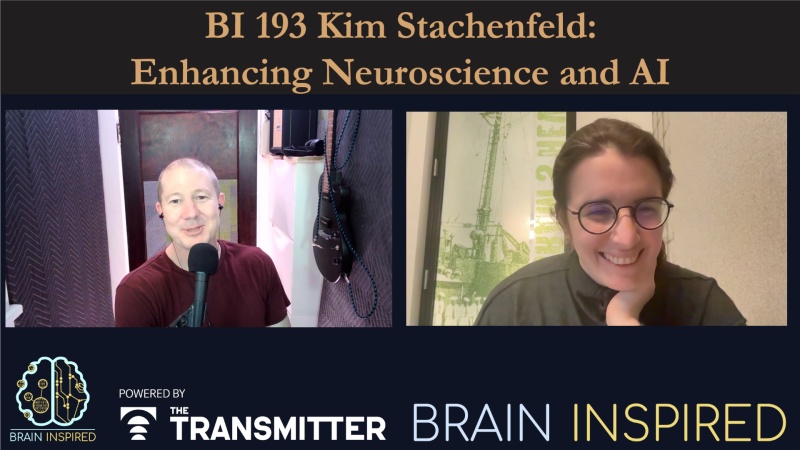
BI 193 Kim Stachenfeld: Enhancing Neuroscience and AI

from Brain Inspired · host Paul Middlebrooks

Support the show to get full episodes, full archive, and join the Discord community. The Transmitter is an online publication that aims to deliver useful information, insights and tools to build bridges across neuroscience and advance research. Visit thetransmitter.org to explore the latest neuroscience news and perspectives, written by journalists and scientists.  Read more about our partnership. Check out this story:  Monkeys build mental maps to navigate new tasks Sign up for “Brain Inspired” email alerts to be notified every time a new “Brain Inspired” episode is released. To explore more neuroscience news and perspectives, visit thetransmitter.org. Kim Stachenfeld embodies the original core focus of this podcast, the exploration of the intersection between neuroscience and AI, now commonly known as Neuro-AI. That's because she walks both lines. Kim is a Senior Research Scientist at Google DeepMind, the AI company that sprang from neuroscience principles, and also does research at the Center for Theoretical Neuroscience at Columbia University. She's been using her expertise in modeling, and reinforcement learning, and cognitive maps, for example, to help understand brains and to help improve AI. I've been wanting to have her on for a long time to get her broad perspective on AI and neuroscience. We discuss the relative roles of industry and academia in pursuing various objectives related to understanding and building cognitive entities She's studied the hippocampus in her research on reinforcement learning and cognitive maps, so we discuss what the heck the hippocampus does since it seems to implicated in so many functions, and how she thinks of reinforcement learning these days. Most recently Kim at Deepmind has focused on more practical engineering questions, using deep learning models to predict things like chaotic turbulent flows, and even to help design things like bridges and airplanes. And we don't get into the specifics of that work, but, given that I just spoke with Damian Kelty-Stephen, who thinks of brains partially as turbulent cascades, Kim and I discuss how her work on modeling turbulence has shaped her thoughts about brains. Kim's website. Twitter: @neuro_kim. Related papers Scaling Laws for Neural Language Models. Emergent Abilities of Large Language Models. Learned simulators: Learned coarse models for efficient turbulence simulation. Physical design using differentiable learned simulators. Check out the transcript, provided by The Transmitter. 0:00 - Intro 4:31 - Deepmind's original and current vision 9:53 - AI as tools and models 12:53 - Has AI hindered neuroscience? 17:05 - Deepmind vs academic work balance 20:47 - Is industry better suited to understand brains? 24?42 - Trajectory of Deepmind 27:41 - Kim's trajectory 33:35 - Is the brain a ML entity? 36:12 - Hippocampus 44:12 - Reinforcement learning 51:32 - What does neuroscience need more and less of? 1:02:53 - Neuroscience in a weird place? 1:06:41 - How Kim's questions have changed 1:16:31 - Intelligence and LLMs 1:25:34 - Challenges

Support the show to get full episodes, full archive, and join the Discord community. The Transmitter is an online publication that aims to deliver useful information, insights and tools to build bridges across neuroscience and advance research. Visit thetransmitter.org to explore the latest neuroscience news and perspectives, written by journalists and scientists.  Read more about our partnership. Check out this story:  Monkeys build mental maps to navigate new tasks Sign up for “Brain Inspired” email alerts to be notified every time a new “Brain Inspired” episode is released. To explore more neuroscience news and perspectives, visit thetransmitter.org. Kim Stachenfeld embodies the original core focus of this podcast, the exploration of the intersection between neuroscience and AI, now commonly known as Neuro-AI. That's because she walks both lines. Kim is a Senior Research Scientist at Google DeepMind, the AI company that sprang from neuroscience principles, and also does research at the Center for Theoretical Neuroscience at Columbia University. She's been using her expertise in modeling, and reinforcement learning, and cognitive maps, for example, to help understand brains and to help improve AI. I've been wanting to have her on for a long time to get her broad perspective on AI and neuroscience. We discuss the relative roles of industry and academia in pursuing various objectives related to understanding and building cognitive entities She's studied the hippocampus in her research on reinforcement learning and cognitive maps, so we discuss what the heck the hippocampus does since it seems to implicated in so many functions, and how she thinks of reinforcement learning these days. Most recently Kim at Deepmind has focused on more practical engineering questions, using deep learning models to predict things like chaotic turbulent flows, and even to help design things like bridges and airplanes. And we don't get into the specifics of that work, but, given that I just spoke with Damian Kelty-Stephen, who thinks of brains partially as turbulent cascades, Kim and I discuss how her work on modeling turbulence has shaped her thoughts about brains. Kim's website. Twitter: @neuro_kim. Related papers Scaling Laws for Neural Language Models. Emergent Abilities of Large Language Models. Learned simulators: Learned coarse models for efficient turbulence simulation. Physical design using differentiable learned simulators. Check out the transcript, provided by The Transmitter. 0:00 - Intro 4:31 - Deepmind's original and current vision 9:53 - AI as tools and models 12:53 - Has AI hindered neuroscience? 17:05 - Deepmind vs academic work balance 20:47 - Is industry better suited to understand brains? 24?42 - Trajectory of Deepmind 27:41 - Kim's trajectory 33:35 - Is the brain a ML entity? 36:12 - Hippocampus 44:12 - Reinforcement learning 51:32 - What does neuroscience need more and less of? 1:02:53 - Neuroscience in a weird place? 1:06:41 - How Kim's questions have changed 1:16:31 - Intelligence and LLMs 1:25:34 - Challenges

NOW PLAYING

BI 193 Kim Stachenfeld: Enhancing Neuroscience and AI

0:00 1:32:41

No transcript for this episode yet

We transcribe on demand. Request one and we'll notify you when it's ready — usually under 10 minutes.

Carnivores Don't Get Sunburn - Carnivore Diet Talks Carnivores Don't Get Sunburn - Carnivore Diet Talks Welcome to “Carnivores Don’t Get Sunburn,” where we have fun and explore the carnivore diet and its transformative power. Join us as we uncover real stories from individuals who have thrived on this diet, defying convention and embracing optimal health. Plus, stay tuned for our upcoming documentary featuring diverse carnivores overcoming health challenges. Learn more at www.carnivoredietdocumentary.com.Excitingly, we’re working on an upcoming documentary where we’ll feature carnivores from various walks of life, conquering diverse health challenges. Join us on this journey and learn more at www.carnivoredietdocumentary.com.Join us in uncovering the power of the carnivore diet. Prepare to be inspired, informed, and empowered to embrace optimal health and well-being.Welcome to “Carnivores Don’t Get Sunburn: Unveiling Real Stories of the Carnivore Diet.” Stay tuned for our upcoming documentary. Discover how this lifestyle can transform lives. Learn more at www.carnivoredietdocumentary.com Living Out Loud Podcast: Entrepreneurship | Blogging | Work-Life Balance | Travel Lifestyle Valerie Fidan: Online Entrepreneur, Social Media Expert, Blogger Living Out Loud (LOL) is a podcast about living vibrantly with health and wellness blogger, digital strategist Valerie Fidan. Each week, LOL is bringing you episodes with interesting interviews and guests in the health and wellness industry. We discuss everything from Millennial entrepreneurship, wellness hacks and topics, key industry advice while keeping it a fun, light-hearted conversation, inviting to feel like you are having out with friends. This is a breeding ground for ideas and excitement for a balanced and inspired lifestyle for living out loud! Submit your questions and topics of interest to [email protected]. And, for more fun, healthy recipes, blog posts and travel visit www.livethelittlethings.com // social media: craveablesocial.com / [email protected] Naturally Inspired Podcast: Health. Freedom. Lifestyle. Tammy Cuthbert Garcia Naturally Inspired Podcast is a weekly podcast where we interview health practitioners, authors, filmmakers, scientists and leading experts in the fields of health and wellness. Guests are on the cutting edge and our conversations aim to inspire listeners to think critically about health choices for better life results. Learn More At https://naturallyinspiredpodcast.com/ Made You Think Neil Soni, Nat Eliason, and Adil Majid Made You Think is a podcast by Nat Eliason, Neil Soni, and Adil Majid where the hosts and their guests examine ideas that, as the name suggests, make you think. Episodes will explore books, essays, podcasts, and anything else that warrants further discussion, teaches something useful, or at the very least, exercises our brain muscles.

Frequently Asked Questions

How long is this episode of Brain Inspired?

This episode is 1 hour and 32 minutes long.

When was this Brain Inspired episode published?

This episode was published on September 11, 2024.

What is this episode about?

Support the show to get full episodes, full archive, and join the Discord community. The Transmitter is an online publication that aims to deliver useful information, insights and tools to build bridges across neuroscience and advance...

Can I download this Brain Inspired episode?

Yes, you can download this episode by clicking the download button on the episode player, or subscribe to the podcast in your preferred podcast app for automatic downloads.
URL copied to clipboard!