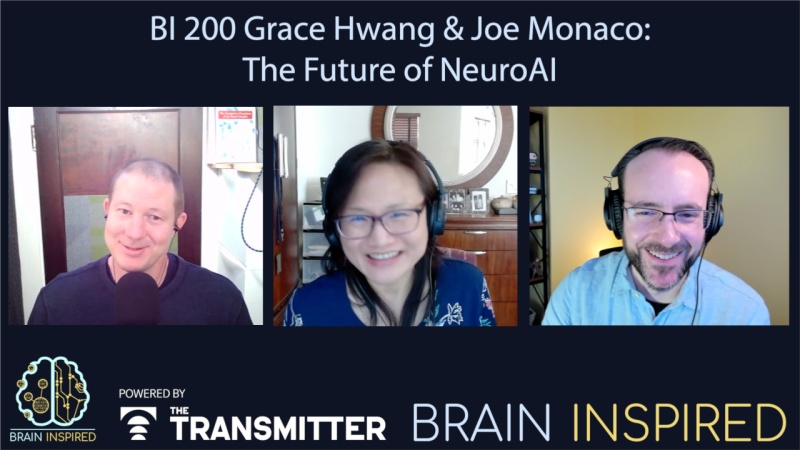
BI 200 Grace Hwang and Joe Monaco: The Future of NeuroAI episode artwork

EPISODE · Dec 4, 2024 · 1H 37M

BI 200 Grace Hwang and Joe Monaco: The Future of NeuroAI

from Brain Inspired · host Paul Middlebrooks

Support the show to get full episodes, full archive, and join the Discord community. Joe Monaco and Grace Hwang  co-organized a recent workshop I participated in, the 2024 BRAIN NeuroAI Workshop. You may have heard of the BRAIN Initiative, but in case not, BRAIN is is huge funding effort across many agencies, one of which is the National Institutes of Health, where this recent workshop was held. The BRAIN Initiative began in 2013 under the Obama administration, with the goal to support developing technologies to help understand the human brain, so we can cure brain based diseases. BRAIN Initiative just became a decade old, with many successes like recent whole brain connectomes, and discovering the vast array of cell types. Now the question is how to move forward, and one area they are curious about, that perhaps has a lot of potential to support their mission, is the recent convergence of neuroscience and AI... or NeuroAI. The workshop was designed to explore how NeuroAI might contribute moving forward, and to hear from NeuroAI folks how they envision the field moving forward. You'll hear more about that in a moment. That's one reason I invited Grace and Joe on. Another reason is because they co-wrote a position paper a while back that is impressive as a synthesis of lots of cognitive sciences concepts, but also proposes a specific level of abstraction and scale in brain processes that may serve as a base layer for computation. The paper is called Neurodynamical Computing at the Information Boundaries, of Intelligent Systems, and you'll learn more about that in this episode. Joe's NIH page. Grace's NIH page. Twitter:  Joe: @j_d_monaco Related papers Neurodynamical Computing at the Information Boundaries of Intelligent Systems. Cognitive swarming in complex environments with attractor dynamics and oscillatory computing. Spatial synchronization codes from coupled rate-phase neurons. Oscillators that sync and swarm. Mentioned A historical survey of algorithms and hardware architectures for neural-inspired and neuromorphic computing applications. Recalling Lashley and reconsolidating Hebb. BRAIN NeuroAI Workshop (Nov 12–13) NIH BRAIN NeuroAI Workshop Program Book NIH VideoCast – Day 1 Recording – BRAIN NeuroAI Workshop NIH VideoCast – Day 2 Recording – BRAIN NeuroAI Workshop Neuromorphic Principles in Biomedicine and Healthcare Workshop (Oct 21–22) NPBH 2024 BRAIN Investigators Meeting 2020 Symposium & Perspective Paper BRAIN 2020 Symposium on Dynamical Systems Neuroscience and Machine Learning (YouTube) Neurodynamical Computing at the Information Boundaries of Intelligent Systems | Cognitive Computation NSF/CIRC Community Infrastructure for Research in Computer and Information Science and Engineering (CIRC) | NSF - National Science Foundation THOR Neuromorphic Commons - Matrix: The UTSA AI Consortium for Human Well-Being Read the transcript. 0:00 - Intro 25:45 - NeuroAI Workshop - neuromorphics 33:31 - Neuromorphics and theory 49:19 - Reflections on the workshop 54:22 - Neurodynamical computing and information boundaries 1:01:04 - Perceptual control theory 1:08:56 - Digital twins and neural foundation models 1:14:02 - Base layer of computation

Support the show to get full episodes, full archive, and join the Discord community. Joe Monaco and Grace Hwang  co-organized a recent workshop I participated in, the 2024 BRAIN NeuroAI Workshop. You may have heard of the BRAIN Initiative, but in case not, BRAIN is is huge funding effort across many agencies, one of which is the National Institutes of Health, where this recent workshop was held. The BRAIN Initiative began in 2013 under the Obama administration, with the goal to support developing technologies to help understand the human brain, so we can cure brain based diseases. BRAIN Initiative just became a decade old, with many successes like recent whole brain connectomes, and discovering the vast array of cell types. Now the question is how to move forward, and one area they are curious about, that perhaps has a lot of potential to support their mission, is the recent convergence of neuroscience and AI... or NeuroAI. The workshop was designed to explore how NeuroAI might contribute moving forward, and to hear from NeuroAI folks how they envision the field moving forward. You'll hear more about that in a moment. That's one reason I invited Grace and Joe on. Another reason is because they co-wrote a position paper a while back that is impressive as a synthesis of lots of cognitive sciences concepts, but also proposes a specific level of abstraction and scale in brain processes that may serve as a base layer for computation. The paper is called Neurodynamical Computing at the Information Boundaries, of Intelligent Systems, and you'll learn more about that in this episode. Joe's NIH page. Grace's NIH page. Twitter:  Joe: @j_d_monaco Related papers Neurodynamical Computing at the Information Boundaries of Intelligent Systems. Cognitive swarming in complex environments with attractor dynamics and oscillatory computing. Spatial synchronization codes from coupled rate-phase neurons. Oscillators that sync and swarm. Mentioned A historical survey of algorithms and hardware architectures for neural-inspired and neuromorphic computing applications. Recalling Lashley and reconsolidating Hebb. BRAIN NeuroAI Workshop (Nov 12–13) NIH BRAIN NeuroAI Workshop Program Book NIH VideoCast – Day 1 Recording – BRAIN NeuroAI Workshop NIH VideoCast – Day 2 Recording – BRAIN NeuroAI Workshop Neuromorphic Principles in Biomedicine and Healthcare Workshop (Oct 21–22) NPBH 2024 BRAIN Investigators Meeting 2020 Symposium & Perspective Paper BRAIN 2020 Symposium on Dynamical Systems Neuroscience and Machine Learning (YouTube) Neurodynamical Computing at the Information Boundaries of Intelligent Systems | Cognitive Computation NSF/CIRC Community Infrastructure for Research in Computer and Information Science and Engineering (CIRC) | NSF - National Science Foundation THOR Neuromorphic Commons - Matrix: The UTSA AI Consortium for Human Well-Being Read the transcript. 0:00 - Intro 25:45 - NeuroAI Workshop - neuromorphics 33:31 - Neuromorphics and theory 49:19 - Reflections on the workshop 54:22 - Neurodynamical computing and information boundaries 1:01:04 - Perceptual control theory 1:08:56 - Digital twins and neural foundation models 1:14:02 - Base layer of computation

NOW PLAYING

BI 200 Grace Hwang and Joe Monaco: The Future of NeuroAI

0:00 1:37:11

No transcript for this episode yet

We transcribe on demand. Request one and we'll notify you when it's ready — usually under 10 minutes.

Carnivores Don't Get Sunburn - Carnivore Diet Talks Carnivores Don't Get Sunburn - Carnivore Diet Talks Welcome to “Carnivores Don’t Get Sunburn,” where we have fun and explore the carnivore diet and its transformative power. Join us as we uncover real stories from individuals who have thrived on this diet, defying convention and embracing optimal health. Plus, stay tuned for our upcoming documentary featuring diverse carnivores overcoming health challenges. Learn more at www.carnivoredietdocumentary.com.Excitingly, we’re working on an upcoming documentary where we’ll feature carnivores from various walks of life, conquering diverse health challenges. Join us on this journey and learn more at www.carnivoredietdocumentary.com.Join us in uncovering the power of the carnivore diet. Prepare to be inspired, informed, and empowered to embrace optimal health and well-being.Welcome to “Carnivores Don’t Get Sunburn: Unveiling Real Stories of the Carnivore Diet.” Stay tuned for our upcoming documentary. Discover how this lifestyle can transform lives. Learn more at www.carnivoredietdocumentary.com Living Out Loud Podcast: Entrepreneurship | Blogging | Work-Life Balance | Travel Lifestyle Valerie Fidan: Online Entrepreneur, Social Media Expert, Blogger Living Out Loud (LOL) is a podcast about living vibrantly with health and wellness blogger, digital strategist Valerie Fidan. Each week, LOL is bringing you episodes with interesting interviews and guests in the health and wellness industry. We discuss everything from Millennial entrepreneurship, wellness hacks and topics, key industry advice while keeping it a fun, light-hearted conversation, inviting to feel like you are having out with friends. This is a breeding ground for ideas and excitement for a balanced and inspired lifestyle for living out loud! Submit your questions and topics of interest to [email protected]. And, for more fun, healthy recipes, blog posts and travel visit www.livethelittlethings.com // social media: craveablesocial.com / [email protected] Naturally Inspired Podcast: Health. Freedom. Lifestyle. Tammy Cuthbert Garcia Naturally Inspired Podcast is a weekly podcast where we interview health practitioners, authors, filmmakers, scientists and leading experts in the fields of health and wellness. Guests are on the cutting edge and our conversations aim to inspire listeners to think critically about health choices for better life results. Learn More At https://naturallyinspiredpodcast.com/ Made You Think Neil Soni, Nat Eliason, and Adil Majid Made You Think is a podcast by Nat Eliason, Neil Soni, and Adil Majid where the hosts and their guests examine ideas that, as the name suggests, make you think. Episodes will explore books, essays, podcasts, and anything else that warrants further discussion, teaches something useful, or at the very least, exercises our brain muscles.

Frequently Asked Questions

How long is this episode of Brain Inspired?

This episode is 1 hour and 37 minutes long.

When was this Brain Inspired episode published?

This episode was published on December 4, 2024.

What is this episode about?

Support the show to get full episodes, full archive, and join the Discord community. Joe Monaco and Grace Hwang  co-organized a recent workshop I participated in, the 2024 BRAIN NeuroAI Workshop. You may have heard of the BRAIN...

Can I download this Brain Inspired episode?

Yes, you can download this episode by clicking the download button on the episode player, or subscribe to the podcast in your preferred podcast app for automatic downloads.
URL copied to clipboard!