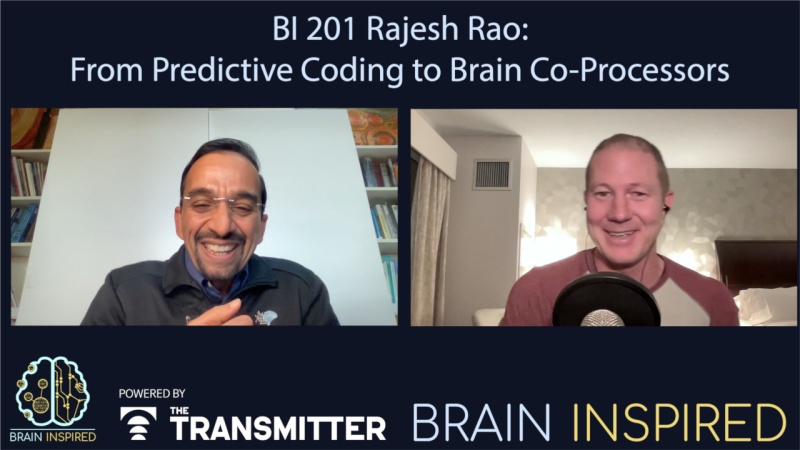
BI 201 Rajesh Rao: From Predictive Coding to Brain Co-Processors episode artwork

EPISODE · Dec 18, 2024 · 1H 37M

BI 201 Rajesh Rao: From Predictive Coding to Brain Co-Processors

from Brain Inspired · host Paul Middlebrooks

Support the show to get full episodes, full archive, and join the Discord community. Today I'm in conversation with Rajesh Rao, a distinguished professor of computer science and engineering at the University of Washington, where he also co-directs the Center for Neurotechnology. Back in 1999, Raj and Dana Ballard published what became quite a famous paper, which proposed how predictive coding might be implemented in brains. What is predictive coding, you may be wondering? It's roughly the idea that your brain is constantly predicting incoming sensory signals, and it generates that prediction as a top-down signal that meets the bottom-up sensory signals. Then the brain computes a difference between the prediction and the actual sensory input, and that difference is sent back up to the "top" where the brain then updates its internal model to make better future predictions. So that was 25 years ago, and it was focused on how the brain handles sensory information. But Raj just recently published an update to the predictive coding framework, one that incorporates actions and perception, suggests how it might be implemented in the cortex - specifically which cortical layers do what - something he calls "Active predictive coding." So we discuss that new proposal, we also talk about his engineering work on brain-computer interface technologies, like BrainNet, which basically connects two brains together, and like neural co-processors, which use an artificial neural network as a prosthetic that can do things like enhance memories, optimize learning, and help restore brain function after strokes, for example. Finally, we discuss Raj's interest and work on deciphering an ancient Indian text, the mysterious Indus script. Raj's website. Twitter: @RajeshPNRao. Related papers A sensory–motor theory of the neocortex. Brain co-processors: using AI to restore and augment brain function. Towards neural co-processors for the brain: combining decoding and encoding in brain–computer interfaces. BrainNet: A Multi-Person Brain-to-Brain Interface for Direct Collaboration Between Brains. Read the transcript. 0:00 - Intro 7:40 - Predictive coding origins 16:14 - Early appreciation of recurrence 17:08 - Prediction as a general theory of the brain 18:38 - Rao and Ballard 1999 26:32 - Prediction as a general theory of the brain 33:24 - Perception vs action 33:28 - Active predictive coding 45:04 - Evolving to augment our brains 53:03 - BrainNet 57:12 - Neural co-processors 1:11:19 - Decoding the Indus Script 1:20:18 - Transformer models relation to active predictive coding

Support the show to get full episodes, full archive, and join the Discord community. Today I'm in conversation with Rajesh Rao, a distinguished professor of computer science and engineering at the University of Washington, where he also co-directs the Center for Neurotechnology. Back in 1999, Raj and Dana Ballard published what became quite a famous paper, which proposed how predictive coding might be implemented in brains. What is predictive coding, you may be wondering? It's roughly the idea that your brain is constantly predicting incoming sensory signals, and it generates that prediction as a top-down signal that meets the bottom-up sensory signals. Then the brain computes a difference between the prediction and the actual sensory input, and that difference is sent back up to the "top" where the brain then updates its internal model to make better future predictions. So that was 25 years ago, and it was focused on how the brain handles sensory information. But Raj just recently published an update to the predictive coding framework, one that incorporates actions and perception, suggests how it might be implemented in the cortex - specifically which cortical layers do what - something he calls "Active predictive coding." So we discuss that new proposal, we also talk about his engineering work on brain-computer interface technologies, like BrainNet, which basically connects two brains together, and like neural co-processors, which use an artificial neural network as a prosthetic that can do things like enhance memories, optimize learning, and help restore brain function after strokes, for example. Finally, we discuss Raj's interest and work on deciphering an ancient Indian text, the mysterious Indus script. Raj's website. Twitter: @RajeshPNRao. Related papers A sensory–motor theory of the neocortex. Brain co-processors: using AI to restore and augment brain function. Towards neural co-processors for the brain: combining decoding and encoding in brain–computer interfaces. BrainNet: A Multi-Person Brain-to-Brain Interface for Direct Collaboration Between Brains. Read the transcript. 0:00 - Intro 7:40 - Predictive coding origins 16:14 - Early appreciation of recurrence 17:08 - Prediction as a general theory of the brain 18:38 - Rao and Ballard 1999 26:32 - Prediction as a general theory of the brain 33:24 - Perception vs action 33:28 - Active predictive coding 45:04 - Evolving to augment our brains 53:03 - BrainNet 57:12 - Neural co-processors 1:11:19 - Decoding the Indus Script 1:20:18 - Transformer models relation to active predictive coding

NOW PLAYING

BI 201 Rajesh Rao: From Predictive Coding to Brain Co-Processors

0:00 1:37:22

No transcript for this episode yet

We transcribe on demand. Request one and we'll notify you when it's ready — usually under 10 minutes.

Carnivores Don't Get Sunburn - Carnivore Diet Talks Carnivores Don't Get Sunburn - Carnivore Diet Talks Welcome to “Carnivores Don’t Get Sunburn,” where we have fun and explore the carnivore diet and its transformative power. Join us as we uncover real stories from individuals who have thrived on this diet, defying convention and embracing optimal health. Plus, stay tuned for our upcoming documentary featuring diverse carnivores overcoming health challenges. Learn more at www.carnivoredietdocumentary.com.Excitingly, we’re working on an upcoming documentary where we’ll feature carnivores from various walks of life, conquering diverse health challenges. Join us on this journey and learn more at www.carnivoredietdocumentary.com.Join us in uncovering the power of the carnivore diet. Prepare to be inspired, informed, and empowered to embrace optimal health and well-being.Welcome to “Carnivores Don’t Get Sunburn: Unveiling Real Stories of the Carnivore Diet.” Stay tuned for our upcoming documentary. Discover how this lifestyle can transform lives. Learn more at www.carnivoredietdocumentary.com Living Out Loud Podcast: Entrepreneurship | Blogging | Work-Life Balance | Travel Lifestyle Valerie Fidan: Online Entrepreneur, Social Media Expert, Blogger Living Out Loud (LOL) is a podcast about living vibrantly with health and wellness blogger, digital strategist Valerie Fidan. Each week, LOL is bringing you episodes with interesting interviews and guests in the health and wellness industry. We discuss everything from Millennial entrepreneurship, wellness hacks and topics, key industry advice while keeping it a fun, light-hearted conversation, inviting to feel like you are having out with friends. This is a breeding ground for ideas and excitement for a balanced and inspired lifestyle for living out loud! Submit your questions and topics of interest to [email protected]. And, for more fun, healthy recipes, blog posts and travel visit www.livethelittlethings.com // social media: craveablesocial.com / [email protected] Naturally Inspired Podcast: Health. Freedom. Lifestyle. Tammy Cuthbert Garcia Naturally Inspired Podcast is a weekly podcast where we interview health practitioners, authors, filmmakers, scientists and leading experts in the fields of health and wellness. Guests are on the cutting edge and our conversations aim to inspire listeners to think critically about health choices for better life results. Learn More At https://naturallyinspiredpodcast.com/ Made You Think Neil Soni, Nat Eliason, and Adil Majid Made You Think is a podcast by Nat Eliason, Neil Soni, and Adil Majid where the hosts and their guests examine ideas that, as the name suggests, make you think. Episodes will explore books, essays, podcasts, and anything else that warrants further discussion, teaches something useful, or at the very least, exercises our brain muscles.

Frequently Asked Questions

How long is this episode of Brain Inspired?

This episode is 1 hour and 37 minutes long.

When was this Brain Inspired episode published?

This episode was published on December 18, 2024.

What is this episode about?

Support the show to get full episodes, full archive, and join the Discord community. Today I'm in conversation with Rajesh Rao, a distinguished professor of computer science and engineering at the University of Washington, where he also...

Can I download this Brain Inspired episode?

Yes, you can download this episode by clicking the download button on the episode player, or subscribe to the podcast in your preferred podcast app for automatic downloads.
URL copied to clipboard!