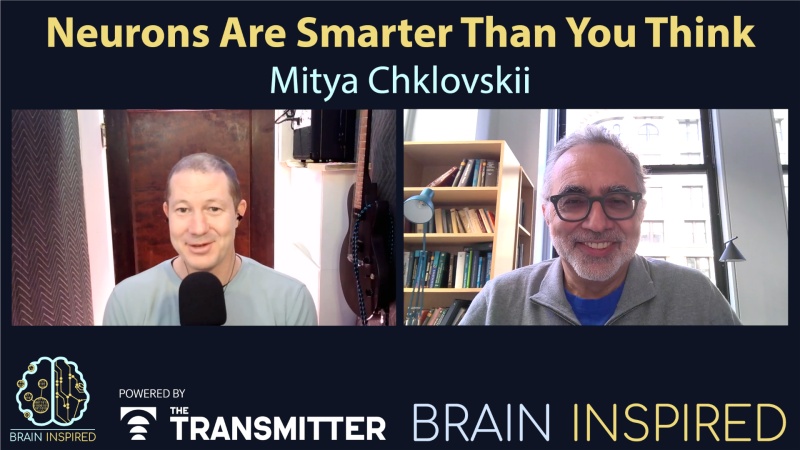
BI 205 Dmitri Chklovskii: Neurons Are Smarter Than You Think episode artwork

EPISODE · Feb 12, 2025 · 1H 39M

BI 205 Dmitri Chklovskii: Neurons Are Smarter Than You Think

from Brain Inspired · host Paul Middlebrooks

Support the show to get full episodes, full archive, and join the Discord community. The Transmitter is an online publication that aims to deliver useful information, insights and tools to build bridges across neuroscience and advance research. Visit thetransmitter.org to explore the latest neuroscience news and perspectives, written by journalists and scientists. Read more about our partnership. Sign up for the “Brain Inspired” email alerts to be notified every time a new “Brain Inspired” episode is released: To explore more neuroscience news and perspectives, visit thetransmitter.org. Since the 1940s and 50s, back at the origins of what we now think of as artificial intelligence, there have been lots of ways of conceiving what it is that brains do, or what the function of the brain is. One of those conceptions, going to back to cybernetics, is that the brain is a controller that operates under the principles of feedback control. This view has been carried down in various forms to us in present day. Also since that same time period, when McCulloch and Pitts suggested that single neurons are logical devices, there have been lots of ways of conceiving what it is that single neurons do. Are they logical operators, do they each represent something special, are they trying to maximize efficiency, for example? Dmitri Chklovskii, who goes by Mitya, runs the Neural Circuits and Algorithms lab at the Flatiron Institute. Mitya believes that single neurons themselves are each individual controllers. They're smart agents, each trying to predict their inputs, like in predictive processing, but also functioning as an optimal feedback controller. We talk about historical conceptions of the function of single neurons and how this differs, we talk about how to think of single neurons versus populations of neurons, some of the neuroscience findings that seem to support Mitya's account, the control algorithm that simplifies the neuron's otherwise impossible control task, and other various topics. We also discuss Mitya's early interests, coming from a physics and engineering background, in how to wire up our brains efficiently, given the limited amount of space in our craniums. Obviously evolution produced its own solutions for this problem. This pursuit led Mitya to study the C. elegans worm, because its connectome was nearly complete- actually, Mitya and his team helped complete the connectome so he'd have the whole wiring diagram to study it. So we talk about that work, and what knowing the whole connectome of C. elegans has and has not taught us about how brains work. Chklovskii Lab. Twitter: @chklovskii. Related papers The Neuron as a Direct Data-Driven Controller. Normative and mechanistic model of an adaptive circuit for efficient encoding and feature extraction. Related episodes BI 143 Rodolphe Sepulchre: Mixed Feedback Control BI 119 Henry Yin: The Crisis in Neuroscience Read the transcript. 0:00 - Intro 7:34 - Physicists approach for neuroscience 12:39 - What's missing in AI and neuroscience? 16:36 - Connectomes 31:51 - Understanding complex systems 33:17 - Earliest models of neurons 39:08 - Smart neurons 42:56 - Neuron theories that influenced Mitya 46:50 - Neuron as a controller 55:03 - How to test the neuron as controller hypothesis 1:00:29 - Direct data-driven control 1:11:09 - Experimental evidence 1:22:25 - Single neuron doctrine and population doctrine 1:25:30 - Neurons as agents 1:28:52 - Implications for AI 1:30:02 - Limits to control perspective

Support the show to get full episodes, full archive, and join the Discord community. The Transmitter is an online publication that aims to deliver useful information, insights and tools to build bridges across neuroscience and advance research. Visit thetransmitter.org to explore the latest neuroscience news and perspectives, written by journalists and scientists. Read more about our partnership. Sign up for the “Brain Inspired” email alerts to be notified every time a new “Brain Inspired” episode is released: To explore more neuroscience news and perspectives, visit thetransmitter.org. Since the 1940s and 50s, back at the origins of what we now think of as artificial intelligence, there have been lots of ways of conceiving what it is that brains do, or what the function of the brain is. One of those conceptions, going to back to cybernetics, is that the brain is a controller that operates under the principles of feedback control. This view has been carried down in various forms to us in present day. Also since that same time period, when McCulloch and Pitts suggested that single neurons are logical devices, there have been lots of ways of conceiving what it is that single neurons do. Are they logical operators, do they each represent something special, are they trying to maximize efficiency, for example? Dmitri Chklovskii, who goes by Mitya, runs the Neural Circuits and Algorithms lab at the Flatiron Institute. Mitya believes that single neurons themselves are each individual controllers. They're smart agents, each trying to predict their inputs, like in predictive processing, but also functioning as an optimal feedback controller. We talk about historical conceptions of the function of single neurons and how this differs, we talk about how to think of single neurons versus populations of neurons, some of the neuroscience findings that seem to support Mitya's account, the control algorithm that simplifies the neuron's otherwise impossible control task, and other various topics. We also discuss Mitya's early interests, coming from a physics and engineering background, in how to wire up our brains efficiently, given the limited amount of space in our craniums. Obviously evolution produced its own solutions for this problem. This pursuit led Mitya to study the C. elegans worm, because its connectome was nearly complete- actually, Mitya and his team helped complete the connectome so he'd have the whole wiring diagram to study it. So we talk about that work, and what knowing the whole connectome of C. elegans has and has not taught us about how brains work. Chklovskii Lab. Twitter: @chklovskii. Related papers The Neuron as a Direct Data-Driven Controller. Normative and mechanistic model of an adaptive circuit for efficient encoding and feature extraction. Related episodes BI 143 Rodolphe Sepulchre: Mixed Feedback Control BI 119 Henry Yin: The Crisis in Neuroscience Read the transcript. 0:00 - Intro 7:34 - Physicists approach for neuroscience 12:39 - What's missing in AI and neuroscience? 16:36 - Connectomes 31:51 - Understanding complex systems 33:17 - Earliest models of neurons 39:08 - Smart neurons 42:56 - Neuron theories that influenced Mitya 46:50 - Neuron as a controller 55:03 - How to test the neuron as controller hypothesis 1:00:29 - Direct data-driven control 1:11:09 - Experimental evidence 1:22:25 - Single neuron doctrine and population doctrine 1:25:30 - Neurons as agents 1:28:52 - Implications for AI 1:30:02 - Limits to control perspective

NOW PLAYING

BI 205 Dmitri Chklovskii: Neurons Are Smarter Than You Think

0:00 1:39:05

No transcript for this episode yet

We transcribe on demand. Request one and we'll notify you when it's ready — usually under 10 minutes.

Carnivores Don't Get Sunburn - Carnivore Diet Talks Carnivores Don't Get Sunburn - Carnivore Diet Talks Welcome to “Carnivores Don’t Get Sunburn,” where we have fun and explore the carnivore diet and its transformative power. Join us as we uncover real stories from individuals who have thrived on this diet, defying convention and embracing optimal health. Plus, stay tuned for our upcoming documentary featuring diverse carnivores overcoming health challenges. Learn more at www.carnivoredietdocumentary.com.Excitingly, we’re working on an upcoming documentary where we’ll feature carnivores from various walks of life, conquering diverse health challenges. Join us on this journey and learn more at www.carnivoredietdocumentary.com.Join us in uncovering the power of the carnivore diet. Prepare to be inspired, informed, and empowered to embrace optimal health and well-being.Welcome to “Carnivores Don’t Get Sunburn: Unveiling Real Stories of the Carnivore Diet.” Stay tuned for our upcoming documentary. Discover how this lifestyle can transform lives. Learn more at www.carnivoredietdocumentary.com Living Out Loud Podcast: Entrepreneurship | Blogging | Work-Life Balance | Travel Lifestyle Valerie Fidan: Online Entrepreneur, Social Media Expert, Blogger Living Out Loud (LOL) is a podcast about living vibrantly with health and wellness blogger, digital strategist Valerie Fidan. Each week, LOL is bringing you episodes with interesting interviews and guests in the health and wellness industry. We discuss everything from Millennial entrepreneurship, wellness hacks and topics, key industry advice while keeping it a fun, light-hearted conversation, inviting to feel like you are having out with friends. This is a breeding ground for ideas and excitement for a balanced and inspired lifestyle for living out loud! Submit your questions and topics of interest to [email protected]. And, for more fun, healthy recipes, blog posts and travel visit www.livethelittlethings.com // social media: craveablesocial.com / [email protected] Naturally Inspired Podcast: Health. Freedom. Lifestyle. Tammy Cuthbert Garcia Naturally Inspired Podcast is a weekly podcast where we interview health practitioners, authors, filmmakers, scientists and leading experts in the fields of health and wellness. Guests are on the cutting edge and our conversations aim to inspire listeners to think critically about health choices for better life results. Learn More At https://naturallyinspiredpodcast.com/ Made You Think Neil Soni, Nat Eliason, and Adil Majid Made You Think is a podcast by Nat Eliason, Neil Soni, and Adil Majid where the hosts and their guests examine ideas that, as the name suggests, make you think. Episodes will explore books, essays, podcasts, and anything else that warrants further discussion, teaches something useful, or at the very least, exercises our brain muscles.

Frequently Asked Questions

How long is this episode of Brain Inspired?

This episode is 1 hour and 39 minutes long.

When was this Brain Inspired episode published?

This episode was published on February 12, 2025.

What is this episode about?

Support the show to get full episodes, full archive, and join the Discord community. The Transmitter is an online publication that aims to deliver useful information, insights and tools to build bridges across neuroscience and advance...

Can I download this Brain Inspired episode?

Yes, you can download this episode by clicking the download button on the episode player, or subscribe to the podcast in your preferred podcast app for automatic downloads.
URL copied to clipboard!