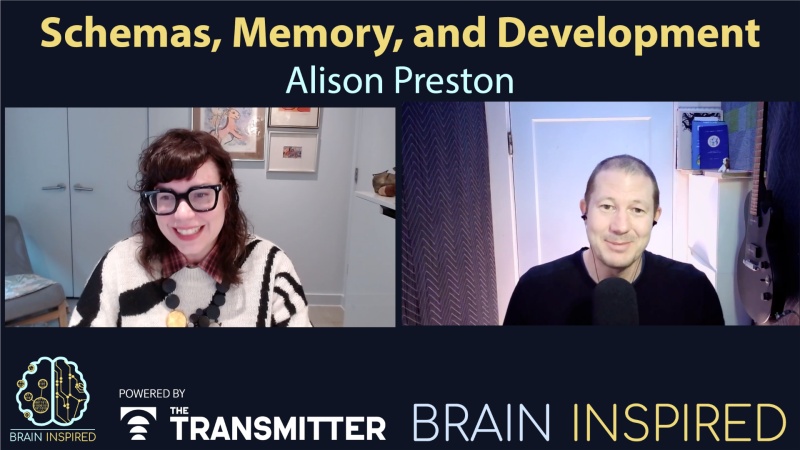
BI 207 Alison Preston: Schemas in our Brains and Minds episode artwork

EPISODE · Mar 12, 2025 · 1H 29M

BI 207 Alison Preston: Schemas in our Brains and Minds

from Brain Inspired · host Paul Middlebrooks

Support the show to get full episodes, full archive, and join the Discord community. The Transmitter is an online publication that aims to deliver useful information, insights and tools to build bridges across neuroscience and advance research. Visit thetransmitter.org to explore the latest neuroscience news and perspectives, written by journalists and scientists. Read more about our partnership. Sign up for the “Brain Inspired” email alerts to be notified every time a new “Brain Inspired” episode is released. To explore more neuroscience news and perspectives, visit thetransmitter.org. The concept of a schema goes back at least to the philosopher Immanuel Kant in the 1700s, who use the term to refer to a kind of built-in mental framework to organize sensory experience. But it was the psychologist Frederic Bartlett in the 1930s who used the term schema in a psychological sense, to explain how our memories are organized and how new information gets integrated into our memory. Fast forward another 100 years to today, and we have a podcast episode with my guest today, Alison Preston, who runs the Preston Lab at the University of Texas at Austin. On this episode, we discuss her neuroscience research explaining how our brains might carry out the processing that fits with our modern conception of schemas, and how our brains do that in different ways as we develop from childhood to adulthood. I just said, "our modern conception of schemas," but like everything else, there isn't complete consensus among scientists exactly how to define schema. Ali has her own definition. She shares that, and how it differs from other conceptions commonly used. I like Ali's version and think it should be adopted, in part because it helps distinguish schemas from a related term, cognitive maps, which we've discussed aplenty on brain inspired, and can sometimes be used interchangeably with schemas. So we discuss how to think about schemas versus cognitive maps, versus concepts, versus semantic information, and so on. Last episode Ciara Greene discussed schemas and how they underlie our memories, and learning, and predictions, and how they can lead to inaccurate memories and predictions. Today Ali explains how circuits in the brain might adaptively underlie this process as we develop, and how to go about measuring it in the first place. Preston Lab Twitter: @preston_lab Related papers: Concept formation as a computational cognitive process. Schema, Inference, and Memory. Developmental differences in memory reactivation relate to encoding and inference in the human brain. Read the transcript. 0:00 - Intro 6:51 - Schemas 20:37 - Schemas and the developing brain 35:03 - Information theory, dimensionality, and detail 41:17 - Geometry of schemas 47:26 - Schemas and creativity 50:29 - Brain connection pruning with development 1:02:46 - Information in brains 1:09:20 - Schemas and development in AI

Support the show to get full episodes, full archive, and join the Discord community. The Transmitter is an online publication that aims to deliver useful information, insights and tools to build bridges across neuroscience and advance research. Visit thetransmitter.org to explore the latest neuroscience news and perspectives, written by journalists and scientists. Read more about our partnership. Sign up for the “Brain Inspired” email alerts to be notified every time a new “Brain Inspired” episode is released. To explore more neuroscience news and perspectives, visit thetransmitter.org. The concept of a schema goes back at least to the philosopher Immanuel Kant in the 1700s, who use the term to refer to a kind of built-in mental framework to organize sensory experience. But it was the psychologist Frederic Bartlett in the 1930s who used the term schema in a psychological sense, to explain how our memories are organized and how new information gets integrated into our memory. Fast forward another 100 years to today, and we have a podcast episode with my guest today, Alison Preston, who runs the Preston Lab at the University of Texas at Austin. On this episode, we discuss her neuroscience research explaining how our brains might carry out the processing that fits with our modern conception of schemas, and how our brains do that in different ways as we develop from childhood to adulthood. I just said, "our modern conception of schemas," but like everything else, there isn't complete consensus among scientists exactly how to define schema. Ali has her own definition. She shares that, and how it differs from other conceptions commonly used. I like Ali's version and think it should be adopted, in part because it helps distinguish schemas from a related term, cognitive maps, which we've discussed aplenty on brain inspired, and can sometimes be used interchangeably with schemas. So we discuss how to think about schemas versus cognitive maps, versus concepts, versus semantic information, and so on. Last episode Ciara Greene discussed schemas and how they underlie our memories, and learning, and predictions, and how they can lead to inaccurate memories and predictions. Today Ali explains how circuits in the brain might adaptively underlie this process as we develop, and how to go about measuring it in the first place. Preston Lab Twitter: @preston_lab Related papers: Concept formation as a computational cognitive process. Schema, Inference, and Memory. Developmental differences in memory reactivation relate to encoding and inference in the human brain. Read the transcript. 0:00 - Intro 6:51 - Schemas 20:37 - Schemas and the developing brain 35:03 - Information theory, dimensionality, and detail 41:17 - Geometry of schemas 47:26 - Schemas and creativity 50:29 - Brain connection pruning with development 1:02:46 - Information in brains 1:09:20 - Schemas and development in AI

NOW PLAYING

BI 207 Alison Preston: Schemas in our Brains and Minds

0:00 1:29:47

No transcript for this episode yet

We transcribe on demand. Request one and we'll notify you when it's ready — usually under 10 minutes.

Carnivores Don't Get Sunburn - Carnivore Diet Talks Carnivores Don't Get Sunburn - Carnivore Diet Talks Welcome to “Carnivores Don’t Get Sunburn,” where we have fun and explore the carnivore diet and its transformative power. Join us as we uncover real stories from individuals who have thrived on this diet, defying convention and embracing optimal health. Plus, stay tuned for our upcoming documentary featuring diverse carnivores overcoming health challenges. Learn more at www.carnivoredietdocumentary.com.Excitingly, we’re working on an upcoming documentary where we’ll feature carnivores from various walks of life, conquering diverse health challenges. Join us on this journey and learn more at www.carnivoredietdocumentary.com.Join us in uncovering the power of the carnivore diet. Prepare to be inspired, informed, and empowered to embrace optimal health and well-being.Welcome to “Carnivores Don’t Get Sunburn: Unveiling Real Stories of the Carnivore Diet.” Stay tuned for our upcoming documentary. Discover how this lifestyle can transform lives. Learn more at www.carnivoredietdocumentary.com Living Out Loud Podcast: Entrepreneurship | Blogging | Work-Life Balance | Travel Lifestyle Valerie Fidan: Online Entrepreneur, Social Media Expert, Blogger Living Out Loud (LOL) is a podcast about living vibrantly with health and wellness blogger, digital strategist Valerie Fidan. Each week, LOL is bringing you episodes with interesting interviews and guests in the health and wellness industry. We discuss everything from Millennial entrepreneurship, wellness hacks and topics, key industry advice while keeping it a fun, light-hearted conversation, inviting to feel like you are having out with friends. This is a breeding ground for ideas and excitement for a balanced and inspired lifestyle for living out loud! Submit your questions and topics of interest to [email protected]. And, for more fun, healthy recipes, blog posts and travel visit www.livethelittlethings.com // social media: craveablesocial.com / [email protected] Naturally Inspired Podcast: Health. Freedom. Lifestyle. Tammy Cuthbert Garcia Naturally Inspired Podcast is a weekly podcast where we interview health practitioners, authors, filmmakers, scientists and leading experts in the fields of health and wellness. Guests are on the cutting edge and our conversations aim to inspire listeners to think critically about health choices for better life results. Learn More At https://naturallyinspiredpodcast.com/ Made You Think Neil Soni, Nat Eliason, and Adil Majid Made You Think is a podcast by Nat Eliason, Neil Soni, and Adil Majid where the hosts and their guests examine ideas that, as the name suggests, make you think. Episodes will explore books, essays, podcasts, and anything else that warrants further discussion, teaches something useful, or at the very least, exercises our brain muscles.

Frequently Asked Questions

How long is this episode of Brain Inspired?

This episode is 1 hour and 29 minutes long.

When was this Brain Inspired episode published?

This episode was published on March 12, 2025.

What is this episode about?

Support the show to get full episodes, full archive, and join the Discord community. The Transmitter is an online publication that aims to deliver useful information, insights and tools to build bridges across neuroscience and advance...

Can I download this Brain Inspired episode?

Yes, you can download this episode by clicking the download button on the episode player, or subscribe to the podcast in your preferred podcast app for automatic downloads.
URL copied to clipboard!