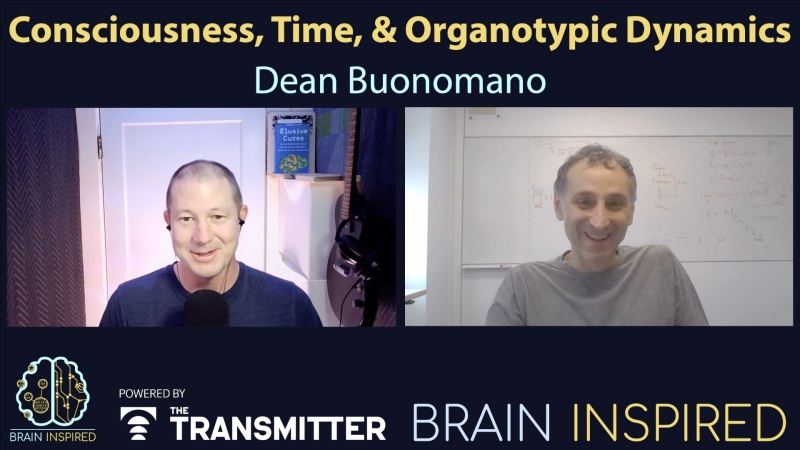
BI 210 Dean Buonomano: Consciousness, Time, and Organotypic Dynamics episode artwork

EPISODE · Apr 22, 2025 · 1H 50M

BI 210 Dean Buonomano: Consciousness, Time, and Organotypic Dynamics

from Brain Inspired · host Paul Middlebrooks

Support the show to get full episodes, full archive, and join the Discord community. Dean Buonomano runs the Buonomano lab at UCLA. Dean was a guest on Brain Inspired way back on episode 18, where we talked about his book Your Brain is a Time Machine: The Neuroscience and Physics of Time, which details much of his thought and research about how centrally important time is for virtually everything we do, different conceptions of time in philosophy, and how how brains might tell time. That was almost 7 years ago, and his work on time and dynamics in computational neuroscience continues. One thing we discuss today, later in the episode, is his recent work using organotypic brain slices to test the idea that cortical circuits implement timing as a computational primitive it's something they do by they're very nature. Organotypic brain slices are between what I think of as traditional brain slices and full on organoids. Brain slices are extracted from an organism, and maintained in a brain-like fluid while you perform experiments on them. Organoids start with a small amount of cells that you the culture, and let them divide and grow and specialize, until you have a mass of cells that have grown into an organ of some sort, to then perform experiments on. Organotypic brain slices are extracted from an organism, like brain slices, but then also cultured for some time to let them settle back into some sort of near-homeostatic point - to them as close as you can to what they're like in the intact brain... then perform experiments on them. Dean and his colleagues use optigenetics to train their brain slices to predict the timing of the stimuli, and they find the populations of neurons do indeed learn to predict the timing of the stimuli, and that they exhibit replaying of those sequences similar to the replay seen in brain areas like the hippocampus. But, we begin our conversation talking about Dean's recent piece in The Transmitter, that I'll point to in the show notes, called The brain holds no exclusive rights on how to create intelligence. There he argues that modern AI is likely to continue its recent successes despite the ongoing divergence between AI and neuroscience. This is in contrast to what folks in NeuroAI believe. We then talk about his recent chapter with physicist Carlo Rovelli, titled Bridging the neuroscience and physics of time, in which Dean and Carlo examine where neuroscience and physics disagree and where they agree about the nature of time. Finally, we discuss Dean's thoughts on the integrated information theory of consciousness, or IIT. IIT has see a little controversy lately. Over 100 scientists, a large part of that group calling themselves IIT-Concerned, have expressed concern that IIT is actually unscientific. This has cause backlash and anti-backlash, and all sorts of fun expression from many interested people. Dean explains his own views about why he thinks IIT is not in the purview of science - namely that it doesn't play well with the existing ontology of what physics says about science. What I just said doesn't do justice to his arguments, which he articulates much better. Buonomano lab. Twitter: @DeanBuono. Related papers The brain holds no exclusive rights on how to create intelligence. What makes a theory of consciousness unscientific? Ex vivo cortical circuits learn to predict and spontaneously replay temporal patterns. Bridging the neuroscience and physics of time. BI 204 David Robbe: Your Brain Doesn’t Measure Time Read the transcript. 0:00 - Intro 8:49 - AI doesn't need biology 17:52 - Time in physics and in neuroscience 34:04 - Integrated information theory 1:01:34 - Global neuronal workspace theory 1:07:46 - Organotypic slices and predictive processing 1:26:07 - Do brains actually measure time? David Robbe

Support the show to get full episodes, full archive, and join the Discord community. Dean Buonomano runs the Buonomano lab at UCLA. Dean was a guest on Brain Inspired way back on episode 18, where we talked about his book Your Brain is a Time Machine: The Neuroscience and Physics of Time, which details much of his thought and research about how centrally important time is for virtually everything we do, different conceptions of time in philosophy, and how how brains might tell time. That was almost 7 years ago, and his work on time and dynamics in computational neuroscience continues. One thing we discuss today, later in the episode, is his recent work using organotypic brain slices to test the idea that cortical circuits implement timing as a computational primitive it's something they do by they're very nature. Organotypic brain slices are between what I think of as traditional brain slices and full on organoids. Brain slices are extracted from an organism, and maintained in a brain-like fluid while you perform experiments on them. Organoids start with a small amount of cells that you the culture, and let them divide and grow and specialize, until you have a mass of cells that have grown into an organ of some sort, to then perform experiments on. Organotypic brain slices are extracted from an organism, like brain slices, but then also cultured for some time to let them settle back into some sort of near-homeostatic point - to them as close as you can to what they're like in the intact brain... then perform experiments on them. Dean and his colleagues use optigenetics to train their brain slices to predict the timing of the stimuli, and they find the populations of neurons do indeed learn to predict the timing of the stimuli, and that they exhibit replaying of those sequences similar to the replay seen in brain areas like the hippocampus. But, we begin our conversation talking about Dean's recent piece in The Transmitter, that I'll point to in the show notes, called The brain holds no exclusive rights on how to create intelligence. There he argues that modern AI is likely to continue its recent successes despite the ongoing divergence between AI and neuroscience. This is in contrast to what folks in NeuroAI believe. We then talk about his recent chapter with physicist Carlo Rovelli, titled Bridging the neuroscience and physics of time, in which Dean and Carlo examine where neuroscience and physics disagree and where they agree about the nature of time. Finally, we discuss Dean's thoughts on the integrated information theory of consciousness, or IIT. IIT has see a little controversy lately. Over 100 scientists, a large part of that group calling themselves IIT-Concerned, have expressed concern that IIT is actually unscientific. This has cause backlash and anti-backlash, and all sorts of fun expression from many interested people. Dean explains his own views about why he thinks IIT is not in the purview of science - namely that it doesn't play well with the existing ontology of what physics says about science. What I just said doesn't do justice to his arguments, which he articulates much better. Buonomano lab. Twitter: @DeanBuono. Related papers The brain holds no exclusive rights on how to create intelligence. What makes a theory of consciousness unscientific? Ex vivo cortical circuits learn to predict and spontaneously replay temporal patterns. Bridging the neuroscience and physics of time. BI 204 David Robbe: Your Brain Doesn’t Measure Time Read the transcript. 0:00 - Intro 8:49 - AI doesn't need biology 17:52 - Time in physics and in neuroscience 34:04 - Integrated information theory 1:01:34 - Global neuronal workspace theory 1:07:46 - Organotypic slices and predictive processing 1:26:07 - Do brains actually measure time? David Robbe

NOW PLAYING

BI 210 Dean Buonomano: Consciousness, Time, and Organotypic Dynamics

0:00 1:50:33

No transcript for this episode yet

We transcribe on demand. Request one and we'll notify you when it's ready — usually under 10 minutes.

Carnivores Don't Get Sunburn - Carnivore Diet Talks Carnivores Don't Get Sunburn - Carnivore Diet Talks Welcome to “Carnivores Don’t Get Sunburn,” where we have fun and explore the carnivore diet and its transformative power. Join us as we uncover real stories from individuals who have thrived on this diet, defying convention and embracing optimal health. Plus, stay tuned for our upcoming documentary featuring diverse carnivores overcoming health challenges. Learn more at www.carnivoredietdocumentary.com.Excitingly, we’re working on an upcoming documentary where we’ll feature carnivores from various walks of life, conquering diverse health challenges. Join us on this journey and learn more at www.carnivoredietdocumentary.com.Join us in uncovering the power of the carnivore diet. Prepare to be inspired, informed, and empowered to embrace optimal health and well-being.Welcome to “Carnivores Don’t Get Sunburn: Unveiling Real Stories of the Carnivore Diet.” Stay tuned for our upcoming documentary. Discover how this lifestyle can transform lives. Learn more at www.carnivoredietdocumentary.com Living Out Loud Podcast: Entrepreneurship | Blogging | Work-Life Balance | Travel Lifestyle Valerie Fidan: Online Entrepreneur, Social Media Expert, Blogger Living Out Loud (LOL) is a podcast about living vibrantly with health and wellness blogger, digital strategist Valerie Fidan. Each week, LOL is bringing you episodes with interesting interviews and guests in the health and wellness industry. We discuss everything from Millennial entrepreneurship, wellness hacks and topics, key industry advice while keeping it a fun, light-hearted conversation, inviting to feel like you are having out with friends. This is a breeding ground for ideas and excitement for a balanced and inspired lifestyle for living out loud! Submit your questions and topics of interest to [email protected]. And, for more fun, healthy recipes, blog posts and travel visit www.livethelittlethings.com // social media: craveablesocial.com / [email protected] Naturally Inspired Podcast: Health. Freedom. Lifestyle. Tammy Cuthbert Garcia Naturally Inspired Podcast is a weekly podcast where we interview health practitioners, authors, filmmakers, scientists and leading experts in the fields of health and wellness. Guests are on the cutting edge and our conversations aim to inspire listeners to think critically about health choices for better life results. Learn More At https://naturallyinspiredpodcast.com/ Made You Think Neil Soni, Nat Eliason, and Adil Majid Made You Think is a podcast by Nat Eliason, Neil Soni, and Adil Majid where the hosts and their guests examine ideas that, as the name suggests, make you think. Episodes will explore books, essays, podcasts, and anything else that warrants further discussion, teaches something useful, or at the very least, exercises our brain muscles.

Frequently Asked Questions

How long is this episode of Brain Inspired?

This episode is 1 hour and 50 minutes long.

When was this Brain Inspired episode published?

This episode was published on April 22, 2025.

What is this episode about?

Support the show to get full episodes, full archive, and join the Discord community. Dean Buonomano runs the Buonomano lab at UCLA. Dean was a guest on Brain Inspired way back on episode 18, where we talked about his book Your Brain is a...

Can I download this Brain Inspired episode?

Yes, you can download this episode by clicking the download button on the episode player, or subscribe to the podcast in your preferred podcast app for automatic downloads.
URL copied to clipboard!