
EPISODE · Jul 2, 2025 · 1H 52M
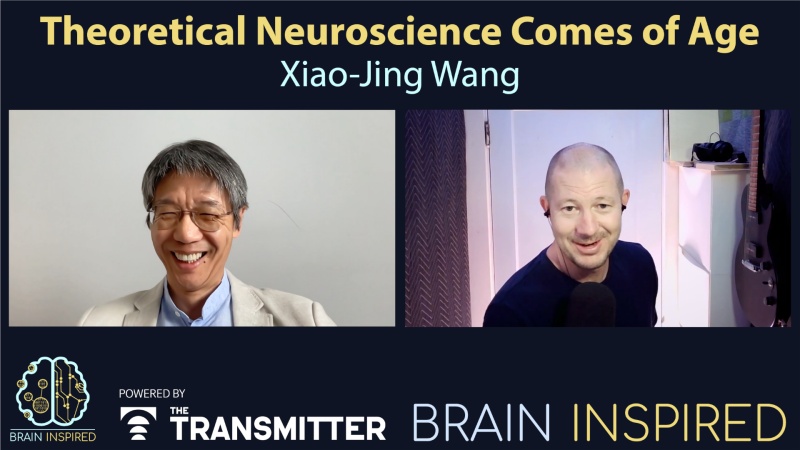
BI 215 Xiao-Jing Wang: Theoretical Neuroscience Comes of Age
from Brain Inspired · host Paul Middlebrooks
Support the show to get full episodes, full archive, and join the Discord community. The Transmitter is an online publication that aims to deliver useful information, insights and tools to build bridges across neuroscience and advance research. Visit thetransmitter.org to explore the latest neuroscience news and perspectives, written by journalists and scientists. Read more about our partnership. Sign up for Brain Inspired email alerts to be notified every time a new Brain Inspired episode is released. To explore more neuroscience news and perspectives, visit thetransmitter.org. Xiao-Jing Wang is a Distinguished Global Professor of Neuroscience at NYU Xiao-Jing was born and grew up in China, spent 8 years in Belgium studying theoretical physics like nonlinear dynamical systems and deterministic chaos. And as he says it, he arrived from Brussels to California as a postdoc, and in one day switched from French to English, from European to American culture, and physics to neuroscience. I know Xiao-Jing as a legend in non-human primate neurophysiology and modeling, paving the way for the rest of us to study brain activity related cognitive functions like working memory and decision-making. He has just released his new textbook, Theoretical Neuroscience: Understanding Cognition, which covers the history and current research on modeling cognitive functions from the very simple to the very cognitive. The book is also somewhat philosophical, arguing that we need to update our approach to explaining how brains function, to go beyond Marr's levels and enter a cross-level mechanistic explanatory pursuit, which we discuss. I just learned he even cites my own PhD research, studying metacognition in nonhuman primates - so you know it's a great book. Learn more about Xiao-Jing and the book in the show notes. It was fun having one of my heroes on the podcast, and I hope you enjoy our discussion. Computational Laboratory of Cortical Dynamics Book: Theoretical Neuroscience: Understanding Cognition. Related papers Division of labor among distinct subtypes of inhibitory neurons in a cortical microcircuit of working memory. Macroscopic gradients of synaptic excitation and inhibition across the neocortex. Theory of the multiregional neocortex: large-scale neural dynamics and distributed cognition. 0:00 - Intro 3:08 - Why the book now? 11:00 - Modularity in neuro vs AI 14:01 - Working memory and modularity 22:37 - Canonical cortical microcircuits 25:53 - Gradient of inhibitory neurons 27:47 - Comp neuro then and now 45:35 - Cross-level mechanistic understanding 1:13:38 - Bifurcation 1:24:51 - Bifurcation and degeneracy 1:34:02 - Control theory 1:35:41 - Psychiatric disorders 1:39:14 - Beyond dynamical systems 1:43:447 - Mouse as a model 1:48:11 - AI needs a PFC
Embed this episode
Ready to play
BI 215 Xiao-Jing Wang: Theoretical Neuroscience Comes of Age
No transcript for this episode yet
Similar Episodes
No similar episodes found.
Similar Podcasts
No similar podcasts found.