
EPISODE · Sep 24, 2025 · 1H 43M
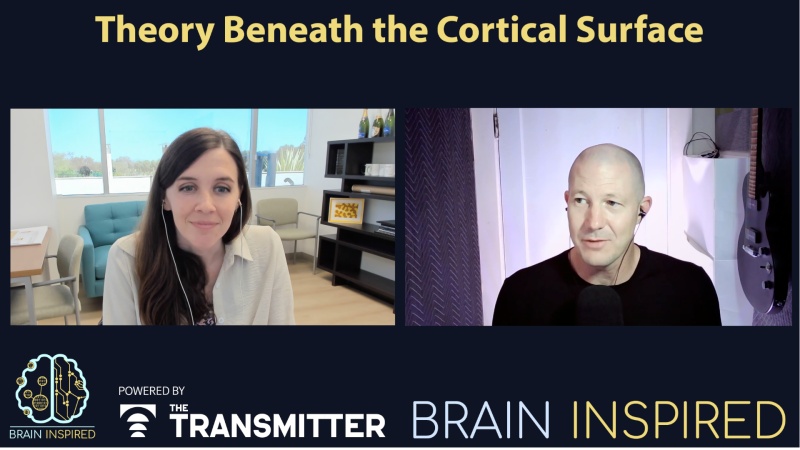
BI 221 Ann Kennedy: Theory Beneath the Cortical Surface
from Brain Inspired · host Paul Middlebrooks
Support the show to get full episodes, full archive, and join the Discord community. Ann Kennedy is Associate Professor at Scripps Research Institute and runs the Laboratory for Theoretical Neuroscience and Behavior. Among other things, Ann has been studying how processes important in life, like survival, threat response, motivation, and pain, are mediated through subcortical brain areas like the hypothalamus. She also pays attention to the time course those life processes require, which has led her to consider how the expression of things like proteins help shape neural processes throughout the brain, so we can behave appropriately in those different contexts. You'll hear us talk about how this is still a pretty open field in theoretical neuroscience, unlike the historically heavy use of theory in popular brain areas throughout the cortex, and the historically narrow focus on spikes or action potentials as the only game in town when it comes to neural computation. We discuss that and I link in the show notes to a commentary piece Ann wrote, in which she argues for both top-down and bottom-up theoretical approaches. I also link to her papers about the early evolution of nervous systems, how heterogeneity or diversity of neurons is an advantage for neural computations, and we discuss a kaggle competition she developed to benchmark automated behavioral labels of behaving organisms, so that despite different researchers using different recording systems and setups, analyzing those data will produce consistent labels to better compare across labs and aggregated bigger and better data sets. Laboratory for Theoretical Neuroscience and Behavior. Social: @antihebbiann.bsky.social @Antihebbiann The Kaggle competition Ann developed to generalize behavior categorization. Related papersDynamics of neural activity in early nervous system evolution.Theoretical neuroscience has room to grow. Neural heterogeneity controls computations in spiking neural networks. A parabrachial hub for the prioritization of survival behavior. An approximate line attractor in the hypothalamus encodes an aggressive state. Read the transcript. 0:00 - Intro 3:36 - Why study subcortical areas? 13:30 - Evolution 15:06 - Dynamical systems and time scales 21:32 - NeuroAI 28:37 - Before there were brains 33:11 - Endogenous spontaneous activity 40:09 - Natural vs artificial 43:09 - Different is more - heterogeneity 45:32 - Neuromodulators and neuropeptide functions 55:47 - Heterogeneity: manifolds, subspaces, and gain 1:02:43 - Control knobs 1:09:45 - Theoretical neuroscience has room to grow 1:19:59 - Hypothalamus 1:20:57 - Subcortical vs "higher" cognition 1:24:53 - 4E cognition 1:26:56 - Behavior benchmarking 1:37:26 - Current challenges 1:39:46 - Advice to young researchers
Embed this episode
Ready to play
BI 221 Ann Kennedy: Theory Beneath the Cortical Surface
No transcript for this episode yet
Similar Episodes
No similar episodes found.
Similar Podcasts
No similar podcasts found.