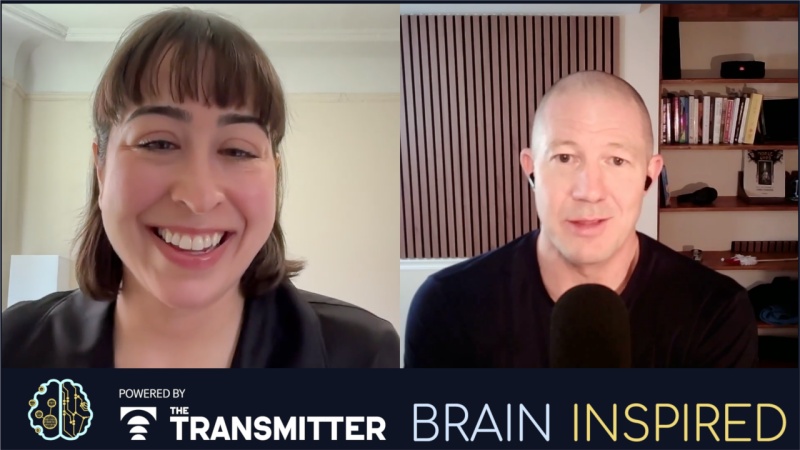
BI 239 Nedah Nemati: Naturalistic Neuroscience and Lived Experience episode artwork

EPISODE · Jun 3, 2026 · 1H 53M

BI 239 Nedah Nemati: Naturalistic Neuroscience and Lived Experience

from Brain Inspired · host Paul Middlebrooks

Support the show to get full episodes, full archive, and join the Discord community. he Transmitter is an online publication that aims to deliver useful information, insights and tools to build bridges across neuroscience and advance research. Visit thetransmitter.org to explore the latest neuroscience news and perspectives, written by journalists and scientists. Read more about our partnership. Check out this story: Beyond the algorithmic oracle: Rethinking machine learning in behavioral neuroscience Sign up for Brain Inspired email alerts to be notified every time a new Brain Inspired episode is released. To explore more neuroscience news and perspectives, visit thetransmitter.org. Neuroscience studies in part the relation between brain activity and behaviors. But, what is a behavior? It's a simple question, but there's no simple answer. For example, you're behaving right now, whatever you're doing, even if you're not doing much. When you cross the street, how many behaviors do you use? When you sleep, what behaviors do you do? Hopefully these simple examples make you think about how difficult it can be call some single movement a behavior. Nedah Nemati is a philosopher of neuroscience at Columbia University. I met Nedah at a workshop a few months ago, where we chatted about the growing trend in neuroscience toward what is sometimes being called "naturalistic neuroscience," which really means varying levels of allowing organisms to behave more freely, less constrained, than traditional neuroscience experiments that seek to minimize unrelated to the behavior or cognition you want to isolate to study and explain. In more extreme cases, researches will try in the lab to emulate as much as possible the ecological world a particular organism has evolved to exist in, or even perform the experiments out of the lab, in the wild, so to speak. So a good part of our discussion revolves around this trend, and what counts as a "naturalistic" behavior, and how the tools we use to perform experiments shape the experiments and the scientific questions themselves. Nedah has a neuroscience background, but in her philosophical work she has embedded herself into various neuroscience labs to better understand how the experiences of the researchers themselves, called their lived experiences, shape the assumptions and questions in their science. As an example, we discuss her work looking into the neuroscience of sleep from over a 100 years ago to today. When a modern neuroscientist studies sleep, are they studying the same thing a scientist claimed to be studying 100 years ago, even though they claimed to be studying sleep back then as well? Nedah's website. Transmitter piece: Beyond the algorithmic oracle: Rethinking machine learning in behavioral neuroscience Related papers Rethinking Neuroscientific Methodology: Lived Experience in Behavioral Studies What is ‘Natural’ about Naturalistic Neuroscience? 0:00 - Intro 5:00 - Philosopher in a lab 20:21 - Sleep as behavior 22:22 - How the study of "sleep" has changed 27:24 - How tools and methods shape definitions 46:07 - Naturalistic neuroscience 1:00:47 - Naturalistic vs experimental 1:14:32 - How tools change theory 1:16:57 - Lived experience 1:26:28 - Lived experience vs. bias 1:37:09 - AI and engineering in neuroscience 1:45:29 - Should a lab hire a philosopher?

Support the show to get full episodes, full archive, and join the Discord community. he Transmitter is an online publication that aims to deliver useful information, insights and tools to build bridges across neuroscience and advance research. Visit thetransmitter.org to explore the latest neuroscience news and perspectives, written by journalists and scientists. Read more about our partnership. Check out this story: Beyond the algorithmic oracle: Rethinking machine learning in behavioral neuroscience Sign up for Brain Inspired email alerts to be notified every time a new Brain Inspired episode is released. To explore more neuroscience news and perspectives, visit thetransmitter.org. Neuroscience studies in part the relation between brain activity and behaviors. But, what is a behavior? It's a simple question, but there's no simple answer. For example, you're behaving right now, whatever you're doing, even if you're not doing much. When you cross the street, how many behaviors do you use? When you sleep, what behaviors do you do? Hopefully these simple examples make you think about how difficult it can be call some single movement a behavior. Nedah Nemati is a philosopher of neuroscience at Columbia University. I met Nedah at a workshop a few months ago, where we chatted about the growing trend in neuroscience toward what is sometimes being called "naturalistic neuroscience," which really means varying levels of allowing organisms to behave more freely, less constrained, than traditional neuroscience experiments that seek to minimize unrelated to the behavior or cognition you want to isolate to study and explain. In more extreme cases, researches will try in the lab to emulate as much as possible the ecological world a particular organism has evolved to exist in, or even perform the experiments out of the lab, in the wild, so to speak. So a good part of our discussion revolves around this trend, and what counts as a "naturalistic" behavior, and how the tools we use to perform experiments shape the experiments and the scientific questions themselves. Nedah has a neuroscience background, but in her philosophical work she has embedded herself into various neuroscience labs to better understand how the experiences of the researchers themselves, called their lived experiences, shape the assumptions and questions in their science. As an example, we discuss her work looking into the neuroscience of sleep from over a 100 years ago to today. When a modern neuroscientist studies sleep, are they studying the same thing a scientist claimed to be studying 100 years ago, even though they claimed to be studying sleep back then as well? Nedah's website. Transmitter piece: Beyond the algorithmic oracle: Rethinking machine learning in behavioral neuroscience Related papers Rethinking Neuroscientific Methodology: Lived Experience in Behavioral Studies What is ‘Natural’ about Naturalistic Neuroscience? 0:00 - Intro 5:00 - Philosopher in a lab 20:21 - Sleep as behavior 22:22 - How the study of "sleep" has changed 27:24 - How tools and methods shape definitions 46:07 - Naturalistic neuroscience 1:00:47 - Naturalistic vs experimental 1:14:32 - How tools change theory 1:16:57 - Lived experience 1:26:28 - Lived experience vs. bias 1:37:09 - AI and engineering in neuroscience 1:45:29 - Should a lab hire a philosopher?

NOW PLAYING

BI 239 Nedah Nemati: Naturalistic Neuroscience and Lived Experience

0:00 1:53:43

No transcript for this episode yet

We transcribe on demand. Request one and we'll notify you when it's ready — usually under 10 minutes.

Carnivores Don't Get Sunburn - Carnivore Diet Talks Carnivores Don't Get Sunburn - Carnivore Diet Talks Welcome to “Carnivores Don’t Get Sunburn,” where we have fun and explore the carnivore diet and its transformative power. Join us as we uncover real stories from individuals who have thrived on this diet, defying convention and embracing optimal health. Plus, stay tuned for our upcoming documentary featuring diverse carnivores overcoming health challenges. Learn more at www.carnivoredietdocumentary.com.Excitingly, we’re working on an upcoming documentary where we’ll feature carnivores from various walks of life, conquering diverse health challenges. Join us on this journey and learn more at www.carnivoredietdocumentary.com.Join us in uncovering the power of the carnivore diet. Prepare to be inspired, informed, and empowered to embrace optimal health and well-being.Welcome to “Carnivores Don’t Get Sunburn: Unveiling Real Stories of the Carnivore Diet.” Stay tuned for our upcoming documentary. Discover how this lifestyle can transform lives. Learn more at www.carnivoredietdocumentary.com Living Out Loud Podcast: Entrepreneurship | Blogging | Work-Life Balance | Travel Lifestyle Valerie Fidan: Online Entrepreneur, Social Media Expert, Blogger Living Out Loud (LOL) is a podcast about living vibrantly with health and wellness blogger, digital strategist Valerie Fidan. Each week, LOL is bringing you episodes with interesting interviews and guests in the health and wellness industry. We discuss everything from Millennial entrepreneurship, wellness hacks and topics, key industry advice while keeping it a fun, light-hearted conversation, inviting to feel like you are having out with friends. This is a breeding ground for ideas and excitement for a balanced and inspired lifestyle for living out loud! Submit your questions and topics of interest to [email protected]. And, for more fun, healthy recipes, blog posts and travel visit www.livethelittlethings.com // social media: craveablesocial.com / [email protected] Naturally Inspired Podcast: Health. Freedom. Lifestyle. Tammy Cuthbert Garcia Naturally Inspired Podcast is a weekly podcast where we interview health practitioners, authors, filmmakers, scientists and leading experts in the fields of health and wellness. Guests are on the cutting edge and our conversations aim to inspire listeners to think critically about health choices for better life results. Learn More At https://naturallyinspiredpodcast.com/ Made You Think Neil Soni, Nat Eliason, and Adil Majid Made You Think is a podcast by Nat Eliason, Neil Soni, and Adil Majid where the hosts and their guests examine ideas that, as the name suggests, make you think. Episodes will explore books, essays, podcasts, and anything else that warrants further discussion, teaches something useful, or at the very least, exercises our brain muscles.

Frequently Asked Questions

How long is this episode of Brain Inspired?

This episode is 1 hour and 53 minutes long.

When was this Brain Inspired episode published?

This episode was published on June 3, 2026.

What is this episode about?

Support the show to get full episodes, full archive, and join the Discord community. he Transmitter is an online publication that aims to deliver useful information, insights and tools to build bridges across neuroscience and advance...

Can I download this Brain Inspired episode?

Yes, you can download this episode by clicking the download button on the episode player, or subscribe to the podcast in your preferred podcast app for automatic downloads.
URL copied to clipboard!