
EPISODE · Apr 30, 2026 · 23 MIN
Bioprocess Intelligence Bulletin: April 2026 Breakthroughs and Manufacturing Trends
from Biomanufacturing & Fermentation Technology · host prasad ernala
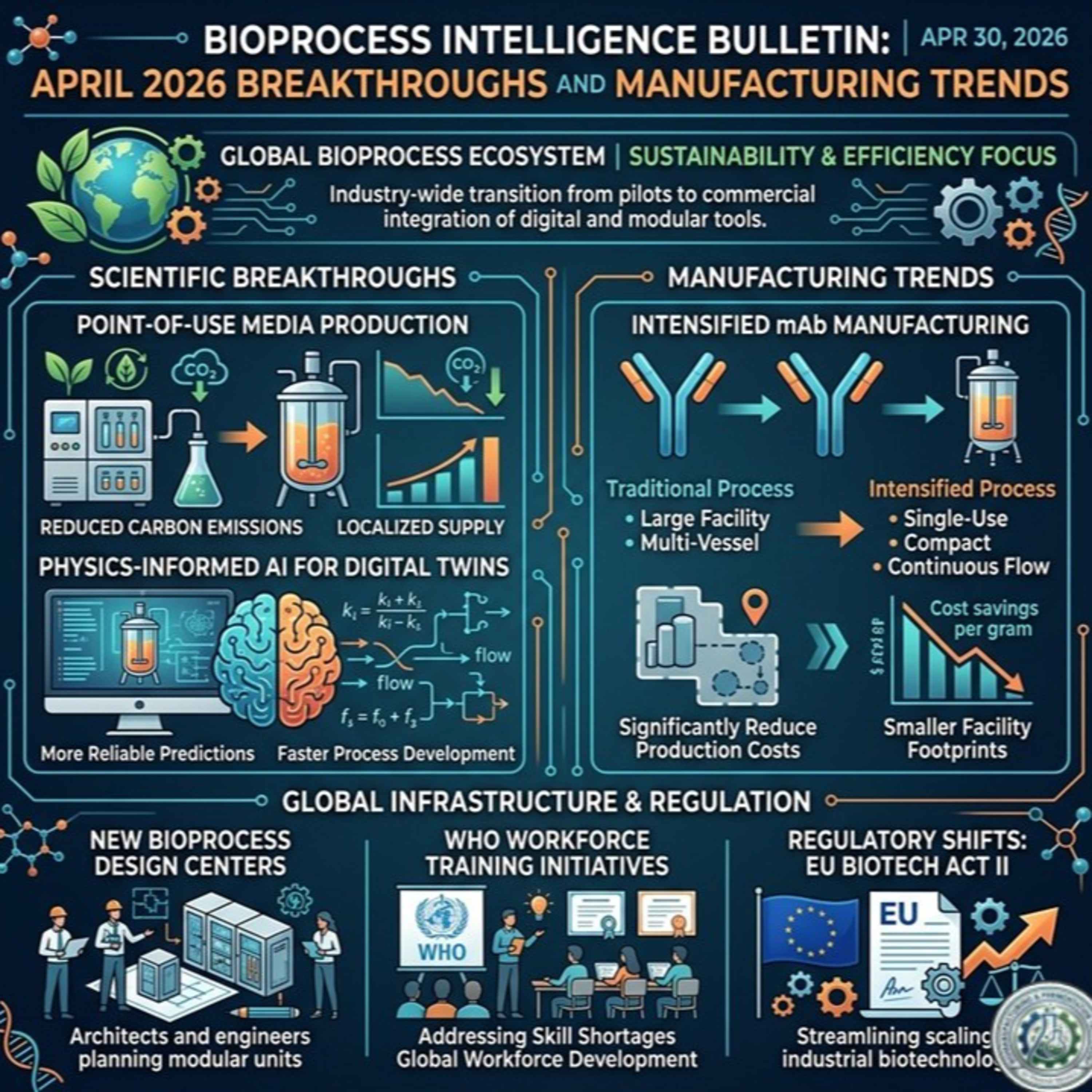
Apr 30, 2026The provided discussion on report outlines the state of the bioprocess and biomanufacturing industry as of April 2026, focusing on technological shifts toward sustainability and efficiency. Key scientific breakthroughs include point-of-use media production to lower carbon emissions and the adoption of physics-informed AI for more reliable digital twins. Major industry trends highlight a move toward intensified manufacturing processes for monoclonal antibodies, which significantly reduce production costs and facility footprints. Global infrastructure is expanding through new bioprocess design centers and workforce training initiatives led by the WHO to address critical skill shortages. Furthermore, the report discusses regulatory shifts, such as the EU Biotech Act II, aimed at streamlining the scaling of industrial biotechnologies. Collectively, these updates signal an industry-wide transition from experimental pilots to the commercial integration of digital and modular tools.#Science #STEM #Bioprocess #ScaleUp and #TechTransfer,#Industrial #Microbiology,#MetabolicEngineering and #SystemsBiology,#Bioprocessing,#MicrobialFermentation,#Bio-manufacturing,#Industrial #Biotechnology,#Fermentation Engineering,#ProcessDevelopment,#Microbiology,#Biochemistry,#Biochemical Engineering, #Applied #MicrobialPhysiology, #Microbial #ProcessEngineering, #Upstream #BioprocessDevelopment, #Downstream Processing and #Purification,#CellCulture and #MicrobialSystems Engineering, #Bioreaction #Enzymes, #Biocatalyst #scientific #Scientist #Research
What this episode covers
Apr 30, 2026The provided discussion on report outlines the state of the bioprocess and biomanufacturing industry as of April 2026, focusing on technological shifts toward sustainability and efficiency. Key scientific breakthroughs include point-of-use media production to lower carbon emissions and the adoption of physics-informed AI for more reliable digital twins. Major industry trends highlight a move toward intensified manufacturing processes for monoclonal antibodies, which significantly reduce production costs and facility footprints. Global infrastructure is expanding through new bioprocess design centers and workforce training initiatives led by the WHO to address critical skill shortages. Furthermore, the report discusses regulatory shifts, such as the EU Biotech Act II, aimed at streamlining the scaling of industrial biotechnologies. Collectively, these updates signal an industry-wide transition from experimental pilots to the commercial integration of digital and modular tools.#Science #STEM #Bioprocess #ScaleUp and #TechTransfer,#Industrial #Microbiology,#MetabolicEngineering and #SystemsBiology,#Bioprocessing,#MicrobialFermentation,#Bio-manufacturing,#Industrial #Biotechnology,#Fermentation Engineering,#ProcessDevelopment,#Microbiology,#Biochemistry,#Biochemical Engineering, #Applied #MicrobialPhysiology, #Microbial #ProcessEngineering, #Upstream #BioprocessDevelopment, #Downstream Processing and #Purification,#CellCulture and #MicrobialSystems Engineering, #Bioreaction #Enzymes, #Biocatalyst #scientific #Scientist #Research
NOW PLAYING
Bioprocess Intelligence Bulletin: April 2026 Breakthroughs and Manufacturing Trends
No transcript for this episode yet
Similar Episodes
Apr 21, 2026 ·13m
Apr 19, 2026 ·16m
Apr 17, 2026 ·13m
Apr 13, 2026 ·11m
Apr 11, 2026 ·16m