
EPISODE · Sep 11, 2025 · 57 MIN
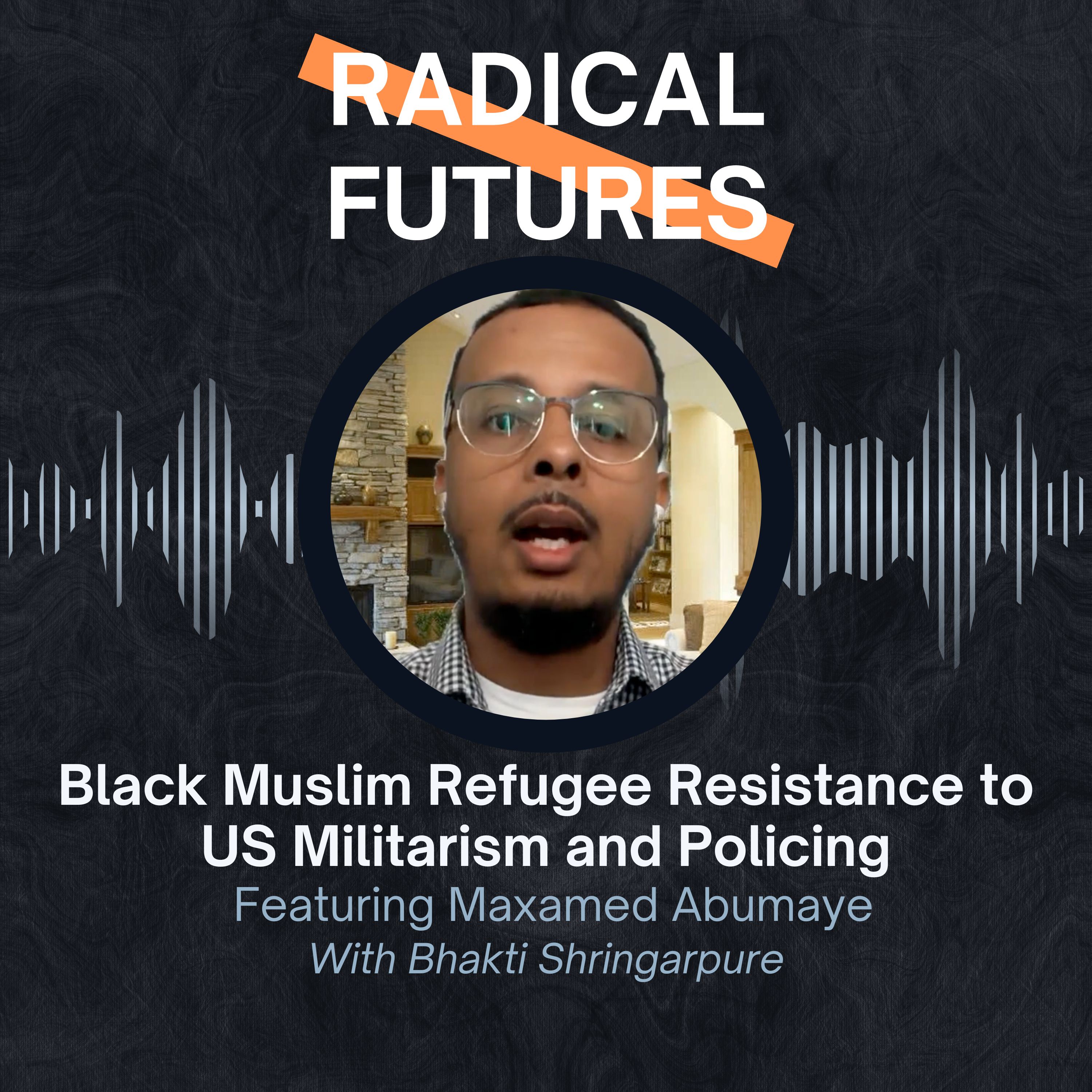
Black Muslim Refugee Resistance to US Militarism and Policing: Featuring Maxamed Abumaye
from Radical Futures
“I have been writing this book almost my whole life,” Maxamed Abumaye admits when asked about the motivation behind his recently published Black Muslim Refugee: Militarism, Policing, and Somali American Resistance to State Violence. Though this is a scholarly book published by a university press, Maxamed deviates from the academic format by making his own life story central to the text. He writes about his family’s journey as they fled the civil war in Somalia and spent many years in a refugee camp in Kenya before being resettled to the US.In the US, Maxamed realized that the violence of American military interventions in Somalia during the 1990s that had displaced his family and turned them into refugees boomeranged right back into their lives in San Diego, California. This violence had become part of the daily lives of the large population of Somali refugees in the San Diego area in the form of “militarized police units breaking down people's doors to deliver search warrants…Imagine someone who experienced the trauma of war, refugee resettlement and now has militarized SWAT teams breaking down their doors?”Even as Maxamed explores this vicious cycle of surveillance, policing, and brutality in great depth, he foregrounds the fact that “Somalis have found a way to resist that violence and to build life and homes in the context of deprivation.” Maxamed witnessed these modes of resistance and world-making firsthand with his family and the larger community. He speaks about “the ways in which we came together, we organized, we built lives, we built community without very little state intervention, where that intervention was often violence.”While Black Muslim Refugee focuses on San Diego’s Somali refugee community, it also stages a much broader intervention. For starters, the book offers a history of contemporary Somalia, tracing where the country, as well as its diaspora, finds itself today. Secondly, given his personal experience and having conducted extensive interviews with Somalis who have spent years in limbo in refugee camps, Maxamed formulates a complex and cogent critique of humanitarianism.In particular, we speak about “humanitarian violence,” a concept that seems like an oxymoron to many who see humanitarianism as force for benevolence and charity. Here, Maxamed explains that the refugee camps are places of great precarity where people are enclosed and lack freedom of movement. Food scarcity is a daily reality and cruel forms of calorie rationing means that families often go hungry. In addition, the policing and hyper-securitized environment are not conducive to safety and general wellbeing.Finally, a key feature of Black Muslim Refugee is Maxamed’s exploration of the experiences of the Somali triple identity formation of simultaneously Black, Muslim, and a refugee. At a time when border regimes are more draconian than ever, when anti-Muslim hatred is on the rise and when anti-Blackness has become structural to policing, Maxamed’s research feels particularly poignant. By virtue of being Black, Muslim and refugee all at once, he believes that Somalis might be able to pave the path for strategic organizing against police and against militarism, broadly.The Black Lives Matter movement became a turning point for young Somalis as African-Americans, Somalis, Nigerians and Caribbean people came together against police harassment. For Somalis, it became clear that straddling all three identities meant they had a unique understanding of the situation, and Somali youth began mobilizing and coming together more than they had before. “Now, as of 2025, Somali youth are in leadership positions in Black Lives Matter movement.”Maxamed believes that these Black, Muslim and refugee Somalis are changing the system from within by arguing that BLM is not just an American issue but that violence against Blacks and Muslims is a global and diasporic issue. Thus, “young Somalis are actually changing BLM organizing to think beyond the United States.”Is there any hope for radical futures when it comes to the abolition of policing? I ask. Maxamed is hopeful. Exposure to BLM activism and organizing has allowed us to see a future “in which police are not considered natural and normal, but are an aberration to everyday life.” Maxamed believes that a radical future is possible due to a radical past: history has shown us that “there have been alternatives to policing that have existed and continue to exist, and that we can function as society outside of that.”Further reading: Black Muslim Refugee: Militarism, Policing, and Somali American Resistance to State Violence by Maxamed Abumaye. https://www.ucpress.edu/books/black-muslim-refugee/paper Hosted by Bhakti Shringarpure. Radical Futures is produced by WarscapesTitle Music: "Cottonstorm" by Bayern Boom BeatSubscribe | Follow www.radicalbookscollective.com
Embed this episode
NOW PLAYING
Black Muslim Refugee Resistance to US Militarism and Policing: Featuring Maxamed Abumaye
No transcript for this episode yet
Similar Episodes
No similar episodes found.
Similar Podcasts
No similar podcasts found.