
EPISODE · Mar 28, 2026 · 19 MIN
Blind-spots, Self-Deception, and Seeing Around Corners
from Culture Coalition Podcast
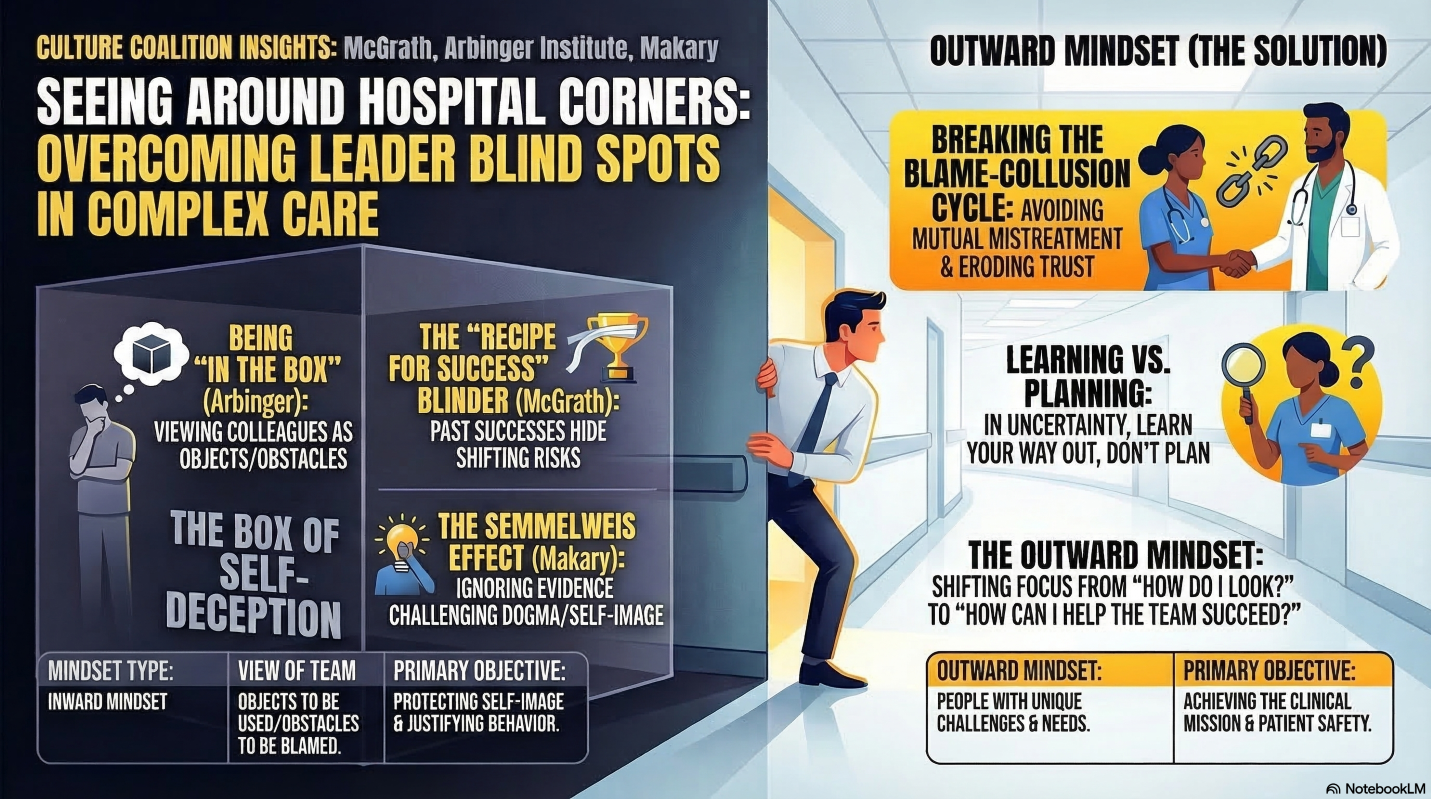
The Ego vs. The Scalpel: Seeing Around Corners in the ORImagine a standard handoff where a scrub tech’s "gut feeling" is silenced by a surgeon’s dismissive "I’ve got this." Minutes later, a 10x force hits the sterile field—a catastrophic bleed. At our last Culture Coalition, we synthesized the works of Rita McGrath (Seeing Around Corners), the Arbinger Institute (Leadership and Self-Deception), and Marty Makary (Blind Spots). Our conclusion was clinical: In the OR, the ego is a more dangerous instrument than a dull scalpel. A leader’s inability to see their own blind spots is the ultimate threat to patient safety.Escaping the "Box" of ObjectificationArbinger defines being "In the Box" as an inward mindset where we see colleagues as obstacles or tools rather than people. Surgical leaders often inhabit "Better-than" (arrogance) or "I-deserve" (entitlement) boxes, while junior staff retreat into "Worse-than" boxes to survive.As Arbinger notes: "When we are in the box, we no longer really see what's going on... we become blind to the humanity of other people." This triggers dangerous OR collusion: a surgeon’s brusqueness causes a nurse to withhold vital data, which then "justifies" the surgeon’s view of the nurse as incompetent. This mutual reinforcement of bad behavior is what ends lives.Clinical Inflection Points: Gradually, then SuddenlyMcGrath’s "strategic inflection points" apply directly to the declining patient. Leaders often fall into the "lagging indicator" trap—relying on stable monitors while ignoring "leading indicators." According to the research, leading indicators are qualitative stories, suppositions, and "water cooler" talk.A loss of safety culture follows Hemingway’s bankruptcy metaphor: "gradually and then suddenly." By the time the patient crashes "suddenly," the "gradual" warnings were already there in the team’s ignored gut feelings.The Danger of the "Success Recipe"Veteran leaders are most at risk because "past success is a powerful blinder." Relying on an outdated "Success Recipe"—"I’ve done 1,000 of these cases without a complication"—causes them to dismiss weak signals.However, "snow melts at the edges." The periphery—the junior staff and APPs physically closest to the patient—sees the melting first. Leaders must be "Out of the Box" to listen to those at the periphery before the 10x shift occurs.Why It MattersSelf-awareness is a clinical skill. When leaders see clearly, the team moves from self-justification to results-oriented healing.During your next shift, who is the one person you’ve "boxed" into an object, and what clinical warning are they currently trying to tell you? Hosted on Acast. See acast.com/privacy for more information.
Embed this episode
NOW PLAYING
Blind-spots, Self-Deception, and Seeing Around Corners
No transcript for this episode yet
Similar Episodes
No similar episodes found.
Similar Podcasts
No similar podcasts found.