
Wait, you're listening to Radio Lab from WNYC. And NPR. I'll say this is Radio Lab the podcast, and you take it from there. Hey, I'm Jad Abumrod.
I'm Robert Kroll, which is Radio Lab the podcast. Let me say, this is Radio Lab the podcast, damn you. Come on. You know what, actually, this is a sort of appropriate, because we want to talk about sharing right now.
I was doing that, I was trying to share the moment with you in my hand. Unsuccessful. So last hour was all about trying to solve the puzzle of why is there niceness in a very, very cruel, doggy dog world? Why would there be any kind of sharing niceness?
And as we asked the scientists in the show, which we called The Good Show, the scientists kept saying over and over again, well, oftentimes what you would call nice behavior is actually disguised selfishness as critters of one kind of trying to push their genes into the future, by being nice to particular folks, to their sisters, to their cousins, to their mothers, to those who are within their family, which share so many of their genes. Yeah, according to some real hard-ass biologists could argue, if you're a nice to your sister, you're really just being nice to your own genes in another person's body. We were like, huh, yeah. Is there another way of thinking about this?
And so we met a guy. Yes, my name's Jerry Wilkinson. I'm a professor and chair of the Department of Biology at the University of Maryland College Park. And the story that Jerry told us happened way before he was a chair or anything like that.
Back when he was a lowly grad student. The first summer of my graduate education, I went to Costa Rica. This was the summer of 1977. We went all over the country, you've studied various things, and we had an opportunity to apply for money to stay in Costa Rica and do individual projects.
And Jerry decided what he was gonna study were bats. Right. Why bats? Have you always liked bats?
I never actually handled a bat before I went to Costa Rica. So I had no prior experience whatsoever. And I was like anyone I think maybe a little bit hesitant. But he says he just happened to be in this place that had a lot of bats.
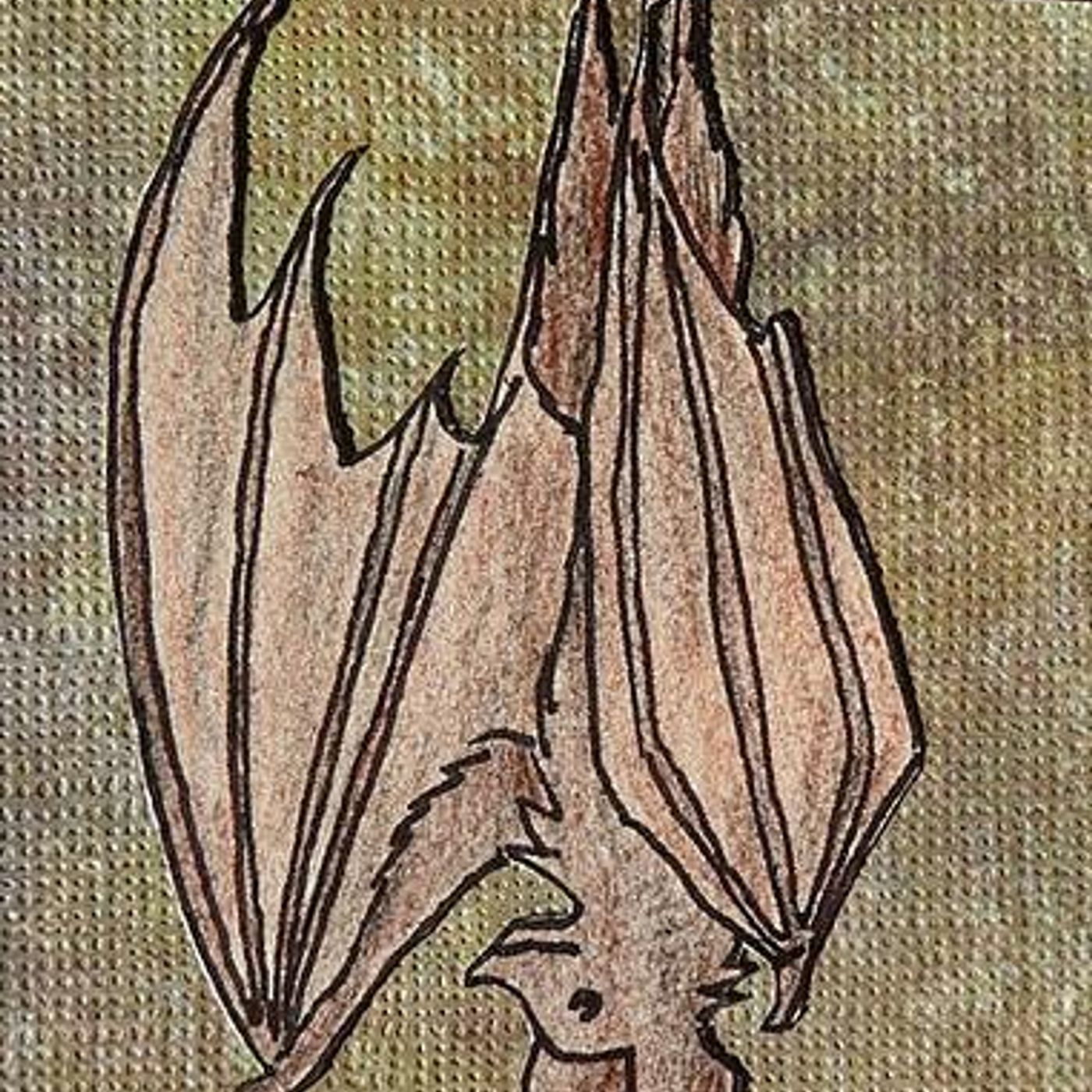
Because I was on a cattle ranch, otherwise known as the McDonald's of bats. Yes, because there's something we ever told you here. These were vampire bats. The common vampire bat which feeds primarily on mammalian blood.
And these particular bats Jerry says live down by the river. In hollow trees. Big ones. Inside they were like caves.
The trees along the rivers. In every night he says. Hundreds of these bats would fly out of their trees, kind of like a cloud. And move across the fields, hitting towards a herd of cows.
Basically they will hop up onto a cow, sink their teeth, razor sharp teeth. Into the cows neck and start sucking its blood. And in a matter of about a half an hour, they basically swell up like a big tick and fly home to the tree quickly. Then they come back to the trees.
And how what Jerry was really interested in was not so much the cow split sucking thing. It was how did the bats behave with each other? Yeah. So one morning he went down to the river where these bats live, found himself a tree.
These trees, some of them were so big that I could actually lie down inside the tree without bending my knees. We would use binoculars to look up at the top of the cavity, which could be anywhere from 15 feet to 40 feet above the ground. Now picture this, you're in the street, it's four stories high. It's dark, it's wet, and up at the top.
How many are up there? Maybe 20 would be sort of some of the larger groups. What about poop? You're right in the direct line?
Yes, they do that. And it's sort of like tar when they defecate blood. It's very sticky. But day after day he would go into these trees, get pooped on and watch them.
Pretty soon he starts to notice that these bats are behaving ways he really didn't expect. They behave quite a bit like primates. Meaning what? They spend a lot of time grooming each other.
Really? 30% of the time in the trees they spend grooming each other. So there you were looking at these repeatedly evil creatures and seeing them kind of snuggle. I mean were you surprised by this?
Oh yeah, no time at all to become very fond. I guess we'll be the best way to describe it. They are very social, they're very interactive. But then Jerry saw one of the bats do something.
They went way beyond just being social. You know it's hard to say, it certainly was not a single observation. But basically here's how it would go. One bat.
One bat will sort of sittle up to another bat and give her a little hug. They sort of clutch each other with their wings which are folded up. And then the bat that made the move, that came up and gave the hug. You'd see that bat try to lick at the mouth of the other bat but when it's hugging.
And if you have a good view you can actually see the tongue of one bat going into the mouth of the other bat. Like they're giving each other a kiss? Very similar, yes. But after seeing this a few times he realized what really was happening is that the one bat was feeding the other bat.
Yes, giving it a meal by regurgitating blood. Into the other bat's mouth. And that was a shock. A shock because well these weren't moms feeding their babies.
I mean that we've all seen. That makes sense. Now these were adult animals. Feeding other adult animals.
Food that they could have been eating themselves. Right, which is weird. That had not been described before. But then he thought wait a second.
Wait a second. I know what's going on here. What? These bats, they're just related.
Correct. They're relatives. Close relatives. The idea that was invoked then and is still invoked now and certainly it's actually got much more support now than it did then is that animals tend to help close relatives and sort of never help anybody who's not a close relative.
So we thought that must be it. They're related. But you don't just assume it. You must test it if you're a scientist.
So jay. So I'm going to set up a little experiment. Yeah, so he went out and got a bunch of bats that he knew were not related. I think I had two groups of six.
Total of 12 bats. Brought them into my house at the time with a slaughterhouse, got a lot of blood. And then every night I would take one of the 12 bats out of the cage and not let it feed while everybody else got access to blood. Which means the sad little bat gets no dinner but has to watch the others eat and it's just getting hungrier and hungrier.
Well how long can a bat go with no blood? Three days, at most. At most. And then they're dead.
So you can imagine that by the time the sun rises this bat is literally starving. And then at dawn I would put the female back in who hadn't fed she will go and beg pretty from other individuals. And really instead of them saying to her. You're not my sister, blah blah blah.
Yeah according to Jerry what would happen is that they hold still part their lips and throw up in her mouth. Thank you. I mean at that point I was thrilled that I had found something that seemed to indicate that it wasn't just all about relatedness. Just to make sure this wasn't a fluke.
What I then did over the span of the next two weeks is I continued to take one bat out of the cage every night. And you do the whole starvert till dawn thing and then put her back in the cage with the others. And she was always fed. By someone from her group.
And occasionally even by more than one individual from her group. Sometimes one bat was stepped up and say hey, hey, hey, hey, hey, have something. And then maybe another, sometimes a third. And he thought, I wonder what's going on here.
Is this random or is there some kind of system? He just couldn't really tell. So then I just kept track of who fed whom. While I was there I was you know, staying up all night.
I wasn't really doing a lot of analysis of the information. And I was only there for a relatively short period. I got back up to San Diego. Did the analysis and discovered that there appeared to be a pattern.
If you know Sally fed Agnes on the first day and then I later starved Sally, then Agnes fed Sally on the second night. Right. Let's just go through this one more time. If on the first day Sally fed Agnes.
Then on the second day Agnes fed Sally invariably. Not always, but invariably. And what does invariably mean in that? Most of the time?
Most of the time. So if I'm Agnes, I'm only going to feed Sally under the condition that at some later point in time she will repay the favor. I feed you. You feed me Agnes feed Sally.
Sally feeds Agnes. And if you think about it, this is kind of what friendship is. We never say that explicitly, but friendship works on these kinds of traits. And many feeds many feeds many in.
In fact, with the bats, Jerry at a certain point created a kind of matrix that plotted. Who had spent time with who? The friendships between the individual bats. And that allowed me to actually calculate a number that measured who was the best friends and who were the not such good friends.
Like a friend number? Yes. Who was the so eighth grade? And it turns out that number is the best predictor of who will feed who.
It's better than who's related to him. Better? Yes. Although it turned out that they both were important.
I want to write a headline around this. I want to write a headline about that. That buddies beat Kim. Yes.
Yes. Think about this means. If friends can beat family, then first of all, friends are people that you choose. Yeah.
I mean, you've stuck with your family. But you can choose your friends. No, this is in fact an idea that niceness is really deeply chosen. Yeah.
Well, so what is in the broad scientific community, does this mean what you counted and saw open up altogether again? The question of who helps who and why? Yes. But now we're talking 1984.
That's when this work was published. And so that's when I gave talks about it various places. So it became well known pretty quickly. And it was a really big deal.
In fact, some scientists thought maybe this is going to revolutionize our whole understanding of niceness and nature and social dynamics and creatures because maybe this behavior isn't just a bat thing. It's everywhere. And we just haven't been seeing it. We haven't been working hard enough to see it.
Like this Jerry guy slept in a tree, got pooped on for weeks on end. Maybe if we pushed ourselves that far, we'd find this all over the place. But no. It didn't work out that way.
There are not many convincing cases that I think people identified in those next few years. So the observation you're making may not be writ large. It just may be writ small. Well, I'm not sure I would describe it exactly that way.
But clearly it's how much we can extrapolate the vampire bat story to other systems is an open question. Well, in your most extrapolated frame of mind, maybe when you're sitting in a bar and your three martinis in and in your gun and your drunk gut at that moment, what is your hunch? Is this a representative case and we just haven't found it elsewhere, but we will? Or is this a one off?
Oh, I don't think it's unique. But I don't think it's very common. I think it would be quite uncommon. You know, the epivats are really pretty special because of this reliance on blood.
Here's one story you could tell, says Jerry. Way back in the day. It's 40,000 or more years in the past. The planes where the bats lived were filled with all of these giant creatures.
Big mammals were abundant. Mm, saber-toothed tigers, mammoths, wolves and giant slaws. And all of these things were filled with warm blood, so the bats were very happy. But presumably there was a point in time when all of these large mammals disappeared.
Really fast. And there are all kinds of theories as to why that happened. The point is it must have created a time when vampire bats all of a sudden had a hard time finding prey. At that point, I would think it would have been a behoove of vampire bat to come up with some way to deal with periodic food shortages.
And you think it's a strategy they came up with somehow? Somehow? What's to share? If they didn't help each other, I think you would find vampire bats gone.
I mean, we wouldn't see them now. Well, this is interesting. This is a new way to explore the question we've been exploring all this time. Yeah, why is there nice in the world?
Yeah. Now up to now we thought, well, mostly niceness is a secret form of selfishness. Selfiness. Selfiness.
Yeah. But this is a different version. This one says, you know, under certain circumstances for a group of animals being nice really isn't an option. It's the only way.
Yeah. When going, it's tough. The tough get. Nice.
How's that for a bumper sticker? Hi, my name is Kim Euchar and I'm from Sioux Falls, South Dakota and I'm a radio web listener. RadioLab is supported in part by the Alfred T. Sloan Foundation in Hampton Public Understanding of Science and Technology in the Modern World.
More information about Sloan at www.sloane.org. Thank you very much. End of message.