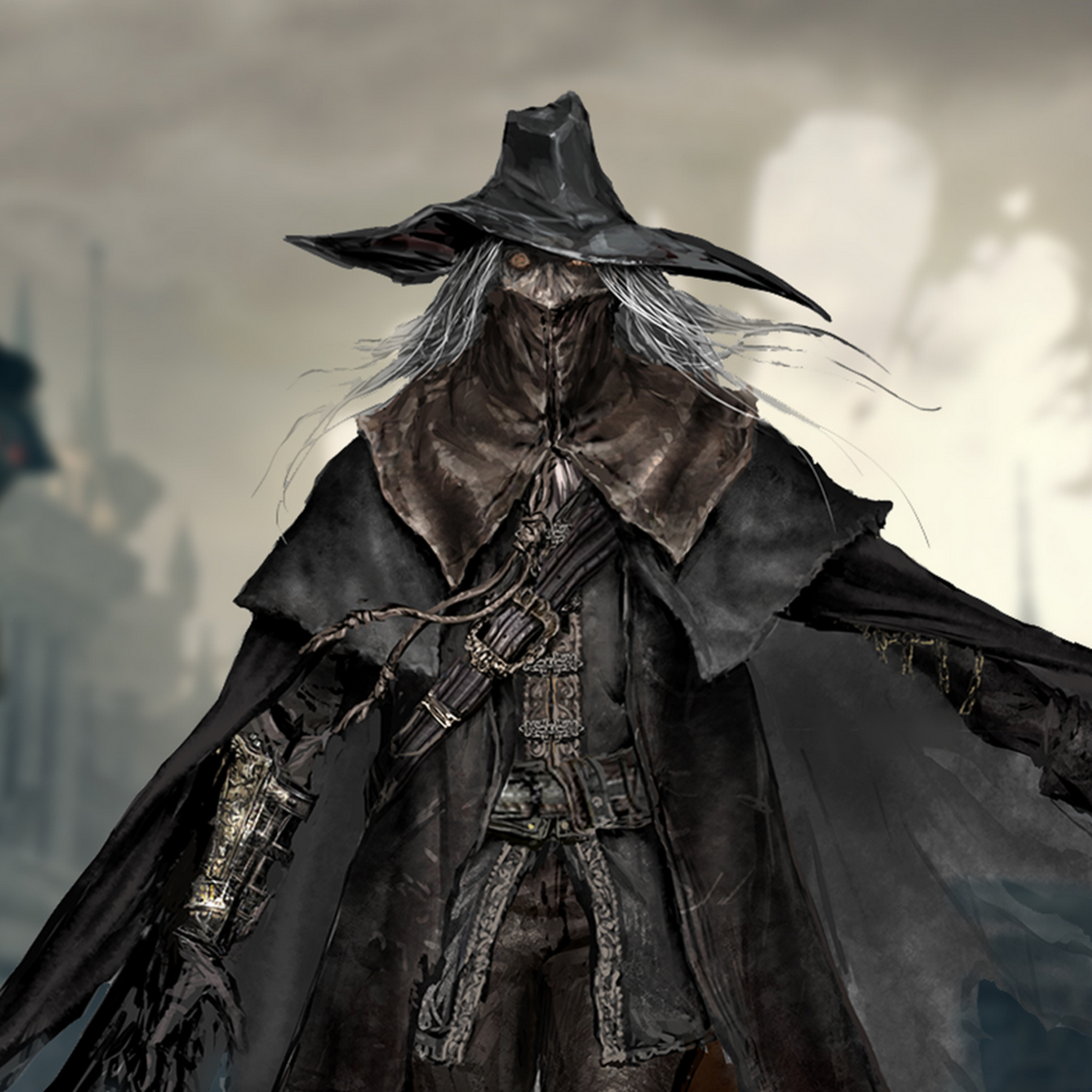
Welcome back to Dreamscape Archives. Tonight, we're returning to the blood-soaked streets of Yarnam to explore the secrets that even the most dedicated hunters might have missed. Over the next hour, we'll uncover obscure mechanics, mysterious unsolved puzzles, cut content that never saw the light of day, and hidden details that reveal just how deep from Software's masterpiece truly goes. So settle in, get comfortable, and prepare yourself for a journey into the lesser-known mysteries of Bloodborne.
This is knowledge that transcends the obvious. Secrets whispered in the shadows of the healing church and discoveries that make even veteran hunters see Yarnam with fresh eyes. The living world through insight. One of Bloodborne's most ingenious mechanics is also one of its most subtle.
Insight, that strange stat that accumulates in the corner of your screen, is far more than just a currency for summoning help or buying rare items. It's a gateway to perceiving the true nature of Yarnam's nightmare, and the changes it brings to the world are both fascinating and deeply unsettling. Most players know that Insight allows you to see the lesser amygdala's clinging to buildings throughout Yarnam. But the rabbit hole of insight-based revelations goes much, much deeper than that initial shock of seeing a cosmic horror you've been walking past for hours.
Let's start with one of the most charming, yet eerie discoveries. When you reach 50 Insight and use the Hunter Chief emblem to open the gate leading to the Grand Cathedral, something extraordinary happens. If you have enough cosmic awareness, you'll see that the lever mechanism on the other side isn't operating by itself. Instead, a group of messengers, those ghostly little creatures that populate the Hunter's dream, have gathered together to physically pull the lever for you.
These diminutive beings, working in perfect synchronization, reveal that they're far more present in the waking world than most hunters ever realize. It's a detail so easy to miss, yet it speaks volumes about the interconnected nature of the Hunter's dream and the physical realm of Yarnam. The messengers aren't just passive observers or simple shopkeepers, they're actively participating in your hunt, manipulating the physical world on your behalf when you possess the Insight to perceive their efforts. This revelation transforms every door you've opened, every gate you've passed through.
Were the messengers there all along invisibly assisting you or does your growing cosmic awareness somehow enable them to manifest and help? The game never tells you, leaving you to wonder about the true nature of these helpful spirits. But the Insight Systems revelations become progressively more disturbing as your cosmic knowledge deepens. At 60 Insight, a threshold that represents truly profound awareness of the nightmare's reality, something deeply unsettling begins to happen.
You'll hear it first as a faint sound, easy to dismiss as ambient noise or imagination. But then it comes again, clearer this time. The unmistakable sound of a baby crying. This isn't tied to any specific location.
The crying follows you throughout Yarnam, a ghostly infant's whale that echoes through the Gothic streets regardless of where you are. It's Murgo, the invisible great one child who stillbirth and subsequent existence as a disembodied consciousness is central to bloodborne's cosmic horror. At lower insight levels, you're mercifully deaf to this perpetual lamentation. But once you've gazed too deeply into the abyss, once you've accumulated too much forbidden knowledge, you can hear the cosmic infant's endless grief wherever you go.
This audio phenomenon is brilliantly designed to be both lower appropriate and psychologically effective. In Lovecraftian horror, increased knowledge of cosmic truths traditionally drives people mad. Here, that madness is represented not through character stats going haywire but through your own gradual discomfort as a player. The baby's crying is deliberately unsettling.
And unlike visual changes that you can look away from, you can't unhear it. It's there constantly reminding you that you've seen too much, learned too much and can never go back to blessed ignorance. The insight system also dramatically alters enemy behavior in ways that fundamentally change combat encounters. At 15, insight, the church doctors scattered throughout Cathedral Ward undergo a disturbing transformation.
These already dangerous enemies gain entirely new abilities based on the weapons they carry. The lantern-wielding church doctors suddenly begin shooting projectiles from their lamps, turning what was once a melee threat into a dangerous ranged encounter. The side-wheelers find their weapons reaved in flames, adding fire damage to their already considerable reach. Most disturbingly, the crossbarrows gain the ability to build up your frenzy meter with their attacks.
This last change is particularly significant because frenzy is one of Bloodborne's most punishing status effects. And your resistance to it actually decreases as your insight increases. It's a cruel cosmic irony. The more you understand about the true nature of reality, the more vulnerable you become to the madness that comes from that understanding.
High insight. Hunters take massive chunks of damage when their frenzy meter fills and having enemies that can artificially build that meter creates a feedback loop of cosmic horror. Your knowledge makes you vulnerable, and your vulnerability punishes you for having that knowledge. The Winter Lanterns, those brain-headed monstrosities that sing haunting melodies while building your frenzy just by looking at you, also change their tune based on your insight level.
At higher insight, their singing takes on a different quality, becoming more distant and ethereal as if you're hearing it through the veil between dimensions. It's a subtle audio change that many players never notice, but it adds another layer to these already nightmarish enemies. Perhaps most significantly, the mad ones, those bizarre floating creatures encountered during the Witch of Hemwick boss fight simply don't exist if your insight is at zero. This creates one of the strangest difficulty curves in gaming.
Players who somehow manage to reach Hemwick, Charna, Lane, without gaining any insight will find the Witch of Hemwick to be an absurdly easy boss fight, essentially a game of hide and seek with a defenseless old woman. But players with higher insight face a completely different encounter, one complicated by enemies that can attack you while you're trying to locate the witches. The game never explains this, never hints at it. It simply happens, rewarding ignorance with an easier fight and punishing knowledge with additional challenges.
Even Gurman, the first hunter who serves as your guide in the Hunter's dream, reveals hidden depths at higher insight levels. When you have enough cosmic awareness, you can approach Gurman while he sleeps in his wheelchair and hear him muttering in his dreams. He calls out to Lawrence and Master Willem, begging them to save him from the Hunter's dream. These fragmented pleas reveal the depth of Gurman's torment, his desperate desire to escape the cycle he's trapped in.
At lower insight levels, he's just a sleeping old man. At higher levels, you can hear his nightmares and their heartbreaking. The genius of the insight system is that it makes knowledge itself a double-edged sword. In most games, learning more about the world is purely beneficial.
In Bloodborne, learning the truth comes with tangible consequences. You see more, hear more, understand more, but that understanding has a cause. Enemies become stronger, your vulnerabilities increase and you're forced to experience the full horror of Yarnam's Nightmare. It's thematically perfect for a Lovecraftian horror game and it's implemented with such subtlety that many players complete entire playthroughs without realizing the full extent of how their insight is shaping their experience.
The mysterious Yarnam stone and unsolved mysteries. Even years after Bloodborne's release, certain mysteries remain stubbornly unsolved. The community has theorized, experimented, and exhaustively tested various ideas. Yet some secrets refuse to yield their truths.
Chief among these enigmas is the Yarnam stone, an item that seems incredibly important, yet has no discernible function. To understand why the Yarnam stone is so mysterious, you need to know how to obtain it. This isn't some random item you'll stumble across during a casual playthrough. The Yarnam stone is earned only by defeating Yarnam.
Through Marion Queen, the final boss of the Chalice Dungeons. To even reach her, you must descend through the most challenging content Bloodborne has to offer, navigating layers of procedurally generated dungeons filled with the game's deadliest enemies and most punishing boss encounters. Reaching Yarnam herself represents dozens of hours of effort, careful preparation, and considerable skill. When you finally defeat this ancient queen, she drops the Yarnam stone.
The item description is tantalizing, stating that it's a sacred heirloom containing the queen's sleeping consciousness. The stone itself resembles a fetus. It's designed suggesting a connection to Bloodborne's themes of failed reproduction and cosmic surrogacy. Everything about this item screams importance.
It's classified as a key item, which typically means it unlocks something significant. It's obtained from a major lore figure after completing the game's most difficult, optional content. Its description explicitly tells you it contains a great one's consciousness, and yet nobody has ever definitively discovered what it does. The community has tried everything.
Hunters have carried the stone to every location in the game, looking for some interaction or reaction. They've shown it to every non-player character, hoping for unique dialogue or a quest trigger. They've tried using it in specific locations at specific times, combining it with other items, using it while wearing particular armor sets or at certain insight levels. Players have attempted gestures while holding the stone in front of altars, graves, and significant lore locations.
They've tried bringing it to place associated with Yarnam herself or other Thumerian culture. Some theorists believe the stone might interact with the doll, given the connections between Queen Yarnam, the moon presence, and the dreamlike nature of consciousness in Bloodborne's lore. Others thought it might reveal something about the true ending or provide additional context for the childhood's beginning ending where the player becomes an infant great one. Neither theory panned out.
The stone has been tested at maximum insight to see if cosmic awareness reveals hidden properties. It's been examined in every possible game state before and after every major event. Data miners have scoured the game files looking for unused triggers or hidden mechanics associated with the item. All of this effort has produced exactly nothing.
The Yarnam stone remains an enigma, a key with no lock, a promise with no fulfillment. There are two primary theories about what this means. The first is that the Yarnam stones function is so subtle or abstract that the community simply hasn't discovered it yet. Perhaps it grants a minor statistical bonus that's difficult to detect or affects some obscure game mechanic that hasn't been isolated through testing.
This theory is supported by From Software's history of hiding incredibly obscure secrets in their games. The second theory is more cynical, but perhaps more likely. The Yarnam stone might be Bloodborne's equivalent of Dark Souls pendant, an item that Haida Takamiazaki explicitly confirmed was meaningless, but included specifically to troll players who assumed everything must have a purpose. By placing a mysterious item at the end of the game's most challenging content, From Software created an irresistible puzzle that would occupy the community for years, even if the answer is that there is no answer.
Both possibilities are fascinating in their own way. If the stone has an undiscovered function, finding it would be one of the most significant Bloodborne discoveries since the game's release. If it's meaningless, then it's a masterful piece of game design that turns players' expectations and pattern recognition against them, forcing us to question whether significance must always equal function. The Yarnam stone isn't the only mystery that continues to perplex hunters.
The very beginning of the game presents another, Pale Blood. Your character's contract at the start of Bloodborne reads, seek Pale Blood to transcend the hunt. This phrase is presumably your motivation for coming to Yarnam, yet the game never clearly defines what Pale Blood actually is. Various theories have emerged.
Some players believe Pale Blood refers to the blood of the Great Ones, that pale otherworldly icor that differs from human blood. This interpretation suggests the hunter came to Yarnam seeking cosmic power or knowledge. Others think Pale Blood is a metaphor for the Pale Moon that hangs in the sky during the game's events, particularly the Blood Moon that appears after ROM's death. A third theory proposes that Pale Blood refers to the Moon Presence itself, which has a distinctly pale appearance when you finally confront it in the game's true ending.
What makes the Pale Blood mystery so compelling is that all of these interpretations have merit. The game provides evidence for multiple readings while confirming none of them explicitly. Its possible Pale Blood is intentionally vague, a catch-all term that can mean different things to different characters, or perhaps its meaning evolved during development, leaving traces of multiple concepts that were never fully reconciled. The doll's true nature presents another fascinating enigma.
She's clearly connected to Lady Maria with her appearance and clothing suggesting she was created in Maria's image. Gereman's dialogue and the doll's own statements hint at a complicated history, but the exact nature of her existence, consciousness, and relationship to the dream remains ambiguous. Is she truly conscious, or is she a construction animated by the Moon Presence, or the dream itself? When she comes to life at one insight, does that mean she was always alive, and you simply couldn't perceive it?
Or does your insight somehow grant her consciousness? Some of Bloodborne's most interesting secrets lie in NPC behaviors that most players never witness. Take Adela the Nun, who can be rescued and sent to the Cathedral Ward's chapel, along with other survivors. She seems kind and grateful, referring to the player as her savior, but there's a dark jealousy lurking beneath her pious exterior.
If you accept Blood from Ariana, another NPC, you can rescue more than three times Adela will murder her. What many players don't notice is that Adela's obsession is telegraphed long before she acts on it. Every single time you speak with Ariana, while Adela is present, you can observe Adela in the background. She's watching you, her gaze fixed with uncomfortable intensity.
She's not just glancing over. She's staring, tracking your movements, her jealousy, visible in her body language, if you know to look for it. It's a brilliant piece of environmental storytelling that adds depth to what could have been a simple, crazy NPC kills another NPC story. The music box you receive from the little girl in Central Yarnam is famously useful against Father Gascoigne, briefly stunning him during the boss fight.
But if you somehow manage to summon Gascoigne as an ally for the cleric beast fight, which is possible, but easily missed, and use the music box while he's fighting alongside you, something unexpected happens. He chuckles. It's a bittersweet moment that reveals Gascoigne's humanity still exists beneath the beast he's becoming. A brief glimpse of the man who once returned home to his family and was greeted by that familiar melody, that little girl's quest line itself contains one of Bloodborne's most tragic secrets.
If you follow the quest through to its conclusion, giving her mother's broach to her after Gascoigne's death, and then later directing her to the chapel, she never arrives. Instead, you'll find her bloodied ribbon in the area patrolled by the giant pigs in the sewers. The implication is horrifying and clear, yet the game never explicitly shows what happened. It simply presents you with evidence and lets you piece together the tragic fate of one of the few genuinely innocent characters in Yarnam.
These mysteries, both solved and unsolved, are part of what makes Bloodborne endlessly fascinating. The game respects its players enough to leave questions unanswered, to hide secrets that reward careful observation and to create puzzles that may never have solutions. In a medium that often feels the need to explain everything, Bloodborne's willingness to embrace ambiguity and mystery is refreshing and deeply effective. Cut content and what could have been.
Bloodborne, as we know it today, is a masterpiece, but it's also a significantly different game than what FromSoftware originally envisioned. Through the efforts of dedicated modders and dataminers, we've discovered a treasure trove of cut content that reveals fascinating insights into the game's development process and the different directions it could have taken. One of the most significant discoveries involves the game's original starting area. The Bloodborne we received begins with the player waking in Eosephka's clinic before emerging into central Yarnam.
But buried in the game's files are clear indications that Hemwick, Charnell, Lane, the area we now know as a mid-game location was originally intended to be where players started their journey. The evidence for this is compelling. There is an unused third floor in the witches and bowed building that clearly served as a starting area. In this cut version of the game, the hunter would have awakened on this upper floor and descended to encounter a dead hunter's body.
By touching this corpse, you would have received the torch of the hunt, transferring the duty of hunting from the deceased to yourself. This opening would have been far more ritualistic and explicit about the transfer of hunter status. Compared to the more mysterious clinic awakening, we got in the final game. The presence of an unused path connecting Hemwick to Yarnam, currently blocked by an iron fence, further supports this.
The area was clearly designed to flow into the main game world from a different direction. Why did Fromm software change this? We can only speculate, but starting in Hemwick would have given players a very different first impression of the game. Hemwick is darker and more overtly supernatural than central Yarnam, which eases players into the horror more gradually with its Victorian Gothic atmosphere before revealing the cosmic horror lurking beneath.
Cut bosses represent some of the most exciting discoveries in Bloodborne's unused content. Data miners have found models and partial implementations for bosses that never made it into the final game. The great one beast appears to have been a fully modeled boss with a complete design, suggesting it was cut relatively late in development. This creature has a disturbing appearance that fits perfectly with Bloodborne's aesthetic, making its absence from the final game all the more puzzling.
Even more intriguing is the discovery that the moon presence originally had a second form. The moon presence serves as the final boss if you consume three umbilical cords before defeating Gherman, but the fight as implemented is relatively straightforward. The unused second phase would have dramatically increased the challenge and significance of this encounter. Given the moon presence's importance to the game's lore as the entity binding Gherman to the hunter's dream and orchestrating the entire hunt, a more elaborate battle would have reinforced its power and significance.
Through PlayStation 4, Save Editor, Manipulation, dedicated fans have actually managed to access these cut bosses within Chalice Dungeons. The glyph codes circulated online allow players to experience these encounters firsthand, though they exist in a somewhat broken state since they were never fully implemented. It's a remarkable example of community dedication to experiencing every possible aspect of Bloodborne's content, even pieces that were explicitly removed. The cut content also reveals that Bloodborne once had a more prominent shield system.
While shields do exist in the final game, they're clearly not the intended playstyle with wooden shields satirically described as providing players with a false sense of security. But unused content shows that shields had a much larger role during development with more variety and presumably more viable defensive options. The shift away from shields represents a fundamental decision that shapes Bloodborne's aggressive momentum-based combat system, where dodging and rallying health through counter-attacks is preferred over passive defense. One of the most fascinating pieces of cut content involves unused dialogue that would have fundamentally changed our understanding of the game's lore.
Gurman has dialogue that was recorded but never used where he explicitly names the moon presence. He calls it Flora, a name that appears nowhere in the final English version of the game's available dialogue. This omission is particularly interesting because the name does appear in the Japanese version and the doll can very rarely be overheard praying to Flora if you catch her at a gravestone at just the right moment. The decision to largely excise this name from the English version while keeping it in Japanese suggests some deliberate localization choice or late development change in how explicitly the game names its cosmic entities.
Gurman's cut dialogue also reveals a completely different relationship between him and Lawrence. In the unused lines, Gurman speaks of a vow he and Lawrence took to duel for the right to be consumed by the moon presence. This suggests a more competitive or sacrificial dynamic between the two founders of the hunters organization. In the final game, Lawrence pursues blood ministration and founds the healing church while Gurman remains bound to the dream.
But the cut content implies they were originally conceived as rivals or partners in a more explicit pact with cosmic forces. The blood minister, the character who gives you the blood transfusion at the very beginning of the game also has extensive cut dialogue that would have provided much more context for your character's origins. In these unused lines, the blood minister explains that the player character comes from a distant land plagued by disease and has traveled to Yarnam specifically seeking a cure through blood ministration. He explicitly mentions Ebrietas, the great one discovered by the healing church much earlier than players would otherwise learn about her.
This cut dialogue would have significantly changed the tone of the opening. Instead of waking confused and thrust into a nightmare with no clear explanation, players would have had explicit motivation and context from the start. The decision to remove these explanations makes bloodborne more mysterious and disorienting, which ultimately works in the game's favor. Love, Crafty and Horror thrives on confusion and the gradual revelation of terrible truths.
Starting with clear answers would have undermined that carefully crafted atmosphere of creeping dread. Lady Maria's cut dialogue in the old hunters DLC reveals a more nuanced character. In unused lines, she thanks the hunter for killing various characters and ending their nightmares, suggesting a more complex moral stance on her role in the research halls atrocities. The final version presents Maria as more unambiguously hostile and guilt ridden, which arguably makes for a more focused and emotionally impactful encounter.
Perhaps the strangest piece of cut content is a chalice dungeon map that appears to be a direct recreation of the shore below the nexus in demon souls. This area where the old one resided in From Software's earlier game exists in bloodborne's files complete with lore and is variants. The implications are wild. Does this suggest bloodborne and demon souls share a universe?
Are the great ones just demons that have been worshipped as gods? Is this the lake of mud that Michelash refers to in his dialogue, which was eventually replaced by the shore in the fishing hamlet? The presence of this unused map tantalizingly hints at connections between From Software's various games while refusing to confirm anything definitively. It was left in the files, perhaps deliberately, for curious data miners to find and theorize about.
Whether it represents actual canonical connections or simply recycled assets repurposed during development is impossible to determine and that ambiguity is perfectly on brand for bloodborne. A cut boss rush mode for chalice dungeons has also been discovered complete with code for an optional modifier that would have allowed players to face multiple bosses in succession. This would have added a substantial challenge mode to the game's already considerable end game content. Why it was removed is unclear.
Perhaps From Software felt it didn't fit the tone they wanted for the chalice dungeons or maybe it created technical issues that couldn't be resolved before release. An unused building near the grand cathedral, Castle-like in appearance, remains a complete mystery. It's clearly visible in the game world if you look from the right angles, but it serves no purpose and has no interior. Speculation suggests it might have been an early design for the School of Mences or another cut factions headquarters.
The grand cathedral itself has an unused secondary floor, accessible through cut content exploration with a lamp location called Secret Place of the Moon. This strongly suggests a location for moon worship that was removed, possibly to streamline the cathedral ward area. There are also indications of a cut fire-themed area suggested by several unused enemy designs that appear to be fire-based variants of existing creatures. This aligns with Bloodborne's aesthetic preference for Gothic horror and body horror over elemental themes, including a heavily fire-focused area might have felt tonally inconsistent with the rest of the game.
All of this cut content reveals a development process where From Software experimented extensively with different approaches, locations, story beats, and mechanics before settling on the final version. Bloodborne could have been a very different game, but through careful curation and willingness to remove even fully developed content that didn't serve the final vision. From Software created something remarkably cohesive and focused. The cut content isn't failures or mistakes.
It's evidence of an iterative creative process that produced a masterpiece by knowing what to keep, and just as importantly, what to discard. Hidden areas and secret pathways. Bloodborne's world design is deceptively intricate, with numerous areas hidden behind carefully obscured pathways, specific item requirements, or counterintuitive exploration. Some of these secrets are relatively well-known among the community, but others remain genuinely obscure, missed even by players who've completed the game multiple times.
Let's start with one of the most significant hidden areas, though many wouldn't consider it hidden since it's required for certain endings. Eosefka's Clinic has a secret back entrance that completely changes your understanding of what's happening in that seemingly benevolent location. Early in the game, you can speak with someone claiming to be Eosefka through a locked door, and she asks you to send survivors to her for treatment. If you do so and never investigate further, you might assume you're being helpful.
But there's a hidden path in the forbidden woods that leads to the clinic's back entrance. Approaching from this direction reveals a horrifying truth. The survivors you've been sending aren't being treated. They're being transformed into celestial emissaries.
Cosmic kin creatures that represent attempted ascension to a higher state of being. The woman you've been talking to isn't the original Eosefka at all, but an imposter from the choir who has imprisoned the real Eosefka and is conducting grotesque experiments. Entering through this back entrance allows you to confront the false Eosefka and obtain a third umbilical cord, one of the items required for the true ending. The placement of this secret is brilliant because it rewards exploration while punishing players who blindly trust and never verify.
The path itself isn't obviously marked, requiring you to notice a side passage that diverges from the main route through the forbidden woods. It's easy to miss if you're focused on progressing forward rather than thoroughly exploring every branching path. The hypo-gian gale presents one of blood-borne's strangest hidden areas because of how it's accessed. After defeating the blood-starved beast, new enemies called snatchers begin appearing in certain locations.
These tall, hunched figures carry sacks and have a devastating grab attack. If they kill you with this grab, instead of respawning at a lamp, you wake up in yahar ghul, the unseen village, specifically in the prison area known as hypo-gian gale. This is counter-intuitive game design. Normally, dying is purely negative, but here, dying in a specific way to a specific enemy type becomes the key to unlocking a secret area.
The jail is only accessible through this method at this point in the game. Later, after the blood-moon rises, you can reach yahar ghul through conventional means, but the jail itself becomes inaccessible, locked away by the progression of the main story. This creates a limited window where this area exists at all, and the only way through that window is to deliberately allow yourself to be killed. The jail is valuable beyond the novelty of its access method.
It contains a lamp that serves as one of the most efficient early game blood-echo-farming locations, with numerous enemies that yield substantial echoes relative to the stage of the game where you can access it. For players who discover this secret early, it can significantly ease the difficulty curve. Forsaken Canehurst Castle represents a substantial hidden area gated behind multiple requirements. First, you must defeat Vicar Amelia to open the paths forward.
Then, you need to find the secret passage in the Forbidden Woods leading to Iosefka's clinic that we mentioned earlier. Inside, you'll find the Canehurst summons and invitation to the castle, but you can't immediately use this invitation. You must travel to Hemwick-Charnall Lane and locate a specific giant obelisk before the Witch of Hemwick-Sposs Arena, only by examining this obelisk with the summons in your possession, will you trigger the arrival of a ghostly carriage that transports you to Canehurst? The castle itself is entirely optional, but contains crucial lore about the vilebloods, a covenant system allowing for specific PvP interactions, and unique weapons and attire.
Many players complete Bloodborne without ever discovering Canehurst exists, making it one of the game's most substantial pieces of easily missed content. The multi-step process required to access it ensures that only players committed to thorough exploration will find it. The upper cathedral ward is hidden behind the upper cathedral key, which itself is concealed in the Healing Church Workshop. To reach the workshop, you must take a specific circuitous path through Cathedral Ward, including navigating a tower where you're assaulted by crows and then carefully dropping down through platforming sections.
The key is easily missed even once you reach the workshop, tucked away where only careful exploration will reveal it. Once you have the key and unlock the upper cathedral ward, you're presented with one of Bloodborne's most challenging areas. It's filled with brain suckers that drain your insight with their grab attacks, werewolves that hit devastatingly hard, and celestial children whose presence builds your frenzy. The area culminates in a boss fight against the celestial emissary, which many players find anti-climactic after such a difficult approach.
But the upper cathedral ward has another secret within it. After defeating the celestial emissary, you reach the Lumen Flower Gardens and a lamp activates. Behind this lamp is what appears to be a window, but if you look closely, you can see movement behind the glass. Striking this window shatters it, revealing an elevator that descends to the altar of despair.
Here, in this deepest hidden sanctum, you can encounter Abriettis, daughter of the cosmos, one of the great ones and a crucial figure in the Healing Church's history. Finding Abriettis requires not just navigating to a hidden area, but also having the observational skills to notice that the window can be broken. The game doesn't telegraph this. There is no prompt, no obvious visual indicator beyond the slight movement visible through the glass.
It rewards players who examine their environment carefully and are willing to experiment with attacking seemingly indestructible scenery. Dark Beast Parle is another optional boss that many players miss entirely. There are two ways to encounter Parle. The first is through the Hypogian Jail Method mentioned earlier, where being killed by a snatcher takes you to Yahar Ghul early.
From the lamp in the jail, you can descend deep into the cathedral area, navigate past extremely dangerous werewolf type enemies, and find a small opening in a wall that leads outside. Careful platforming on ledges brings you to a courtyard where Parle awaits. The second method involves reaching Yahar Ghul later in the game through the main story path after the blood moon has risen. From the Yahar Ghul chapel lamp, you can descend to the same area, though the path is slightly different since the jail lamp is no longer accessible.
Parle is one of the most visually impressive bosses in Bloodborne, a skeletal beast crackling with electricity and encountering it for the first time is breathtaking. But its entirely optional status means players can complete the game without ever seeing this striking creature. The Chalice Dungeons contain their own hidden secrets in the form of illusory walls. Unlike the main game, which has hidden paths revealed by breaking objects, the Chalice Dungeons feature true illusory walls reminiscent of dark souls.
These walls look like normal walls, but can be dispelled by attacking them or rolling through them. Identifying illusory walls in Chalice Dungeons requires a keen eye. They often appear as doorways filled with a brick wall that has a slightly different texture or pattern than surrounding walls. Some have a visible band or seam running through them.
Candles or light sources sometimes appear to extend into these walls in physically impossible ways, hinting at their false nature. The walls are only present in locations where a door could structurally exist based on the room's layout. So players don't need to test every surface, but identifying which potential door locations are actually illusory requires careful observation. Behind these walls are usually treasure rooms containing valuable crafting materials, blood gems or ritual materials needed for creating further dungeons.
Occasionally illusory walls lead to balconies, overlooking the beginning or end areas of a dungeon layer, providing messengers, offering covenant related items or unique gestures. The procedurally generated nature of Chalice Dungeons means that illusory walls appear in different locations across different dungeon instances, keeping their discovery fresh even for experienced players. All of these hidden areas serve multiple purposes in Bloodborne's design. They reward thorough exploration and experimentation, encouraging players to investigate every suspicious detail and try every potential path.
They create memorable moments of discovery that punctuate the game with surprises. They hide substantial content that ensures even veteran players can find new experiences, and they contribute to the game's reputation as a world with depth and secrets, where persistent curiosity is consistently rewarded. From software understands that the joy of discovery is amplified when a discovery feels earned when you had to work or think or observe carefully to find something that others might miss. Obscure mechanics and Easter eggs.
Beyond the major hidden areas and cut content, Bloodborne is filled with smaller obscure details, unusual mechanics, and subtle references that reveal the incredible attention to detail from software brought to the game's development. These are the secrets that make each play through potentially revelatory. The little touches that reward careful attention and experimentation. One of the strangest obscure mechanics involves the Witch of Hemwick boss fight.
This is already unusual encounter as you're fighting two witches who spawn mad one enemies to attack you while they teleport around the arena and resurrect each other. Most players find it a moderate challenge with the Mad Ones, providing the bulk of the difficulty, but there's a bizarre trick that makes this fight absurdly easy. If you approach the Witch of Hemwick with zero insight, the Mad Ones don't spawn at all. The fight becomes a simple game of finding and attacking defenseless old women who can barely fight back.
This creates one of the only scenarios in Bloodborne where having less knowledge is explicitly advantageous. Of course, reaching Hemwick with zero insight is challenging since you naturally gain insight by entering boss arenas and discovering new areas. You'd need to deliberately spend or lose your insight before the fight. Even more interestingly, you can manipulate this mid-fight.
If you enter with insight, start fighting, then die, or use a bold hunter's mark to leave, you can spend all your insight at the bath messengers and return to find that Mad Ones no longer spawn. The game dynamically checks your insight level and adjusts the encounter accordingly. It's a brilliantly strange design choice that exemplifies Bloodborne's philosophy of making knowledge itself a stat that shapes your experience. The messengers respond to player gestures in the Hunter's dream, a detail that most players never discover because they have no reason to perform gestures at the bath messengers.
But if you do specific emotes near them, you'll see the messengers react with their own animations. They'll wave back if you wave at them. They'll cower if you perform threatening gestures. These tiny creatures have a surprising amount of personality programmed into them, personality that only becomes apparent if you take the time to interact with them in unconventional ways.
This hidden interactivity suggests that from software, anticipated players would eventually start experimenting with every system and wanted to reward that curiosity with small moments of character and charm. The messengers are already endearing with their helpful nature and ghostly appearance, but seeing them react to your presence transforms them from simple vendors into entities with responsiveness and awareness. The tragic quest line of the little girl in Central Yarnam contains details that are easy to miss if you're not paying extremely close attention. Most players know the broad strokes.
You can give her the music box for her father. She'll give you a brooch if you find her mother's body and if you tell her about a safe place, she'll eventually die trying to reach it. But there are subtle variations in how this plays out. If you've already killed Father Gascoigne before speaking to the girl, your dialogue options change.
If you refuse to tell her about the chapel, she remains in her home, but when you return later, the window is closed and she doesn't respond, implying something terrible happened anyway. The quest line is designed to have no good ending, reinforcing blood-borne themes of inevitable tragedy and the failure of protection in the face of cosmic horror. The orphan of COS boss fight in the old hunters DLC is considered by many to be from software's most challenging encounter. The sheer mechanical skill required to defeat the orphan often means players are too focused on survival to notice environmental details.
But if you examine COS' corpse lying on the beach before or after the fight, you can see that her face is distinctly human. This detail reinforces the tragedy of the situation and the blurred line between human and great one in blood-borne's world. In the research hall, also part of the old hunters DLC, players encounter two hunters guarding the path to Lady Maria. One of these hunters is Amelia in her human form before her transformation into the beast form encountered in the main game.
Fighting Amelia here before knowing what she'll become adds layers to the Vicar Amelia boss fight. You're not just fighting a beast, you're fighting someone who was once a hunter, someone who stood guard and fought with skill before succumbing to the very scourge she sought to combat. Blood-borne's connections to HP Lovecraft's work go far deeper than the obvious cosmic horror themes. Specific creatures in the game are nearly direct translations of Lovecraftian entities.
The amygdala's closely resemble Lovecraft's descriptions of multi-limbed, incomprehensible entities from beyond human perception. The moon presence shares characteristics with Lovecraft's various court of azathoth entities. The fishing hamlet and COS echo the narrative structure of the shadow over in-smouth with its themes of coastal communities corrupted by packs within human undersea beings. The game even references Lovecraft's racial anxiety and xenophobia.
Though it recontextualizes these themes through the lens of cosmic horror rather than human ethnicity. The fear of contamination, of bloodlines being corrupted, of outsiders bringing change and degradation. These are Lovecraftian themes that blood-borne explores through the spread of the beast's scourge and the old blood's influence. The game takes Lovecraft's horror but strips away its problematic real world bigotry, replacing it with a more universal anxiety about human fragility in the face of incomprehensible cosmic forces.
The prevalence of missing eyes in blood-borne's character design connects directly to the game's themes of insight and vision. Many NPCs and enemies have covered or missing eyes. Father Gascoigne has a blindfold. Master Willem has been blinded.
Vikramilia has a covering over her eyes. This isn't aesthetic choice alone. The lore suggests that some members of the healing church and Bergenwerth deliberately blinded themselves after gaining too much insight, unable to bear witness to the cosmic horrors they had glimpsed. The game repeatedly emphasizes eyes and vision through items like Mad Man's Knowledge and Great One's Wisdom, which grant insight.
And through the recurring phrase, grant us eyes that appears in lore and dialogue. Master Willem's famous declaration about needing more eyes to elevate human thought to transcendental planes forms the philosophical foundation for much of what happens in blood-borne. Eyes represent understanding, but also vulnerability to truths too terrible for human minds to process. Scurrying beasts, those small blue creatures that run away from players, represent one of blood-borne's most easily overlooked features.
They're non-aggressive enemies that flee when they see you. And if you fail to kill them quickly, they vanish. But if you manage to hunt them down before they escape, they drop valuable materials that are otherwise rare or difficult to obtain. Their placement throughout the game serves as a test of player reflexes and awareness.
You have to notice them, recognize what they are, and react quickly enough to catch them. The environmental storytelling in blood-borne is extraordinarily dense. Bodies arranged in specific patterns hint at rituals. The placement of items tells stories about what happened in an area.
The architecture itself often reveals information about the organizations that built or occupied different structures. The healing churches buildings have a grandeur and elevation that speaks to their authority and divine aspirations. The menses structures are filled with cages and restraints, revealing the school's willingness to imprison and experiment. Bergenworth's academic architecture gives way to the organic horror of ROM's lair, showing the literal penetration of cosmic forces into human institutional spaces.
Even seemingly random enemy placements often have lower implications. The distribution of different beast types across Yarnam reflects the progression of the scourge. The presence of celestial children in certain locations indicates the healing church's experimentation with cosmic ascension. The appearance of shadows of Yarnam throughout Mergos Loft suggests the Sumerians continued influence on Yarnam's fate.
All of these obscure details, minor mechanics, and subtle touches combined to create a game that rewards attention at every level. You can play Bloodborne as a pure action game, learning enemy patterns, and mastering combat. But you can also play it as an archaeological expedition, piecing together history and lore from fragments scattered throughout the world. You can approach it as a mystery to solve testing systems and looking for hidden interactions.
Bloodborne accommodates all of these playstyles while ensuring that each reveals different aspects of its carefully constructed world. The game respects players enough to hide significant content and details behind obscure requirements, trusting that the community will collaborate to discover and share these secrets. It understands that in the modern gaming landscape, where wikis and communities can collectively solve puzzles that would stump individual players, you can hide things in plain sight and trust they'll eventually be found. This design philosophy creates a sense of discovery that extends beyond a single playthrough, making Bloodborne a game that continues to surprise and impress even years after release.
The obscure facts we've explored today represent just a fraction of Bloodborne's hidden depths. There are weapon move sets that only activate with specific button combinations. There are dialogue variations based on the order in which you complete areas. There are visual details in boss arenas that hint at lore revelations.
The game is constructed with such care and intention that nearly every element serves multiple purposes, contributing to gameplay, atmosphere, and narrative simultaneously. This is what makes Bloodborne a masterpiece, not just its challenging combat or Gothic aesthetic, but the sheer density of thought and detail that went into every aspect of its creation. From software built a world that feels genuinely mysterious, where discovering something new feels like uncovering a secret that was always there, waiting for someone observant enough to find it. They created a game that respects player intelligence and rewards curiosity that trusts its audience to engage deeply with systems and lore without holding their hands or explaining everything.
Bloodborne doesn't just tell you a story, it invites you to become an archeologist, a detective, a theorist. It presents fragments of truth and asks you to assemble them into understanding. And when you do, when those pieces finally click into place and you grasp some element of Yarnum's terrible history or the great one's tragic nature, it feels earned in a way that few games achieve. Thank you for joining me on this journey through Bloodborne's most obscure secrets.
If you enjoyed diving deep into these hidden aspects of one of gaming's greatest achievements, please consider liking this video and subscribing to Dreamscape Archives for more lore explorations. What obscure Bloodborne facts surprised you most? What secrets do you think are still waiting to be discovered? Let me know in the comments below.
The density of secrets in Bloodborne extends even to its weapon systems and combat mechanics, areas that many players engage with purely on a surface level without realizing the depth of hidden interactions and obscure techniques available to them. Take the Beast Roar Hunter tool, for instance. Most players use it as a simple knockback ability to create space from aggressive enemies. But few realize that Beast Roar can be used to extinguish the torches carried by certain enemies, fundamentally changing how those encounters play out.
The torch-wielding mobs in central Yarnam and other areas use their flames both as weapons and as light sources. Extinguishing their torches doesn't just remove a damaged source, it actually affects their behavior patterns, making them more hesitant and defensive. It's a small tactical advantage that the game never teaches you, leaving it for experimentation to discover. The transform attacks that are central to Bloodborne's trick-weapon system have hidden depth as well.
Beyond the basic knowledge that transforming your weapon, mid-combo extends your attack strength and can deal significant damage. There are specific timing windows where transformation attacks gain additional properties. Certain weapons have transformation attacks that provide brief invincibility frames, allowing skilled players to dodge through attacks while simultaneously striking. The timing is strict and varies by weapon, making it an advanced technique that separates masterful hunters from merely competent ones.
The regain system, Bloodborne's signature mechanic that allows you to recover lost health by immediately counter-attacking after taking damage, also has hidden nuances. The amount of health you can regain isn't fixed, but varies based on which weapon you're using and how aggressive your follow-up attacks are. Faster weapons with multiple hits can regain health more consistently across smaller windows, while slower weapons must rely on landing fewer, more carefully timed, heavy attacks. Different enemy types also have different regain modifiers, though the game never explains this.
Attacking beasts during the regain window tends to restore more health than attacking kin or human enemies with the same weapon, reflecting the thematic connection between beast blood and aggressive hunting. The chalice system itself holds secrets beyond the illusory walls we discussed earlier. Different right combinations when creating dungeons don't just affect difficulty and rewards. They can actually change which enemy types appear in the dungeons and subtly alter the layouts generated.
The fetid, rotted, and cursed writes each influence the procedural generation algorithms in distinct ways. Fettid writes increase the presence of specific enemy families. Rotted writes introduce new enemy placements and can cause otherwise rare enemies to appear in standard rooms. Cursed writes beyond their obvious effect of cutting your health in half, actually alter trap placement and ambush frequency.
Some rare chalice dungeon rooms that only appear with specific combinations of rights contain unique enemy configurations that tell their own stories. There are rooms where you'll find imprisoned through marions alongside their captors, suggesting internal conflicts within that ancient civilization. Other rooms show evidence of failed experiments or corrupted rituals with malformed enemies and unusual environmental details that exist nowhere else in the game. These procedurally generated lore nuggets mean that even exploring the deepest chalices can yield narrative insights if you're paying attention to what the environments are showing you.
The blood gem system, which most players engage with primarily by equipping the highest percentage damage gems they find, actually has intricate hidden mechanics. Different enemy types have different resistances and weaknesses to various damage types, and optimal gem loadouts can vary dramatically depending on what you're fighting. Kin enemies take significantly increased damage from thrust attacks, making thrust damage gems incredibly valuable for those encounters despite their lower raw percentage increases. Beasts take extra damage from fire and serrated weapons, but the game never explicitly explains the seration mechanic or which weapons count as serrated beyond their descriptions.
Even more obscurely, some blood gems have hidden secondary effects that only activate under specific conditions. Cursid gems always have a negative effect along with their positive stat increases, but the severity of these curses can vary based on where the gem drops and what chalice layer you're exploring. There are documented cases of gems with beneficial curses that actually improve your build despite being labeled as negative effects, the result of either bugs in the gem generation system or intentionally hidden benefits for players who experiment extensively. The multiplayer systems in Bloodborne contain their own collection of obscure mechanics and interactions.
The Sinister Bell, used for PvP invasions, has optimal level ranges and locations that affect invasion frequency, but these ranges aren't clearly communicated. Players have discovered through extensive community testing that being within 10 levels plus 10% of a host's level makes invasions possible, but this formula was never officially confirmed and had to be reverse engineered through player experimentation. The covenant systems themselves have hidden depth. Vile Bloods and executioners are presented as opposing factions, but the benefits of ranking up in these covenants aren't immediately apparent.
The Vile Blood Register, which tracks all covenant members and their blood-drag offerings, serves as a persistent online leaderboard, but most players never realize they're competing for rankings that have no material reward beyond bragging rights. It's a purely social system, a way for competitive players to distinguish themselves, hidden within the game for those who care deeply about such recognition. The doll's level up animation has subtle variations that players almost never notice. Depending on how much blood echoes you're spending, she'll handle the process slightly differently.
For small amounts, she's quick and efficient. For massive level increases that consume hundreds of thousands of echoes, she takes more time, her movements more deliberate, as if channeling greater power requires greater concentration. The blood echoes themselves manifest visibly during the process, flowing from the hunter to the doll, and then dissipating into the dream. These visual details reinforce the mysterious nature of the leveling process and the doll's role as conduit rather than merchant.
There are environmental interactions throughout blood-borne that most players never discover because they require specific, counterintuitive actions. Certain explosive barrels aren't just destructible obstacles, but are actually positioned to solve environmental puzzles if you destroy them at the right moment. Some enemies can be made to trigger traps that are ostensibly placed for the player, turning the environment against your foes if you're clever about positioning. Punch and blood.
Cocktails don't just distract beasts, but can be used to lure specific enemies off ledges or into environmental hazards, functioning as an indirect combat tool rather than just a temporary distraction. The game's lighting system is more dynamic than it first appears. Carrying a torch illuminates your surroundings, but also makes you more visible to distant enemies, increasing aggro range. This creates a genuine trade-off between visibility and stealth that most action games don't bother implementing.
In certain dark areas, you can observe enemies failing to notice you when you approach without light sources. Only to suddenly become alert when you switch to a torch or lantern. Boss behaviors have hidden variations based on factors beyond just their remaining health percentages. Some bosses will respond differently to players who maintain aggressive pressure versus those who play defensively.
Father Gas going becomes more erratic and aggressive if you spend too much time dodging without counterattacking, as if sensing hesitation and exploiting it. The cleric beast will prioritize different attacks based on your positioning, with specific movesets emerging when you maintain close range versus mid-range, versus trying to create distance. Certain bosses can even be affected by environmental factors. Romm, the vacuous spider's meteors, become more frequent if you destroy her spider minions too quickly, as if the pace of the battle influences her panic and aggression.
Logarius can be stunned out of his buff state at specific moments with correct timing, preventing his most dangerous phase transition. These aren't random occurrences, but specifically programmed responses that reward players who learn boss patterns at a deep level. The burial blade, German's iconic scythe weapon available only after defeating him has a hidden property that players rarely discover. When wielded in its transformed state, the scythe form, certain attacks have extended hitboxes that can strike enemies through walls and obstacles.
This isn't a bug, but an intentional design choice that reflects the weapon's supernatural nature and German's mastery. It creates situations where the burial blade can hit enemies that other weapons cannot reach. Rewarding players who've completed the game and earned this final weapon with a unique strategic advantage. The various oaths and runes players can equip, have synergies and interactions that extend beyond their stated effects.
The beast's embrace rune, which transforms your character into a beast and changes the move set of your weapons, has specific interactions with different weapon types that create entirely unique play styles. The beasthood meter, which normally builds through taking and dealing damage while using beast blood pellets, behaves differently when combined with certain weapons, creating optimization puzzles for players who want to maximize this aggressive play style. Lake and Great Lake runes, which reduce different types of damage, stack in ways that can create nearly invincible builds against specific damage types if you min-max correctly. Players have discovered combinations of runes, gyms, and armor that can reduce certain damage types to negligible amounts, essentially trivializing specific boss fights or enemy encounters.
The game allows this because it trusts players either to optimize and break the difficulty if that's what they enjoy, or to maintain challenge by refusing to exploit these interactions. Bloodborne Sound Design contains layers of detail that most players experience subconsciously without fully realizing the depth of what they're hearing. The ambient sounds of Yarnam change as the night progresses and the blood moon rises. Early in the game, you hear distant tolling bells, screams, and the sounds of beasts in the distance.
After ROM's death and the blood moon's appearance, these sounds shift to include more cosmic elements, whispers, unidentifiable noises that seem to come from nowhere, creating audio dissonance that reinforces the world's transformation. Different areas have unique ambient soundscapes that reflect their lore and purpose. The research hall has dripping water and distant groaning that suggests the suffering of experimental subjects. Canehurst Castle has wind howling through empty halls with occasional sounds of movement that make you question whether you're truly alone.
The fishing hamlet has waves and seabirds and creaking wood, but also underlying tones of wrongness, subtle audio distortions that suggest reality itself is damaged in this place. Enemy sounds are carefully designed to communicate information beyond just alerting you to threats. Different beast types have distinct vocalizations that experience players learn to identify without seeing the creatures. The sound of an abhorrent beast is unmistakable even through walls, warning you of the challenge ahead.
The screech of a winter lantern gives you precious seconds to prepare before your frenzy meter starts building. These audio cues become part of your threat assessment toolkit if you learn to recognize and interpret them. Boss music isn't just atmospheric, but is structured to enhance the emotional beats of each encounter. The score for Ludwig's boss fight famously transitions from discordant horror to triumphant tragic orchestration when he regains his sanity and remembers his humanity.
This isn't random, but precisely timed to his second phase in dialogue, creating a moment of musical storytelling that elevates the fight from mechanical challenge to narrative experience. Other bosses have similar musical structures that underscore their lore significance or emotional themes, though Ludwig's remains the most dramatic example. The game's use of silence is equally important. Certain moments strip away all ambient sound, leaving only your footsteps and breathing.
These audio vacuums heighten tension more effectively than constant noise ever could. The moment before certain boss encounters or when entering specific lore significant locations, Bloodborne lets silence communicate dread and importance. It's a confident design choice that many games avoid, afraid that players will interpret silence as technical problems rather than deliberate atmosphere. Item descriptions in Bloodborne contain a staggering amount of lore, but they also contain hidden connections and cross references that only become apparent when you read them collectively rather than individually.
The description of one item will mention a character or event and only by finding and reading multiple other item descriptions do you piece together the full story. This fragmented narrative approach means that understanding Bloodborne's complete lore requires almost archaeological documentation and cross referencing of dozens of item texts. Some item descriptions contradict each other reflecting the fact that you're reading accounts from different perspectives and factions with their own biases and limited knowledge. The healing church's items describe events differently than Bergenworth's, which differ from Cainhurst's perspectives.
This creates a historiographical puzzle where you must evaluate source reliability and compare conflicting accounts to approximate truth, much like actual historical research. The Japanese text of item descriptions sometimes provides additional context or slightly different information than the English translations, creating yet another layer for truly dedicated lore hunters to explore. These aren't errors, but localization choices that sometimes emphasize different aspects of the lore or use culturally specific language that doesn't directly translate. Comparing versions reveals nuances that expand understanding of character motivations and event timelines.
Character naming in Bloodborne is deliberately significant with many names drawn from historical, mythological, or literary sources that hint at each character's role or fate. Lawrence's name connects to St. Lawrence, martyred by fire, foreshadowing Lawrence's fate as the first cleric beast consumed by the scourge he tried to control through fire. Michelash's name suggests Nicholas, but also Michelash sounds like microscope, fitting for a character obsessed with seeing beyond normal perception.
These linguistic layers add depth for players who research the etymology and historical contexts of names. Location names similarly carry weight and meaning. Yahar Ghul means unseen in a constructed language, perfectly describing its nature as the hidden village. Sumeru is deliberately archaic sounding, evoking ancient civilizations and lost empires.
Yarnam itself may be derived from various real world place names or historical terms, though from software has never confirmed specific inspirations, leaving players to theorize and interpret. The beast transformations have a specific progression and logic that's never explicitly explained, but becomes apparent through careful observation. The scourge doesn't transform people randomly, but follows patterns based on exposure, temperament and circumstance. Those who give into rage and aggression transform into the larger, more dangerous beasts.
Those who resist or are caught early in the transformation become the hunched, miserable creatures found throughout Yarnam. The beast patients represent early stages. The huntsmen represent mid-stage transformation and the fully monstrous beasts represent complete loss of humanity. Different blood sources lead to different transformations.
Yarnam, old blood, tends toward the classic beast transformation. Blood from great ones or their kin can lead to transformations that are more cosmic than beastial, creating the strange celestial beings and kin creatures. This suggests the scourge isn't a single disease, but a category of related conditions caused by different supernatural contaminants, each with their own symptoms and end states. The architecture of Yarnam itself tells stories through its construction and design.
The city is built on multiple levels with the poorest areas in the lowest sections and wealth concentrated at higher elevations. This vertical-class stratification is also spiritual, with the healing church's institutions occupying the highest points, literally looking down on the common people. The descent into the Chalice Dungeons reverses this, taking you deeper into the earth and backward through time to the Sumerians who predated Yarnam. Different architectural styles mark different factions and eras.
The Victorian Gothic of central Yarnam gives way to the more ancient or innate designs of the healing church structures, which themselves differ from the cold, experimental architecture of the research hall. Cainhurst's castle is deliberately anachronistic, suggesting a nobility that clung to older aesthetics and traditions. Each faction literally built their identity into their spaces. The presence of alien architecture in certain areas, the impossible geometries and non-Euclidean spaces in nightmare realms and great one dwellings, isn't just visual spectacle, but lore significant.
These spaces exist partially outside normal reality, and their architecture reflects that outsider nature. The Hunter's Dream, with its impossible vistas and the nightmare frontier, with its distorted perspectives, are places where cosmic forces have warped the very structure of space. Combat animations have hidden lore implications beyond their mechanical functions. The Beastclaw weapon causes your character to move in distinctly inhuman ways, hunched and feral, showing physical transformation beginning to take hold.
Weapons associated with the healing church have flourishes and techniques that reflect formal training and institutional standardization. Weapons from Cainhurst have an elegant, aristocratic quality to their move sets, while Hunter weapons from the workshop are purely functional and brutal. Your character's posture and movement change subtly based on what you're wearing and which weapons you're using, creating a feedback loop where your equipment shapes not just your stats, but your physical presence in the world. A Hunter in church attire with a curcamer moves with different weight and authority than a Hunter in foreign attire with a blade of mercy.
These aren't dramatic differences, but subtle animations that communicate identity through body language. The cooperative and invasive multiplayer systems have emergent social dynamics that from software anticipated and designed for. The ability to leave messages for other players creates a metagame of communication and deception. Players warn each other about ambushes, celebrate victories, or deliberately mislead with false information about illusory walls or safe paths.
This asynchronous multiplayer element adds a community dimension to what could have been a purely solo experience. The blood stain system showing where other players died serves as both warning and education. See blood stains clustered in one area and you know danger lurks nearby. Watch the death animations and you can learn about enemy attack patterns and fatal mistakes to avoid.
It's a teaching tool disguised as an atmospheric feature, letting the community educate new players without requiring direct interaction. The beckoning bell's summoning system has quirks and complications that experienced players learn to manipulate. Summoning location matters, with certain areas being more or less reliable for connecting with cooperators. Level ranges affect who can join your world, creating organic matchmaking that keeps experienced players from trivializing new players' experiences.
The insight cost for summoning creates an economic factor, forcing players to weigh the value of assistance against the currency they're spending. Now go forth, good hunter. The night is long and there are still mysteries in Yarnam waiting to be uncovered. May you find your worth in the waking world.