KPBS On Demand is supported by the Museum of Photographic Arts at the San Diego Museum of Art, presenting Cecil Beaton's Fashionable World through January 10. Spending the 1920s through 1950s, the exhibition includes fashion photography for Vogue, portraits of Hollywood stars, and more. I don't normally do these kind of speeches, but this feels like a big moment. Working with you has been the lowest point in a disappointing career. Welcome back to listener-supported KPBS Cinema Junkie podcast. I'm Beth Accomando.
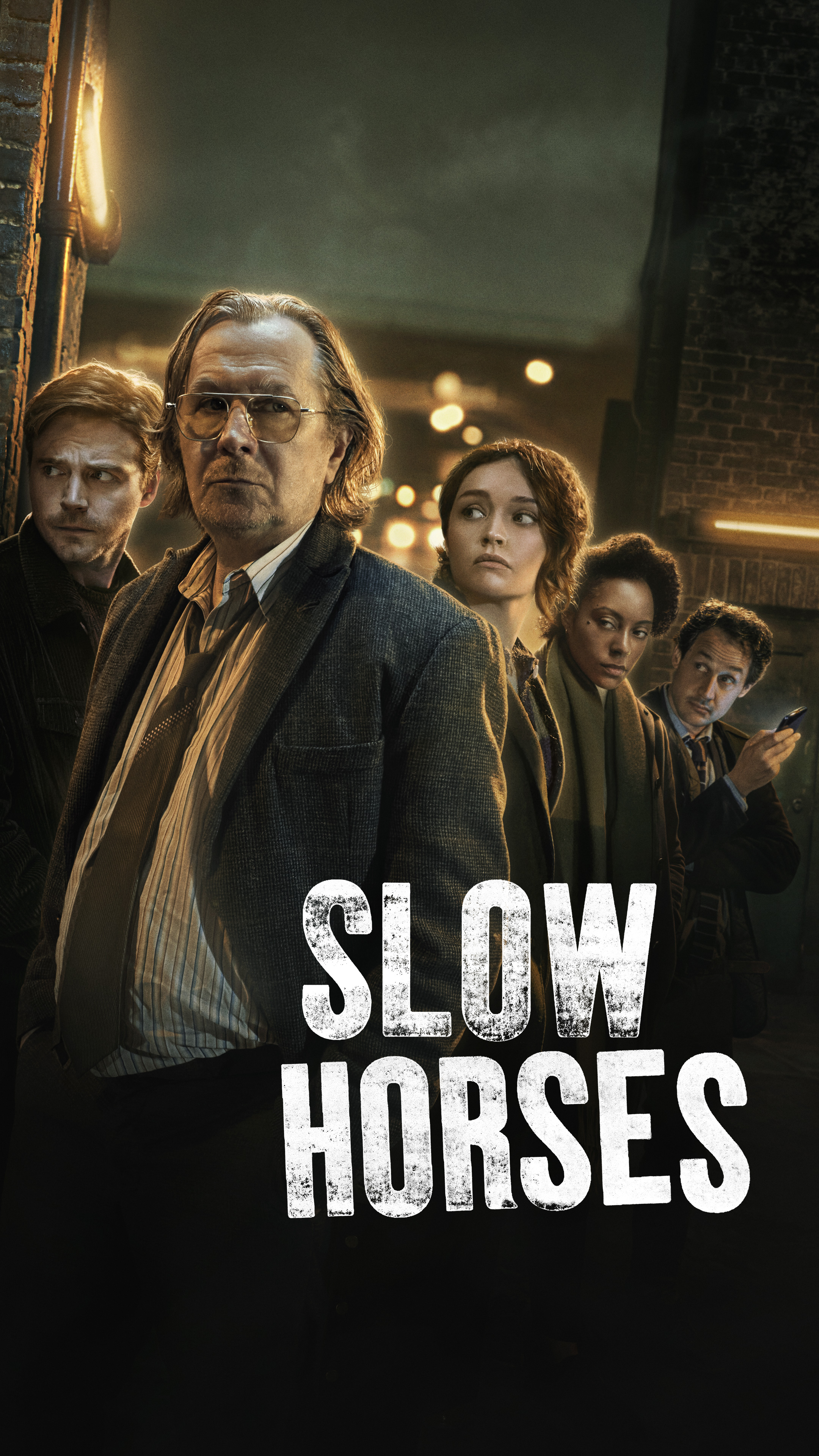
You won't find Slow Horses in cinemas, but it's absolutely cinematic. The new Apple original show brings Nick Herron's book to vivid life and delivers a British spy story, but with a twist. These are the screw-ups. They're about as far away from James Bond and Jason Bourne as you could imagine them to be. Screw-ups like Robert Cartwright, who gets sent to Slow House, where the agents are derogatorily referred to as Slow Horses. The boozing, farting Jackson Lamb oversees these misfits, and I'll be speaking with actor Gary Oldman, as well as the director and other cast members, about Slow Horses on this bonus edition of Cinema Junkie.
Cinema Junkie is officially on a break for another month, but the chance to interview Gary Oldman was just too good to pass up. So here's another bonus episode for you. In addition to Oldman, I'll be speaking with actors Jack Loden and Kristen Scott Thomas, as well as director James Hawes. I got to speak to Gary Oldman and Jack Loden during an Apple TV Plus virtual press day. The chemistry between the two actors was readily apparent, and I was delighted that they decided to end the interview with a fart joke. Absolutely fitting. I began by asking Oldman if author Mick Heron was involved in the series to any extent, because the characters appeared so faithful to what he had written. Well, first of all, you're approaching the characters. You've got...
As you say, you've got these books, so you've got a great roadmap that you're following. And also the scripts, the writing team, we try to keep very much to what Mick has written. He's created such a fantastic world. You know, there are things we, obviously, there are things we lose. We don't have that thing that you have with a movie where you're trying to put a book into a two-hour window. But we've got six hours, which is plenty. But there's still things that you lose along the way. But overall, I think they're pretty... Do you know the books? No, just a little bit of the first one. I started reading that. The series is pretty true to the source material. And Jack, you are one of the quote-unquote slow horses. So explain who they are and what that term means. There are a group of agents who have made mistakes.
They're very difficult to fire because they're civil servants essentially. So they are thrown in this office block right at the very bottom of the service doing all the things that nobody wants to do, all the menial tasks. And it's to sort of encourage them to leave. You know, they're dead weight. They're an embarrassment to the service. And that's very much Jackson's point of being in his position is to...
make it as horrible as possible for them so that they leave. And it's a very, very specific skill that he has to make it as miserable as possible. You imagine that he's the one that, you know, they thought, who should we get to run Slow House? And they went to you. Although there is another reason why he's there, but that's not revealed. Well, I'm going to, it's that thing, it's separate the men from the boys. I'm going to treat everyone the same, but when they come in, you know, I know who's going to stay, who's got the stomach for it.
And the ones, I can imagine going down the list and thinking, yeah, give him to me. I'll give him six months. He'll be gone. Yeah, she'll, no, she won't last. Yeah, I can drive her absolutely mad. I'll give that, you know, I'll give that six weeks. She'll be gone. And he knows, he knows who he's getting on the list and the ones that he thinks have got stamina to, perhaps ultimately. And they all have a bit of an attitude. And they've all got, yeah.
They've all got an ego. I'm going to break that ego. Piece by piece. I'm going to take you apart, boy. Ride you hard. Ride you red. Ride you red raw.
How does it feel to have played two very iconic and very different spies in Smiley and Lamb? I feel very lucky and very privileged to have been really embraced by, as I was, by Le Carre, because he had the ultimate say of who was going to play Smiley. So to have been part of that world and Mick, who is really the heir to the kingdom. of Le Carre, to be a part of this world. So I feel very, very lucky, very privileged. I don't, you know, it's not, that opportunity like this, it comes along, you know, once in, really, it is a one-time thing, once in a career. Yeah, to have had my feet in both those worlds is a wonderful, wonderful privilege. Now, even though this is very intense and very serious a lot of the times, there is a lot of very dark, kind of savage humor as well. So how do you kind of play all the different notes and what kind of a challenge is that for an actor? Do you want to answer that one?
It's a different job for me on this than it is for Gary. River is quite often the butt of the joke, and Lam is quite often the joker, and his whole point of being there is to be there and take as much abuse as he can. It almost becomes another level of his training, is to just receive that constant abuse. And also not forgetting that these people, some of whom I think are trained in interrogation and how to take interrogation, but this is a very different kind of abuse. I think River would probably be far better at receiving some pretty horrible torture.
But this kind of schoolroom abuse I think throws him off balance a bit and it's quite a difficult thing to take. Lamb is so quick-witted and so sharp that you can never defeat him. You can never outwit him. I think he'd be a wonderful stand-up. Lamb? Can you imagine? He'd be a wonderful stand-up. I tell you what, he could handle a heckler. Oh, he could handle a heckler. He'd be wonderful on panel shows where they get comedians on.
He could be on, what is it, the American, America's Got Talent. Oh, my God. Imagine that. Imagine that. Just there in a cloud of smoke. And there's, what's his name? Simon Cowell. So, Jackson, what do you think?
Oldman and Loudon might have been getting a little punch drunk from sitting on Zoom all day doing interviews. I wish I had had more time, but hopefully their interplay will whet your appetite to see the show. Next up is Kristen Scott-Thomas, who plays Lamb's boss, Diana Tavener. The key to Diana Tavener is she's number two. and that number one is about 10 years younger than her. So that's the key. And she is very, very angry about it. And she's beautifully turned out, which may seem like a sort of futile observation, but actually it's also a very important part of her character because it demonstrates her utter control and her obsession with keeping everything...
under a lid and under a very, very, you know, she's just in charge of everything. She won't let anything escape her attention. Well, and also that makes her a character who doesn't want to reveal a lot. So as an actress, how do you tackle that challenge and how do you let us see things that she doesn't want to show? Well, that's the exciting bit about playing a character like that is how much to show when. And it's fun to do when you have a very experienced director like James Hawes, who...
who probably reveals, I haven't seen the whole thing, I've seen the first three episodes, but he will probably reveal more than I was aware that he was revealing, or less than I was aware of everything, because my job as an actress is to give him raw material to make his film with. So I turn up and I act the scenes, and then he will manipulate them to get what he wants. So, you know, that's what I do. And it was difficult to do for me, in a way, because it was the first time I'd actually done long-form TV, so I... I wasn't very good at pacing myself. And luckily, because Gary is such a rock, I felt I was in safe company and in a safe environment and able to explore and expand. And I knew that people would be able to respond if I did something that they weren't expecting or coax other things out of me if they felt what I was doing was too boring.
Since you brought up Gary Oldman, talk about the relationship between Diana and Jackson Lamb and how you build that on-screen relationship in the series. They are like cat and dog. They came up together through the service. We learn from Diana that she's had service in the field and that he did some terrible things. And she knows what terrible things. And he knows stuff about her. And we will find out as time goes by what those things are. But there's an animosity there. But there's also a kind of respect, a mutual respect, because each of them knows how terrifying the other one can be.
And even though the story is very intense and serious, there is also a lot of kind of dark, savage humor that comes up through this. And how is it kind of doing the tone shifts or hitting all those different notes? Well, I love all of that. That's right up my street. You know, that's one of the things that really, really appealed to me because I find that tension and humor go absolutely hand in hand because...
If you make somebody feel relaxed and you give them a laugh, then you really can astonish them with something else afterwards. It's almost hitting below the belt, really. But you can also build, once somebody's relaxed, then you can build tension much more easily. And it's an old trick in the theatre. You give them confidence and then you can take them anywhere. I think it's really useful and it's something that I really enjoy is the flip-flopping between tragedy and comedy, between something very dark and something very light. I really enjoy that.
And last question, I was just curious if you had been familiar with Mick Heron's books before you took on the series. No, I had no idea. And then suddenly, out of the shadows, all my friends, I discover huge Mick Heron fans. And there's a sort of whole cult thing going on with Slow Horse's novels. And people got terribly excited. People rang me up just to talk to me about it. It was astonishing.
That was Kristen Scott Thomas. My final interview is with director James Hawes. I asked him to provide an introduction to the world of Mick Heron's slow horses. Mick has created a world that is inspired by the whole British genre of spy fiction, but it's got a twist. These are the screw ups. They're about as far away from James Bond and Jason Bourne as you could imagine them to be. If that is the Aston Martin and Martini of the spy world, then we're on a broken down.
e-scooter, we're drinking half-poured pints of beer. It doesn't sound that beguiling, but there is such charm and character and accessibility to these characters that these are the guys you really want to hang with. And what attracted you to doing this series? I was drawn because, listen, that spy world is many directors' dream. It's a world you want to be part of building. You want to go and play in the genre that has the legacy of all those great Ticket to the Soldier spy and American conspiracy movies like All the President's Men and Three Days of a Condor. All of that is somewhere in the DNA. Then there is...
this extra vein of dark humor that runs through it that makes it, I think, special. So it's not just a reinvention, it's a really natural growth of the genre. And then somebody said, Gary Oldman, who's going to say no when you've got that combination of elements? Now, I have some friends who are spy aficionados and have been looking forward to the series forever. And they were so impressed by the accuracy with which you captured the characters and the books. So I'm just wondering, was Mick Heron involved to any extent in the actual series? Or what were you doing to kind of...
ensure that accuracy mick heron was uh involved in the writers room so from the moment that it left the page of the novel and started to take shape in the minds of the writers um particularly will smith who was heading up the writing team mick was there to talk about the characters Without wanting to state the obvious too blandly, TV, the screen, it's a different form. You've got to lift the story and the characters off the page. The storytelling takes a different shape. So we needed to make changes for it to adapt to the screen. Mick was there to say, well, okay, you can do that, but such and such a character wouldn't behave in that way. Or, but what if? Because I always had in my mind that a backstory might be. So it's those kinds of elements.
And one of the things that's really fascinating to watch or fun to watch, too, is the interplay between the characters of Jackson Lamb and Diana Taverner and the interplay between these actors you have of Gary Oldman and Kristen Scott Thomas. So talk a little bit about their dynamic. Well, I think what you have is a sense that these are two spy legends, that they have real history and status in the British intelligence service. They've come down different career paths. One of them has been very much more in the field during the Cold War. One has played the politics and played the game and gone up the ranks because that sort of power broking was what she wanted to achieve. And now you have two people that are ostensibly within the same organization, but could not be more different in their approach. And what happens within Snow Horses is you meet these two.
incredible characters played by two legendary actors come head-to-head, face-to-face, they're locking horns. And there are, I think, some of the best scenes of the show when those two have to face off, either beside a wintry canal in North London or in the office of one of the others. And those are some of our classic movie moments within the story. And what's interesting about those characters, too, is there's a certain level at which they are not openly expressing a lot of emotion or showing things. There's a lot that they want to keep, especially with Diana, kind of pressed down and controlled. And so what's the fun or the challenge of...
getting these characters on screen when part of what they're doing and part of what a lot of it is going on is hiding things. Well, yeah, it is a challenge, but also I think there are two things. I think that kind of suppression, it's a very British thing. It's very true to the world of spies and the way those characters behave. They don't express and they do contain their emotions. They've both got to be very sharp and pragmatic and objective when they're making decisions mid-mission as we meet them. And I think with actors like Kristen and Gary, they've done so much work with their backstories. We've talked about it in rehearsal. We know how those characters might have met in the past.
And all they have to do is live with that character, live with those emotions. And those will play then within the scene. And I think with both of them, when you're uptight on those shots, looking at their faces, you know the layers of other character information, the other bits of story, the other bits of history that are going on behind the eyes. Well, I've just been speaking with some editors for another story I was working on. And in watching this, you know, I felt too, it's something in the editing room where you're just getting those split seconds of a glance or a look that really makes the scene just kind of ping in just the right way. Yeah, and we had two great editors working with me, both of whom have a particular talent for cutting dialogue and for seeing the rhythms of the scene.
letting it breathe within the pace of the performance, not trying to desperately speed it up. And obviously feel some of the silences and the spaces in between the words, which can be very tense, very telling in any relationship. Now, a very different relationship you have going on there is between Lamb and River. And I had a chance to interview the two of them and they were together and they felt like they had this almost comic rapport going on. And talk a little bit about the tone of those scenes, because you mentioned that there's this kind of dark humor that comes up and yet you don't sacrifice any of the tension or drama to get there. So talk a little bit about kind of the tonal changes that are going on. The tone was the most frightening thing for me in taking on the show because it is so particular. It's such a narrow, delicate line to have to walk.
And that is part of what makes slow horses different to other shows you might have seen before. The guns are loaded, people die, there's blood on the payments. And yet, on a dime, the story and the mood and the scene changes, and you're laughing about lamb corners and lamb's flatulence. So finding that, it came from, all the humour comes from character. As long as the characters are rooted and real and you believe them in the world, I think there's a lot more space to move. In terms of how we achieved it, it was rehearsal, it was conversation, it was then testing.
on the set with actors as good as Gary Jack to see where the envelope lay, how hard could we push against the walls before it became too big. We needed to be sure that we kept the idea of these guys as spies real and then we could let the humour live alongside. I have to say one of my favourite moments was when Lamb returns the car that they've stolen and he's sitting in there just listening to music and there was something about that scene that was just so pitch perfect about getting his tone and his interaction with the other characters. And he's a guy who uses his own humour as a weapon. to destabilize people that he is negotiating with. He doesn't need to turn up armed to the teeth with some conventional sidearm. He can do it by just unsettling people who expect a certain way of behavior and then he meets them with something completely different.
And you mentioned that these slow horses are kind of the rejects of MI5. You have a great opening song from Mick Jagger for the series that really, from that first moment you hear it, kind of sets the tone. How was it to get him involved and to create that song for the show? It's thrilling. I've described it a couple of times that you have pinching moments in a career. And the first time that the composer, Daniel, sent through Mick's first version of this song.
recording on his iPhone and just to stand there listening. I was on a train platform halfway back from the centre of London to where I live, and it was just extraordinary. It was just before Christmas. It felt really like a Christmas present. Again, we're talking about the tone of the show. After this quite dynamic and more conventional opening, we then have to adapt the tone into Slough House and meeting the rejects. I always thought that a song would be a good way to do that, and I wanted somebody to perform it who was British through and through, who had London in his roots, who probably had some sense of the 70s and 80s, so dated.
from the years of the Cold War when Jackson Lamb was at his strength, but he's also somebody of then and now, somebody who, like Jackson, is still at the height of his powers. And that was Mick Jackett. And to have somebody who's such a poet as Mick is to write those words, to conjure those lyrics. So we happened to have a music supervisor, a brilliant music supervisor, who knew somebody on Mick's producing team. So conversations were begun. We sent through a little snippet of material, the tune that Daniel Pemberton had written, and the writer and I just came out with a few paragraphs about the essence of the show and what we thought might be a good...
which was about second chances for Mick to explore. Well, as he describes it, it came very easily. So there was this serendipitous thing that he knew the books, he'd read the books. So he was already very familiar with Mick Heron's characters. He knew the way of the world. So I think he didn't have to go and do the whole research. It's the sort of thing Gary Oldman always says, it's not how well you know the script, it's how long you've known the script. It's about having lived with it and let it come through. And so we end up with this quite amazing opening song.
And what do you feel that Mick Heron is getting to in terms of contemporary espionage that's different? You've mentioned things about tone, but is he giving us kind of a different insight or a different sensibility about what kind of drives contemporary espionage? I'm not sure it's that different. I think he's allowing us a more democratic point of view. If we went back to the 50s and 60s, I think we'd be thinking of them as, certainly the British, we'd be unquestioning of our security forces and trusting them absolutely in what they were doing to defend the realm. Nowadays...
Both sides of the Atlantic, we as populations are perhaps rather more scrutinous and questioning of our great authorities and institutions. And we know that not everything is always quite as black and white as we might like it to be. And with transparency and being able to see through the chinks of the doors, we discover some things that are a little bit more uncomfortable for us. And I think Mick is showing us some of that, some of the game playing that goes on. Some of the humanity, spies are still humans. They still want to achieve their careers. They still want to go home at the end of the day. They still have ambitions. And I think some of that is being shown to us. It's also, I think there's something about...
seeing a British spy series now when Britain is perhaps not the power that it was when Fleming and Le Carre were first writing and we're having to accept the fact that we're not quite as big a player on the global stage but we're still placed halfway between Europe and America we're still very good at intelligence and security so perhaps this is one of those dramas that encourages us to believe we still have a place on the global stage. And what have been some of the biggest challenges in terms of getting this onto the screen and getting it to be the way you want it to be? Well, I can't talk about making this without mentioning the pandemic. Everybody's bored about talking about COVID, but obviously in our industry, you can't shoot remotely. We had to at some point come face to face. We lost cast members. We lost locations. We had to suspend because of... We had to box very clever to achieve everything we wanted to. Things like the opening sequence, we didn't have crowds in the airports like you would.
on the street outside Slough House, any crowd that came down was in masks and we didn't want to do a spying in the time of COVID kind of movie. So we had to create all the traffic and everybody on the pavement is us manipulating rather than shooting within the real world. So it was that much more logistics and world building to have to do. So that's, I think, a particular challenge that just has to be talked about really. And now that the first season is coming out, what are you feeling kind of most proud of or what was the most rewarding aspect of this? We had a premiere last night.
And I think one of the things for those people who've made the show is that you become over familiar with it. So the things that are scary aren't quite scary, the things that are funny you've forgotten. were funny so to sit there and hear people laughing as much as they were laughing um to feel people tense actually literally grabbing the side of the chair in the opening sequence worrying about some of our characters that was hugely satisfying and i think it's the scale of it as well one of the things that working with a network like apple allows you to do is to imagine and dream a bigger scale and i think this is a show that delivers certainly in sequences a cinematic scale that we're beginning to want more of on our television and that's really thrilling to achieve Well, it's interesting you mentioned watching it with an audience, because for a TV series, do you get much of an opportunity to actually watch it? I mean, I understand other people watch it, but that sense of being in a cinema with a large community of people watching something, are there test screenings of TV series in that kind of a context? Not that this director is aware of. There are moments in the edit room and moments where you're obviously talking about it with your executive and editorial team, where it's like offering your homework as a director to be marked, but it's being marked in front of the class.
and that something changes in the cosmos of the room when other people are there. You feel everything more acutely. It's like being in a traffic accident when everything goes super, super slow. You're aware of every movement. You feel where things maybe need to be tightened still further, or you worry that where you thought you're laughing, they're not. So it is a very different experience watching, just even with people over your shoulders. You don't even have to be looking into their eyes to feel how something is being responded to. But no, the vast majority of it is done with the writers, the executives.
The production team, the editors, and we really take our time stress testing the story, stress testing the moods until we are confident that we've made the very best we can out of the material. And I believe two of the books were shot back to back. Are there plans to go further into McCarran's gallery of books? There are certainly hopes to go beyond this. You're right, they've already shot the next six. Those are in the editorial process and will come out sometime later in the year, I think is currently the plan. And there are all kinds of talks and hopes and aspirations for more beyond that.
Well, thank you very much for talking about Slow Horses and giving us quite a fun and tense ride for a new spy show. It's been a huge pleasure. It's lovely talking to you. Now is director James Haas. Thanks for listening to another bonus episode of Cinema Junkie.
I want to suggest that you check out my earlier podcast episodes focused on James Bond and the real-world spies of John le Carré. Those podcasts offer the perfect complement to this one. And I want to give a shout-out to Jeff Quest, Gary Dexter, and Shane Whaley and direct you to their podcasts, Barbican Station, A Slow House Podcast, and Spyberry Spy Podcast, where you can get some insights on the show and McCarran's books from some spy aficionados. Cinema Junkie will return to regular bi-weekly podcasts in May. Till our next film fix, I'm Beth Accomando, your resident cinema junkie.
KPBS On Demand is supported by Bill Howe Plumbing, Heating, and Air Flood and Restoration Services. Family owned and operated for over 46 years, Bill Howe has been serving San Diego homeowners with home services since 1980. Bill Howe's full service team offers heating and air solutions along with dedicated flood and restoration services and an expert plumbing team. Their trained professionals are available 24 hours a day, 7 days a week to respond to both routine needs and unexpected emergencies. Bill Howe is committed to providing excellent communication, transparent pricing, and quality workmanship on every job. Appointments can be scheduled by phone, online, or through live chat at their website. Call 1-800-BILL-HOWE or visit billhowe.com because we know how.