The November 3rd general election is coming up. Do you know who you're voting for? The KPBS Voter Hub is back to help you make an informed decision. Throughout the 2026 election cycle, KPBS will keep you up to date on the most important issues facing San Diego, our state, and our country. You'll find an interactive ballot guide reporting on candidates and issues, polling, and ballot drop-off locations, and live results on election night. Go to kpbs.org slash voterhub. The urban legend is if you say his name five times while looking in the mirror, he appears in the reflection and it kills you.
Candyman began life in a Clive Barker story, was brought to the screen by Tony Todd in 1992, and now has been reimagined by Nia DaCosta and Jordan Peele. This new Candyman film becomes available VOD starting September 17th. Welcome back to a bonus edition of listener-supported KPBS Cinema Junkie. I'm Beth Accomando. The new Candyman film has so many layers to peel back that I wanted to discuss it with author and professor John Jennings. He's taught classes about black horror and has adapted Octavia Butler's books to graphic novels. He was in San Diego for Afrocon earlier this month, so I asked him to delve into Candyman's many layers with me and consider its place in the growing subgenre of black horror. This interview contains some spoilers, so if you haven't seen the film, put the podcast on hold and get to a cinema to see Candyman or stream it online. And then dive into it with us in this podcast. But if you have seen it, then let's go.
Clive Barker's The Forbidden was a short story in his Books of Blood, Volume 5. That story inspired Bernard Rose's 1992 film, Candyman. I am the writing on the whisper in the classroom. Without these things, I am nothing. So now I must shed innocent blood. Come with me.
The title character was vividly played by Tony Todd in three movies, and his incarnation of the character is referenced in the new Candyman film. The new film is not a reboot of the franchise, but rather a sequel that reimagines the character and builds onto the mythology. John Jennings is professor of media and cultural studies at the University of California at Riverside. He's been a guest on Cinema Junkie before to talk about what he refers to as scary black folks. Before I get to his interview, I need to take one quick break, and then I'll be back to unpack Candyman's themes.
Midlife brings a lot of changes. Your Turn with Alison Aubrey is a new podcast to help you navigate the twists and turns. From health and relationships to creativity and purpose, we can help steer your next chapter. With Your Turn with Alison Aubrey. Find it on the NPR app or wherever you get your podcasts. Welcome back to this bonus episode of Cinema Junkie, all about the new Candyman. To begin, I wanted John Jennings to remind us about the original Candyman. So here's a clip from that 1992 movie. And then John will discuss the significance of that film and the impact of Tony Todd's performance. Have you ever heard of Candyman? No. Well, his right hand is sawn off.
He has a hook jammed in the bloody stump. And if you look in the mirror and you say his name five times, he'll appear behind you, breathing down your neck. You want to try it? The original Candyman film was the screenplay and director is Bernard Rose. He took elements from Clive Barker's short story, The Forbidden. It's very different. The Forbidden really is more about class dynamics. It's a very similar setup where you have a grad student, Helen Lyle, who's doing research on graffiti of this particular area. And what Bernard Rose does is he transplants that discourse to America, and he decides to have it talk about race. And so he creates this amalgam, if you will, of the Hookman, Bloody Mary, the game, the Bloody Mary game, the original Forbidden short story, and an actual murder that happened in Cabrini-Green.
of Ruthie Ann McCoy, which was in 1987. So he actually took elements of that and put it into this Candyman film that he made with Tony Todd. The other urban legend, of course, that he mixes in there is race, right? It's a story, it's a fiction, right? And so he mixes all these things in there as well for good measure. And so I think one of the things that Tony Todd brings to it is like, he's a trained, he's a Shakespearean actor. That's one thing. It's like he's an actor's actor to do this.
Before Candyman, you really only had like, we had a couple of really great performances by black actors in horror films, of course. And I'm forgetting the actor's name right now from Night of the Living Dead, of course. The first time you really see a black protagonist actually taking charge of a film. If you're stupid enough to go die in that trap, that's your business. However, I am not stupid enough to follow you. It is tough for the kid. That old man is so stupid. Now, get the hell down in the cellar. You can be the boss down there. I'm boss up here. And of course, Blackula. You shall be Blackula. Blackula. Black Avenger.
Rising from his tomb to fill the night with horror. Dracula, Dracula's soul brother. Which is from the exploitation era. But we really don't have a really new, iconic black character like Candyman until that film comes out. And it very much picks up on all of the kind of like...
really, really powerful gothic overtones. To me, I mean, it has, I would almost like juxtaposed with something like Dracula. It has that kind of feel to it. But he also is talking about problematic issues around anti-miscegenation, you know, in our country too, because Candyman falls in love, or Daniel Robitaugh, that's his real name, falls in love with this beautiful white woman that he's painting, and he's also affluent himself. His father is wealthy, and so he's gone to these wonderful schools, and it didn't matter because once racist people figured out what was going on and that she was pregnant, then he essentially is lynched, and then his hand is cut off and tortured with this bee honey and stuff, and so basically what he represents is like the constant projection.
of like the monstrous onto like the male black body. And so it's a really, really complex, interesting story to start with that Bernard Rose, I think, was trying to, you know, unpack. Now, Jordan Thiel and Nia DaCosta kind of reimagined Candyman through more of a black lens. So what did you feel was kind of the most significant change that they made? Well, I think one of the most significant ones was the fact that they took the singular story of Daniel Robertaille and they actually kind of posited Candyman more as a mantle. And so he becomes more of a system of, as Coleman Domingo's character, Billy Burke kind of references, he's a hive.
It's almost like you need a systemic avenger to kind of fight against systemic racism. You know what I'm saying? Because he becomes more than one person. And so I think that was a really interesting idea because it doesn't disrupt the original story. It actually adds to more of a mythology, which I thought was really interesting. And a very complex notion about just how race is kind of played out in our country. But a story like that, a pain like that, lasts forever. So, he's real? Bell is real. Samuel, Sherman, Daniel Rubenstein, they're all real. Candyman is how we deal with the fact that these things happened. But they're still happening.
The other thing that was really interesting is that in the first film, he's more of a revenant, which means that he's a dead person that comes back as kind of like a zombie. He becomes, he's physical. You know, he seems like, because people see him before he's about to kill him, he actually appears to them and actually has physicality. But in this one, he actually is more like Ralph Ellison's Invisible Man, where he's like, he really is an apparition and you can only see him in the mirror. And so I thought of it as almost like a reference to W.E.B. Du Bois' veil. You know, like he was talking about the idea of like black people living in the veil. And I always feel like...
by invoking him you're breaking through the veil almost and i just thought that was really really fascinating it's very creepy the other thing i thought was really interesting was they literally shift the white gaze to the black gaze if you look at the end of the film uh you know not to spoil everything but there's a scene where um brianna who plays uh anthony mccoy's uh girlfriend who is living uh fiance who is the new candy man who's now been killed and she's in the back of the cop car there's this part where the cop is actually like looking you can actually just see his eyes in the mirror he's talking to her he's giving her options you know either become a snitch and right out on your you know and we kill your boyfriend and get away with it or you can go to prison But she chooses door number three because she realizes that Candyman, and this is what my friend Sean Taylor called it, he called it weaponized oral history, or weaponized oral culture, where you can actually, like, no, I'll call him, and my intention is to direct it at something else. So very, very powerful moment in the film, you know, where she kind of, like...
does that. Another thing I thought was interesting was the juxtaposition of institutions, right? In the first film, we're really talking about the academy and how the academy kind of like goes to spaces and actually like puts claim on them and actually theorizes around culture. And the second one, this particular film is about the art space, right? And the commodification of black pain or just pain in general, which I thought was really interesting too. So there's some really interesting complex things that they're doing with this second film that I think kind of fills in the gaps in some ways for the first one. So Candyman this time also seems to really reflect or deal
or to raise more issues about kind of intergenerational trauma. And how is that kind of brought up in this, and why is that significant in a black horror film? So one of the utilities of horror, I think, is to be able to deal with different types of social issues. Horror, and I think speculative fiction in general, gives us a certain amount of distance from a particular subject, and so we can experience something. There's a lot of societal issues that I think can play out really well in, say, sci-fi movies and stuff like that. For instance, after the Second World War, you see an uptick in, like, oh, these radioactive mutants are about to take over the world, that kind of thing, because we can destroy ourselves with an atomic bomb. And so all of those, the kind of frenetic zeitgeist kind of goes into the things that we make, right? And I think one of the biggest issues right now in our country is about police brutality and about gentrification and all these different things that are happening in our country right now. So, of course, it makes sense that...
These things would be really, really prevalent in horror movies. Now, I think that Billy Burke, who is the... I almost look at him as the Renfield character from Dracula, because he's preparing the way, right? That's what Renfield was. He was from the Dracula stories where he's like, I'm preparing for the master, right? Billy Burke's character, at the beginning, he sees police brutality happen and kill one aspect of Candyman who comes back and then kills his sister and her friend in the bathroom, right? So he's kind of indoctrinated through trauma, and he actually starts out washing clothes, right?
He's a very painful death because he doesn't have a physical death. He has a spiritual death. He actually, like, never leaves that laundry room. And so what happens is he then becomes a laundry room owner. Like, he actually, like, that becomes his job to say he takes on. And he talks about cycles. And so the laundromat becomes, like, a metaphor for the cycles that we go through. But you have to pay for those cycles, right? Because they're, like, it's a laundromat. And he talks about, like, oh, you know, when a stain is in fabric, it can come clean. That whole thing. He's really talking about our country to a certain degree. That's a metaphor for America. And I love the fact that he's reading a copy of Clive Barker's Weave World.
If you catch it, because We World is a book by Clive Barker that is about a magical tapestry that is another world inside of it. I was like, oh, it's so cool. Anyway, so he represents, I think, intergenerational trauma and how it affects communities. And he takes it upon himself to invoke and create the mythology of oral culture that is Candyman, to protect what's left of his neighborhood. Well, you mentioned how art, like science fiction or films, can kind of distance you from certain things and allow you to look at it. And what's interesting in the film, too, is that the violence...
against the black characters is mostly depicted through these shadow puppets, which kind of removes it one step further from, normally this would be depicted as live action actors with, you know, violence being inflicted upon these characters. So it seemed like there was an interesting way to kind of distance you from some of that violence without letting you forget how horrific it is. Yeah, I totally agree. I use the allegory of Perseus killing Medusa. Because you remember like the Greek mythology or the Greek myth, Medusa is like this horrific creature, once a beautiful woman who was cursed by the gods, and now she turns people into stone when you look at her, right? So the spectacle of her.
is what kills you to a certain degree, right? And Perseus kills her with a merit shield, right? So he's looking at her reflection and not directly at her. And I think that in some ways, DaCosta uses a similar method where she kind of, as you're saying, like she kind of like undercuts the spectacle to a certain degree and it removes you to a certain degree. You can be more objective about it. Now, a lot of horror fans really didn't like that because they want to see the gore. They want to see this, you know, but if you're in this country now and you're black, you know, you turn on CNN and you see that kind of brutalization, right?
To a certain degree, you don't get to be black in America and not see yourself as victim sometimes. So I think what she does is by distancing us from it and actually using these beautiful shadow puppets and other ways that she does that by pulling out. Even when white victims are killed, she's using mostly different types of camera tricks and things, but she doesn't show everything, which I think was really, really, that's really horrific to me. That's actually the stuff that makes, because it leaves so much to the imagination. But I think that's why she did it, though. Yeah, I mean, you mentioned the way she depicts some of the violence. I mean, I thought she displayed a lot of creativity in...
You know, normally you go in for a close-up for a kill and she pulls out. Or there's the one really remarkable one, too, where it's all reflected in the mirror of a small compact. Yes, that's one of my favorite ones. Oh, my God. Okay, two of my favorite kills. First of all is, like, the art critic kill where Anthony has left her apartment.
and then she just goes up in the air. But I think that was a drone shot, even. I think that was shot with a drone, where you just kind of pull out, and you can see what's happening to her, and you're like, what is going on? But it's also just a beautiful shot. The compact scene is amazing, right? Because it's from the point of view of this little black girl who's in the stall, using the bathroom, and she's like, what is going on? And it's like one of the victim's compacts come out, and it's got blood on it, and you can see him floating a little bit, and then you just hear them screaming, and then you see these bees come out, and one hits the screen, walks down, and their reflection splits off, and flies back into the background. I was like, excuse me?
It was just great. I was like, that's a really, really great shot. And a lot of it is up to your imagination. What has happened to these women? And there's some things that she does in the film that are not really directly related to the plot or to Candyman, but that feel like a different perspective in the sense that you get to see this black couple in a very affluent apartment surrounded by books, surrounded by art. Brianna speaks French in her interactions with her business dealings. And it just feels like, in this subtle way, she's trying to say there are different ways to depict black characters that Hollywood...
has really not been given us. And it's very organic as well. The depiction of like the spectrum of blackness and how black people interact. Yes, I think because you see like a different class levels and all kinds of things. No one is having any kind of like disputes, you know? Yeah, I think it's really well done. And you see a character like, I mean, actually that's in some ways works against Anthony because he's so forthright with Billy Burke. Little you know that he's like, ah, you're the new Candyman. By the way, I wonder if Peele wrote this line where he's like, hey, you need a hand? Remember that part?
I was like, oh, dad joke. And that's also the first time you see Billy Burke playing with the shadow puppets. He's like, hands, hands, hands, which is, of course, he's talking about the cops, but he's also referencing, it's literally a foreshadow. Anyway, still finding things. But yeah, I mean, I think that that is a really big part of it to show the spectrum of black experience in our country. Well, and Anthony's an interesting character, too, because he's an artist, and he comes to this urban legend or this character of Candyman, and at first, it's kind of a superficial, you know, very like, ooh, how can I cash in on this? And...
You know, there's this sense of kind of making us look at the role of the artist and how that can function before he actually comes to kind of deeper terms with what this whole legend means. Yeah, no, that's true. And that's what I was saying about, like, how at first in the first film, the Academy is doing the same thing. Like, Helen Lyle is like, oh, I need to get my PhD, and this is very interesting, you know? She's just looking at the shell of the story, right? And then kind of pontificating about what it could mean, but not really being of the culture. And Anthony is like, I need something to become famous, right? And that's why I think, like, Candyman punishes those who don't have the right intent.
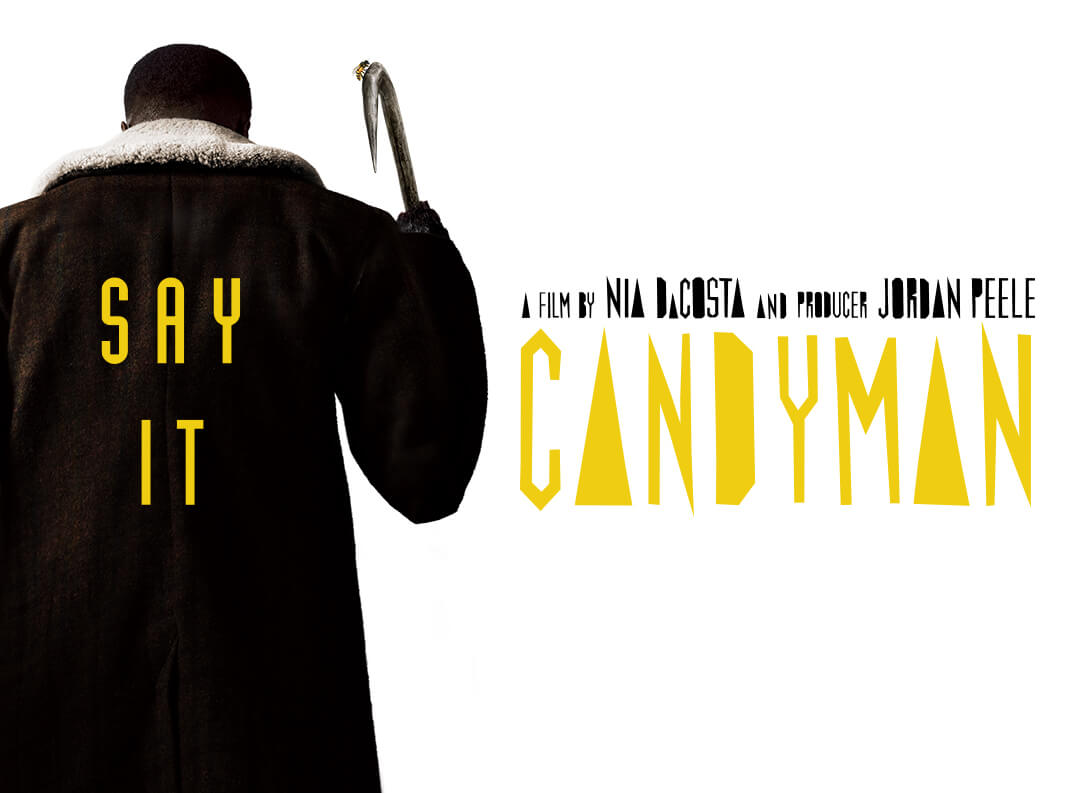
And he kind of punishes those who don't understand what he really is. And at the end of it, Brianna utilizes him as more of a weapon. He's almost like, he's like, you shouldn't play with a gun, don't play with Candyman, right? I mean, it's the same kind of thing. Tony is very interesting because he is the, he's the direct link to the first movie because he is the child that was saved by Helen Lyle in the first film, which I thought was a really good way to actually connect the films, you know. It would be a really interesting character. So the first film, I thought it was interesting because the tagline for the film is, we dare you to say his name. And now the tagline says, say it. And then there's a hashtag for tell everyone. And I just want to know, like,
How do you think this is playing off of Black Lives Matter and this sensibility of say their names, remember who the victims are, and kind of transforming this Candyman legend into something that feels very contemporary and of the moment now? Yeah, no, that's a very good question. Yeah, because the first one really is, I mean, it does, it's talking about race and representation, but it also still centers Helen, you know, as the main kind of protagonist. And she becomes like a really active ally and definitely like... She gives her life to save this little black boy, you know what I'm saying, which I think. And then, of course, the black community reflects that. They actually come to her grave. They give her this hook and what have you. And then she becomes an urban legend, right? Which I think is very interesting. And then in the second film, they shift this lens, right? And as you're saying, like, this is taken directly from, like, some of the chants that are from the Black Lives Matter movement about saying the names.
repairing erasure, because that's what the character's doing, too. Like, do not forget me. This is what happened to us. You know, this is, you know, say my name and actually, like, and see what happens, that kind of thing. So it's, because he's still an angry spirit, you know, but, you know, but it's also, like, a sense of reverence for the people who've been killed in this fashion. And I don't think it's a coincidence that one of the main characters' name is Brianna, you know, and she actually ends up, you know, killing cops at the end by her speaking Candyman's names, right? Tell Everyone, of course, is about really, really tapping into the idea of, like, oral culture.
remembering through speaking, that kind of thing, like passing along these stories because, you know, these urban legends were like, you know, they were folktales. And this is a morality tale, too. That's why the other thing I think is really cool is like back in the 90s, a lot of the black films that they were doing were message movies, right? And so I think this actually is like kind of winking at that, too. Like this is a message movie. This is what this movie is about, which I think is really interesting, too. And when you look at that lens, it also even changes something like I am the writing on the wall, right? It's kind of positing that any of us could be like the writing on the wall. Any of us could have like a mural about our death, right? And that's what I think this is referencing. And I think that's true because at the beginning of it,
whole audience is in the mirror at first because everything's reversed everything's reversed and we're on the other side of the mirror i was like what is going on yeah so i think yes they they decided to take a stand and you know and actually do have an outreach program part as part of the candy man uh film is like if you go to their website there's an entire section about community outreach and about um getting psychiatric help you know community healing and stuff like that too so it's a very intentional film in that regard so Now you teach about black horror, and you're very invested in kind of studying this and talking about it. So where do you see this film kind of fitting into this subgenre, and is it signaling something new at this point in time? That's a great question. And I think you're the first person, besides myself, and maybe a couple other people, have thought of it as a subgenre. I think it might be that. I think Jordan Peele called it social horror, I think is the term he used. But I think it really is dialing into the utility of speculative fiction and horror to deal with these really heavy subjects. And I think that this particular film...
as far as like this new way of looking at like horror with a, you know, this Afrocentric in that space or looking at black trauma is probably, it's probably the gold standard right now. I mean, it's, it definitely has like some unevenness that I would have liked to see kind of like built out, but that's just me as a storyteller. But as far as like the significance of it, I think it's pretty high. I mean, I would, you know, I think it's in some ways up there would get out, you know, as far as like building off of this legend and then actually being a strong sequel, but also like kind of a reboot and how well it's done. You know, it's like, it seems very intentional about the messaging and it kind of shows what you can do if you can take these social issues and bring them to bear. Some people think it's like, oh, it's too heavy handed or whatever, but I'm like, well, so were the.
horror comics from the 1950s and stuff too. They call them preachies, right? Some people just don't want it to be preached to. I was like, well, being subtle doesn't seem to be working, right? We're still in the same mess, right? So anyway, I really enjoyed it. I thought it was a fine film. And do you have any final words about the film or anything that you would like to encourage people to think about when they go see it or when they exit the theater after having seen it? I think one of the things is that certain Hollywood films have kind of ruined how we look at horror. Because actually it's funny because my sister-in-law is a big horror fan and she's like, oh, it wasn't even scary. Wasn't it though? I think what Hollywood's done is they have these jump scares and stuff and you feel like
Oh, if you haven't jumped enough, then it's not scary. But if you sit and think about what it's actually implying, it makes your skin crawl. You know, like, it's certain aspects of that film. Like, for instance, there's this one part where Tony is in the bathroom, and he's had a nightmare, and he has Brianna leave the bathroom. And for a second, he's moving, and his reflection isn't terrifying. I was like, what does it mean for your reflection to be dead? It's like, oh, my God. I just couldn't stop thinking about that. So it's a very, very visceral, weird film. And so I think, like, going with an open mind, but also understand that this is not like, this isn't Jason. You know, this isn't like the first movie. It's very thought-provoking. It's a slow burn. It's like, it's an arthouse horror film to a certain degree, too. It has that.
that kind of meatiness to it. And I think it's more effective that way. It's more creepy. I think that people want to be shown things and not have to fill in the gaps. And, you know, sometimes it's best for you to do that, you know, to get it. But it definitely bears rewatching as well. Well, and also there's a point where the Burke character says, I think it's when he's recounting what he saw in the laundry room. And he says, like, I saw the true face of horror then. Put him right there on the spot. What shows up a couple of weeks later? More razor blades and more candy. That's when we knew Sherman had been innocent.
Homeless. And to me, it's kind of a little bit like Stephen King's It. It's like the really scary thing is the real world violence. You know, the abuse the kids go through in It. And then in this, it's the fact that the police kill this innocent man in front of this little child. And the supernatural stuff on a certain level is far less terrifying. That's exactly right. And that's what I'm saying. It's like, yes, I got chills when you said that. Because that's exactly what I thought, too. Oh, man, when he said the true face of horror, he was talking about the swarm, the police swarm, right? So, yeah, and he's like doubly traumatized because of that. And now he realizes, well, in order for me to really fight this vicious...
huge thing. I have to create something even darker, you know, and be a part of it. I was like, what I would have loved to have seen is actually The Hive speaking to him, you know, because it is a really quick transition, you know, and I was like, I want to know more about this Billy Burke character. Like, how did he know? Like, how did he come into this role? You know what I'm saying? So I bet that's on the cutting room floor somewhere, you know what I'm saying? Because it's only a 90-minute movie, you know, short, and you get a lot of stuff out. And I want to know more about Brianna, too, and how she deals with the death of her father. But, you know, there's only so much, you know, a friend of mine said she interviewed Don Cheadle, and he said, you know, whenever you make a movie, you're making three different versions, and you just pick which one you're going to make, you know, for
All right. Well, I want to thank you very much for talking about the new Candyman. Oh, thank you so much. And this has been fun. I love talking about this movie.
That was author and professor John Jennings. Thanks for listening to this bonus episode of Cinema Junkie. Please check out this month's episodes about Asians on screen. I have an interview with Shang-Chi director Destin Cretton, as well as an interview with Brian Hu, artistic director of the San Diego Asian Film Festival. He has some surprising recommendations of films to watch along with Shang-Chi. Plus, check out and give a like to the new Geeky Gourmet videos on the KPBS YouTube channel. I'll show you how to make things like chocolate blood, Bollywood popcorn, and the Chinese porridge Shang-Chi eats in the film. So till our next film fix, I'm Beth Accomando, your resident cinema junkie.
Do you know of possible wrongdoing? Do you have information that the public needs to know? The KPBS Investigations team wants to hear from you. Your tip could help bring important issues to light. Email investigations at kpbs.org or message us on Signal at 619-594-8177.