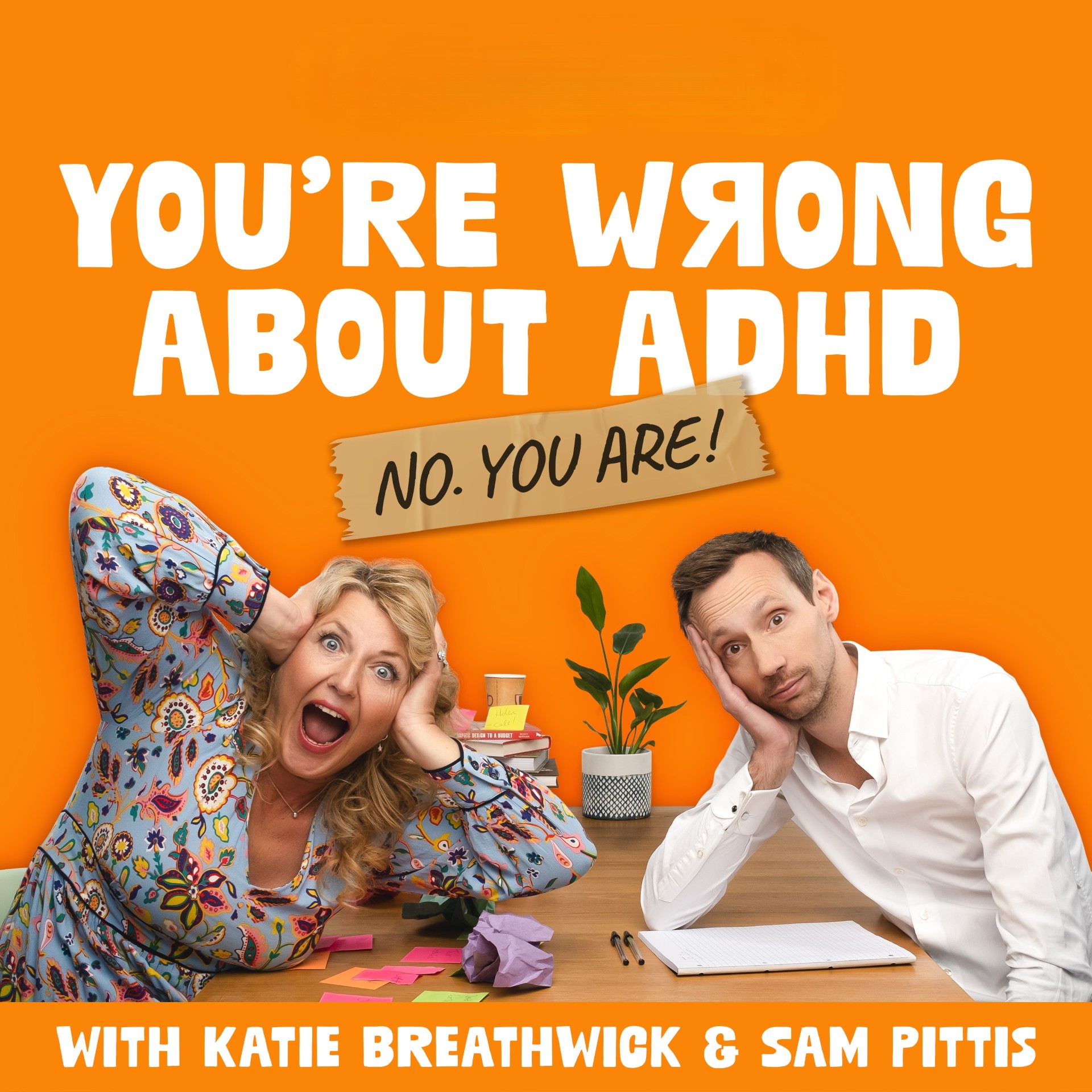
This is a Global Player original podcast. Hello, welcome to a bonus episode of You're Wrong About ADHD. Since we started this podcast, we've had the pleasure of speaking to an array of brilliant guests about everything you need to know about ADHD. So, before we return to Series 3, we wanted to remind you about some of the experts we've spoken to and the fantastic advice they've shared.
First up, Dr. Tony Lloyd from the ADHD Foundation. He explains what ADHD is and why we need to shift the way we think about it. ADHD is a difference in neurocognitive functioning, a difference in how your brain processes information.
It's been around for as long as human beings have. It affects 1 in 20 people. The acronyms ADHD don't really describe it very well because it's kind of best understood by most people as having three core elements of hyperactivity and attention and impulsivity. And in and of themselves, Sam, that sounds a bit trivial.
We can all be a bit hyperactive and impulsive and inattentive. It can't be depending on the context. But for people with ADHD, their neurology weighs in a slightly different way and it means that there are some things that they might find more difficult, particularly in certain contexts. But then there are other ways in which their brain can excel.
So I always say to people, you know, I'm exceptionally good at some things and exceptionally poor at others. But I think we need to frame ADHD in the context of we know that there are lots of people with ADHD in every profession in the world who live very happy, healthy and successful lives. But we also know that a lot of people with ADHD who are more vulnerable to things like anxiety, depression, PTSD, eating disorders, particularly more likely to underachieve at school and experience pervasive levels of learner anxiety in school each day, which we know is going to impact on people's mental health. So ADHD in and of itself, it's not a mental illness.
It's not a behavioural disorder. It's a neurodevelopmental condition. It can affect people in a variety of ways. And often it's the context that we find ourselves in that determines whether or not ADHD can be really disabling and impairing or not.
So for some people, depending on their life events and their lifestyle, ADHD can be really, really challenging. But it is, in effect, a neurology that affects learning, memory, to some extent motivation. And there are lots of acronyms around it. It's a Ferrari brain with a bicycle bridge.
Or it's like watching six televisions all at once, but you're trying to focus on one and you can't because the other five are drowning out your ability to focus. So it's not so much an attention deficit so much as an attention surplus. You can't actually filter out a lot of other information. And many people with ADHD will say their brain wakes up a hundred mile an hour, and that can be quite exhausting.
So I think we have to recognise people. It affects different people in different ways, but we know what the core elements of it are. So what exactly is going on in the brain of somebody with ADHD? Well, from a neurobiological point of view, Casey, we know that there are two major neurotransmitters that work differently.
One is called dopamine, which is a reward-based hormone that's involved in learning, memory, behavior, and another is called noradrenaline. And we know that the regulation and synthesis of those two neurotransmitters works differently in people with ADHD. But, you know, it affects one in 20 people, and that means that out of seven and a half billion people on this planet, everybody who has a brain as unique as their fingerprint. If one in 20 human beings have an ADHD brain, then there's got to be an evolutionary reason as to why.
So I question the notion of disorder. That's not to deny that it can be difficult. I think it's a naturally occurring difference, but I think it's one that often, particularly in modern lifestyle, and particularly for young people when they're at school, and for some people in the workplace, where it can be a real challenge. But when we understand what it is, and we learn the strategies of how to manage it sort of successfully, then we can reduce a lot of those challenges.
And there are, you know, there's still research evidence that says that they do present to leaders and executives, whether they're ADHD or dyslexia or both, that university graduates are twice as likely to start their own business if they've got ADHD. There can be some pluses to it, but I think we need to understand ADHD as one of a whole umbrella collection of different neurodevelopmental conditions, like dyslexia, which affects one in 10, and 40% of people with ADHD also have dyslexia. We know that there's a strong genetic overlap with autism, so it's estimated that more than half people with autism also meet the diagnostic criteria for ADHD. Similarly with dyscalculia, dyspraxia, these things very rarely travel alone.
And, you know, we have historically seen any child who didn't conform the way we wanted to as being somehow abnormal or disordered, but I think we're moving away from that. Next, Karen Dorothy. She's a relationship expert who specializes in couples impacted by neurodiversity. We have learned so much from Karen each time she's joined us on the podcast.
Notice and warning is a big feature of better communication in these relationships. You know, sort of daily check-ins, for example, that are quite structured and formulated. They can be really helpful. Everybody's working so hard.
Everybody's tired. Everybody's, and days go by and nobody checks in. Whereas actually, if there's a time set aside, they both know, and it's a sort of structured conversation. How are you?
Not long, not long. Maybe 10, 15 minutes. What's up? What's going on?
But it's structured and it's time. It's time balanced. You know when it is and you know how long it's going to go for. You don't get these swathes of disconnection that can happen.
When would that happen? What time of the day would that happen? It's like every couple. You know, some couples are good in the morning.
Some couples are better at night. But it's a check-in. It's a check-in to keep communication flowing rather than that distance, which is more prevalent in an NTND relationship. That distance grows more quickly, I believe, because people go off on different tracks.
I can really see what you mean, actually. I think about my wife and my experience. It's when you then get to a pressure point or a pressure situation, you're able to say, hang on a minute, we had that conversation and I know that such and such is going on for you. Or I know that this is where you are.
Rather than, oh, she's chipping with me. What's going on here? And it being a complete surprise because you've not actually taken into consideration what you're doing. What about when you get into those heated conversations, when actually you've gone too far and you start to, things start to escalate?
Are there ways of de-escalating? Definitely. Interesting, that whole escalatory phase of a conversation. I think often the NT can see it coming before the ND.
The ND's going to be triggered emotionally and will actually fire up much more quickly than the NT's in some cases. And so if a couple can really think about this and decide, actually, we don't want to do that, there are strategies that can be employed. So there's the use of the code word that just, you know, says, take a break. But both have to buy into it and both have to sort of actually acknowledge and not misunderstand and think it's being used to close the other down, which can happen when the conversation gets very heated.
When I was going through the sort of worst phase of, you know, having just been diagnosed, not realising I had a trace of borderline personality disorder, I didn't have the treatment I needed, we, my wife and I, used stop. And we would say stop. And it was a word that we used that would just say, this isn't going to get resolved now because neither of us are in a position to deal with this. So we're going to stop and we're going to walk away.
And it is hard because you sort of say, yeah, but I just want to say this. You want to have a final word. But it is really effective if you can both stick to it. And how did you get there?
Were you given the advice to do that? Or was that just something you kind of found on your own? I think we came to our own actually because we really, you know, there was clearly a lot going on with me and we realised that we were going into these spirals. We had conversations afterwards where we'd called down and realised what had happened and sort of said, well, actually, if we could get to this before it starts, that would be a way of intervening.
And that's what it's about, isn't it? It's about intervening before you say something you regret. Exactly. It's about arresting that escalation, which can become sometimes vicious and nasty or definitely loud and aggressive.
And it is about arresting that. So you can use the code words, you can use numbers, you can use red, amber, green. You know, each couple can make up their own way of actually deciding together that they don't want to escalate. So it's a mutual decision about not wanting to escalate.
Up next is Dr. Joanne Reardon, an educational and child psychologist. She shares some brilliant advice for parents with ADHD. Often when I see parents and we're talking about their child who typically either has an ADHD diagnosis themselves or is like to meet that criteria between, you know, often ones in families, parents talk about the guilt that they feel that perhaps for genetic reasons their child's got the ADHD.
And I often say, actually, you know, you're our best resource in this, in the system, in the child's life, because we can learn from what's been useful to you. We can normalise ADHD for a child by the factors already in their family. We can look at what's worked for you and really help the child understand themselves. And that's a massive benefit.
But on the flip side, I think the main difficulty for parents who are ADHD as themselves is that they can often feel less regulated and more dysregulated because, you know, kids are chaotic themselves, busy. And they throw up all sorts of extra challenges that we weren't putting. So we have, like, you know, we're chaotic and busy, so are they, and what can happen if you get this dysregulation? And what we now know from, like, brain research is that, you know, this co-regulation of children is a two-way process.
So if we're calm, then there are literally neurons in our children's brain that borrow that calm and it helps to calm them down and manage and regulate their emotions. So I think that's one thing as an ADHD parent we need to be particularly careful of is, you know, how do we manage our emotions and help ourselves stay regulated so that our children can borrow our calm when possible. It's not realistic for anyone all the time. That's so interesting.
So it's about not whipping them up. It's about learning to calm down, to be quieter, to be more present, but without having to be jokey and make a big song and dance about it. It's just that if we're stressed, then they're going to feed off that stress. Or if we respond to their kind of dysregulation bucket and irritate and stress ourselves, it feeds it up higher.
So it's about how do we, in those moments of stress, make sure that we're really consciously thinking about how do we maintain our calm so that they can borrow our calm. I think that's where it can be trickier just because of our difficulties as an ADHD to think about. But if we're aware of that and we're consciously trying to think about, like, this is a stressful point, like, do my deep breathing, like, you know, don't get too entrenched in the problem, I keep myself calm, if need to leave the room for two minutes and then come back and calm my child. You know, once we know this and we can consciously put steps in place, it's easier.
Dr. Max Davey from ADHD UK explains how ADHD medication works and how meds can help manage our ADHD. Broadly speaking, there are two forms of medication most often used for ADHD. Those are stimulants and non-stimulants.
Now, in order to understand how they work, it's a bit difficult in a purely audio format. But if you imagine, you've got to sort of think back about what ADHD is. And I'm sure you've had lots of discussions and lots of episodes about what it actually is, because it's such a difficult question. But one way of thinking of it, a mental model I find really helpful, is that ADHD is a chronically under-stimulated brain.
So you have, imagine a level of stimulation at which your brain would be comfortable. And every brain has a level of stimulation at which it is comfortable. That's a universal, that's a human universal. But people with ADHD, that level is much higher than the level of stimulation that the world typically provides to us.
I say us, because I have ADHD myself. Now, the medication acts to close that gap between how much stimulation you're receiving and how much your brain is comfortable with. So the stimulant medications, which are best thought of as a little bit like a cup of coffee that lasts all day, that's got that kind of feel to them, those increase the level of stimulation that you are experiencing so that that gap becomes lower, so that the behaviours that you might be kind of driven to do, the fidgeting, moving around, getting distracted, may well be reduced. The non-stimulants somewhat act in the same way by increasing the level of stimulation that you are experiencing, but also act over a longer period of time, talking six, eight weeks, to reduce the amount of stimulation that your brain seems to require.
In a way that is actually, if I'm honest, slightly mysterious quite how they do it, and they don't do it quite as reliably as the stimulants. So that's broadly the two sorts and how they work. Are there any side effects that come along with these drugs? Yeah, I mean, they definitely are.
And I think we need to be absolutely clear that the decision to go on to medication like this is not to be taken lightly in any way. What I tend to say to people, and I'm a paediatrician, but actually there isn't a magical difference between a 17-year-old and a 19-year-old who's suddenly an adult, as we know. So I think what I say is relevant, and it's what I say to my teenage patients, definitely. The first few weeks can be a bit rough.
Your brain feels different. And sometimes it's hard to sort of explain or describe, but I mean, I have taken medication and no longer take it. And the experience of going on to medication was odd. It almost felt a little bit like jet lag that just went on for a longer period.
You didn't feel quite in your own brain. It was hard to explain what was wrong. Sometimes this can manifest itself with agitation or irritability. And so it's just not a fantastic experience to start these medications.
You can feel a bit weird. I've mentioned that it feels a bit like coffee, the stimulants anyway. That feels for me, actually, gives me that energy throughout the day. Yeah, but equally, if you have a bit too much coffee, if you can't overdo it for your body, you can get that kind of tightness in your chest and the palpitations.
But certainly at the same time, Katie's certainly seen that the medication works. So there are situations, and there are lots of situations for lots of people whereby that medication, they take it, and it does, is a magic bullet in the way. Absolutely. One of the, I was telling Sam earlier, one of the psychiatrists who treated me said that he's found it an enormously rewarding area to work in for that reason, because they can be a wonder drug for the right people.
If the meds work for you, and they seem to work for me, and I can't tell you really why, actually, because it's not like some people describe everything as something coming into focus. There is clarity, definitely, but it's about energy, I think, for me, and volition, and it definitely enables me to get more done, which means all of that other stuff that comes rushing in with ADHD, the emotional dysregulation and the anxiety, they are held at bay because the meds are working for me. Is there an issue, do you think, with taking them long-term? You know, should we all be working, even if you're somebody like me, for whom they work, that's great, take them every day, should I be working towards not taking them one day?
I don't think so. I mean, it's very difficult. We talk about evidence-based in medicine, and the reason why the meds are first-line is because the evidence-based is strongest for them. Let's be clear about that.
The evidence for long-term use is very difficult, because you can't put people in a randomized controlled trial for three years, they just won't stay, it doesn't work. So all you've got is observational data. But if you look at the very large cohorts from Scandinavia, for instance, the outcomes for people who stay on their medication long-term are very much better for people who don't stay on medication, who are not treated. So I think, overall, that is a population who tends to do better.
Now, there's all sorts of confounders and there's all sorts of criticisms you can make of that data, but certainly there doesn't seem to be any harm in long-term use, and there does appear to be some evidence that there is benefit to your long-term outcomes to continue, providing it works for you. As we know, medication doesn't work for everyone, and not everyone wants to take it. Joseph Pack, founder of DrugFreeADHD.org, shares other ways you can manage ADHD. The types of people that generally come and learn from me have either had a very bad experience with medication or absolutely don't want to take it for one reason or another.
But it's to be, we have to proceed with caution, and I'm going to try to give some more basic tips today. But there's like, I call it the fundamentals, so we've got cold exposure, breathing techniques, and meditation. Now, cold exposure is really interesting, because it's one of the only, if not the only way, to actually hack the increase of dopamine in your brain. The other two ways to do that are medication and doing something interesting.
But we can't always fabricate a situation where we're interested. But we can, if we choose to, get in cold water. So that's cold showers and ice baths. And I do that.
If I'm in a situation where I think I'm about to get overwhelmed, facing cold water calms me down, and then I've just got a moment to think. I have cold showers. I don't go like hot showers. I have cold showers.
My husband gets really irritated because I was a bit turned down. I get some cold shower. And interestingly, during lockdown, pre-diagnosis, I was swimming in our local river, and I would feel really, really, I would feel crazy before I got in the water. And of course, the water then made me feel great.
And I thought that was nature. I thought it was being in nature and all of that. I now realize it was the cold water that was doing that. So there's some research done where they got, I can't remember how many people, quite a lot, and they basically put them in 13 degrees Celsius water, which is actually not very cold.
But they made them safe for one hour, which is a long time. And when they measured their dopamine, at the end, it elevated by 250% above what it was before. And did that level remain? For three hours.
That's how long it was. That's amazing. And then it was also boosting norepinephrine. So giving you huge amounts of energy and feel-good hormones.
Now, obviously, that's essential. The difference between the way that dopamine is released from cold water versus ADHD medication is that ADHD medication lasts longer, can last eight hours, maybe longer. But it can have quite a big crash. So you can notice the difference between the medication is working now versus it's not working at all.
Whereas the cold exposure decline in dopamine is extremely shallow. You don't even notice it going off. And finally, it's the queen of the ADHD kingdom, Jessica McCabe, whose YouTube channel, How to ADHD, has over 1.7 million subscribers. She shared some brilliant advice for anyone who's just received an ADHD diagnosis.
Whatever you're feeling about your diagnosis, know that that's normal, actually. Grief is normal. Joy is normal. Laughing hysterically is normal.
People have so many different reactions to their diagnosis. hypnosis that it just it runs the gamut because it is a really big thing to learn about yourself especially as an adult and you start having a process there can be a great process but there's at least a lot of processing has to happen because not only processing the fact that this happened but you're processing the fact that it's been happening your entire life and all of the reasons you thought you were struggling weren't the reasons you were actually struggling right it's not like finding out you're pregnant and like oh and moving forward i'll be pregnant it's like oh i've been pregnant this whole time i've been vomiting that makes sense like this you know like i feel like yeah somebody who like just didn't realize they were pregnant for months and months and like is about to have a baby and is like wait that's why it's kind of like that experience right um so take some time to process take some time to grieve take some time to cry take some time to eat some whatever it is that you need to do and then learn what it means because we've all had a lot of misconceptions put into our head by society about what adhd is and a lot of the representations of adhd especially in media are incorrect or based on outdated assumptions or understandings of adhd so take some time to learn so take some time to process and take some time to learn thank you so much for listening please do listen back to all the episodes from across the series they're packed with excellent advice from some of the best experts on everything you need to know about adhd and how to manage it we'll be back with you very soon for series three of you're wrong about adhd you can listen to you're wrong about adhd for free on global player this is a global player original podcast