Welcome to the Daily Stoic Podcast, where each day we bring you a stoic inspired meditation designed to help you find strength and insight and wisdom into everyday life. Each one of these episodes is based on the 2000 year old philosophy that has guided some of history's greatest men and women, help you learn from them. To follow in their example, and to start your day off, the little dose of courage and discipline and justice in wisdom. For more visit DailyStoic.com.
Welcome to another bonus episode of the Daily Stoic Podcast. So maybe you picked up on this. Maybe you didn't. There's a little behind the scenes or I guess inside baseball.
But I write the Daily Stoic emails, usually a couple of them every day. I obviously take breaks, but I usually write it whenever inspiration strikes me based on what's happening around me. So I listen to a lot of music and I spend a lot of time in the car with my kids, my wife. For instance, we did actually a version of this over at the Daily Dad.
My kids are obsessed with Hamilton, so we've listened to Hamilton over and over and over again. And what happens is little phrases, little lines from the songs, ideas in the songs, they sort of make their way into my brain. I'll write that down and I put that on my to-do list for the day where I send an email to my phone and that becomes a line that I'll build a Daily Stoic email around or a Daily Dad email around. So a little phrase here, there, a little here, it becomes an email.
I thought sometimes even a full article, but usually it's just enough to kind of tie to something I wanted to say about Stoic Philosophy or that I needed in my life. And that's sort of how the sausage gets made. We don't run them in the order that I write them. There's a big document.
It's called the Unsent Document. And I'm always writing the emails and then they get taken by the editor who tweaks them and improves them. And then I do another pass when I record them here for the podcast and then they get selected for a schedule. And I'm not saying the same thing too many times.
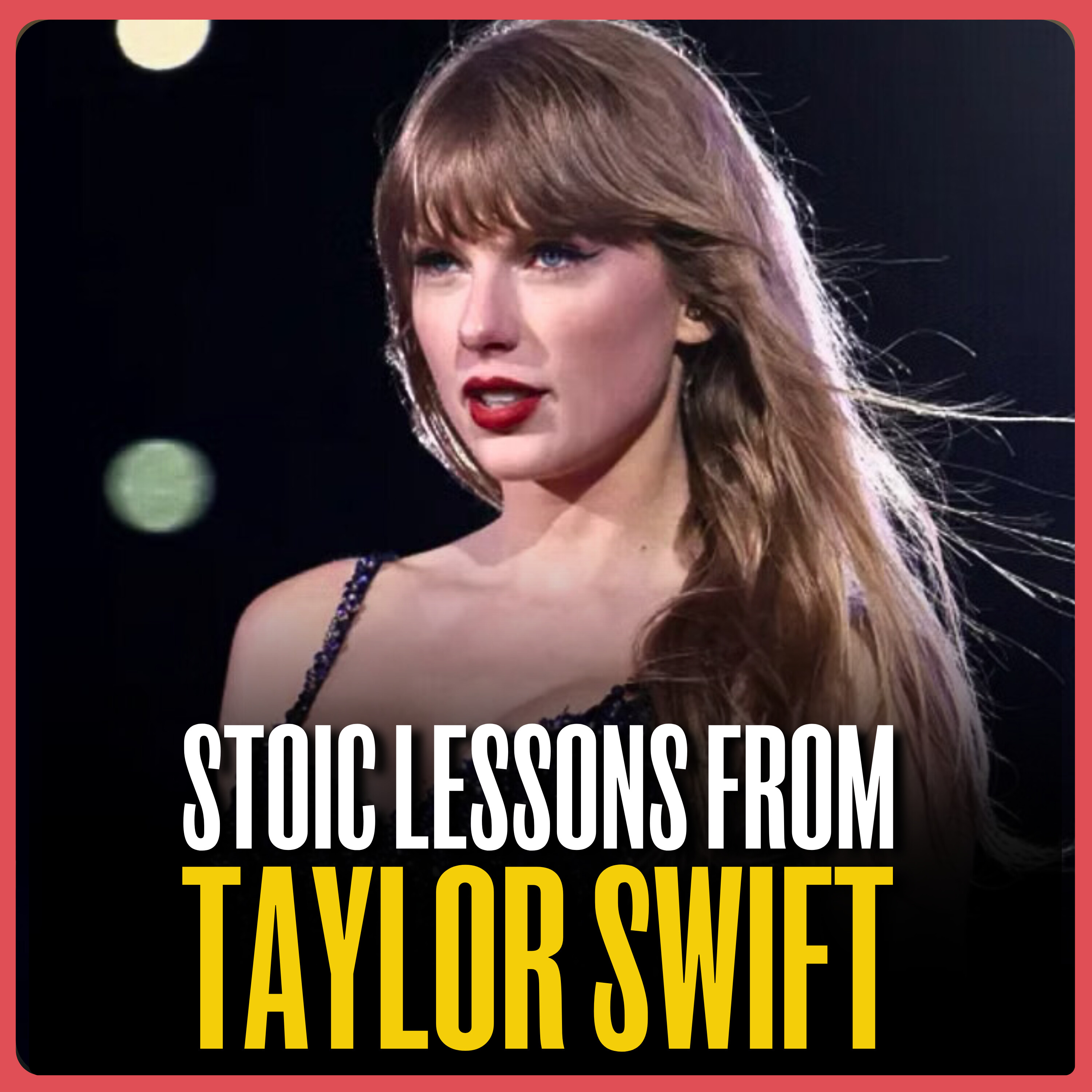
So I might write three emails about Hamilton because something popped into my head. And then those might run in three consecutive months or two might run in one month and then we might run another six months from now. I can sometimes get that far ahead. So if you're a careful listener, you might have noticed over the years a number of Taylor Swift illusions or ideas in the Daily Stoic email along with lots of other music, some of my favorite bands, what they're talking about.
Alice and Chains, everyone's one, Iron Maiden. I just wrote one from a lyric from Nathaniel Raitliff just the other day. That's just kind of how it works. And as I said, it's been a lot of time with the kids.
My wife, so that has made me slowly and steadily. I guess a Swiftie. You might think Taylor Swift has nothing to do with social media, but I found a way to shoe horn it in. Have I not?
This is actually a talk I gave at Live Nation a couple of years ago where I was talking about how we take professional obstacles and turn them into opportunities for success. When Taylor Swift's masters are sold in 2019, she's not happy about this, right? They're sold to Scooter Braun, who actually leads the Daily Stoic every day. So it's cool with me.
But she doesn't like it, right? That's what matters. She decides that's not something that works for her. So after she reminds herself to calm down and then reads this tweet from Kelly Clarkson, one of the most epic tweets of all time, I think we'd have to say, she decides she's going to do precisely this, right?
So she re-records her first five albums and has basically been putting out music almost every day since that point, right? So Taylor Swift was, of course, very successful, very popular, very well known before this. But it becomes this sort of springboard, the act of constantly releasing music being the cultural center of the universe now for basically three or four consecutive years. It not just transforms her and her crew, but it elevates her to a level of pop-startum that I don't think anyone has ever reached before, maybe other than the Beatles.
And you look at the heiress tour, the heiress tour is possible, right? Precisely because she's just reintroduced a whole generation to her music. And I think what's interesting too is it's not just that she becomes bigger and more popular as a result of this process. And sees this control of something that she didn't have control of financially before.
But the songs get better, too, right? And this is a remarkable example of taking something that you never would have chosen, that you thought was profoundly unfair or screwed up, right, the worst part of the music business. And it becomes this catapal, right? And 1989 is the most streamed album of all time.
She's times person of the year now, right? What we do after the thing has happened to us is what matters, right? And it's not that everything is this, right? That everything becomes the catapal that advances our career to stratospheric levels, right?
That's not always how it works, right? Life is much more brutal and frustrating and unfair than that. But we always have the opportunity to decide the end of that story. It's going to mean to us how we integrate it into our lives, who we become.
So it struck me as I was driving my kids to school this morning, listening to the new Taylor Swift album, which came out at midnight, The Life of a Show Girl. I thought, I wonder how many Taylor Swift emails have we actually done? Sometimes I'd be very clear that I'm talking about a Taylor Swift lyric. Sometimes I'll just have used it in the title and it's just like a little inside joke that only I know about.
But I wondered how many times I'd actually done this. And so I had Claire, our producer, throw that compilation together in honor of the new album, which I thought was pretty good. I tend to find, and I think this is a quality of her music, you gotta listen to the songs like many, many times, which is how I listen to music. I tend to find songs that strike me in the moment and then I listen to them on repeat until it kind of fades into the background and then I can write.
So I'm only maybe one and a half listens through the album. But I wanted to throw together this compilation in honor of that. And I hope that you enjoy it. If you don't, got a little stoic idea for you.
Just skip this one. You don't have to get upset. You don't have to send a nasty email about it or a nasty comment. You can just now listen.
And the people who do like Taylor Swift, which is apparently most people, they can enjoy it. So enjoy. Could you survive this? His father died when he was about three years old.
He was raised by a single mother with an enormous fortune, and then at an alarmingly young age he caught the eye of the emperor of Rome, a brilliant but twisted man and decline. He was groomed for absolute power, forced to come and live in Hadrian's palace, a place to live with spies and sycophants and capricious violence. At 18, he was made a junior magistrate in charge of Rome's financial affairs. Up and up he went the curses on Orem, the ladder of offices, until he put on the purple at age 39, becoming in an instant the most powerful man in the world.
When we judge the rule of Marcus Aurelius, how often do we adjust for what an absolutely deranged childhood he endured? I want to snarl and show you how disturbed this has made me, Taylor Swift sings, you wouldn't last an hour in the asylum where they raised me. In fact, for the most powerful person in the world, for someone who has been performing in public since she was 11, she's, Taylor Swift is pretty well adjusted. And the same goes for Marcus Aurelius.
How did he not turn out to be a Nero or a Tiberius? It's almost unbelievable. And the answer, of course, is stoicism. Stoicism made the difference.
The philosophy he got from his teachers, that copy of Epictetus, loaned to him by Rousticus, the moral compass that is the four virtues, the spiritual practice of which meditations as a byproduct, seems to have saved him. It centered him. It guided him. But do you think it would have done the same for you?
How long do you think you would have lasted in the asylum where they raised him? The real reason Marcus Aurelius wasn't corrupted by power, why he wasn't made insane by his surroundings is because he worked hard at it, incredibly hard at it. He strove actively, daily, to not be caesarified, to not be stained by that purple cloak that fortune put on his shoulders. It doesn't just happen.
It doesn't matter how good you are, to survive success and fame and power to be virtuous in such a situation one must make it the work of their life. The business failure, the blown meaning, the marriage that fell apart. These things didn't go the way you wanted it. It's frustrating and painful and hard to see anything good about it.
Surely that's how Taylor Swift felt when she discovered that her masters had been sold to a hedge fund in 2019 and she lost control over how her music was distributed and marketed. There were many ways that Taylor could have responded that she could have raised millions of dollars to buy them for herself. She could have hired a lawyer to fight her battle. She could have let her frustrations sour her on her old music and stopped playing it at concerts, alienating fans who loved those songs.
Instead, in a career-defining moment, she calmed down to follow her own advice and she decided to rerecord her albums, redistributing them herself and republishing them to fans' Taylor's version. Of course, Taylor Swift was successful and popular before this, but because she's basically been releasing music nonstop for the last half decade, she became the center of culture, catapulting herself to a level of pop-start of not-seen since the Beatles. Her era's tour grossed more than a billion dollars. Even the movie about the two were made hundreds of millions.
This was all possible because a new generation discovered her music and wanted to be part of her team and join in her. But it's not simply that she became bigger and more popular as a resolver, that she sees control over something that was previously outside her control. It's that her songs got better, her concerts got better, she got better. And on top of all that, she made herself the underdog in the process.
It's quite a move she pulled off, a level of career and public relations jiu-jitsu without parallel. And it's also a remarkable example of taking something you never would have chosen, something you thought was profoundly unfair, and using it as fuel to find new potential within yourself. What we do after that thing happens to us is what matters. We get an opportunity to decide the end of each story.
When jarred, unavoidably by circumstances, revert and once to yourself, Marx really writes in meditations and don't lose the reason more than you can help it. You'll have a better grasp of harmony if you keep going back to it. This story about Taylor Swift, how she turned the obstacle into the way, is actually one of the stories I wanted to add to the 10th anniversary edition of The Obstacles The Way. I just thought it was so fascinating the way she outsmarted and outmaneuvered the music industry, which is notorious for taking advantage of artists.
And I put that in the chapter maybe you remember about channeling your energy. Because she showed that we can redirect the negativity thrown at us into something positive for ourselves and others. When I got asked to do a 10th anniversary edition of The Obstacles Way, I wasn't sure why I do it. But then I kind of actually liked the idea of doing a Ryan's version, getting the update and change and tweak, getting to take all the things that I have learned and gone through in the intervening 10 years and use it to make the book better.
And that's what this new version of The Obstacle is the way is. You're on your own kid. There are moments when we feel more alone, of course, after the divorce, when we head off to school for the first time, when we strike out on our own, start working for ourselves, when we do something that people don't understand that engenders criticism, we realize we're on our own that we have to blow our own nose, as Eppetita said, that we'll have to be our own savior while we can't, as Marx really throughout. No one but us can solve our problems.
No one but us can manage our emotions. We only control what we control. We can only demand the best from ourselves. But this is not new.
You've always been on your own, as Taylor Swift put it, and you always will be. You can instead let these moments when we feel more alone serve as reminders, that we have the tools to change, that we only get to choose how we react, that we evolve into whomever we want to be. Because what you have to lose, you are already on your own kid, and no one can take you away from you. Only you can do that.
The smallest man who ever lived. They hoped he would grow into the job. They hoped a tutor like Seneca would teach the boys some wisdom and gravitas. Instead Nero seemed to get worse as he grew up in gained power.
He tried multiple times to kill his own mother, eventually succeeding. He banished a poet for being too talented. He forced Roman crowds to listen to him perform. He eliminated potential successors.
He exiled philosophers. Even when this all came crashing down and he was driven to suicide to escape the consequences of his mismanagement and his enemies, he had to ask a secretary, Eppetita's owner, as it happens, to do the deed for him. Nero was to paraphrase the song lyrics, the smallest man who ever lived. He might have possessed a great kingdom, but he did not command himself or his urges or his ego.
He was vain and cowardly, petty and vindictive, murderous and untalented. He was rushed on a sparkling empire. The question is, as we've talked about before, is how did Seneca get so mixed up in it? What was he doing writing speeches for this guy, advising him, supporting him when he was so obviously unsuited for power in every conceivable way?
James Roms fascinating biography, dying every day, along with Emily Wilson's The Greatest Empire, offers several answers. Seneca was greedy. Seneca was hypocritical. Seneca was a martyr.
He thought he was the adult in the room, saving Rome from worse. Seneca was weak and then became strong when Nero finally turned on him. When truth, Seneca was a lot like us probably. He knew what he should do, but he made excuses.
He had trouble seeing what his salary and his status depended on him not seeing. He hoped that he could do things through Nero. He told himself it was not as bad as everyone said it was. He told himself he was waiting for the right moment.
Well, we're an election year here, not just in America, but across the world. Let us learn from Seneca. Let us be reminded what happens when you let a man child run a country, when ego and incompetence run amok. Don't be this kind of friend.
They've always been with us. They were there in Nero's court, telling McCain what he wanted to hear. They were there in the slave quarters too, as Epictetus would have known. Notions of solidarity being tossed aside for an extra scrap of food or slightly better treatment.
Seneca would have known them in his literary salons too. It's rare to see Marcus Aurelius get as specific or as judgmental as he does in meditations 1115, when he talks about despicable phoniness, which he calls a knife in the back. We've all known these people. They do one thing and say another.
They virtue signal, but act without virtue. They are as Taylor Swift sings, vipers dressed in empaths clothing. But it's important that we understand when Marcus Aurelius is saying that false friendship is the worst and that we must avoid at all costs. He's not saying that we can get through life without experience and false friendship.
That's unavoidable. What he is saying is that we make sure that we aren't false friends. Remember, we don't control what other people do, whether they lie to our faces or establish in the back. We don't control other people's hypocrisy or their vulnerabilities.
We do however control who we are. We control how we treat others. We control what kind of friend we are. Can you do it even when you don't want to?
When the weather is nice, it's easy. When you've had plenty of sleep, it's easy. When you like the taste, it's easy. When everyone is rooting for you, it's easy.
In these cases, it doesn't take much discipline. But just as courage is only courage when there's a risk when you're pushing past fear, discipline is a virtue that comes into play only when things are hard. When I was in Canada for the daily stoic life tour, I just did. I was talking about physical practices running and swimming and lifting weights and walking anything that forces you to confront and push past the resistance of not wanting to do it.
I was saying that these are mental and emotional practices. But instead of quoting from a stoic, and she was in town and quoted a lyric from Taylor Swift, it's a great camera bitch smile even when you want to die. Can you hit your marks when you're tired, when you're sick, when your kids are sick? Can you do it when the weather is bad, when you think people are laughing at you?
Can you do it even when it's hard, even when you don't want to, even when you think that maybe you can't? That's what discipline is about. That's the muscle you cultivate from a physical practice. The muscle of doing the thing even when you don't want to do the thing, even when it's extra hard to do the thing, even when you think can't do a thing.
Can you do it with a broken heart? It's one thing to get up there and perform. It's one thing to show your kids a wonderful day. It's one thing to go make the sale.
It's one thing to put in a full 12-hour shift. It's another thing to do it after a wrenching custody handoff. It's another to do it as you're grieving. It's another to do it when you feel the shame.
It's another to do it when you feel terribly alone. Stoicism is not the absence of emotion. We have stories of Marcus Aurelius crying, multiple. In fact, we have incredibly thoughtful essays from Seneca on grief and loss.
My favorite translations in the pain of porch, I'll link to that. The Stoics made beautiful works of art. They wrote poetry. They loved the theater.
These were people that felt no question. They also understood that life, especially leadership, requires being able to balance these emotions with the responsibilities and duties that each of us have. Life's camera, bitch, smile, even when you want to die. Taylor Swift sings, and I can do it with a broken heart.
We can imagine Marcus Aurelius trying to hit his marks, trying to perform the public duties of the emperor even as a plague devastated Rome, even as he grieved the loss of another one of his children, even as he was suffering from his own debilitating health issues. We have to process these emotions to be sure. We may also have to put them aside for a second, because our children are depending on us, because we've got to go make our living, because we made a commitment, because the world is counting on us. Life doesn't care if you have a broken heart, only that we hit our marks.
No one likes to be insulted, no one likes to be attacked or slandered. It feels great to be praised, we like being celebrated, renowned, and recognized. But the stoic in us has to remember that these things are not worth very much, don't mean very much one way or another. Why?
Because they're not in our control. When the rapper and music mogul Birdman demanded that the radio host and Daily Stoic fan Charlemagne the god put some respect on my name, he was asking for something outside his control. However powerful he was in the business. More important, what would it have been worth anyway?
What matters is self-respect? Not obligated acknowledgement. The stoic understands that deserving or good reputation is what we strive for. It cuts the other way to another music reference.
In her song, but daddy I love him, Taylor Swift, no stranger to gossip and criticism sings. We should remember that no one can demean or harm us with their insinuations or expectations. No one can truly damage us with scandal or controversy. Our name is ours.
Can we disgrace ourselves though? Absolutely. Your only harmed Marcus Bielius wrote to himself if your character is affected. Not impugned, but affected.
Meaning only you have this power. So remember they can praise you, they can insult you, they can raise you up or tear you down, they can spread your name far and wide, they can ignore you. They can love you or hate you, but really the only thing matters is who you are to yourself. What matters is whether you are living up to your standards, whether you are following those virtues of courage and discipline and justice and wisdom.
Are you putting respect on your name? Are you disgracing your name? That's what counts. Not what anyone else says or says you do.
Hey, it's Ryan. Thank you for listening to the Daily Stoward podcast. I just wanted to say we so appreciate it. We love serving you.
It's amazing to us that over 30 million people have downloaded these episodes in a couple of years. It's an honor. Please spread the word, tell people about it and this isn't to sell anything. I just wanted to say thank you.