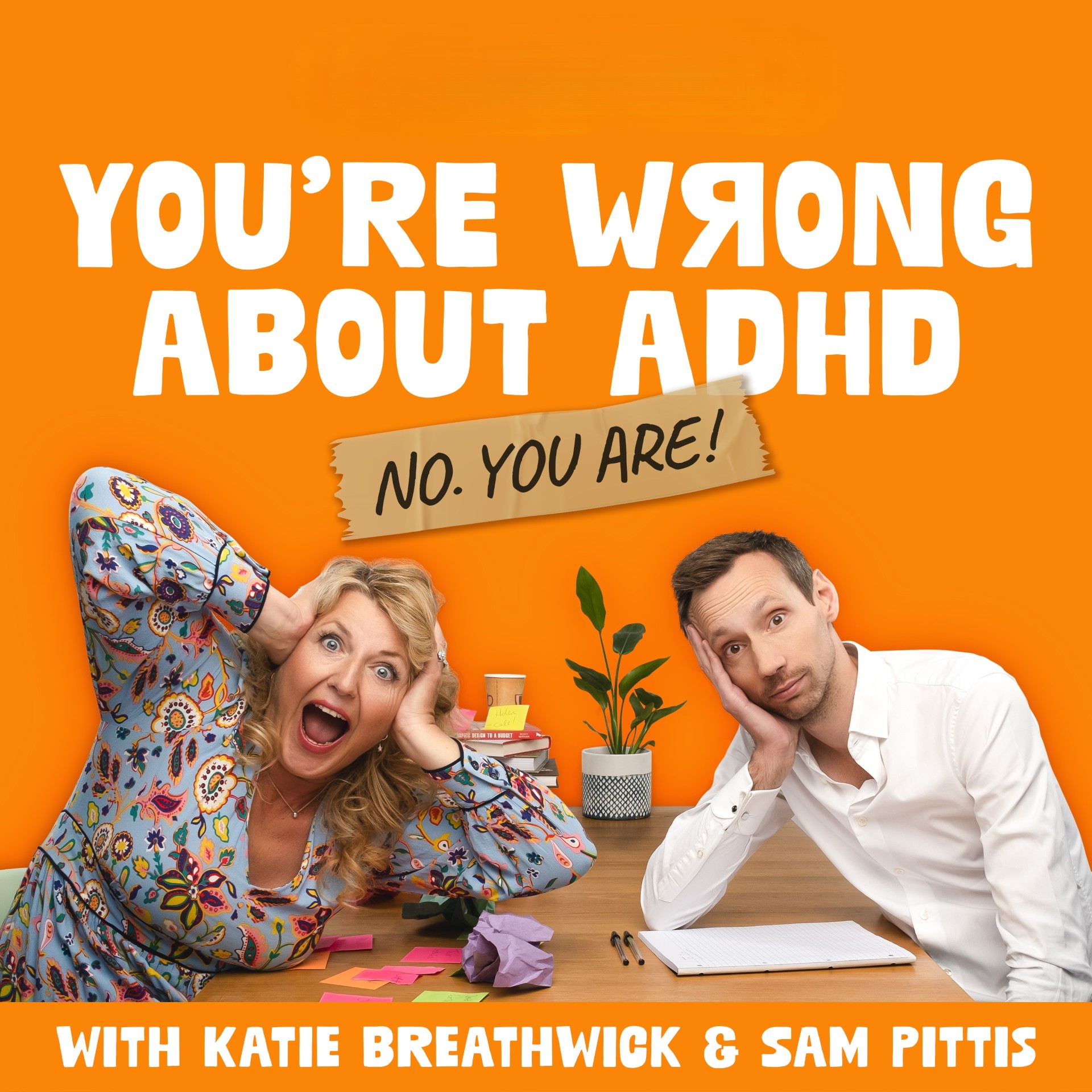
This is a Global Player original podcast. Hello, welcome to the bonus episode of You're Wrong About ADHD. I'm Sam Pissis. And I'm Katie Graphic.
In the last episode, we spoke to neurodiversion specialist Mark Redwood about masking. It's such a huge topic, essentially, about all the ways in which we pretend to be normal. Whatever normal is, I mean, it's different for everyone, isn't it? But all the ways in which we pretend, that could be all the times we set an alarm so that we're not late, or the times we pretend that we're looking at somebody so that we are, we look like we're listening, even if we're not.
All those different things. Everyone's experience of masking is unique. But one of the things that we talk about is the exhaustion. It's exhausting, isn't it, Sam?
Definitely, it is. And I thought, you know, what Mark was talking about, about the sense that you feel you have to do it because of the embarrassment and shame attached to it, which, you know, has another layer of exhaustion on top of it. Well, surely, it's the thing that underpins all of this, ultimately, isn't it? You know, when I think about why I do it, why do I force myself to sit still?
Why do I stop drilling my hair? Why do I knock back my nails? It's because a lot of times I've been criticised for those things. And, you know, I grew up with parents who were constantly telling me to stop doing things.
And teachers, sit down, stop digitating, finish your work quickly. Why is that so messy? Go and stand outside the classroom, go and see the head teacher. Because these were things I couldn't help doing and I had to grapple with myself to stop.
We get these messages at a young age and then things become habits. But part of it, part of the embarrassment about being perhaps overly emotional or overly excitable, you suddenly realise, you know, this isn't socially acceptable, so you start to stop doing it. But then also, I find, you squash things into a box, it burst out. And then you've got all the guilt and embarrassment that's associated with that because I wasn't able to keep a lid on it.
Yeah, absolutely. And, you know, that becomes this sort of ever-decreasing circle of shame in the end, doesn't it? Those constant anxious thoughts are going round and round and round ever, ever, ever quicker. It's an absolutely, utterly exhausting thing to handle.
And it was a big breakthrough for me when I first got diagnosed with ADHD. You know, there was a dropping of the mask almost completely for a bit. I was a quite frightening person to be around for a while because I just let go. And it was so liberating to be more me, to realise ultimately, the people around me who find that irritating should just be irritated and not be around me.
It's up to them to deal with that. And Mark talked about that, didn't he, about the need to create this ADHD life. You know, we have both acknowledged that the world in which we work, the world of broadcasting and radio and the opportunity to sit here and share and have a chat, it suits us because we're people who are vulnerable. We like to talk and interrupt and all those sorts of things.
You know, that has proved to be a really important part of how we handle our ADHD. And he's right, you know. So, God, if I found myself working, sitting at a desk for eight to ten hours a day, unable to talk to people, unable to move around, I think I'd have gone mad. Yeah, I mean, this is something we've touched on a lot.
And it's something that's sort of an ongoing process to try and work out. You know, we are trying to come to terms with our own ADHD. And he acknowledged that not everyone is able to get themselves in a situation that is perfectly suited to ADHD. And what I took from what he was saying about ADHD life is, yes, for some people it is working like he did, you know, keeping his own hours and deciding who he was able to talk to.
You know, it does come back to being aware of what are going to be your trigger points and saying, OK, I know that I'm going to be in a social situation which I'm going to find really tiring. Maybe I need to give myself a bit of a rest, a bit of a break before I go into it. Or maybe I need to make sure that my home life is very ADHD friendly. Or honestly, the friends I spend time with are very ADHD friendly.
You know, there are different parts of an ADHD life, I suppose. Absolutely. And I'm saying, you know, talking about absolutely, he talked about that too, didn't he? About not living in extremes, not living in absolute extremes.
In relation to what Mark was saying, there are times when we are going to have to mask. There are times when it's perfectly appropriate to say, OK, I'm going to have to sit quietly, I'm going to have to listen. But there are other times when maybe we need to say, OK, what if I just took the mask off a bit? So, you know, let's use some concrete examples.
If you're in a work meeting, you've got to sit quietly, you've got to listen, you've got to speak at appropriate times, and maybe in your social interaction, or your social interaction with colleagues, you say, oh, what if I just took my ADHD in this? Would that hurt? And also, is there a conversation that you can have with somebody in that meeting to say, sometimes, occasionally, I will need to get up and walk around the room, or I might need to have a fidget spinner that will help me concentrate on everyone else if my body is moving? I found what he said about the difference between men and women, girls and boys, really interesting.
You know, that maybe we are. There's a huge amount of social pressure put on young girls to behave. Young girls should be seen and not heard, is what I was told by my parents when I was little. And so we learn very, very quickly that there are certain kinds of behaviours that are expected of us from when we were really small.
Do you know what? It occurred to me when I was getting ready for our conversation today, that during the pandemic, when we were all expected to wear masks, actual real masks, I absolutely loved it, because it meant that I could go out into the world, I could go shopping in the supermarket, I could go to the theatre, I could go to all kinds of places, and my face could do all the things that it wanted to do without me having to hide it. Isn't that extraordinary? Because my face was so, usually, it wants to be able to be expressive and express the sadness or the anger or the irritation, all those different things.
And, you know, the guy stopping me in the street, he was saying, you know, I can see every single emotion in your face as you're walking down the road. I was aware that this is not something everyone else does, but you put a mask on, and you can do all the things all the time, and no one can see you. And it was so liberating. It was so liberating.
Isn't that extraordinary? I can totally see that, and it makes total sense. I suppose it goes back to what we were saying a moment ago, is that maybe you need to think about, you know, there are times when, honestly, you need to hide your reaction in a certain situation, it's not appropriate to go, whatever you're talking about. But maybe there are times when you need to say, maybe I just need to be comfortable with people seeing how I react.
What I'm actually thinking, rather than what they think I'm thinking, which is, oh my God, this is so boring. But basically, you know, there was, the real-life mask enabled me to relax a little. This is one aspect of this whole subject, which we really need to think about, is the unmasking of ourselves. I was about to ask you the same question.
You know, we need to, awful phrase, we need to practice what we preach, but we've spoken to Mark, how comfortable are we, let's start with you, how comfortable are you, unmasking? Unmasking, well, I can tell you exactly in what places I do it. I mean, obviously, at home, at home, I, my poor family, at home I unmask, and I, you know, I'm surrounded by neurodivergent family, so that helps a lot. It's a safe space, it's a place where we all laugh at each other, we don't criticise each other, we gently tease each other, and that makes it a really wonderful place to be.
But I'm also aware that there are places where I unmask as well, and that's in this building, actually. I feel I'm truly myself in front of a radio microphone. My radio show is absolutely me at large, so there is no shame when I'm on air. And I think that's partly why I love doing what I do, because I know when I'm in that space, I just raise the fader, and I'm me, I'm me, and I love it.
And what about those situations with people who you think, do you know what, maybe I'd be embarrassed to let these people know the whole of me? Yeah, well, even the shroud that we've talked about comes down, doesn't it? That sort of... How do you feel about...
It's really hard, because at the same time, it's appropriate to say, I'm not going to give this person a little bit to know all of me. But how would you feel about saying, do you know what, I'm just going to react like I normally would, and if people think I'm a bit off the wall or a bit over-emotional, so what? Well, it depends on the person, doesn't it? And it depends on what your requirements are in that moment from that relationship, because if that person is irrelevant, and you don't need them in your life, then it's okay, and you can be exactly who you want to be, and who cares if they take it, and they're great and fabulous, but say it's your boss, and you're trying to impress them, for instance, there are certain things you have to say, aren't they?
And that's when it becomes really, really hard. You know, that moment, those moments, sentence to sentence, of thinking, don't say that, don't say that, don't react to that, that's when it becomes really difficult. Well, maybe the answer to this is, and I'll get into my experience as well, I'm not shirking the question, maybe the answer to this is what we already said about not living in absolute, so be prepared, there are occasions when it's totally appropriate, so I'm going to keep my personal life to myself, I'm going to keep how I feel to myself, but am I prepared to give a bit more of myself? Come on, Sam, come on!
No, I am, the same as you, I can sit here and talk to you on this, I can sit on, I can do a radio show, and I can give myself away, and that is something I do, and I love, and I really enjoy. I hear it. But, you know, in a social setting, I feel awkward, perhaps, you're guarded because you're trying to protect yourself, and I suppose I am absolutely prepared to give more of myself, but I think it's about picking the environment and saying, you know, okay, is this an appropriate environment to unmask? Where are those, I'm interested, where are those environments?
Where do you feel safest, and where are those places? With my family, with my friends, obviously, there's a sort of true version of myself. I think it's not necessarily about giving all of yourself away, though, it's like in those conversations where you think I need to put on a front with this person, and I'm sort of stifling my personality a bit, and maybe there's an opportunity, when you're going into a social setting with people you don't know, to have this conversation in your head beforehand, or to say to myself, right, there's a good chance I'm going to mask here, there's a good chance I'm going to try and squash how I feel, there's a good chance I'm going to keep my arm's length. Okay, let's have that conversation before I go.
Maybe today I could let it out a bit. Almost, you know, be prepared to have that conversation first. I see exactly what you're saying. Yeah, to sort of mentally outchat with yourself, and drop the mask sooner rather than later.
Because that is a really big thing, actually, isn't it? Because if you start with a mask, then the question is, when are you going to drop it? But if you've left the mask at home, you don't ever need to drop it, because you're already yourself, and you can chill out and relax. And one of the things that we've reflected on is that when you do drop the mask, it can be a really good feeling.
It's the best feeling in the world. That feeling of the whole thing about dance like no one is watching. I've always danced like no one is watching. I don't know why you'd ever, why would you ever dance like you're embarrassed?
Because the whole point about dancing is supposed to make you feel joyful. And I know that I get funny looks in the club or at the wedding if I'm on the dance floor and I'm giving it some. But that is when I feel most of myself. And that is when I really, that's when I truly feel that the mask is dropped.
It was checked in at the cloakroom. And it is a feeling of pure and utter joy. So I was doing a radio programme on Classic FM the other week, and one of our colleagues walked in, and I was, the chair I was on, was wheeling across the room, I had the music whacked up, I was waving my arms, and my nostrils were flaring. I know her quite well, but she went in and still did a double take.
And I just went, this is ADHD in action. This is what it looks like. And it's a great feeling. And I think it's important to go, do you know what?
Sometimes this is great. Let's not lose it. Oh my God, are you saying, are you saying that sometimes having ADHD is an upside to this? It's a great feeling, doesn't it, it's a superpower.
I'm going to take that as a win. Let's stop that there. Before he says anything else, that's everything from us for today. Yeah, don't push your luck.
You can listen and subscribe to You're Wrong About ADHD on Global Player, or wherever you get your podcasts. Thanks for listening, and see you next time. You're Wrong About ADHD is made in association with Apex Content Ventures. This is a Global Player original podcast.