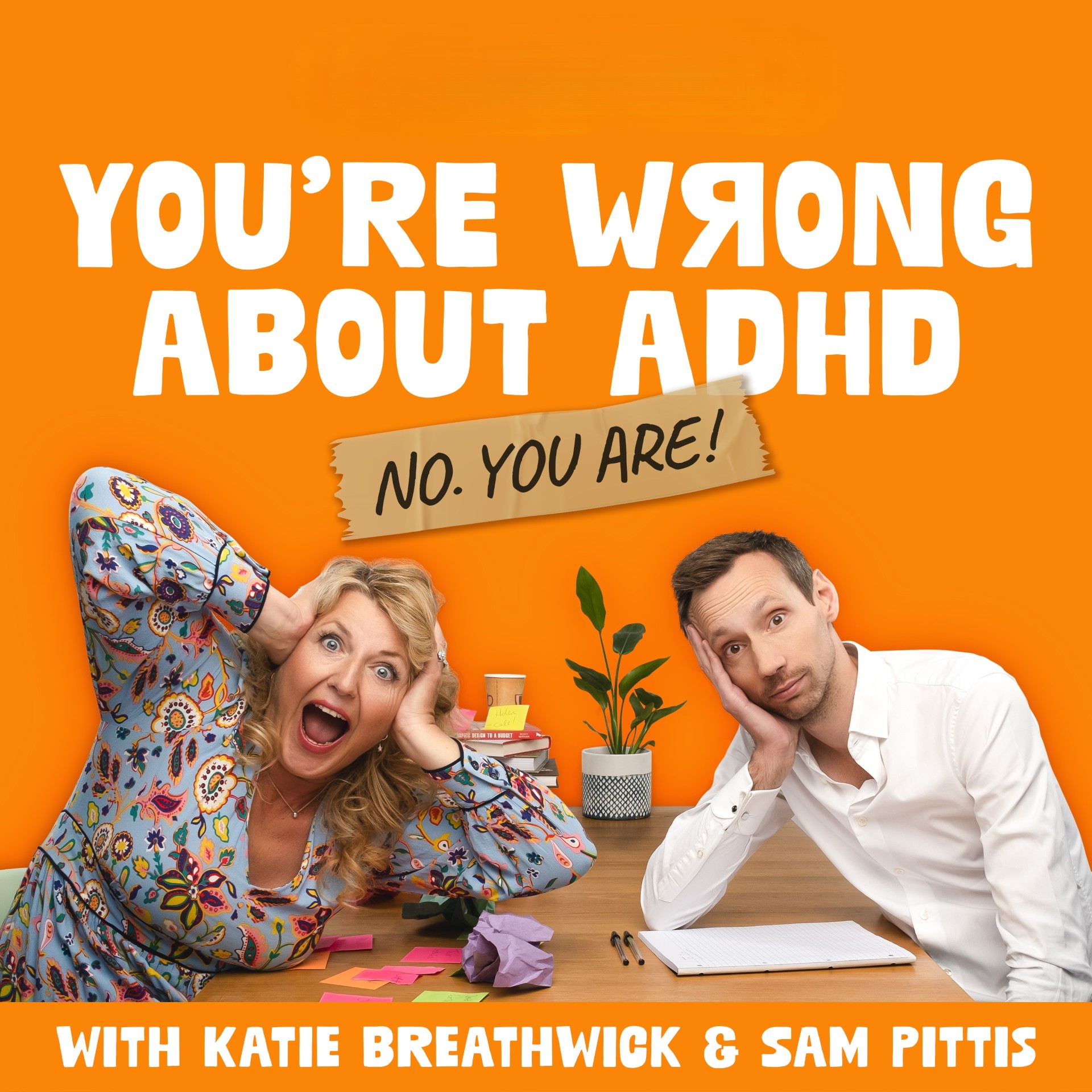
This is a Global Player original podcast. Hello, I'm Katie Rethwick. And I'm Sam Pittis. And welcome to our podcast, You're Wrong About ADHD.
Sam and I have been friends for maybe 20 years and a couple of years ago. We both found out we have ADHD. I think it's fair to say we feel very differently about it. Getting an ADHD diagnosis answers lots of questions, but it also raises nuance.
Each week we're going to be talking about everything from our experiences being diagnosed as adults to relationships, coping strategies, and how we manage these most special brains. So we can learn more about ADHD and what it means to neurodivergent. Hello, Sam. Hello, Katie.
How are you? Well, wow. What a big question. I know we ask each other how we are every week.
But actually, this week it's even more important because today we're talking about where we are now, what has happened, how much have we changed, I suppose, actually, how much have we learned since we started doing this podcast? And it's a massive question. And it's a massive milestone. We're coming towards the end of series two, and we've had so many different guests talk about so many different things, ask so many questions, have so many thought-provoking answers, actually.
How are you feeling about it all? It's, of course, it sounds like a really sweeping set. It's completely changed my life, which is ridiculous. In a good way.
Well, you know, isn't that ridiculous? Because maybe that would have happened anyway, because I know this happened, and then that period of self-examination begins, doesn't it? But I think what has been the real privilege of this experience of making this podcast with you is that, actually, you've been part of that process. I feel you've become a bit of a mentor, actually.
I think you've spotted things about my story that I basically think, well, yeah, oh God, that's not good, is it? Sam's my mentor. That's not good. Anyway, but also, that's privilege of being able to ask questions of the people who know the most about what we're dealing with, and getting those tips from people who have done the research, who know what they're talking about.
And there are so many little tiny tweaks and changes that I've made to my life that have added up to a whole lot, and I'm so fucking grateful for that. It's amazing. We've been able to challenge each other, as well as getting alongside each other, and that's been fantastic, and, you know, you've asked me challenging questions so many times, things that have made me think and made me reconsider my ADHD. In what ways would you say that you have changed some of the behaviours or habits?
What's changed? So, the biggest, I think, and most important is that I have learnt to ask for help. I think I was always very bad at that. Even accepting help, even when other people recognised that I needed help, allowing others to step in was not something I liked to do.
And having recognised that, A, I have a problem with certain challenges, but also, actually not that I have a problem with them, that I'm bad at it, and actually, other people are much better at it. Let's take, for example, keeping a house tidy, and throwing stuff away, and going through and thinning items in your house, okay? I live with a holder anyway, so the two of us have amassed a whole lot of stuff over the years, and I've just coped with that, and I've dealt with that, and I've just moved all of these mountains of items around the house. It's enormously time-consuming and annoying, and, of course, it then got worse in lockdown.
And we started this podcast, and I began to realise, actually, my brain doesn't work in a helpful way when it comes to tidying up those messes, and so I got in a professional. I've spent three days with a wonderful woman, Amy, who lives locally, who has come in and works side-by-side with me, pulls everything out of all the drawers, gets everything off all the shelves, and we, together, work through taking stuff to charity shop, putting stuff away, burning other items that just need to be disagreed. Absolutely! I mean, that's one element I have realised, I hate clothes shopping, I've always been terrible at it, I'm terrible at remembering that there's one item in one shop that might go with another in another, so I just don't do it, I've never gone shopping with friends, I find it really upsetting, so I now go and see a free, it has to be said, it doesn't cost me any more, stylist in a department store close to where I live, and wonderful Kim, who helped me out last time, said, yeah, I reckon about 90% of my clients are neurodiverse.
Really? Yes, because they are turning up with an event, like a wedding, or that's making them feel really stressed, and she sits them down in this very comfortable little dressing room, and brings you something to drink, which, of course, means that you probably spend a little bit more than you should, but she then brings things into the room and says, this goes with this, and I think, oh my god, let's go with that, that does, I'll try that on, and it's like a miracle, she's a miracle worker. Do you know what, it's interesting, you said, that's a free service, that's something that a lot of people could do, actually, go into a shop, the key phrase in my head is, you go into a shop, you've got ADHD, whatever situation you think, oh, I can't face this, I can't face this, I can't face this, I can't face this, I can't face this, I can't do you know what, what you've done is ask for help. Yes!
And is that the key difference, do you think? Because she is so kind, and generous, and understanding, and quiet, and calm, and towards the end of the two hour process, as it was with her, I was getting a bit bored and ready to kick off, and then she brought something in, and I said, I don't want to try that on, and she just waited very calmly, and then she said, and then I said, oh, all right then, all right, then I'll try it on. I went out with probably a quarter of the items I would normally take home from a shopping trip, because I do scatter dash shopping, and of course, usually I get home, and three quarters of it, I can't wear, I will never wear again, I might get it back to the shop, and I need to go back to the shop, and sit down the corner waiting to be taken work, and you presumably forget to take it back, and I have worn every single item that I would, so that's another thing. I'm always going into this asking for help, though, because I think that is a bigger issue for you in your wider life, isn't it, not just about that, is that the asking for help is the difference.
To some extent, I think sometimes I will get to a place where I will say, I just need to go, it's like, I can see in my head how this works, I just need to get on and do it, and I can't explain to anyone else, and I can't take them with me. I feel like the only way I can make myself do this is on the sort of direct train, it's like, I'm doing this, I've got to get this job done, it might just be clearing up the house, I've got to get it done, leave me alone, I can't explain, because actually sometimes I've realised that causes more problems, because it causes arouse with my wife, for example, it causes other issues, but sometimes if I step back and say, you know what, I'm going to do this bit, maybe you can do this bit of this job, or do you know what, I don't think I can do this today, because my brain's all over the place, and I think that's the difference for me, is being able to say, I can't manage this. Yeah, yeah, and in fact, I've said this to you before on this podcast, I think your relationship with Vicky has been inspiring for me, actually, because I think you two have got an incredibly supportive working relationship, and I think, you know, you two have got the emotional language, probably because of her family background, and her mum does what she does, her mum's a counsellor, which means that into your relationship comes this language that not everybody has. Yes, yeah, but did you get therapy because you were with Vicky, who encouraged you to get therapy?
I think certainly that was my jumping off point. What about, because you mentioned relationships, we did two, you know, really key episodes on relationships, and I think those were really key for you, because I learned so much in the world, but I know there were points where you sort of, like folks when I formed Yeah, so, you know. There in the archive, by the way, do go back and listen if you haven't already. So again, I have to say, you know, that was an early moment when you spotted something about my story that I didn't, and it was sort of revelatory, it was sort of a moment for me to, and I do think it's partly because you've had therapy and I haven't, so that's something I need to think about in the future.
But my relationships, that's a massive thing that has changed since I started doing this podcast. My relationship with my husband has completely changed. You know, whenever we bump into people, if we bump into a friend who is listening to this podcast and they comment on it, he will immediately say, oh, she over-exaggerates, I don't do this much. She says, I'm not nearly as understanding, and she says, blah, blah, blah.
That's not true, and I know that I'm incredibly lucky to be in a relationship with him. I'm now able to recognise that. I always did, but I recognise it better now, I think. But also, the relationships episode has changed all of my relationships.
It's changed how I am with my children. It's changed how I am with my friends. It's changed how I relate to my friends who have ADHD, Sam. You know, not mentioning anybody in particular, but it's made me more compassionate.
It's made me think, you know, we're not being a bit irritated. What? I think. What?
I think. Well, he's got ADHD. Poor Sam's got ADHD, so that's all right. What is it that bothers you so much?
When I start? But, you know, it is... I do know. I know exactly what you mean, because honestly, I feel the same way sometimes.
When you texted today and said you would have been 20 minutes late for the recording, I thought, normally that would have really annoyed me, but today I thought, you know what? She's got a bit of a break. I hear it in your text back. I can hear you through your thumbs going, I'm really irritated, but I'm going to pretend that I'm kind and generous.
What you haven't told people is that what you actually sent was a voice message. You sent a voice message and you expected me to sit and listen to your voice message. Do you know what I did? I listened to it on double speed, because I'm not spending my time listening to that.
Of course I used to do. Do you know how much I hate people who leave voice messages? I'm so sorry. I hate them.
I don't send them, but I had no choice today. So it is. It's all of those different ways. You know, that analogy about you in a tanker, it's heading in one direction.
And if you, not to ever so slightly one degree, you end up in a completely different destination. That's how I feel this podcast has changed me. Because you're aware of your behavior and in the context of other people. So if I'm having a conversation with my wife, I can see that maybe my ADHD is frustrating for her.
I can see that maybe that thing I'm being impatient with is not as unreasonable as I think it is, it's just that I don't have any patience. You know, I've talked about this awareness before. Just being able to see that changes the decisions you make in social interaction, which, as you said, changes your relationships. It does, fundamentally.
And what a privilege to be able to sit here and know that I am, you know, when we first started doing this, I was already diagnosed and medicated. So that was already in place. What we have done since then is look at all the other little tiny changes that we can make to the way we live our lives. And, you know, a good example, actually, is Sophie Bostock, who we spoke to about sleep recently, right?
Okay, and you challenged me at the end, really annoyingly, to make small changes to my sleep pattern. Now, because you stay up late, you say you can't go to sleep early, you can't go to bed at the same time, you can't wake up at the same time, you've got to have your phone by your bed. Have you tried? Have you tried to do things differently?
So, as I said to you, I have done that thing. I've done it every morning, obviously, for having ADHD. But I have done that thing of trying to get up, get out into the night, I now have my breakfast outside. I go out and I sit in the garden.
Now, obviously, I'm getting light, but I'm also getting so much more than that. I'm getting birdsong. And are you generally getting up at the same time? I'm trying to.
I am trying to. And if I'm aware that the clock is ticking, I will make myself go out of bed. And because I'm doing what Sophie suggested in the morning, and trying to do the morning dog walk as well, you know, trying to get a little bit of early exercise, it's affected how tired I get at night. You don't say.
You don't say. Oh, my God. Don't be smugged with me. Don't be smugged with me.
You see, we draw a bloody line. Do you understand? We invite these experts on, and then we're surprised when the advice works. Oh, my God.
I know, but my problem has always been, genuinely, I don't believe that I can do as I'm told. That's what it boils down to. I'm still in the classroom, and when someone says to me, yeah, all you need to do is this, just, just do that. I can't.
I almost, I almost start grinding my teeth with the people who just say, just do that. Just do that. All you need to do is just go out at the same time every day, and then go out and do a dog walk. And for some reason, at least because Sophie was so lovely, and she was so persuasive, it really landed, and it made me do it.
So, yeah. Will I do it forever? Oh, my God. Who knows?
But this was the conversation when we did an episode on exercise, because I totally recognise what you're saying. Even though you know you'll be better, happier, healthier. Absolutely. So the conversation we had in our episode on exercise was that it's about changing how you feel about it.
So you're saying, do you know what? I want to do this. I choose to do this. This thing, whether it's going and doing a bit of exercise, whether it's getting up early, going a bit earlier, this thing is something that I choose to do for my benefit that will make things better.
And that just slight shift of mindset, like you said, just moving the tanker in a slightly one way makes a difference. So be more specific. In what way does this podcast change you? Do you know what?
It goes right back to the very start. One of our first episodes was about what is ADHD with Tony Lloyd from the ADHD Foundation. We've done a series of different episodes with him talking about different facets of ADHD, which are all available in the archive. But he talked early on about ADHD being a type of brain.
And I think that really resonated with me. The idea that, you know, whether it's a sort of spectrum or whether it's just one way of being is a completely different perspective to it being a disorder or a disability. We talked with Jessica McHabe, who makes those brilliant ADHD how to ADHD videos. That's a pleasure talking to her, wasn't it?
And she said, you know, how she wanted when she was first starting, I was right, I need to learn all about this so I can overcome it and get rid of it. And then she realised, no, I can't get rid of this. ADHD will always be there. And I think that is the change of mindset for me, realising this is me.
It's not a growth or a cyst that needs to be removed. It's central to me. I am my ADHD. That's lovely.
It doesn't mean I'm all right with it yet. No, no, well, you're on that journey. What that is, is you're heading in the direction of acceptance. I think acceptance is a massive thing for all of us.
Anybody with any issues or problems or challenges accepting that we are who we are. I had a lot of acceptance to do, I think. I left undone before we started. Well, because in the early days, you were still really sceptical.
This thing existed at all, actually. No, I've never been sceptical that it exists. I think the extent that it affects me, you know, you'll sort of hand go, well, you'll be late today, or I forgot to send an email, or whatever. I do things, and I might say, well, that's my ADHD.
You think, well, is it an excuse for everything? And I think it's getting to a place where I realise that so much of my life is affected by ADHD. So many things that I do, whether it's just going to the kitchen and suddenly deciding I'm going to eat an entire pack of biscuits, whether it's staring at the ceiling in the morning going, I've got to get out of bed, but I just can't move my arms. That stuff is ADHD.
And I think one of the big things about this podcast is that there's so many stories we've had of people, and we really appreciate the emails we've had telling us about things in their life, and you realise actually getting confused and distressed and then getting angry and not being able to process other emotions is not just unique to me. And it isn't me just looking for an excuse for some sort of behaviour that actually I should be able to manage. It's a condition that I struggle with and that lots of other people struggle with. And I think hearing those stories helps with that acceptance.
Knowing that you're not alone. Yeah, absolutely. Yeah, and feeling kind of part of a community. And again, that's another thing that's happened, actually.
A number of friends have, you know, who started listening to the podcast, essentially because they felt that they were getting together with me for a coffee for 20 minutes on a Monday, had light bulb moments and went, oh, hang on a minute, I've also got ADHD, this is also about me. And that has been an extraordinary process. First of all, going along on that road of their self-discovery with them, which is wonderful, because we know that's a fabulous thing, to know more about this and to understand it. But also, the other thing that was incredibly moving, especially in the early days, I remember, in fact, when we made that very first episode about who we are and what ADHD does to us, and when we talked about school, I had some very old friends who live very distantly, live a long, long way away, get in touch and write very moving messages about what it was like to be in the classroom with me.
Because I've carried a lot of guilt about that, knowing that I disrupted other people's education, knowing I'm a basic dick in the classroom. I was just annoying. And because they are lovely people, these lovely people reached out to me and said, it's okay, we enjoyed you and your energy and you were fun. And when we had a cheese fight at lunchtime, that's what I was enjoying about your ADHD and that's because we have talked so openly and so often vulnerably about what is going on in our lives, it has brought me closer to my friends.
And isn't that weird? Isn't that weird that, you know, there's that sort of, that sense of opening up to you? I definitely got closer to you and that's just been a pleasure. I know, I know, I know, because you are, well done, Sam.
But you are, you are, you know, you're a very good listener and you're a very good bloke to hang out with. So you have enabled me to talk more openly about stuff that's gone on in the past, but I probably only ever talked a lot about. One of the things that I found really useful, actually, is that tension here in this conversation about the fact that I'm medicated and you are not. That's been a bit of a breakthrough for me because I've realised actually the changes that you've made to your life have been enormously helpful and it's really encouraged me.
to do the same because before I just went well the meds work therefore why should I do anything else and actually I needed to engage more than that well it's funny you talk about tension there's attention within me still now I have accepted ADHD much more but there's still attention within me that says yes I have ADHD and yes it does explain a lot of things but I don't want it to be an excuse for things and I think that's part of where we look to manage it you know and you talk about being open and digging into how we feel I think that's because there's been a need there's been a need to actually address things in our lives so that we can manage our ADHD and we've got there's so much advice from different experts from different people we've spoken to in episodes we did an episode on medication we did an episode on you know coping without medication and I think what we've tried to do with this podcast is learn more about ADHD so that we can manage it and I found the advice that we've had along the way really really helpful I think looking at how we manage it looking at coping strategies I think that's something we should explore more in our next series don't you oh definitely and thank you for being such a great pal along the way because it has been life-changing who'd think a podcast was bringing us together rather than falling out thank you so much for listening please do listen back to all the episodes from across the series are packed with excellent advice from some of the best experts on everything from managing ADHD without medication to parenting exercise and sleep and we want to hear from you have you ever forgotten to put your kids up from school or maybe you've got excited about using a shiny new gadget only to use it for three days and then abandon it forever if you have a funny story or a confession about an ADHD moment we would love to hear it the more embarrassing the better send us a voice note to adhdpodcast at global.com just to remind you it's a voice note we need adhdpodcast at global.com is the address we'll be back with you very soon for series three of you're wrong about ADHD you can listen to you're wrong about ADHD for free on global player download it from the app store or go to globalplayer.com see you next time this is a global player original podcast