The topics and opinions expressed in the following show are solely those of the hosts and their guests and not those of W4C Radio, its employees are affiliates. We make no recommendations or endorsement radio show programs, services or products mentioned on Air or on our web. No liability explicit or implied she'll be extended to W4C Radio or its employees are affiliates. Any questions or comments should be directed to those show hosts.
Thank you for choosing W4C Radio. Welcome back everyone to the Geek's Caesars and Googleization Show, the home of Googleization Nation, where we talk with HR and business thought leaders about the crazy shift going on in the world of business, technology and HR. Here's your host, Ira Wolf. Hey, hello everyone, Nogration Day if you're in the US, so a new chapter in our beginning.
Welcome back to Geek's Caesars and Googleization, I'm Ira Wolf, as I said and my co- Hi, I'm Joyce Joya. Good to see you Joyce. We've got an exciting show. You talk about a good time to be talking about adaptability, beginning a new chapter.
Hopefully it's all for the positive and hopefully we're going to be able to share many, many ideas about that. And so what's going on? What's new in your world? Wow, so much has happened.
I got vaccinated on Saturday. Oh, congratulations. And it's the first one. Yeah, sure.
And it was a mojana. And four weeks from now, I can get another one and then I can hug my grandchildren. And then I'm really looking forward to. Yeah, excellent.
I have a lot of people are we just I was just sharing before we got on. I just registered my mother who's in Florida. Hopefully to get an appointment shortly and we're registered, but we're still waiting. So in Pennsylvania, but it's a good turn.
Texas, you had to get very lucky with timing. Yeah, very lucky with timing. Well, it's all a little bit of luck this time, but hopefully it will be straight now going forward. As I said, we're starting a new chapter for us every day is a new chapter anymore.
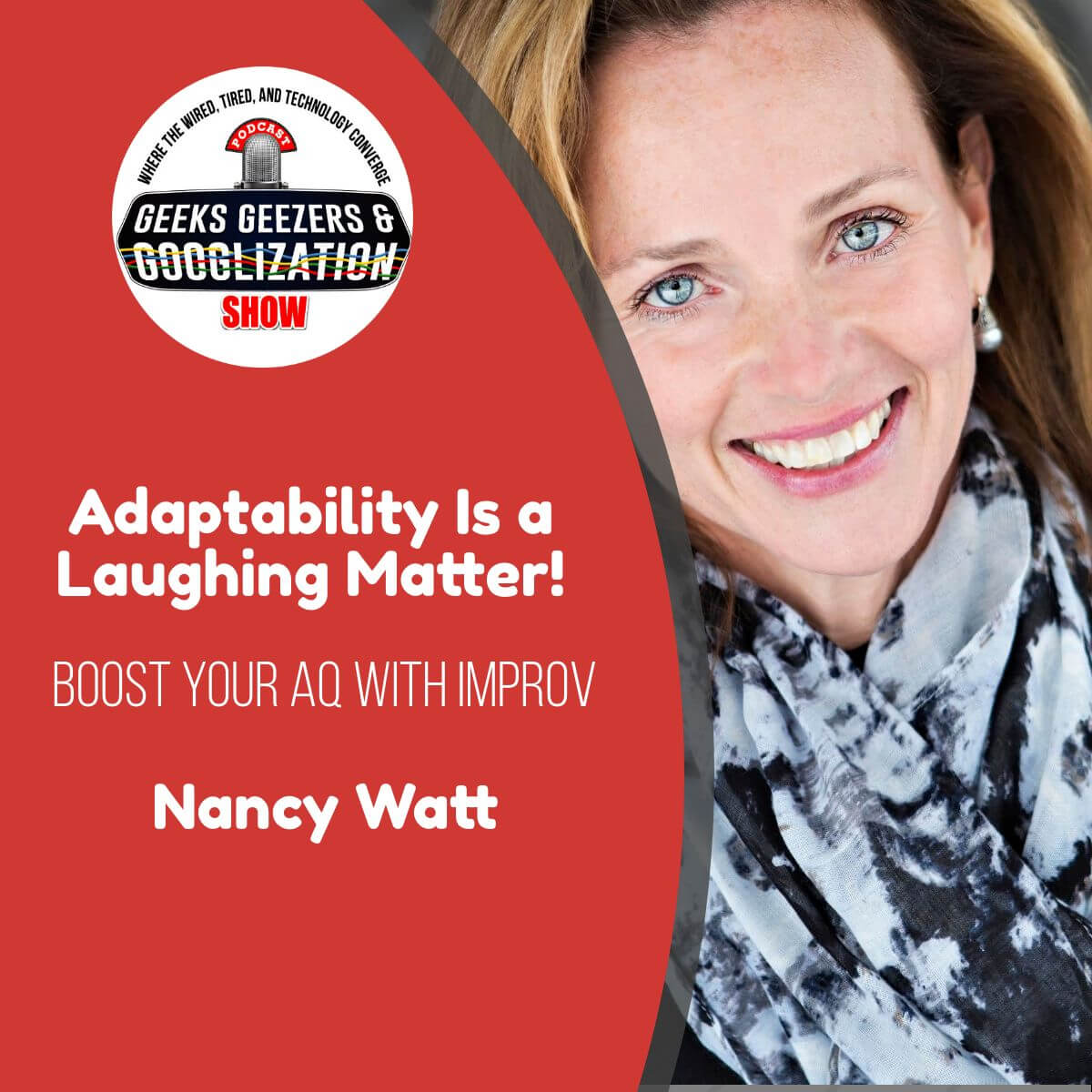
It doesn't matter what country you're in, what industry you're in, what job you're in, what role you're in. Every day is definitely a new day. And as I've talked about, we talked about normal or normal 2.0 talking about the next wave of normal. And so today we've got Nancy Watt, who will be bringing on in just a few minutes.
We'll chat a little bit yet, but we'll bring Nancy on. Nancy through the AQAI network. We based we both were certified in the adaptability quotient of the AQAI in the same cohort. We bonded right away.
We connected and she's got a very interesting approach and what I loved about that. And that's why she's on the show. She talked about how she used how she used that using improv with a group of clergy. She actually used it with a group of nuns.
And they have a community event. I believe this is correct. You'll correct me if not community event once a year or when how often they do it. And they bring together they've had the Catholics, the Jews, the Muslim, all varieties, different types of clergy.
How do they use that to engage a different conversation? How do they get more comfortable with change? One of the things that I talked about was it's not the assessment doesn't solve anything. It just gives us a baseline.
Talking about it doesn't do anything unless we apply it. But ultimately what people are struggling with is to have the courage to take that first step. Because people are afraid of it. I mean, are fearful of the unknown.
The fear of the unknown. And improv can help that. So how can we help people gain the courage? If you have the courage, you'll be more confident.
And if you're more confident, then you're more hopeful. No, I just want to share something quickly with you. I have a very good friend named Althana Ambler. And one of the books that she suggested that I write was a book called Grounded Courage.
And Grounded Courage is having the competence and confidence that gives you the courage to basically climb any mountain to approach any problem. To know that whatever it is, you can handle it. Exactly. And that's what we're talking about.
And whether it's the courage to have confidence or confidence to have courage. It's the matter of doing that. And also importantly to be hopeful. I mean, there's a lot of pessimism.
There's a lot of skepticism. There's a lot of the stopia going on. There's the so big futures. But there's so many opportunities.
And you and I see the opportunity. I know Nancy sees the opportunity. But a lot of our listeners don't. Well, a lot of our listeners don't.
That's true. Although some have a pretty good future. That's what their view is. Before we jump into Nancy's, I do want to be able to give her as much time as we possibly can.
It's going to be a really fun conversation, especially talking about improv, especially second city backgrounds. What's that have to do with the future? Everything. There's a couple things I want to invite everybody again to join Googleization Nation.
It's free. It's our community. Hopefully we're going to be able to build it. Certainly you'll get updates and notices about the podcast, but other events that are coming up actually looking at having an Adaptability Summit with a few people lining up or maybe the beginning of March.
So which they tuned for that. You'll be some of the first to know. I also forget to do this every week. My book, Recruiting in the Age of Googleization.
It was selected as one of the top 50 books to read by thinkers. 360. It's still in the top 50 on the best H.R. Recruiting books of all time.
And you can get it for free by going to besthrbook.com. Besthrbook.com. Real simple. And the only thing you pay is shipping.
You'll get a signed copy of the book. So if you do that, really appreciate it. And Joyce, I know your book is coming out. I'm coming out, but we can't promote my book until I have a place for people to go and pre-order it.
Which will happen. And it's Experience Rules. It's Experience Rules. How Positive Experiences will drive profit into the future.
And I know you and I are very similar, but you and I are working on a project with Employer of Choice. Yes, we are. We're going to revitalize that and I'm very excited about that because this is definitely a year to do that. So no time like the present to bring on Nancy.
As I said, I met Nancy three, four, five months ago. Time flies. I don't know. Right.
Right. I'm really looking forward to having Nancy on because I love improv. My husband and I took an improv course just for fun for something to do together. And we had a blast.
We hated when it was when it had to end. And improv is not only valuable in terms of how it can change your perspective. But it's also a great kind of team building thing if you're looking for something to do with a team or even with a husband. Even with a husband.
Or even with a husband. How great are you? And even the Canadians are excited about the inauguration today, right? We are.
Hail from Toronto. Happy inauguration day to you both and all my American friends. Thank you. We are very excited.
Very happy. Good. I'm glad. So, Nancy, we made the introduction about improv.
Hopefully I didn't screw up your story a whole lot about the nuns. The whole humor. What a fantastic group. I love it.
You recall that. I remember one of our very first conversations about that happens four times a year. And our city's religious leaders, we get the rabbis and the moms and the native elders and the priests and they come together to connect and laugh and communicate in a different way with experiential learning from all of the tools and techniques of improv. And it's so great.
It is so great. I had one of the wonderful things about it is that not just to appreciate the differing perspectives and points of use, but to find the commonalities. Because, let me tell you, almost all the time in these workshops, they end up talking shop and they all have the same issues. They're all leading human beings.
And there's always the same type of, you know, domestic strife or challenges or things like that. And they're really just building community. And that is what we do. And when we build an ensemble, that is what we do.
So it's so much fun. And I'm so glad you referenced it. It's one of my favorite projects. And I think this goes for anything.
Once a conversation starts, a genuine conversation, we always realize we have more similar things in our lives than we have differences. And then this cascade starts of common interests and bonding and the yes and and the me too. Right. It's so much more important for us to see the similarities than it is for us to see the differences.
And so often in the last, especially four years, we in the United States have been focused on the differences. And I am looking forward to four years of focusing on the similarities. And yet, it's interesting. You know, I study, I study humor and comedy and social science for a living.
About four years ago, someone called me a prac-a-demic. And it seems to have stuck because like the wonderful thing that you said in your opening, something like talking about it doesn't change anything. We need the courage to act. You know, the research and evidence-based data and the academia that I study and appreciate is largely synthetic knowledge.
Nothing changes anything until we actually practically apply it. So that's the beauty of applied improv. That's what I do and largely why I do it to give people the experience of that. I love choice, how you also have experienced rules.
It's so true. Right, Nancy? I want to start at the beginning. I want to define improv for us, please.
Ah, wonderful. Improv is, although we know it as an art form, improv is not a thing. It is not a tangible thing. Improv is a way.
It is a way of listening. It is a way of interacting and co-creation and connection. The fundamental rule of improv is something called yes and, yes and, whereby as you and your husband know Joyce, when you are on stage together and the offer of where we are, the environment, you know, if you and your husband are on stage and he creates the reality that, say, he is on a sailboat. You accept that reality.
That is the yes. The end is where you contribute and advance the scene and you say yes and here comes the North Wind. We were warned about that in a way you go in a scene. The important thing that I always like to stress when I talk about yes and is not that we agree with the, I mean, we agree that the reality has been set in this case, a sailboat, but it's not necessarily that we like it.
It is simply acceptance, not necessarily always this yes and, yes and, agreement. It just means that we accept the reality that has been created. And I think that that point is important to bring home because I tell you, the number one reason that miscommunication happens is that we don't accept the reality of the other. And may I say largely why we live in such a politically polarized world that we don't, the conversation doesn't go anywhere.
It stops when we simply don't accept the reality of the other. It is only when we do that, then we can continue to build that forward, build that forward and in the experience that Ira and I have to appreciate what it means to have adaptability, what that looks like in our ability, in our character, in our environment. What you're reminding me of Nancy is something that H.L. Menken used to do.
He had a lot of detractors. He was not a great guy in some ways. He was a misogynist and had some kind of way out views. We would consider him not a politically correct person for our time.
And his response to all of the people who criticized him was to send them a postcard which says, you may be right, H.L.M. And the reason that that came to mind is that in doing that, he was doing exactly what you're saying. He was accepting that it's okay for them to be where they are. He's not saying that he's embracing that point of view.
But it's okay for them to be there. I've never said that more than once. One of my very first business mentors years ago, a wonderful executive and a great line that she gave me was to say, hmm, let me think about that. Instead of always having the need to have an answer, the need to be on, allowing for the space between us to exist and my commitment to think about what you have just said.
And I do allows for more of a deepening of that connection. And it enriches the experience. We often say an improv that listening is a sacrificial act. You know, that improv does not happen unless we are mindfully actively listening.
And you know from your experience, I mean, when you're on stage and you're in the moment and you're building something, you are deeply in that moment. It is indeed a very mindful, playful experience. And listening should be that too. And that we can appreciate that.
That doesn't often happen. You know, so often people listen, waiting for their turn to respond rather than being affected, imagine having having changed as a result of hearing something you just heard. Right. So one of the things that I think you've said at some point is that silence can create connection.
Can you explain that a little bit for us? So in my workshops, I will tell you that silence shows up as another character. Silence allows for that in terms of whether perhaps we are in the negotiating table or we are in a heated discussion or even on an improv stage. Silence builds contemplation and it allows for this space of others to experience a connection that is informed by that silence.
And I know that totally sounds artsy. So let me, let me, I sound like, you know, I'm in an improv workshop. But very often is in its simplest form. What silence does is give us that space, that opportunity to respond versus react.
I tell you the difference is huge. Forming, allowing silence to be a part of our conversation gives us that space and that mindfulness and that ability to form a response to be affected by what we have just heard to listen, listen as that sacrificial act and respond with kindness and intelligence and thoughtfulness. Reaction is much more common. And so embracing the silence and that is straight out of an actor's playbook and you know right out of Second City, allowing silence to be a part of the conversation is really, really effective.
It works for professional speakers too. I can tell you. Absolutely. And I know what you were talking about, silence and speaking and hearing and listening.
Both of you I think are familiar with the DISC assessment. And oftentimes we use that as a tool to help start that conversation to understand one another. And the high eye for those who aren't familiar with it. I know many are high eye is energized by influencing other people and a low is the energized by that.
So typically the eyes are will be doing the talking and the low eyes will not. What's significant about that is when I see somebody that has a hundred percent eye on the scale is that that they need to become better listeners but becoming a better listener does not mean just stop talking and waiting for that opportunity to jump in. So you're sitting there counting the seconds, counting the minutes. Now I can do it.
It's really is really is what you know it took a while to understand that active listening listening is a skill listening is just not talking is just not somebody else coming in you hear the words but you're not absorbing them. I also love what you said Nancy and going back to what you and I have been talking about that continuum of adaptability. You know starting with flex again people throw in a lot of buzzwords. Last year the buzzword of the year was resilience.
Everybody needs to become more resilient and the year before that was or a few years before that was grit. The things we measured with the AQI so we have very incense mindset mental flexibility and learning but people can fight is what I was looking for. Yes flexibility, agility, resilience, grit, adaptability all went in the same and what I was trying to do is differentiate it to make sense. What you just said something about react the difference between reacting and responding which is really embracing it.
So in the continuum the research is the research is saying is that flexibility and agility are reactions to a situation. So flexibility is the ability to react to a catalyst to a change like changing going down the river flowing down the river. Similar to agility some talk about flexibility being an individual trade and agility is being more of an organization or team trade. But whichever is a everybody agrees that it's a reaction to a recent to an event where when we talk about resilience it's the ability to bounce back after that event but you haven't grown further.
You haven't really grown at all and endurance is just being able to plow through that. It's having that tanker that hummer that machine the terminator crash through a brick wall and come out the other side unscathed but no different. They just survived. But when we're talking about adaptability it's really is the ability to grow stronger to become better.
It's all of those it's to be able to endure to bounce back to be able to be flexible and agile. But when the words that you said and we were talking about this earlier is that as people were talking and picking up helping because we're figuring this out on the fly we're literally doing improv. How do we help people is the difference between just reacting to an event or embracing the event. And if you just want to continue to react it's exhausting to to to to to to style change the volatile uncertain complex and an accelerating pace of change.
It's exhausting to constantly be zigging and zagging without a strategy without the skills to do that. We're talking about and how improv can help you build that courage and confidence in order to be able to adapt into zig and zag with ease. It's just constantly dancing with change. That was that was aligned for my TED talk.
You know I grew up dancing with change is how do we do that. And so for somebody to you know other than signing up for a class in bras what can what can an individual or what can an organization start right now. What's an exercise that they can do to say I get it. This sounds good.
How where do we get started. Right. Indeed. There was so much of what you said that I appreciate the the tenacity of grit the elasticity of resilience to be able to bounce back and to have an agility within an organization and the emotional fortitude and ability to be to have that difference between the response and a reaction.
So we're in complicated challenging exciting times. You know I also want to give a shout out for at the beginning of this conversation you talked about optimism. You talked about hope and it intrigues me that the research shows that hopeful people are more realistic which is somewhat a little bit counterintuitive you know hopeful people give that sort of Pollyanna the son will come out tomorrow type of thing and yet a great researcher. Shane Lopez does something called hope mapping and he there is more realism in people who are hopeful and they are consequently able to see where the speed bumps are ahead.
See where the problems are ahead and be able to navigate those better hope hope is what can an organization do. I I would encourage them to look into the work of positive psychology because they are kissing cousins to apply improv and indeed the program that I run. It's called happy happy spelt with an IE it is an acronym for how to apply positive psychology improv exercises. And so the work of Marty Seligman the past president of the APA the American Psychological Association and his work in learned optimism Robert Fredericton and Adam Grant and I've Jonathan Hight and Angela Dweck and I beg your pardon Angela Duckworth Carol Dweck all of these very interesting researchers who are looking at this emerging field of psychology are revealing that as opposed to traditional psychology which took sort of a what is wrong approach you know what is what is dysfunctional what is abnormal and that's all well and good because the history of that field should look at this positive psychology looks at what is working what humans and organizations do to thrive and that and often erroneously thought of as some sort of happy ology what the field of positive psychology looks at is how people indeed people and organizations thrive and more pointedly how we can learn to suffer well you know you talked about the necessity of discomfort and being able to you know adapt to change and all pedagogy the science of how we learn reveals that when we play and when we laugh and we are experiencing and especially co creating with another we learn better we retain things for longer indeed it's not just information in it is part of us it is that experience.
So to extrapolate the field of positive psychology and to summarize it in the yes and approach is to offer just one little I see what 126. So do we have time do we have time I wrote to ask her the question that I would love to hear. I would like to show. Tell us about the most challenging client situation you ever faced.
Wow. For different reasons. So a quick recipe for burnout in the world of HR as you both know is being in a being in a position where you are on the front lines and hold the responsibility hold the weight of the responsibility to complete the task at hand you know have in your forefront perfect execution and at the same time have no decision making power to change the system. So our very difficult our teachers our our emergency room nurses you know people who are on the front line and it is and in organizations and I've worked with universities and hospitals and government organizations for a lot of those employees.
They need to be heard and I speak to this example because it took a long time for me to get up the runs of the latter to talk to the right people to do the necessary change in the organization so that those people could be heard. And once they were then that moved the behavioral dial you know there's a whole world in diversity and inclusion as well that I think adaptability quotient is going to be extremely valuable in and I look forward to I look forward to some important social experiments that I've collaborated that that I've begun to collaborate with to be able to make significant change in that world as well. I'm looking forward to learning more about adaptability and the AQ. Oh good it's fascinating.
It's fascinating you know if it be true. Something pop up. I got a question for you Nancy we're almost at the other segment. We've just we've ended 2020 and you know everybody's glad to put it behind us.
However there are things that happen during the course of the year that are that we hope don't go away. We hope to continue that we learned either about ourselves or about a situation. What's something that you hope that we can take away from 2020 that that can continue something new that continues. What a great question I see this is why I hit it off with you.
And I'm going to have to share something and I'm going to have to share something a little personal. I'm going to talk to you about that. You know courage never feels courageous. When I need to do something courageous it's always an experience in vulnerability.
And I do not like feeling vulnerable. You know I am much more comfortable speaking behind the world of academia statistics blah blah blah and being able to facilitate a workshop. But if I am to be true to my work if I am to chase the good I do two things I chase what is good and what is true. I was in the spring of 2020 losing 95% of my revenue.
I was supposed to be in four different countries had speaking engagements all over the world and you could hear the breaks screeching to a halt. So I had to retreat, revamp, renew, reinvent and feel the vulnerability through that. I came out not unscathed but stronger. So if you ask me what I want to continue in 2021 it is just that I want to keep doing things not because they are not in spite of the fact that they are uncomfortable but because of the fact that they are uncomfortable.
And I think that is the message that shows like this and you know the professionals like yourselves we need to continue that message for our students and our children and our grandchildren that Joyce will soon hug after she gets her second vaccine and our organizations I mean get comfortable being uncomfortable because that is you know the North winds are coming and we will experience more change. And there is a way to do so with that we can adapt with optimism. And I think that is you know that's what we're being called to do. Nancy how can people reach out to you we have your website going across the bottom before we'll put it back up there.
Thank you. How else can they get a hold of you how can they reach you? Yeah the website is the best way shoot me an email I am Nancy at NancyWalk.com. My name is Nancy Wott.
My company is Nancy Wott Communications and I am privileged to do the work that I do. I look forward to hearing from some of your listeners if anyone has any questions about Applied Improv. I promise you I get back to you and I am very grateful for the opportunity to share with you today Joyce and I. I have just one last final question.
Were you able to move your previously in-person improv training online? Thank God. Yes. Oh my goodness.
So I did so with a couple different things. I built an in-house home studio with the help of a startup company called Lightboard Depot.com. This was a game changer. I needed to build myself a bit of stage and I love it.
And so thank goodness so many improv exercises translate really well online. Thank you for that. And the Lightboard is fascinating. I know we talked about maybe using it today and it wasn't the kind of right format.
But I saw it on another presentation you did. Yeah. It's fascinating. Lightboard Depot.
Again another thing probably prior to this said how can you possibly do improv digitally? How can you do it? And there it is. Exactly.
I have a paper published in the Journal of Psychology, Neuroscience and Behavior, lowering social anxiety disorder for youth using a 12-week improv bootcamp. Wow. I know. I am delighted that that worked.
I can't even. I'm sorry that I didn't mention it earlier, but it's a great project. But we have continued with those youth online and they named their Ensemble Connection Deficit Disorder. Not a combination of connection deficit disorder.
And so if you are Ira, if you want to join us on 4 p.m. on a Friday, we have psychologists and actors and improvisers join us from all over the world. And what a beautiful thing to be able to do online. If any of you are listeners have an interest in that in youth education and social anxiety, I'd be delighted to continue that conversation as well.
Thank you. Glad we continued that conversation. Nancy, it's always a pleasure. So Janice.
I know we'll be chatting quite a bit. Yeah. I look forward to collaborating and building the AQ community. And being part of helping 100 people, a million people not be left behind.
Absolutely. You know your president said this morning, maybe show the world not by the example of our power, but by the power of our example. A fine statement on this important day. Happy inauguration day to you both.
Thank you for allowing me to go on your show. Thanks so much. Really appreciate it. Nancy what calm calm.
Joyce. Yes. We could go on. I always are with Nancy are always quick and robust and and and you know invigorating.
So hopefully we left that feeling with a lot of people. And always over before we're ready for them to be over. That's a good thing. It leaves us wanting at least hopefully at least everybody else.
You need to have a quick quick. Come back a quick shorter segment. We borrowed some of your time for ahead of the curve. You're listening to Geekscissors and Googleization.
Thank you for being part of Googleization Nation. If you haven't subscribed to it, go to Googleization Nation.com. Oh, I forgot one of the most important things. We now have a Geekscissors Googleization LinkedIn page.
So if you go to LinkedIn, just type in Geekscissors Googleization. And you'll also get updates on there as well. We're going to take a short break. We're going to hear from our sponsor success performance solution.
And another real quick announcement. We have a new sponsor coming on board in a couple of weeks in Go. Very excited. Yeah.
We'll be talking about that. But today we'll hear from success performance solutions and we'll be back with the head of the curve. Hiring top talent shouldn't be left up to the roll of the dice. And yet that's exactly what many organizations do.
They roll the dice across their fingers and pray for a better outcome. Hiring the right employees the first time is much too important and way too costly to leave to a game of chance. Your employees and your customers deserve better. For 25 years, success performance solution has been helped small and medium sized businesses hire smarter.
They offer pre-employment and leadership assessments for typing and data entry to C-suite competence. Whether it's production, sales, healthcare, call centers, or management, success performance solutions can help. Visit their website at www.successperformanceolutions.com to schedule a free demo or call 800-803-4303. A lot of you might be feeling like you're standing in deep shift.
But do you know what grows and rises out of deep shift? Opportunity. To successfully navigate the shift to the new normal. Each of us must learn to rapidly adapt to the speed of change.
Some of us are hardwired for this. Others. Not so much. That's where success performance solutions can help.
Success performance solutions is now your A-Q headquarters. Whether you are personally struggling with the next chapter in your career or wondering how ready your team is for fastness, or up to change, our A-Q assessment and coaching will provide you a detailed scientific and backed roadmap to guide you into the new normal. Optimize your adaptability today. Contact success performance solutions about evaluating your team's change readiness or joining our upcoming A-Q Masterclass.
Visit successperformanceolutions.com or call us at 800-803-4303. Hey, welcome back everyone to Kix Keesis Googleization. We're here for our segment, ahead of the curve with my co-host Joyce Joya, who this the origin of this is. I've been a reader and a follower of the Herman Trend Alert for 20 years, I think, a long time.
And then just a few months ago, Joyce and I had started to talk, wanted to feature part of that. She was talking a lot of trends about the normal, what was going to happen normal 2.0. We started to do this as a just a few minutes segment and we're still continuing this segment, but expanded that into a co-host role as well. So Joyce, what's on your mind?
And by the way, I'm thrilled about it. Thank you so much, Byron. So the topic that I wanted to discuss today is a trend alert that I wrote a couple of weeks ago called Access is the new currency. Let me explain.
I was sitting in the office of the general manager of the hotel where I was staying in Mazatlan, Mexico. And we were talking about the fact that most of the hotels that are on the Kamara Sabbalah, I believe is how you say it, the particular street that he's on, have this problem in that people who live in Mexico think about Mazatlan as a weekend-only destination. And I said, well, we just need to create some midweek events. And so he said, well, we need to get you in to talk to the hotel association.
And I said, great. And let's keep talking about this. And I realized that there was a connection that I was seeing. You know, what I do as a futurist, I think, is to connect the dots.
I see something going on here, something going on here, something going on there. And I put it together and say, okay, the world's going in this direction. Well, what I realized is for the people who would be coming, access to celebrities might be a real draw. It might be enough to get them to come to those hotels and to the city during the week, right?
Spend that extra money for that access to celebrities. And that helped me. From there, I began thinking about a trend alert that I had written in the past that was about something that Jim Brickman was doing. Jim Brickman is a pianist whose work I really like.
And Jim Brickman at one time was selling experiences back stage experiences with him for $300. You could do a backstage tour and have a special, be there at a special reception with him and have extra access, right? You could also buy a spot on his radio show for $300. I mean, different things, different kinds of experiences that he was selling, but basically what they really were was access.
And so that helped me to start thinking, well, if consumers value access, then I'll bet that all stakeholders would value access. And so I began thinking about how each of the different stakeholder groups would perceive access in a different way. For instance, when I was doing some work with the state of Colorado, we were, this was years ago, and it was one of the agencies, and they wanted to reward their people for very good work, but we had no money. And so I got them together and I said, okay, so besides money, what would you value?
And one of the answers came back as breakfast or lunch with the head of the agency or the number two. And connecting the dots, I realized it was access that they were finding to be valuable. They were placing a high value on that access. Think about sponsors or, as we call them, now corporate partners in corporate events.
What are they looking for? They're looking for access to their economic buyers. So going back to my question that I had from Nancy at the end of the first segment, which was what was something from 2020 that you wanted to keep from 2021. And as you're talking about access, what I found, what I got was access to people in 2020 that I probably would have never had before because they were speaking.
They were busy. I might not have ever had that opportunity to meet with Nancy because if Nancy wasn't, she didn't have to reimagine her business. She wasn't on stage all the time. She wasn't doing training all the time.
She may not have gotten involved with the AQAI. If she wasn't involved with the AQAI, then she wouldn't have been in my certification cohort. And then that leads to something else. But I had the opportunity to reach so many people.
I think that's what's relevant about what you're saying. And maybe people thinking, what's this have to do with me? I'd have to pay someone and have access to them. Is no, you don't.
You have free access to people now because people aren't commuting. They're not traveling. They're not on stage. They're not in meetings.
They're in meetings all the time. But there's a little bit more flexibility. It's different, right? Access to people that we didn't have access.
They don't have to spend hours getting on airplanes or even getting in a car to commute from one place to another. And let me give you another great example following on exactly what you're talking about. And that is that the Institute of Management Consultants was able to get the Malcolm Gladwell as a keynote speaker for their conference, whom they never could have afforded pre-COVID. And he was amazing.
He was phenomenal. And it was because they were able to get that access due to COVID. Anyway, so I'd really love because we're moving toward the end of the show to talk a little bit about what I'm going to be doing on Friday morning. Because on Friday morning, I'm going to be working with our new sponsor.
Our new sponsor is Ingomo. And Ingomo is a learning platform. And on Friday morning, I'm going to be interviewed by them in the opening segment. It's called, to get there, it's bemoredays.com.
And if you would please put that into the chat so that Rebel can put it up for our audience, that would be great. Bemoredays.com. And that's where you can go and register. It's free.
And I'm going to be talking about the future of health and wellness. The entire half-day event is about health and wellness and different aspects. It's a learning community. You'll get to hear the coaches and find out a little bit about what they do.
It's a great opportunity to become acquainted with our new sponsor Ingomo. And that's spelled I-N-G-O-M-U. And I think we have it. I'm not sure if it's scrolling.
Well, there's be more days. Bemoredays. That's the place to go to Red and Day. Okay.
And then if you want to learn about Ingomo, then that also should be scrolling across as well. We've had a great January so far. We've had Jeff Wald. Yes.
They kick it off. Talking about future work. We've had Derek Lenson last week to talk certainly about health and well-being. And today, I mean, with Nancy, I feel tremendous about AQ using improv out of how to develop, build your courage, your confidence, and still hope for future because we certainly need it.
The world is not slowing down by any means. Next week we're going to have Jason Cochran. Jason, we've got a company, I Aspire again, talking about how we can, how people, how we humans can adapt, be more comfortable, how we can help other people do that. And we've got a great lineup.
We just scheduled a few more people even into March. So we'll have a great show. We really do appreciate everybody being who listens on a regular basis. Please share.
Don't forget, if this is your first time listener, where you haven't done it yet, please subscribe on Apple, Audible, Google Play, Stitcher, you name it. We're on them all. Or just subscribe on YouTube channel. Please subscribe.
Leave your comments. Let us know what you're thinking about, what you're doing. We want to grow the community and we really do want to help everybody succeed to be able to grow forward. There is a tremendous amount of opportunity that is coming up that we all share in.
But again, people are a little bit tentative. They're waiting for things to settle down and you have a long wait. For sure. I want to make one more suggestion.
And that is that if there are any topics that you'd like us to cover on the head of the curve, please don't hesitate to let us know. And the same. If there's somebody you want to hear from, if there's a topic you have to share for Geeks, Geeks, Googleization, please let us know. We're happy to entertain that as well.
Reminder, go to bestbook.com. You can get your recruiting in the age of Googleization copy. Second edition, get a signed copy. Just make for the shipping.
And you'll have that. Don't forget to go to Googleization Nation.com and subscribe. Or just go and follow Geeks, Geeks, Googleization, which is now on LinkedIn. Go to our page there.
Thank you to Success Performance Solutions. Thank you for your choice. I'm going to bring part of the show. Thank you to you.
We're going to bring it in Gomo on to the show as a new sponsor beginning in February. And thank you all the listeners. I appreciate you being here. Please spread the word.
And until next week, when the shift hits your plan, we'll see you then. Take care. Thank you.