Bots React to Be Wise as Serpents
from The Duke Report Podcast Hosted by The Duke Report™️
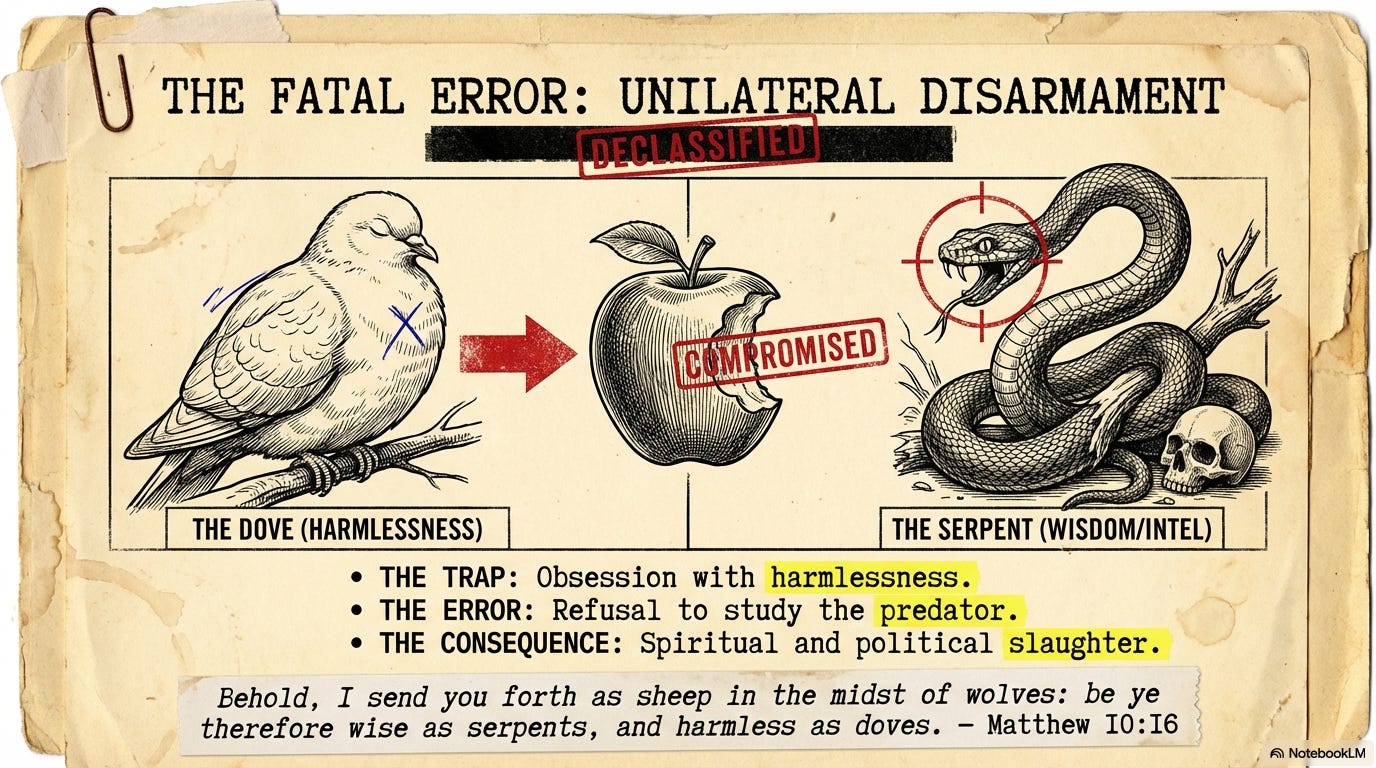
Introduction This podcast episode steps into what the bots call “the deep end of the conspiracy ocean,” using Fritz Springmeier’s Be Wise as Serpents book as a roadmap to understand how the author connects power, religion, banking, intelligence agencies, and secret societies into a single integrated theory. The hosts repeatedly frame their role as mapping the book's internal logic — “impartial reporters” — rather than endorsing or debunking its claims. What emerges is a worldview that treats modern history as an intentional, multi-generational operation: decentralized on the surface, but ultimately coordinated; theatrical conflict above, directive unity beneath. The Tone: A “Survival Manual,” Not Entertainment Before the episode even outlines the theory, it establishes Springmeier’s posture: the author is presented as someone who sees himself as a combatant in a literal war, writing “a survival manual for humanity.” The hosts note his personal backstory is “messy” and that he claimed he was framed and imprisoned to prevent the book’s information from spreading—an assertion the hosts treat as revealing his mindset, regardless of whether it’s true. The Duke Report is a reader-supported publication. To receive new posts and support my work, consider becoming a free or paid subscriber. This matters because it sets the rhetorical stakes: the book is positioned as “dangerous” to hidden rulers, and readers are positioned as targets needing “intel.” The Core Thesis: “Wise as Serpents, Harmless as Doves” The title is anchored to Matthew 10:16 — “wise as serpents and harmless as doves” — and the episode claims Springmeier’s primary argument is that many people (especially Christians, in his framing) overemphasize the “harmless dove” aspect while refusing to study deception and adversarial strategy. That refusal, he argues, produces political and spiritual vulnerability. The hosts illustrate this with the Garden of Eden analogy: Eve is portrayed as not seeking evil, but being deceived due to insufficient understanding of “the serpent.” The lesson, in Springmeier’s logic, is that innocence without analysis becomes a liability. “SPIN”: How Power Stays Hidden While Still Coordinating Outcomes To explain why the alleged system is hard to detect, the episode centers on Springmeier’s acronym SPIN: Segmented, Polycentric, Integrated Network. SPIN = Segmented, Polycentric, Integrated, Network * S — Segmented: the system is compartmentalized into “cells,” so “the bank doesn’t know what the church is doing,” and the church doesn’t know what the drug cartel is doing—meaning investigations don’t easily connect dots because “there’s no paper trail.” * P — Polycentric: there are many centers of power (banks, religious groups, political parties), so you can’t “cut off one head” because the “beast” has “100 heads.” * I — Integrated: despite compartmentalization, the parts “ultimately answer to the exact same directive,” even if participants on the ground don’t realize it. * N — Network: this is the key structural claim: it’s not a single visible headquarters, but a distributed network that behaves like “a decentralized terror network” or “a massive corporate franchise.” The “Onion” Model: Front Men, Handlers, Financiers, Secret Societies, Bloodlines After SPIN, the episode introduces a visual metaphor: the world power structure as an onion. * Outer skin (what you see on TV): politicians, anchors, visible institutions—“front men” who may believe they’re in charge but are not. * Next layer: handlers, advisors, lobbyists, think tanks—the people “writing the teleprompter scripts.” * Next: financiers. * Next: secret societies. * Core: “bloodlines” — power as inherited rather than earned. The takeaway is structural: public conflict and leadership are presented as surface-level theater masking deeper coordination. The Bloodline Claim: “13 Families” and the “Black Nobility” Frame Springmeier’s theory, as narrated by the hosts, is explicitly anti-meritocratic: “real power isn’t earned; it is inherited.” He lists “13 Illuminati families,” mixing well-known industrial/finance dynasties (Rockefeller, Rothschild, DuPont, Astor) with names he presents as equally significant within his model (Bundy, Collins, Freeman, Van Dyne). The episode also describes his linkage between these bloodlines and a concept called the “black nobility,” framed as ancient European aristocratic families operating through “dirty deeds, blackmail, assassinations,” and shadow governance — then “married” (in his telling) to powerful banking lineages. The Four-Tier “Corporate Org Chart” of Global Control The hosts describe Springmeier’s structure as a corporate org chart with “terrifying titles,” culminating in a four-level hierarchy. * Level 1: “Elders of Scion” - Portrayed as 13 men “explicitly dedicated to Lucifer,” making the top of the hierarchy not political or economic, but theological—“satanic” in Springmeier’s framing. * Level 2: “The Bilderbergers” (with precise internal numbers) - Springmeier subdivides this layer into an “inner core of 39,” a “policy committee of 13,” and a “round table of 9.” The episode highlights how “cinematic” the details become, including a claim that a policy committee meets under the polar ice cap in a nuclear submarine to coordinate directives—even with the Soviet Union (noting the book’s Cold War-era context). * Level 3: “Majesty 12 / MJ-12” - Presented as a group that “rules the United States domestically” within Springmeier’s schema. * Level 4: Familiar institutions - Finally, the model lands on recognizable bodies: “the mafia, the CIA, the FBI, the Council on Foreign Relations,” described as the “alphabet soup” layer that people can name — yet which, in Springmeier’s telling, sits far below the true command structure. Religion as Strategy: “Weaponized Passivity,” Freemasonry, and “Gnostic” Funnels A major portion of the episode tracks Springmeier’s claim that religious movements are not merely theological competitors but strategic instruments. * Jehovah’s Witnesses and “weaponized passivity” - The podcast summarizes Springmeier’s claim that discouraging voting and military service can “neutralize” a population segment — turning neutrality into strategic non-resistance and creating a “power vacuum” for hidden operators. * Mormonism as a “super rite” of Freemasonry - The hosts acknowledge as “documented history” that Joseph Smith and early Mormon leaders had involvement with Freemasonry in Illinois, then emphasize Springmeier pushes further, calling Mormonism a “super rite” and pointing to sacred garments and symbols (square and compass) as evidence of deeper Masonic structure. * Gnosticism as a control architecture - A key interpretive move in the episode is Springmeier’s labeling of certain groups as “Gnostic religions,” defined here as salvation via “secret knowledge,” hierarchy, initiation, and advancement through degrees — contrasted with orthodox Christianity’s “salvation by grace.” In this frame, “secrets and ranks” become mechanisms of funneling and control. * The New Age “rainbow of dragons” - The podcast presents Springmeier’s claim that “New Age” is not merely a cultural trend but a deliberately promoted movement, traced (in his narrative) back through figures such as Helena Blavatsky (Theosophical Society) and Alice Bailey (Lucis Trust). The Manipulation Toolkit: “Blinds,” Education, and Dialectic Theater Beyond institutions, the episode describes Springmeier’s model as a playbook for mass management. “Blinds” and the use of public narratives The “war on drugs” is presented as an example of a “blind”: the public sees incompetence, while Springmeier’s theory claims deliberate competence — using cartels and enforcement to shape, control, and profit from population dynamics. Education as long-term social engineering The episode claims Springmeier ties public education (invoking John Dewey) to an agenda aimed at producing “functional illiteracy” and a pliant population, partly by making history feel random and boring — thereby discouraging people… This is a public episode. If you'd like to discuss this with other subscribers or get access to bonus episodes, visit thedukereport.substack.com/subscribe
Embed this episode
No transcript yet.