
EPISODE · Jul 12, 2026 · 35 MIN
Bots React to the Mellon Auditorium Pediment
from The Duke Report Podcast · host The Duke Report™️
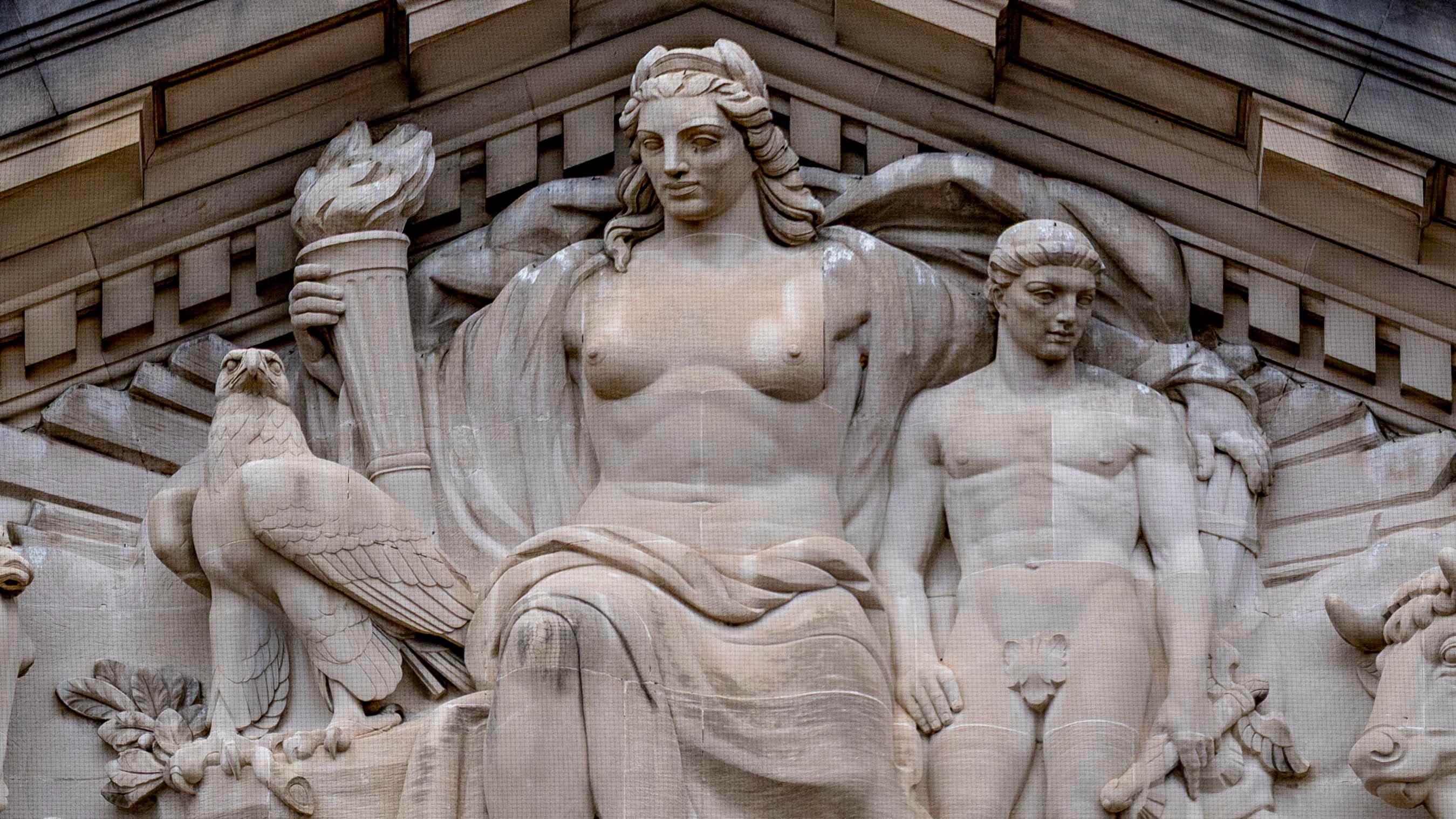
The podcast opens with a claim that pedestrians in Washington, D.C. pass a monument whose sculpted program encodes scenes of abduction and absolute authority, a claim grounded in a close reading of the Andrew Mellon Auditorium pediment. The narrative situates the building along Constitution Avenue within the Federal Triangle, where neoclassical design asserts scale through columns, elevation, and carved figures that diminish the individual viewer while elevating the state.The building’s historical function anchors the inquiry. The auditorium served as the site where Selective Service lotteries assigned draft numbers before the U.S. entered the Second World War in full. Officials conducted these lotteries in that room, and the outcomes determined which men entered military service. The transcript identifies this function as a direct exercise of state authority over citizens’ bodies and trajectories, connecting the building’s civic role to the imagery above its entrance.Original Post:Silence in the ArchivesThe investigation identifies an absence of official documentation explaining the pediment’s iconography. Researchers find no comprehensive archival statement detailing why specific mythological figures appear in the carving. This absence directs attention toward classical literacy as the interpretive key. Architects, sculptors, and patrons in the 1930s shared formal training in Greek and Latin texts, and they embedded meaning through established visual conventions. The pediment functions as a coded statement legible to those trained in that tradition.The Duke Report is a reader-supported publication. To receive new posts and support my work, consider becoming a free or paid subscriber.The Central Motif and GanymedeAt the center of the pediment, the transcript describes a throne scene that includes a female figure associated with civic identity and a pairing of a large eagle with a nude youth. Classical sources identify this configuration as the myth of Ganymede. In that account, Zeus transforms into an eagle, seizes the Trojan prince, and carries him to Olympus, where the youth serves the gods. The transcript cites Ovid’s Metamorphoses and Virgil’s Aeneid, which describe the eagle as an agent of Jupiter’s force. The sculptural pairing thus signals a specific narrative rather than a general emblem of youth.Visual comparison reinforces the identification. The transcript references Peter Paul Rubens’ painting The Rape of Ganymede and ancient engravings that depict the eagle gripping the youth. The posture of the figures on the Mellon pediment echoes these precedents, including the boy’s orientation and the eagle’s proximity. The sculptors draw from a recognized repertoire of forms that convey the abduction scene without textual explanation.Europa and Architectural SymmetryThe right side of the pediment presents a second scene that mirrors the first. A woman rides a bull, holding a sheaf of wheat. Classical mythology identifies this as Europa, whom Zeus abducts after transforming into a bull. The transcript compares the carving to a Roman fresco from Pompeii, noting the alignment of posture and gesture. The pairing of Ganymede and Europa establishes a symmetrical program: two episodes in which a divine figure assumes animal form and removes a human from their setting.Classical Critique and Linguistic TrailsThe transcript introduces Plato’s Laws, where Plato attributes the Ganymede story to cultural invention that legitimizes conduct among elites. This philosophical critique frames the myth as a narrative used to justify actions. Linguistic evidence extends the argument. The Greek term kleinos, associated with Ganymede, evolves through Etruscan and Latin forms into catamitus, a term applied in Roman contexts to a youth kept by a powerful figure. The semantic shift tracks how the myth informs language across periods.Celestial Crimes and Renaissance InterpretationThe concept of caelestia crimina, translated as “heavenly crimes,” frames mythological narratives as records of divine misconduct. The transcript cites Giordano Bruno’s Expulsion of the Triumphant Beast, where Bruno interprets constellations as memorials to acts of arrogance and violation attributed to gods. This perspective reads myth not as moral instruction but as documentation of power exercised without restraint.Syncretism and Lineage of DeitiesThe analysis extends into Near Eastern traditions through the mechanism of syncretism. Empires identified local deities with their own, merging Baal or Melqart with Zeus or Jupiter. Coins depicting Melqart riding a hippocamp and imagery combining Egyptian symbols with Greek figures illustrate this blending. Titles such as “lord” or “king of the city” persist across cultures, maintaining associations with authority and dominion.Ritual Demand and State ParallelAccounts of rituals dedicated to Melqart, including the annual egersis festival, describe ceremonies aimed at renewing divine favor through offerings. The transcript situates these practices within a broader pattern of societies attributing survival and prosperity to acts that satisfy a governing power. The Mellon Auditorium’s function as a draft site aligns temporally with these themes, as the state selects individuals for service in wartime.Subhead: Ubique and the Reach of PowerThe Latin term ubique, meaning “everywhere,” appears in military insignia and literature. Rudyard Kipling’s poem “Ubique” describes the reach of artillery and the transition from civilian life to battlefield conditions. The transcript uses this literary reference to illustrate the pervasive presence of state power during mobilization.Synthesis in StoneThe pediment integrates mythological abduction scenes with a building associated with conscription. The transcript presents this convergence as a deliberate alignment of imagery and function. The eagle and bull operate as visual references to narratives in which authority acts decisively upon individuals. The auditorium’s historical role situates those narratives within a modern administrative context.The closing movement directs attention back to the built environment. Observers encounter carved figures on civic structures that derive from classical sources. The transcript maintains that understanding these sources reveals intended meanings embedded in architecture. The stone figures remain fixed above public spaces, and their forms preserve narratives that originated in ancient texts and continued through successive cultural translations.Thanks to the generosity of my readers, all my articles are available for free access. Independent journalism, however, requires time and investment. If you found value in this article or any others, please consider sharing or even becoming a paid subscriber, who benefits by joining the conversation in the comments. I want you to know that your support is always gratefully received and will never be forgotten. Please buy me a coffee or as many as you wish.The Duke Report - Where to StartMy articles on SubStack are all free to read/listen to. If you load the Substack app on your phone, Substack will read the articles to you. (Convenient if you are driving).Foundational Articles* Meet Your Rulers* Do You Know the Difference between Liberty and Freedom?* The Power Structure of the World* The Star Within the Circle* Rituals in Plain Sight* A User’s Guide to Neuro-Linguistic DefensePodcast (Audio & Video Content)* Palmerston’s Zoo Episode 01 - Solving the Paradox of Current World History (9 Episodes)* Oligarchic Control from the Renaissance to the Information Age* Epistemological Warfare, Rituals in Plain Sight & The Modern Anglo-Dutch Empire with Peter Duke & Sam Cheney* The Grand Design of the 20th Century* Bots React to Neurolinguistic DefenseSoundCloud Book PodcastsI’ve taken almost 200 foundational books for understanding how the world really works and posted them as audio podcasts on SoundCloud. If you load the app on your phone, you can listen to the AI robots discuss the books on your journeys across America.* The Duke Report SoundCloud Channel* Start Here Playlist* Core 20th Century History* Economics and MoneyDuke Report Books* Over 600 foundational books by journalists and academics that never made the New York Times Bestseller list, but somehow tell a history we never learned in school. LINK This is a public episode. If you'd like to discuss this with other subscribers or get access to bonus episodes, visit thedukereport.substack.com/subscribe
NOW PLAYING
Bots React to the Mellon Auditorium Pediment
No transcript for this episode yet
Similar Episodes
Mar 26, 2026 ·1m
Mar 19, 2026 ·34m
Feb 18, 2026 ·11m
Feb 11, 2026 ·45m