
Oh, wait, you're listening to Radiolab. From WNYC. Hey, I'm Chad Abumran. I'm Robert Krolich.
This is Radiolab. And today... All right, we are on the corner of 3rd and 42nd, heading east. We're talking about...
What are we talking about? We're talking about your... We're talking about... Your ex-pat rebellion.
Yes. Okay, I like it. And as you just heard, it comes from our producer, Simon Adler. And a quick warning, if you've got kids listening, there are a few curse words in the story, so just be warned.
Okay, here's Simon. Right, so... All right, another police checkpoint here. A month or so back...
Have your bags open! Have your bags open! I went down to the United Nations looking for this group of activists. Okay.
I was walking down 2nd Ave, and that morning, the UN General Assembly was in session, so security was super tight, lots of guys with guns, and they had cordoned off everything within about a block of the UN building itself. See what's in my bag? After getting searched, I ended up on 47th Street, which is a block that security had designated as a protest corridor. So on this one block, security had divided the street into a dozen or so quadrants, each quadrant occupied by a different protest group yelling at the UN.
And so I was suddenly thrust into this frothing technicolor mask... Let's move! Hello, hello! Let's go!
Okay, and this used to be protest alley. ...of people shouting, waving flags, and shaking placards. I mean, you could pick any cause, any issue on the planet that you would like to protest. Show up, and there will be at least seven other people protesting it along with you.
Really? So who, wait, who was out there? Oh, you name it. My issue was Palestine-Israel.
Folks were pro-Palestine. We were protesting against the Buhari government. Anti-Nigerian government, climate change activists. Most groups had their own little 10-foot-by-30-foot area marked by police barricades, and so every few steps, you'd encounter a different cause.
I mean, on 47th Street, on the far left side of it, you had these Egyptian-Americans just going wild. I'm from Egypt. I'm for the President Sisi. Chanting in support of President Sisi.
Well, just 60 feet away on the other side of the street, there's an anti-Sisi Egyptian protest going on. And then smack dab in the middle of all of this chaos are the Fulon-Kong protesters, probably a hundred of them, decked from head to toe in bright yellow, standing like statues, perfectly still and silent. This is a buffet of discontentedness. All of the protesters were facing the UN, yelling in that direction, trying to get the attention of the media, or presumably of the diplomats walking in.
But this one group, the group I was there to see, in fact, they had their backs turned to the UN. They were taking a totally different approach, because their audience was actually halfway around the world. Ah, and here's a friend. Joel.
Good to see you, man. Hi, how are you? They're from Gabon, the small little country on the west coast of Africa, and the reason these Japanese folks had gathered around the UN was to protest against their long-time quote-unquote president, dictator Ali Bongo. Like B-O-N-G-O?
Bongo, like the drum. Anyway, they were this sort of eclectic group. One of them, Joel, was wearing a Japanese flight as a cape. The best-dressed activist in the whole lot.
Another, Yurik, was in a suit. You guys expecting more people to show up? Well, obviously so. And there were only like seven of them there.
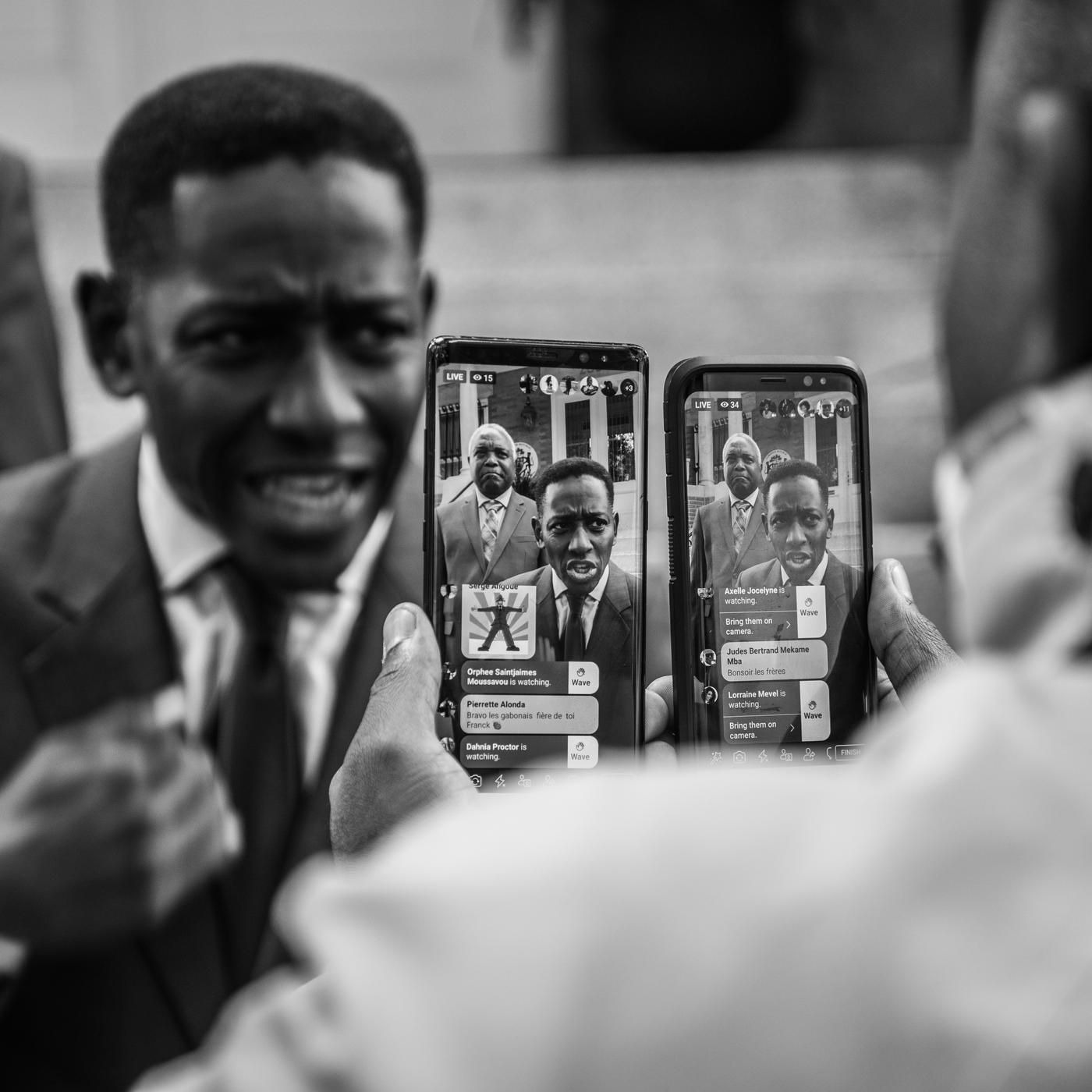
But, one of them always had their phone out, shooting video, and live-streaming. This was why I'd come to see them. Because, well, everybody else at the UN that day was trying to get the media or the people around them to take notice. These Japanese activists were broadcasting directly to the people of Gabon.
Through videos and tweets and Facebook posts, they were fighting a dictatorship thousands of miles away. Finding that this distance was surprisingly empowering, but also perilous. Because it sent them down this path to creating an alternative reality. It would crash them straight into the limits of using truth to create political change.
But how, exactly? Check, check. One, two, three, four, five. Well, let me back up a little bit.
The first time I met this group of Gabonese activists was at this annual vigil. Do you mind telling me where we are and what we're doing here? Okay. Excuse me.
For the church. Where are we in the church? Which church is that again? Here in New York.
St. Alois. St. Alois.
Okay. So, we are in St. Alois Church. This is Frank Jacques 10.
Is it a Catholic church in New Holland? Yeah, St. Alois in Holland. And I met him in the entryway of this huge Roman Catholic cathedral on 132nd Street.
We went inside and there were about nine people there. Otherwise I'm to church. Otherwise I'm to church. The service is beginning.
Everyone was gathered in the first couple rows of pews. The whole thing was in French. And it was basically just a Catholic mass. But then this woman, Elvina Anjembe, in a red blouse and black slacks, goes up to the lectern and starts reading out these names.
And who are these people? Well, they're the names of several dozen men and women who were killed by Oli Bongo's government. And what happened? Why were they killed?
Well, I mean, you know, there are consequences for Japanese people going against the regime. This is Elvina, the woman you just heard reading those names. Elvina Anjembe, and yeah. Elvina is an activist by night, academic by day.
I work as a researcher for NYU, looking at sexual behavior, sexual health, and I live in Harlem. She moved here from Gabon in 2006, and she says on the ground back in Gabon. Protesting openly is impossible. Anybody that has been outspoken is threatened and arrested, you know, by the Bongo regime.
And to understand how Gabon got to this place, she says, Oh, well, how far do you want to go? Yo, you go as far back as you want to. You've really got to go back to the beginnings of the country. Okay.
Gabon was colonized by friends in the 1800s, and they governed Gabon until 1960, when the front pulled out and shortly thereafter handed power over to a man named Omar Bongo. And Omar, Papa Bongo, had no political experience. Ruled the country between 1967 and 2009. Totaling 42 years.
This, by the way, is Brett Carter. And I studied politics in Central Africa. Now, over the course of these four decades, Omar Bongo served the interests of the ruling Gavanese elite and the French elite, not average citizens in Gabon. Papa Bongo basically made himself and his cronies wealthy, while the rest of the country crumbled.
Gabon is an oil-rich country, and while we were pumping thousands of barrels of the stuff a day, next to none of that revenue was invested in things like roads or schools. Of course, he controlled the army, he cracked down on the press, bought off, killed off political opponents. And while Omar was busy with all this, running the country into the ground, his son Ali was busy trying to get his disco career off the ground. Now, his career as an entertainer didn't work out, but in 2009, when Omar Bongo died, Omar Bongo of Gabon died in office, and the Japanese lived their whole lives under his presidency.
Ali found another call. Ali Bongo became the detaider, so-called president, as you would hear it, of Gabon. Okay, so it's Bongo followed by a bongo. Bongo, bongo.
Bingo, bingo, bongo, okay. And now there was an election in 2009 that put Ali Bongo in power, but There's obvious electoral fraud on behalf of the Bongo regime. The election was marred with paying voters for voters' cards, giving citizenship to foreigners in exchange for votes. So he's elected, but it's not an actual election.
And when Ali took over, the country continued to spiral. Thousands of Bongo's allies were put on the government payroll, but never expected to work. A third of the country remained stuck below the poverty line, all while Bongo was adding to his collection of hundreds of luxury cars and scores of French villas. And along with this came violence.
Well, my brother, again, French up ten. A little brother of mine was politically involved with one of Ali Bongo's opponents. And right away, Frank says, Bongo cracked down. You have people entering his house in the middle of the night, terrifying his children, being harassed by the police, and I mean, my mother was calling me, for example, crying and stuff like this.
Like, she was actually afraid that your brother could be killed for his political position. That is correct. That is correct. So I felt that she was asking me to help out.
But at this point, Frank was already living here in the States. He arrived in 1991 and was working in IT. You know, I was so far from the country. And so what I do is go to Twitter, make a profile, and typed in, The Bongo's not a country with good governance, something like that.
Then I put the hashtag on, White House, CNN, and I sent my first tweet when there was nothing else that I could do. Well, you never heard back from the White House or CNN. No, they didn't really respond, but what it did is connect me to other Japanese people, who, when they saw the tweet, they tweet back. And in that moment, Frank tapped into this digital Gabon, this diffuse online network made up of Gabonese people leaving abroad, people like L.D.
in Europe, Barcelona, Paris, New York, Washington, D.C., posting videos, sharing their frustrations, and all basically saying, We do not agree with what's going on in Gabon. We need to stand up and end the Bongo regime. And this digital Gabon, they set their sights on the 2016 presidential election, when Ali Bongo would have to run to hold on to power. We all decided, okay, we're going to win this.
This is Yorick. Yorick, Yorick Ayun. And what am I supposed to say again? He's also an activist.
So, they're pinning their hopes on having a free and fair election, which they have never had. Well, yes. If you know that the dictators hell-bent on winning come what may, I wonder why that's even plausible. Well, first of all, plausible or not, I think these Gabonese folks living outside of the country felt a real moral imperative here.
Like, we're not subject to the same risks as people living inside the country. We thought because we're diaspora, we have the responsibility to influence the political game. They believed they could do things, campaigning and politicking, that would have been very dangerous or even impossible on the ground. And second of all, they had a plan.
So, electoral campaigns have been officially launched. First of all, what we started to do is that testing candidates are in the wrong to replace Ali Bongo with impact. We could pressure on the opposition to fund us one candidate. Opposition party say Bongo has done.
And thank God, the protracted negotiations led all the key challenges to pull out. They heard us and pull us behind the candidacy of Jean Ping. Again, Brett Carter. So, you know, there's a sense that Jean Ping was somebody who would implement a much more transparent government and ultimately represent a change.
And this coalescing was important because one of the ways the Bongo had always won while maintaining the sort of appearance of democracy was because there would be so many different opposition candidates splitting the vote. And so this was going to be the most competitive Gabonese presidential election in Gabonese history. The diaspora started flooding social media with pro-Jean Ping posts. And then on top of that, as the election got closer, they set up this network of people throughout the country to go to polling stations on election day where they would film on their smartphones as the votes were being tallied.
So when they count the votes, we could film everything posting on social media. Nobody's going to cheat us anymore. And so the people of Gabon began voting. The day the election comes, Jean Ping versus Ali Bongo.
Were you in Gabon or were you in New York at that point? I was here in New York. I was at the consulate. We started getting results.
And it becomes very, very clear. Jean Ping said he just announced that he thinks he's winning. That Jean Ping is winning. And seemingly by a lot, according to their election monitoring videos and early results.
I mean, it looked like out of the nine provinces in Gabon. Seven had voted predominantly for him. And meanwhile, online... Elvin found a flood of videoclips coming out of Gabon.
People actually out in the streets, celebrating. They were crying. People were opening champagne. This is it.
This is what we're done with the Mongolian regime. We did it. And here, as members of the NAFORM, there was just... There was a lot of joy everywhere.
But... Exactly. So we're starting to think, OK, something's not right. They're going to do something.
Gabon is hence, as the results of the presidential vote remain unresolved. The results started to delay. Specifically because they weren't getting the vote counts from one final province. So we're waiting.
A day goes by. Then the second. And the third. And then finally...
After four days of waiting, the Electoral Commission declared a 99% turnout in Ougue province. The official result, only 47 people did not vote. They announced that basically everyone in this province voted, which was significantly higher than turnout rates in the rest of the country. And of the 99.93% of people that voted...
95% cast their ballot for Ali Bongo. The equivalent of like every single person in Wisconsin voting Democrat. Results that are just not true, but are just enough to give Bongo the victory over jumping. Just enough so that he would remain president and dictator of Gabon.
I mean, come on. What can you possibly do? I mean, it's blatant. So blatant, so obvious.
There's no way. Yeah, this is a profoundly fraudulent election. You know, no one thought that the 2016 election would be at all fair. But this sort of obvious electoral fraud was basically unprecedented.
We reached out to the Gavonese government to get their side of all this. They did not return our request for comment. And so when the results were announced that Gabon's incumbent leader Ali Bongo has just scraped to victory in the weekend. Videos started popping up online, but this time they showed people getting furious.
The announcement has, as feared, sparked violence in the streets of the country. And now, riots. Sorry. I mean, he was, he was, he was chaos.
Flash is broke out in capital. The opposition supporters claim the election fraud. Watching from Paris, New York, D.C. Did I score it?
We don't know what's going on. Other than what they can see in these video clips that's being up to. People were sending us videos of people in the streets. What the army was doing to the people.
The National Assembly was set on fire. We hear that the building of the General Assembly is burning. Oh my gosh. And then.
Alvin ends up on the phone with her brother-in-law who is at the headquarters of John King. And he says, there are soldiers trying to get in. We could hear shots. We could hear anything.
Okay, they're coming up. And then at some point his cell phone died. So now we're thinking, okay, he's going to die. And right around then as well, the internet and the entire country is shut up.
So these people living outside the country who feel like they're sort of in the action basically, mediated by a phone screen obviously, but it feels pretty live and real are suddenly cut off. The powerlessness, yes, it's the feeling of powerlessness. There's nothing, absolutely nothing that you can do. You feel like a puppet essentially.
It's really, you have this kind of double consciousness that you function with. It feels unreal. I'm nodding the bone. This is what's going on there.
But at the same time here, and personally I am a teacher and I have to talk to my students about psychology, about sex and gender, about stats. So you're just overwhelmed. You don't know what to do. You don't know what you can do.
Do we know what happened there? Well, they didn't know anything for several days, but when they were able to get back in touch, in the case of Elvine, they found out that her brother-in-law was okay. He'd been arrested, but was okay. And more broadly, they learned what happened.
Bongo basically ordered his Republican Guard, which has a series of sort of like, you know, fighter helicopters armed with missiles, basically, and they opened fire on Ping's headquarters. Jesus, filled with people in and outside. Now, the death toll from that helicopter assault is unclear. We still do not have the full count to this day, but at least two dozen, three dozen.
And so this is what they were gathered at that church to commemorate. Now, in Gabon, after these attacks. We basically went back to that cemetery piece that we've always had. Things went back to the way they were before the election, with Ali Bongo in power and the people of Gabon really unable to do anything about it.
But Alvin, Frank, and other activists living outside the country, they had seen what an effect they could have, that they could move people in a way that they hadn't been moved before. But they also were confronting the limits to all of that power. And so it felt like a decision point. I don't want to call it an emergence, you know, or an awakening, you know, but there was a sense that this was a watershed moment.
There's no longer a candidate to support, you know, election to watch Og, but they thought the least they could do is to try to get the UN or the Western media to pay attention to what had happened. The form this usually took was a couple of these activists going out in front of the Japanese embassy in Paris or D.C. And they just sort of give a monologue and live stream for 30 minutes, hoping that CNN would do some story on them or the UN would pass some resolution. But it didn't really work.
At first, we were very naive because we assumed, okay, people are being killed in Gabon. Obviously, the United Nations is going to react and do something. And if you very quickly discovered, oh, you poor thing. Nobody in the West was paying any attention.
But back in Gabon, people were. With the help of a reporter in Libreville, the capital of Gabon, we talked to lots of people, people whose names we're not using, of concern for their safety, who said they were tuning into these videos the activists were posting. Because in the wake of the 2016 election, everybody was terrified to talk about what happened. Obviously, to go to the terminal to support someone who I respect, I started to follow...
But then they'd come across these videos, the diaspora was upstate, and they'd see people not just speaking about how the election was stolen and how people were killed, but also condemning it. And it was revelatory. They heard someone giving voice to feelings they had, but couldn't say. But that was not the end goal here.
I mean, we wanted to end the bongo regime. They felt like they hit the limit of what this sort of media they were generating could produce. He was timid because he was at his emphasis, right? By the way, I just want to let you know that Alan is here, too, so he just stepped in.
Oh, great, Alan, welcome. Yes, how you do? Welcome to have me here. Alan Serge Obamé is an activist as well, and together, he and Frank were putting out a lot of these videos, playing around with different ways to try to spark some change.
Yes. Until the hotel, when it blows up. So, in this video that was filmed and streamed live, the first thing that you see is a straight-on shot of Alan's goateed face, big smile. Hello.
Salud, friend. Hearing straight into the lens of a phone camera that he's holding out at arm's length. He swivels around. That's how you get.
You don't call it. You don't call it. You don't call it. You don't call it.
You don't call it. You don't call it. Points the camera at Frank and introduces him along with a couple other folks that are there with him. And then you notice that there's a reception desk and that they're inside of this swanky hotel lobby.
It was the four-season hotel. One of those most beautiful, the most luxurious hotels in the city. Marble pillars, plush chairs. And the reason that they were there was because the Japanese official, actually the woman who signed off on Ali Banga's election, was staying there.
The president of the constitutional court. And we decide just to let her know we're not happy with the decisions. They're just milling around the lobby, hoping to bump into her, I guess, when you hear the camera around's voice change. And you see as he trains the camera's lens on this man walking down a hallway towards them into the lobby.
You shove the camera right up into the guy's face, who's actually their target husband. And we'd started to have an entire interaction with him. And now you see him making a beeline for the elevator. Pushes the button, but it's not coming.
And we're starting to scream. And she killed people in Gabon and stuff. At this point, called security. Moments later, these black-suited men start ushering them towards the exit.
Through the revolving doors. And so now they're out in the rain, and at this point you think they're done. Like, they made their point. They're not going to be able to get back inside.
But no. Instead of ending it right there, he told the Japanese people that's where the hotel, where she is, posted the hotel's phone number. He said, blow the phone line. And thousands of miles away, people in Gabon thought, people like this guy.
He was a student at the time, says he remembers it well, it was right around 11 p.m. Despite not speaking very much English, he says, he dials the number. Receptionist picked up, and he told her that the hotel should not be housing terrorists, which she promptly responded to by, hanging up. But the thing is, this guy wasn't the only one.
No. People from France, people from Gabon, people from the United States started to call and jam the, uh, the, uh, the, uh, what, the line? The telephone line. And suddenly, the receptionist is just being bombarded.
Oh, my God. They docked the hotel. Wow. To the point that the chief justice no longer felt comfortable, and so she goes to a second hotel.
We did the same thing. She leaves that one. She goes to a third hotel. And they do it again.
Eventually, she ends up staying in, uh, like, the apartment of her daughter, who lives somewhere in D.C. I was going to stop you for saying, like, a motel safe in Newark. Yeah, with no phone line. Yeah.
And for the folks back in Gabon, who were then involved in this stunt, they saw how such powerful people in Gabon could be humiliated like this. And they didn't just see it, this act of political expression. I mean, they were actually able to safely and consequentially take part in it. In fact, one woman in Gabon described the experience and the feeling as a very evisceration of time and space.
And, uh, and when we saw that effect, uh, we enjoyed it. And we said, that's why we're going to do it from now on. This, they realized, is the move. And so, every time a Gabonese official would show up in the States or in France, we would track them.
Live-streaming as they show up wherever the person's at and begin harassing them and shaming the hotel. And a couple of times, it actually worked. We tracked down the cabinet director. And a cheeky mouth.
In Paris, they tracked down Ali Bongo's father-in-law and posted a video of themselves going into the Gabonese embassy and swapping out the framed photo of Ali Bongo hanging on the wall for a photo of Jean-Pin. They even doxed the hotel of Ali Bongo himself. This is going to Gabon, this is going to Paris, this is going to Italy, to Brazil. This is the national movement.
Fuck you. And these videos staged and filmed by members of the Diaspora. Back in the bone, they were firing people up. They became celebrities.
One person referred to them as celebrities inside the country. Oh. Which, even at a distance, could be dangerous. This is something I talked to them about when I was first meeting everyone at this barbecue.
You mind just introducing yourself on tape? Oh, okay, my name is Anderson. Anderson, someone who's not guilty, so, yeah. Pretty much all of them told me that they and their families had at some point been targeted by the Bongo regime.
Everyone here, almost all our families back home. And to be honest, there are worries. My mom told me to stop it. Did she call you?
She said, no, I don't want you. I don't want you to be part of that. You gotta stop it. My family back home.
I don't call. This is fellow activist Joel Namzy. You don't call them from your own cell phone number? No, no.
It's been three years. I cut it off to try to keep them away from trouble. That's why I keep myself away. And what's totally off limits, it seems, is going back.
I mean, that's gonna be dangerous. Yeah. There are people who went back home because of the election, you know, and he got arrested. What's his name?
Uh, Landry. Landry, yeah. Now, Landry, it turns out, is actually the brother of Alan Serge Obama. Yeah, and Landry was like a superstar of videos.
In fact, he was one of the first activists to really be making videos, all the way back before the 2016 election. At the time, he was living in Miami, working as a businessman, and was a huge Jean Ping booster. He went back to Gabon right before the 2016 election to support Jean Ping and do the campaign. But when his plane touched down in Libreville, the capital.
When he gets there to the airport, they kidnap him. Twelve people kidnap him. And, ah, it was a long time before I heard from him. Hello?
Can you hear me? With Alan's help. You can hear me? Yes, I can.
Hey, hey, okay, we're recording. Okay. Okay. I was able to talk to Landry.
My name is Landry Washington. Calling from the prison cell in Libreville, Gabon. How are you calling me right now? They have a social service here at the prison where we can make a phone call.
Do the prison guards, or does anyone know that you're talking to me? They probably listen to all my phone conversations. And there's a certain thing that you understand that I cannot say over the phone. But those in the position are not very, very, very difficult.
And just to be clear, you are an American citizen, yeah? I am an American citizen. A U.S. citizen is just being helped?
Yeah. Someone from the U.S. Embassy visits him every two weeks or so. Oh.
So he's got folks in the West keeping an eye on him. I see. And probably that, plus the Bongo regime trying to maintain some appearance of democracy and the rule of law, is why he can even talk to me at all. Because, you know, they want to hide and pretend that it's a democracy, but that being said, I was concerned, given everything I'd heard about broadcasting his voice, about broadcasting any of this.
And I raised that with him. I'm not worried, Paul. As a matter of fact, I really wanted to do that. I know who I'm dealing with.
What in mind you were? Simon, listen to me. My rights have been violated from the beginning. At this time, I cannot be scared now.
Just do what you have to do. Okay. Yeah. Landry has been in prison for over three years now.
He shares a small little cement cell with a mattress on the floor. And he told me that after they grabbed him at the airport, I didn't know, I didn't really know what was happening. And they took me from there to the local police station. And he found out that charges were being brought against him.
Incitement of violence. And after the president. Assuring that he was a threat to the Vietnamese people and to the president, Ali Bongo. All based on his social media posts.
They went to the internet, to my Facebook page, print everything that I was writing from my video, everything I was saying. Thing that I was basically expressing my freedom of speech while I was in the United States. And this is the thing that they was using against me. All stuff he posted from Miami.
That was the evidence. And now, I can't say that I've watched every minute of every video that Landry has ever uploaded, but the stuff that I have is pretty tame. I mean, Rush Limbaugh or even Rachel Maddow is more likely to incite violence than this guy. But when his case finally went to trial, I was fine, Jesse.
And the judge, he said you can't spend the rest of your life in prison. Wait, he said you can't spend the rest of your life in prison? Yeah, that's what you tell me, the judge. That's what you tell me.
What is the American government doing to help you at the moment? I don't really know what exactly they are doing. I'm American. I'm an American.
And I'm still here, living on a condition, on a very high condition for almost four years. For what? For what? For what reason?
Who spent four years? Who spent four years in prison for speaking up his mind? Who? As for what's going to happen, Landry, we reached out to the State Department.
One of the most important tasks of the Department of State is to provide assistance to U.S. citizens who are incarcerated or detained. And they gave us a written statement that they were willing to read to us. Counselor officers have thought to provide Mr.
Washington all appropriate counselor assistance. The juicer that it was, they know he's there, they've spoken with the Japanese government, but there's not much more they can do. And so I can't ask any follow-up questions. That's what we've got to work with.
Yes, I'm sorry about that. That's all I can talk to you about on record for right now. We also gave Landry's Congresswoman, Debbie Wasserman Schultz, a call multiple times, in fact, and sent multiple emails, and she did not return our request for comment. I don't know what's going to happen because nothing works normal.
Nothing is normal. They're just trying to keep me here as much time as they can, thinking that they're going to, I'm going to get down, they're going to break my mind. No. I died for my right.
I'm American. I won't give up my life for anything, even if I had to give my life. They expect me maybe to change the different power. I won't do that.
I don't care how long I'm going to take. I'm just going to be the same. I'm going to pick up my mind. We're going to take a quick break.
Hey, my name's Laurel, and I'm calling from London. Radio Lab is supported in part by the Alfred T. Sloan Foundation, enhancing public understanding of science and technology in the modern world. More information about Sloan at www.sloan.org.
Hi, Lulu here, and this episode is sponsored by BetterHelp. May is Mental Health Awareness Month, and as someone who reports on mental health, who likes talking to people about their mental health and what they look to in science, in the natural world, in faith, in friendship, wherever it may be, to help guide them through the rough patches of life, I just wanted to take a moment to say what seems to help people turn corners, find relief, get out of ruts, and even flourish is having someone with you. So this may, why not treat your mental health to a buddy? And who better to talk to than a fully licensed mental health therapist with over 30,000 therapists available, BetterHelp has someone you can talk to available at pretty much any time that's convenient for you at the push of a button.
And because finding the help you need often depends on the therapist client vibe, rest assured, with BetterHelp, you can switch providers at any time. Remember, truly, your mental health matters, and you don't have to go it alone. Find the support you need any time with BetterHelp. Sign up and get 10% off at betterhelp.com slash radiolab.
That's betterhelp.com slash radiolab. Radio Lab is supported by Adio, the AICRM for modern businesses. Close deals twice as fast. Prep for calls in minutes.
Effortlessly spin up handoff briefs that used to take hours. Get pipeline intelligence without building a single dashboard. How? Ask Adio.
Adio is the AICRM that keeps teams ahead of the pack. It connects to your email, calendar, calls, product, and billing data, and more, creating a complete picture of your entire business. While others are waiting through multiple tools to find information, teams are using Adio to surface insights and get answers. on their go-to-market data instantly powered by universal context adios intelligence layer adio searches updates and creates across your data to accelerate your workflow ask more from your crm ask adio try adio for free by going to adio.com slash radio lab that's attio.com slash radio lab anxiety depression bipolar disorder at least half of us will experience a mental illness in our lifetime in a new podcast from call to mind we hear about the mental health impact of stress climate change immigration and more i'm angela davis join me for conversations with people managing hardship and experts seeking solutions from american public media comes call to mind listen and subscribe on your favorite podcast app jack robert radio lab back to simon right so at this point we've got a brutal dictator a series of scam elections people murdered and a u.s citizen imprisoned and a diaspora doing what they can from a distance they've gotten some traction but the bongo regime is fighting back threatening their families and i should say sometime in 2016 these activists stopped just doing political stunts to rile people up uh they also started providing facts as it's explained to us freedom of the press in gabon really isn't a thing the bongos have a long history of suspending publications and banning journalists who report things they don't like that's actually why we're not naming the journalist who helped us conduct these interviews in gabon and so folks like frank essentially became news broadcasters yes so i was using the platform that i have in order to spread the information yes like what kind of things everything from palace intrigue inside the bongo regime to things like if a riot was being quashed in port gentile they'd report that they'd report that how they know that if they were living in the district of columbia well inside of the bongo government there's people who do not like that system so they call us and they contact us sometimes even international press and also i mean i have people on the ground they tell me what they see what they hear after you get this information frank says he'd usually make a video sometimes send a tweet and boom thousands of people would know about it and then the audience gets now to actually see what's going on in their own country on a bounce from canada or america or france exactly it's looking across the ocean to see what's going on in your own backyard yeah yeah well people like this businesswoman this was a big deal she says at the end of the day after she's got kids to bed she sits down for what she calls gabon time 30 minutes or so where she scrolls through what the diaspora is posting and at this point she really relies on them for facts and so one of my fear is to relay what donald trump would call fake news and because of that yes i have to be like a journalist i have to really dig deep and make sure that my sources are legit and make sure that what they're saying is true they were basically these remote newsrooms but then things got complicated i was home i was surfing the internet i think sometime around 8 9 p.m uh again this is elvin on gemback i come across a tweet from a reporter from the washington post uh shivano grady saying i've heard james from ali bongo i said i've heard rumors that ali bongo is dead and um like what goes through your head first um shock there was no indication that he was sick or anything and that just seemed too easy is that possible is that a thing are we just free from dictatorship just like that academic brett carter was equally confused uh yeah at that point my sense from communicating with people incidentally on twitter was that ali bongo was in riyadh saudi arabia for a conference and and he suffered some kind of health crisis but whether his heart was still beating remains unclear that's that's that's what we do and as they looked for news of this coming out of gabon nothing nothing for four whole days the government doesn't even acknowledge that anything's going on until on october 28th and that any other claims are just fake news and your response or reaction is what that's complete bullshit come on that's not i mean when omar papa bongo ali's dad died in 2009 there are people who think that there was three weeks between omar bongo's death and its announcement three weeks yes so there's precedent okay for them hiding death while the government claims the president i mean immediately following this government press release it was the very next day writers reports that reuters the media reports that president ali bongo stuff had a stroke ali bongo had a stroke totally contradicting the official account and then november six two weeks later yes okay a french government official tweets ali bongo is deceased like an official the french government yes the municipal councillor of lence we ask him questions and he just he doesn't say anything god damn then there are reports that the japanese government has changed their position the japanese presidency admitted he was seriously ill and had undergone surgery at this point he spent like a month and there have been no sightings of ali bongo and no comments from him bongo is totally incommunicado and and one just doesn't go dazed without hearing from ali bongo that just doesn't happen and when a couple of news outlets in gabon tried to cover this story they were suspended as a result i mean everybody suspected that you know clearly something was wrong and the regime is hiding something right he's probably impaired cognitively or perhaps dead and online the hundreds of gabonese activists quickly split into factions there were two camps um there was one kind that was saying we need to assess the help of ali bongo like let's figure out what we know what we don't know let's still be journalists basically and there was the other camp was like we should provoke the gabonese people to react by saying ali bongo is dead interesting let's use this information right or this confusion and so this online conversation begins i said that you know enough is enough our way of thinking we have to evolve again this is frank shock 10 in another word if we don't adapt then we will perish and eventually they just emerged online and it felt like an epidemic frank side won out we wanted them to have their backs against the wall and please we start pushing using social media the whole idea that ali bongo is dead let's just say he's dead because it's politically advantageous for us to do that correct let's use this uncertainty because remember it could be true there are reasons to think it might be true and even if he's not actually dead he's absent and so they really flood social media thousands of tweets hundreds of hours of video he's dead he's dead he's dead hoping that this is going to create a ripple effect so that maybe people rise up and and and do something and do what exactly essentially they were hoping people in gabon would demand new elections and start a revolution so that's why we said that we will do what we have never done before in fact this sort of became their catchphrase we're going to do what we've never done before but then the truth got foggier the japanese president ali bongo will address his nation during a new year's speech from her part so every new year's bongo traditionally gives a speech were you expecting one this year were you no we were not okay this will be bongo's first speech since it was postalized in saudi arabia on october 24th at this point it's been two months since anyone has heard ali bongo's voice or seen him in person so of course we were all waiting for that video so once the video is posted i saw it on social media she clicked on it it starts with the sound of the bongo's national anthem and the still shot of the presidential palace and then ali bongo appears he's seated behind the desk in a blue suit with this strikingly pink wall as the backdrop and there's a there's a flag the country's flag behind him and elvin says as soon as she heard his voice she thought something's wrong here the speech is slurred and his face the movement the size the even the facial expression as he speaks i mean it looks like it has his face has been pasted onto something it's just it looks it just looks weird uh yes something clearly is not right and some activists came out with the the idea that this is not even him wow the deep fake that it was a deep fake there is growing alarm over the use of deep fakes online so uh real quick deep fakes are basically videos where one person has taken control of someone else's face and changed what it's doing video will be upgraded using hostage intelligence if you're curious we did an entire episode on this and even made our own deep fake of barack obama back in 2017 but anyhow uh well this video was meant to be proof that ali bongo was alive to these activists watching online it was exactly the opposite the term that the people used um at first was puppet right you know this was you know this was a puppet is it a deep fake i don't know we talked to some digital forensic folks they don't know i mean if bongo did in fact have a stroke that could explain the speech and the face but that didn't stop the diaspora from pushing this idea that it was a deep fake i mean that became the most predominant uh theory of what went on with that video and this is where you see that the activists tactics have shifted and digging through their old posts you can see signs that this was coming like uh there were a couple other videos of ali bongo that had come out they were weird as well like they only show one side of his face and you never hear him speaking uh but that said he looks alive and yet the activists said those were fakes too do you think that was him in that video it wasn't him it wasn't him i doubt it it wasn't him it was a body double what a body double like an impersonator this is my strong belief ali bongo we see that's not the real ali bongo we know about and a lot of people believe that you think he's dead i think he's dead for me he's dead right now they use they just use a fake guys wear a mask and then do all this stuff they do right now and to prove that ali bongo is dead they start posting these new sorts of videos uh these shots of what appear to be a dead body lying in a hospital bed with the face blurred out that are clearly fake uh and all the while the international press at this point ppc al jazeera were reporting that in fact ali bongo was very much alive they even dug up this old birtherism conspiracy theory questioning if bongo was even born in gabon like the birther thing from the trump campaign uh it's spookily close that's trump 101 right there and like it's hard to prove where ali bongo was born but again they pushed that message nonetheless and this campaign worked when our reporter on the ground in the bones spoke to people there are many many of them i can't say what percentage but a huge number of people she spoke with believed ali bongo was dead so essentially they're waging a kind of fake news campaign yeah that's one way to put it and i found myself feeling um feeling really uncomfortable about that like yes i'm rooting for them but but suddenly they're just straight up lying uh you know doing things that feel really similar to what the russians did here in 2016 and so i asked frank about all this like do you as we talked about information you and other members of the diaspora are putting out people from gabon are looking to the only real quote-unquote free press they have access to you are seen as the reporters the arbiters of truth in the country of course yes it is true that as we speak there's a lot of people that we are influencing in gabon that's pretty amazing i think well yeah but then at the same time you all have pushed this message that ali bongo is dead when in fact uh it's unverifiable and yet you push that well uh personally i haven't said really that ali bongo is dead i'm not because i've been smart enough to say that but what i do say is that ali bongo is not the same now people can interpret that any kind of way and i leave it vague like that on purpose right but you all put out the hashtag ali bongo is dead or ali bongo say more yeah i relate that information but i personally i never said that he was dead like i said because i need a death certificate okay but of course we live in a world where sensation is is important and ali bongo is dead i mean it's gonna sell i mean it attracts people because he's head of states but what i'm concerned about is the betterment of my people and personally i don't believe in one election in gabon because the people in power have found ways and means to trick and store elections and so yes i'm doing on purpose to incite our people to stand up for a new gabon a better gabon and force this government to to buy down the country's wealthiest enough for them to be able to eat educate their children basic things and if there is a government that do not allow them to experience this then yes this government for me need to be overthrown that's what i want to encourage my people to do that doesn't mean that we need to fabricate stuff like trafficking in the hashtag ali bongo is dead i could see someone interpreting that as fabrication of information but you don't see it that way that is i mean well um uh fortunately we we are we are at war uh wow i have a lot of feelings about this well yeah i think we all do uh but before we get to them there's one final beat to the story uh i think january 5th january 7th actually so one week after that quote unquote beat fake video came out i think it was one one in the morning okay one of my sisters and we're talking and sending voice messages and she was going to work and then at some point she texts all of us and she says i'm going home there's a coup i'm thinking that's weird what's what's going on and moments later someone sent her a link to this video the video of the coup announcement it opens with a soldier sitting behind a desk speaking into a microphone his eyes are looking down he's reading off a script behind him he's flanked by two other soldiers ramishing rifles they're all in camouflage and wearing these bright green berets and what these three men along with four others had done was storm the national broadcaster took over a tv channel and then we're broadcasting this on loop and as alvin is watching this for the first time you know i hear them saying go if you can get guns and they reference the new year's day video saying that it's proof that quote cabone has lost its dignity and that ali dongo is at best an invalid but but despite all this she doesn't quite know what to make of it should she trust these people is this a good thing i mean those are known young men and the whole thing is what in the world is going on but then the leader of the guy was reading the i don't know how to call that again activist alan serich coltane who was also watching this video very early that morning the guy reading the manifestos they say that means we need to do something's never been done before one of the slogans we've been using for years their catchphrase their words coming from the mouth of this man with a gun in gabon telling people to take to the streets and overthrow the bongo regime and then i just rewinded the the videos one more time and to check it did they just say that and then i saw that again i was the tear coming off of my eye i was like wow that mean people can listen to us for all this time and right around that time from libraville videos started showing up online showing people filling the streets and i thought it was the end for real and for people like alan and alvin watching all this on their phone screens playing in bed or sitting up at the kitchen table you feel like you're there and you're participating you're you're an actor you forget that you're not in gabon but then i think it was around 12 in gabon so it must have been like 5 a.m something here i was texting family members and all of a sudden they could not receive my messages anymore that's that's when i knew that okay they shut down the internet again and she suddenly again has no way to know what's happening maybe when these people are standing up, maybe they're in the streets and maybe we're bringing an end to all this.
Or are they shutting down the internet because it's another bloodbath? Later that day, the Japanese government announced that the coup had been quashed. Gunfire had been exchanged. Two of the men involved in the coup had died and the rest were arrested.
But we're not exactly sure of the details. And actually, they're not even sure it was a real coup. Was this a legitimate coup? You know, even now, I think that's kind of profoundly unclear.
Wait, really? Yeah. Maybe this was a fake coup, right? And that has happened before.
We had a fake attempt months before that. In this case, a man also went to the national broadcaster and said, Is this really true? Is this really the Japanese army doing what we've wanted them to do for so long? Or is it another fake out?
I don't know. By the time we're at the end of this piece, I don't know what the heck is going on, honestly. Nobody knows anything. You notice this?
Right, and that is a day-to-day experience in the country. The fog is, to a certain degree, impenetrable. But why would... If this were a good guy, bad guy story, the good guys I'm rooting for are the people who are against the dictator and who had for a while a cause, a just cause, and who were speaking truthfully about what was going on in the country.
All of a sudden, they've kind of made it a little murky by lying outright and telling you that the lie was saleable. Like, that guy said, Hey, Bongo is dead is a great hook. But also, I think that they showed up to what they initially thought was a knife fight to find that the other side had a machine gun. So, what...
I know what you do if you don't do this. Here's what you do. When the president disappears in Saudi Arabia and no one says boo, you say something fishy is going on, and then the enemy goes, Why is it? Why is it?
Why is it? You say, we don't know. That's what you do. But I mean, when the other side says, Oh, he's fine.
Nothing's wrong. That is such a blatant lie that to counterbalance it... Because we don't know. Yeah, we don't know just puts you at the fulcrum.
It doesn't put you on the other side of the spectrum allowing you to balance out opinion. I would stay at the fulcrum because as soon as I start lying to get the... I start making up something to counter what they've made up because there's this vivid and mine has to be equally vivid then we're in a whole new body. Sure, because we're journalists.
But maybe for an activist, especially in a situation like this, maybe they should have a slightly longer rhetorical leash. That's ultimately on some level the deep troubling is that even if you agree with what these activists are doing, it's right. It still feels like just another example of how there is no longer true or false. There is only what is expeditious.
What you can use and what you can't use. But I mean, at the end of the day, their message, and I think they really captured this in this video they recently showed me. It's very clever. Just first, them zooming in on someone outside the UN in a Trump mask and an orange prison jumpsuit with a sign that said like prison bound or something.
And then it pans over and there are two police officers just standing there. And so the story they're telling here is like here is a man who is openly mocking the president and the cops are just going to stand there and not do anything. At least for now, America is a place where you can have freedom of speech and that from all of that speech, hopefully, the truth will emerge. Our story was produced and researched and reported by Simon Adler.
Edited by Pat Walters. Special thanks to Laurent Stong, Anastasia Kavada, Luis DeWast, Marianne Renaud, and Lara Atala for their translation help. And also thank you to our anonymous reporter in Gabon who got all that tape on the ground for us. I'm Jan Abumrad.
I'm Robert Crowlich. Thanks for listening. Hi, this is Daniella calling from Chicago. Radio Lab is created by Jan Abumrad with Robert Crowlich and produced by Soren Wheeler.
Don't Cube is our director of sound design, Susie Westenberg is our executive producer. Our staff includes Simon Adler, Becca Bresler, Rachel Cusick, David Devil, Bethel Hafty, Tracy Hunt, Matt Kilty, Danny Kewin, Latif Nasser, Sarah Kari, Arianna Black, Pat Walters, and Molly Webster. With help from Shima Uliari, Pegu Harris, Fortuna, Sarah Sandbach, Melissa O'Donnell, Neal, Tanisha, Marianne Renaud, and Paloma Moreno-Gimenez. Our staff checker is Michelle Harris.
Thank you.