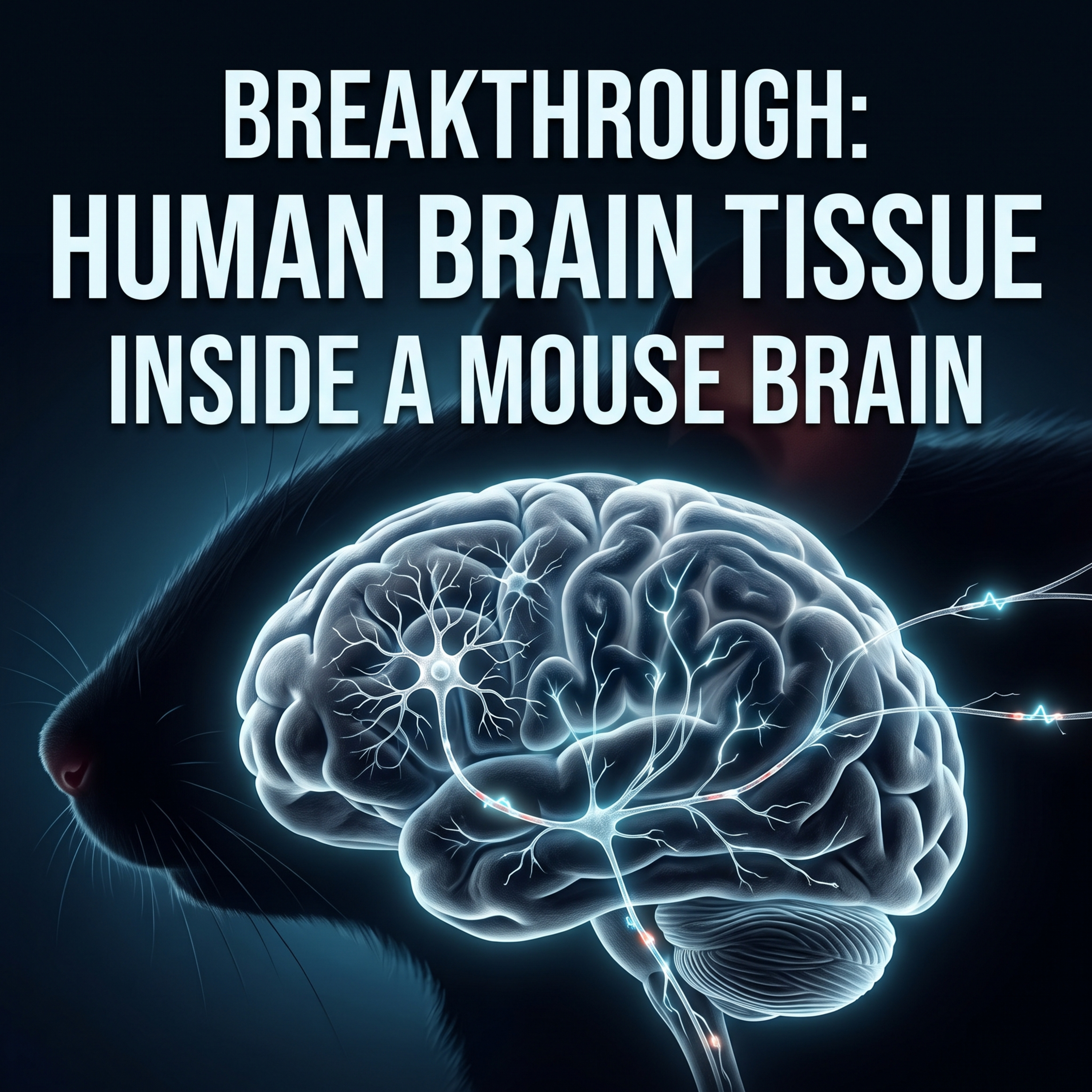
BREAKTHROUGH: Human Brain Tissue Grows and Connects Inside a Mouse Brain
from The Deep Dive Lab: Unraveling Materials Science Hosted by Son Hoang
What happens when human brain tissue is given space to develop inside a living mouse brain? 🧠🐭 In a remarkable experiment, scientists created mice with much of their developing cortex intentionally depleted, then transplanted human stem-cell-derived cortical organoids into the resulting space. The human tissue did more than survive: it expanded dramatically, developed diverse cortical neurons, and formed long-range connections with the mouse nervous system. 🔬 Even more striking, human-derived axons extended through the mouse brain and reached the cervical spinal cord. Calcium imaging and electrophysiological recordings revealed organized, synchronized activity within the graft, with some activity patterns correlated with the animal's movements. ⚡ The researchers also used this xenocortical system to investigate how human cortical tissue responds to hypoxic injury, opening a potential new avenue for studying human brain development, neural circuits, and brain injury. But this does not mean the mice developed a human brain or human-like consciousness. The study demonstrates structural and functional neural integration—not human cognition or consciousness. 🧩 📚 Source: Kaganovsky et al., Nature (2026), “Developmental xenocortication using human-derived organoids in mice.” #DeepDiveLab #HumanBrain #BrainOrganoids #Neuroscience #Xenocortical #NeuralCircuits #BrainResearch
Embed this episode
No transcript yet.