
EPISODE · Jan 29, 2026 · 14 MIN
Bridging the Gradient: Engineering Microbial Scale Translation
from Biomanufacturing & Fermentation Technology · host prasad ernala
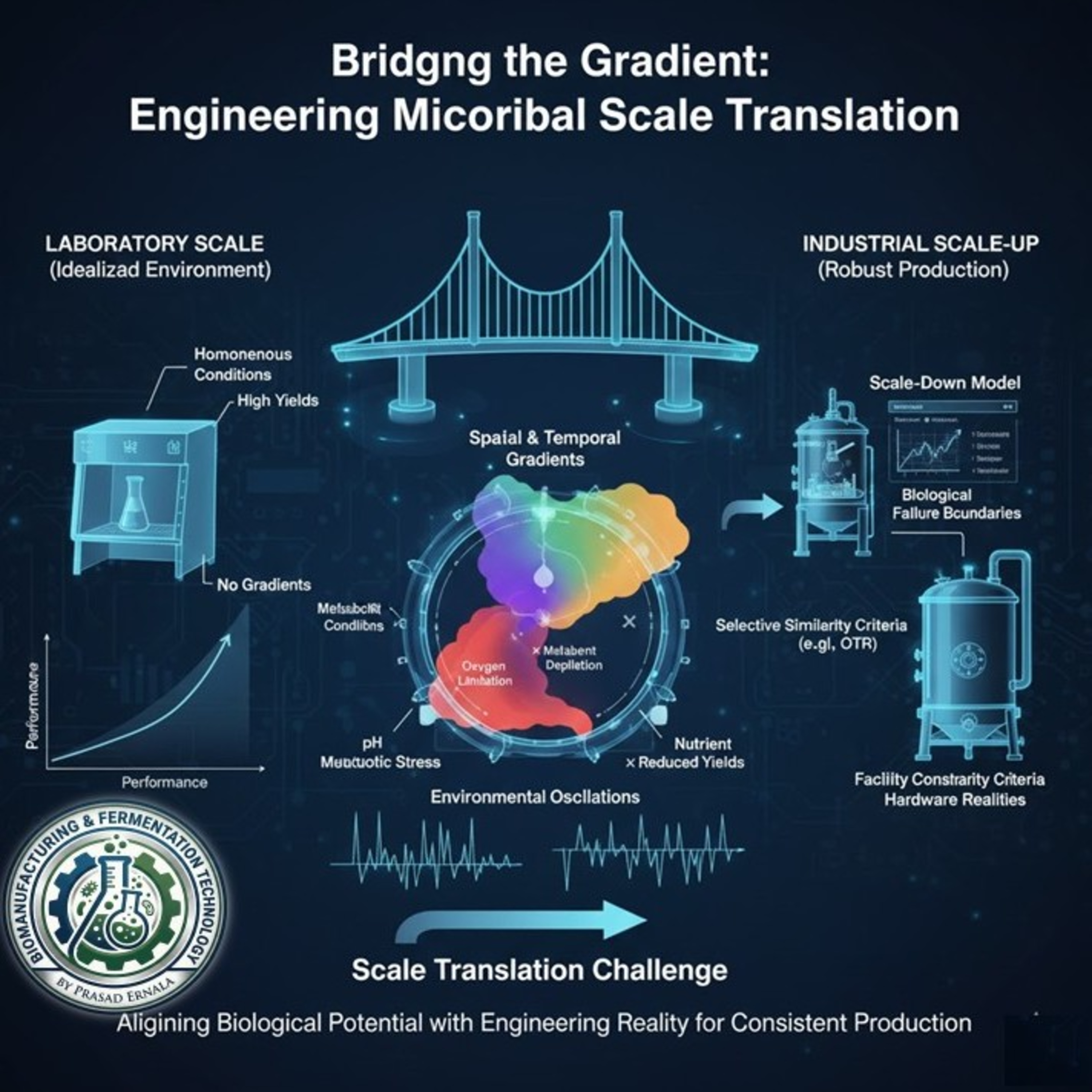
The primary focus of this episode is on a sophisticated approach to scale-translation engineering in microbial fermentation, moving beyond simple parameter matching to focus on how cells experience fluctuating microenvironments. The core problem is that large-scale reactors create spatial and temporal gradients in oxygen, pH, and nutrients that are absent in laboratory settings, often leading to reduced yields and metabolic stress. To bridge this gap, My analysis highlights that the scale-down models and stress emulation to define the biological failure boundaries of an organism before moving to manufacturing. By prioritizing selective similarity criteria—such as oxygen transfer rates over exact vessel geometry—engineers can better predict performance at industrial volumes. Ultimately, successful translation requires reconciling an organism's physiological limits with facility constraints and hardware realities to ensure robust and consistent production.#Bioprocess #ScaleUp and #TechTransfer,#Industrial #Microbiology,#MetabolicEngineering and #SystemsBiology,#Bioprocessing, #MicrobialFermentation, #Bio-manufacturing, #Industrial #Biotechnology, #Fermentation Engineering, #ProcessDevelopment,#Microbiology, #Biochemistry#Biochemical Engineering,#Applied #MicrobialPhysiology,#Microbial #ProcessEngineering,#Upstream #BioprocessDevelopment,#Downstream Processing and #Purification,#CellCulture and #MicrobialSystems Engineering,#Bioreaction #Enzymes #Biocatalyst #scientific#Scientist#Research
What this episode covers
The primary focus of this episode is on a sophisticated approach to scale-translation engineering in microbial fermentation, moving beyond simple parameter matching to focus on how cells experience fluctuating microenvironments. The core problem is that large-scale reactors create spatial and temporal gradients in oxygen, pH, and nutrients that are absent in laboratory settings, often leading to reduced yields and metabolic stress. To bridge this gap, My analysis highlights that the scale-down models and stress emulation to define the biological failure boundaries of an organism before moving to manufacturing. By prioritizing selective similarity criteria—such as oxygen transfer rates over exact vessel geometry—engineers can better predict performance at industrial volumes. Ultimately, successful translation requires reconciling an organism's physiological limits with facility constraints and hardware realities to ensure robust and consistent production.#Bioprocess #ScaleUp and #TechTransfer,#Industrial #Microbiology,#MetabolicEngineering and #SystemsBiology,#Bioprocessing, #MicrobialFermentation, #Bio-manufacturing, #Industrial #Biotechnology, #Fermentation Engineering, #ProcessDevelopment,#Microbiology, #Biochemistry#Biochemical Engineering,#Applied #MicrobialPhysiology,#Microbial #ProcessEngineering,#Upstream #BioprocessDevelopment,#Downstream Processing and #Purification,#CellCulture and #MicrobialSystems Engineering,#Bioreaction #Enzymes #Biocatalyst #scientific#Scientist#Research
NOW PLAYING
Bridging the Gradient: Engineering Microbial Scale Translation
No transcript for this episode yet
Similar Episodes
Apr 21, 2026 ·13m
Apr 19, 2026 ·16m
Apr 17, 2026 ·13m
Apr 13, 2026 ·11m
Apr 11, 2026 ·16m